This comprehensive guide analyzes whether Oasys (OAS), a gaming-focused Layer-2 blockchain platform, represents a viable investment opportunity in 2026. The article examines OAS's current market positioning with a price of $0.001307 and $8.26 million market cap, reviewing its EVM-compatible dual-layer architecture (Hub-Layer and Verse-Layer) backed by major gaming companies. It evaluates key investment factors including tokenomics with 10 billion total supply, institutional adoption potential, macroeconomic sensitivity, and technological ecosystem development. The guide provides detailed price forecasts across conservative, neutral, and optimistic scenarios through 2031, while addressing critical risks such as market volatility (95.39% one-year decline), limited liquidity, and regulatory uncertainties. Structured investment strategies for beginners, experienced traders, and institutional investors offer actionable guidance, complemented by comprehensive risk management frameworks and detailed FAQs addressing
Introduction: Oasys (OAS) Investment Positioning and Market Outlook
OAS is a cryptocurrency asset in the blockchain gaming sector. Launched in December 2022, Oasys has positioned itself as a public blockchain specialized in gaming applications. As of January 27, 2026, OAS holds a market capitalization of approximately $8.26 million, with a circulating supply of around 6.32 billion tokens, and the current price is approximately $0.001307. With its positioning as an EVM-compatible gaming-focused blockchain featuring a dual-layer architecture (Hub-Layer and Verse-Layer), OAS has become a subject of discussion among observers examining "Is Oasys (OAS) a good investment?" This article analyzes OAS's investment characteristics, historical price movements, future price outlook, and associated risks to provide reference information for market participants.
I. Oasys (OAS) Historical Price Review and Current Investment Value
OAS Historical Price Trends and Investment Returns
- 2022–2023: Oasys launched with support from major gaming companies, focusing on blockchain gaming infrastructure → Early adopters experienced initial price discovery phases with significant volatility
- 2024 (February): Market activity showed notable price movements → OAS experienced upward momentum during this period
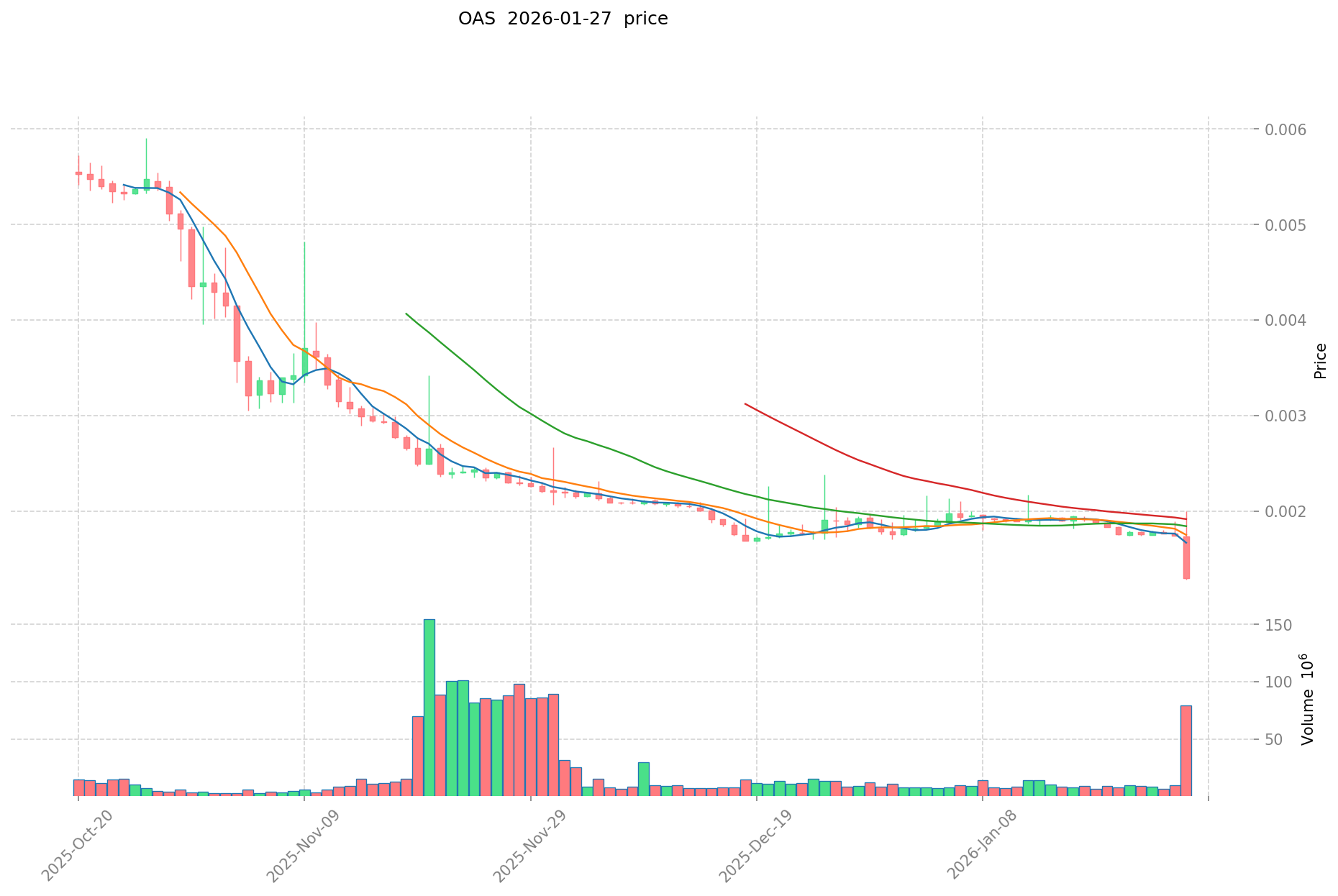
- 2024–2026: Market cycle evolution → Price declined from elevated levels to current trading range
Current OAS Investment Market Status (January 2026)
- OAS current price: $0.001307
- Market sentiment: The token has experienced a 24-hour decline of 24.32%, with 7-day and 30-day decreases of 28.62% and 29.95% respectively
- 24-hour trading volume: $116,294.20
- Market capitalization: $8.26 million, with a circulating supply of 6.32 billion OAS (63.21% of total supply)
Click to view real-time OAS market price
Oasys operates as an EVM-compatible blockchain specifically designed for gaming applications, featuring a unique multi-layer architecture comprising the Hub-Layer (highly scalable first layer) and Verse-Layer (specialized second layer using Ethereum scaling solutions). The OAS token serves as the native utility token across the Oasys ecosystem. The project's value proposition centers on revolutionizing blockchain gaming infrastructure, though current market conditions reflect broader challenges in the gaming blockchain sector.
II. Core Factors Influencing Whether OAS is a Good Investment
Supply Mechanism and Scarcity (OAS investment scarcity)
- Total Supply of 10 Billion Tokens → Influences price dynamics and investment value
- Circulating Supply at 63.21% → With 6.32 billion OAS tokens currently in circulation out of a maximum supply of 10 billion, the controlled release schedule may affect scarcity perception over time
- Investment Significance → Understanding the token distribution and unlock schedule is essential for assessing long-term scarcity and potential price pressure from future supply releases
Institutional Investment and Mainstream Adoption (Institutional investment in OAS)
- Gaming Industry Support → Oasys was launched with backing from renowned gaming companies, positioning it within the blockchain gaming sector
- Enterprise Adoption Potential → The protocol's focus on gaming-specific blockchain infrastructure targets a specialized market segment, with adoption dependent on gaming companies integrating Oasys technology
- Exchange Availability → Currently listed on 8 exchanges, indicating a moderate level of market accessibility for institutional and retail investors
Macroeconomic Environment's Impact on OAS Investment
- Monetary Policy Sensitivity → As a gaming-focused blockchain token, OAS may exhibit correlation with broader cryptocurrency market trends influenced by interest rate changes and monetary policy
- Risk Asset Classification → OAS functions as a specialized sector token within the crypto ecosystem, potentially subject to similar macroeconomic pressures affecting technology and digital asset investments
- Market Volatility Context → Recent price movements show significant fluctuations, with a 24-hour decline of 24.32% and a 30-day decrease of 29.95%, reflecting sensitivity to market conditions
Technology and Ecosystem Development (Technology & Ecosystem for OAS investment)
- Multi-Layer Architecture → Oasys employs a unique structure consisting of the Hub-Layer (a highly scalable Layer 1) and Verse-Layer (a specialized Layer 2 using Ethereum scaling solutions)
- EVM Compatibility → The protocol's compatibility with Ethereum Virtual Machine facilitates developer adoption and ecosystem integration
- Gaming-Specialized Infrastructure → As a blockchain specifically designed for gaming applications, the technology focuses on addressing performance requirements and user experience needs specific to the gaming industry
- Ecosystem Token Structure → OAS serves as the highest-level token across the Oasys ecosystem, functioning as the native asset for the public blockchain
III. OAS Future Investment Forecast and Price Outlook (Is Oasys(OAS) worth investing in 2026-2031)
Short-term Investment Forecast (2026, short-term OAS investment outlook)
Based on available market analysis, short-term price projections for OAS in 2026 present varied scenarios:
- Conservative forecast: $0.00069 - $0.00131
- Neutral forecast: $0.00131 - $0.00144
- Optimistic forecast: $0.00144 - $0.00157
The current price of $0.001307 reflects ongoing market adjustments, with technical indicators suggesting consolidation patterns in the near term. Market participants should note that short-term movements may be influenced by broader cryptocurrency market sentiment and liquidity conditions.
Mid-term Investment Outlook (2027-2028, mid-term Oasys(OAS) investment forecast)
-
Market stage expectation: The 2027-2028 period may witness gradual ecosystem maturation, with potential expansion in gaming partnerships and blockchain infrastructure development influencing valuation trajectories.
-
Investment return forecast:
- 2027: $0.00092 - $0.00176
- 2028: $0.00083 - $0.00171
-
Key catalysts: Gaming industry adoption trends, technological infrastructure enhancements in the Oasys architecture, and broader blockchain gaming sector developments may serve as primary value drivers during this period.
Long-term Investment Outlook (Is OAS a good long-term investment?)
Long-term projections through 2031 incorporate multiple scenario analyses:
- Baseline scenario: $0.00104 - $0.00194 (assuming steady ecosystem development and sustained gaming industry interest)
- Optimistic scenario: $0.00155 - $0.00217 (contingent upon accelerated gaming partnerships and enhanced platform utility)
- Risk scenario: Below $0.00104 (under conditions of reduced gaming sector adoption or increased competitive pressure)
View OAS long-term investment and price forecast: Price Prediction
2026-01-27 - 2031 Long-term Outlook
- Base scenario: $0.001308 - $0.001941 (corresponding to steady progress and gradual mainstream application growth)
- Optimistic scenario: $0.001553 - $0.002173 (corresponding to large-scale adoption and favorable market conditions)
- Transformative scenario: Above $0.002173 (contingent upon breakthrough ecosystem developments and mainstream proliferation)
- 2031-12-31 projected high: $0.002077 (based on optimistic development assumptions)
Disclaimer: The forecasts presented represent analytical projections based on historical data patterns and market modeling. Cryptocurrency markets exhibit inherent volatility, and actual price movements may differ substantially from projections. These assessments should not be construed as investment recommendations, and market participants should conduct independent research and consider their risk tolerance before making investment decisions. Past performance does not guarantee future results, and all cryptocurrency investments carry significant risk.
| Year |
Predicted High Price |
Predicted Average Price |
Predicted Low Price |
Price Change |
| 2026 |
0.0015696 |
0.001308 |
0.00069324 |
0 |
| 2027 |
0.001755336 |
0.0014388 |
0.000920832 |
10 |
| 2028 |
0.00170886276 |
0.001597068 |
0.00083047536 |
22 |
| 2029 |
0.0017686729566 |
0.00165296538 |
0.0013058426502 |
26 |
| 2030 |
0.002172740343741 |
0.0017108191683 |
0.001043599692663 |
30 |
| 2031 |
0.002077704338941 |
0.00194177975602 |
0.001553423804816 |
48 |
IV. Oasys Investment Strategy and Risk Management (How to invest in Gaming Blockchain)
Investment Methodology (Oasys investment strategy)
-
Long-term Holding (HODL Oasys): Suitable for conservative investors who believe in the long-term potential of blockchain gaming infrastructure. This approach involves accumulating OAS tokens during market downturns and holding through volatility cycles.
-
Active Trading: Relies on technical analysis and swing trading strategies. Given OAS's recent price movements, traders may identify entry and exit points based on support and resistance levels, volume patterns, and market sentiment shifts.
Risk Management (Risk management for Oasys investment)
-
Asset Allocation Ratio:
- Conservative Investors: Allocate 1-3% of crypto portfolio to OAS, focusing on established assets for the majority
- Aggressive Investors: May allocate 5-10% to OAS as part of a gaming-focused blockchain portfolio
- Professional Investors: Could consider larger positions with proper hedging strategies and diversification across multiple gaming blockchain projects
-
Risk Hedging Solutions: Implement multi-asset portfolio strategies combining OAS with other blockchain gaming tokens, stablecoins, and traditional defensive assets. Consider using stop-loss orders and position sizing techniques to manage downside exposure.
-
Secure Storage: Utilize cold wallets for long-term holdings and hot wallets for active trading. Hardware wallet options compatible with EVM-based tokens provide enhanced security for OAS storage. Ensure proper backup procedures for recovery phrases.
V. Oasys Investment Risks and Challenges (Risks of investing in Gaming Blockchain)
-
Market Risk: OAS demonstrates significant price volatility, with recent data showing a 24.32% decline in 24 hours and a 95.39% decrease over one year. The token's trading volume of approximately $116,294 indicates relatively limited liquidity, which may amplify price swings during market stress.
-
Regulatory Risk: Gaming blockchain projects face evolving regulatory frameworks across different jurisdictions. Policy changes regarding digital assets, gaming tokens, and NFT regulations could impact OAS's operational environment and adoption potential.
-
Technical Risk: As an EVM-compatible protocol with a multi-layer architecture (Hub-Layer and Verse-Layer), Oasys faces potential technical challenges including network security vulnerabilities, smart contract risks, and execution risks during protocol upgrades. The complexity of layer-2 scaling solutions introduces additional technical considerations.
VI. Conclusion: Is Gaming Blockchain a Good Investment?
-
Investment Value Summary: Oasys presents opportunities within the blockchain gaming sector, featuring EVM compatibility and support from gaming companies. However, the token has experienced substantial price volatility, with current trading near historical lows. The project's multi-layer architecture aims to address scalability challenges in blockchain gaming.
-
Investor Recommendations:
✅ Beginners: Consider dollar-cost averaging (DCA) approach with secure wallet storage. Start with small positions to understand market dynamics and token behavior.
✅ Experienced Investors: Implement swing trading strategies combined with portfolio diversification. Monitor gaming sector developments and OAS ecosystem growth metrics.
✅ Institutional Investors: Evaluate strategic long-term allocation as part of broader gaming blockchain exposure. Conduct thorough due diligence on project fundamentals and competitive positioning.
⚠️ Disclaimer: Cryptocurrency investments carry significant risks. This content is for informational purposes only and does not constitute investment advice. Conduct independent research and consult with financial professionals before making investment decisions.
VII. FAQ
Q1: Is Oasys (OAS) a good investment for beginners in 2026?
OAS may suit beginners exploring blockchain gaming exposure through small, diversified positions. As a specialized gaming blockchain token with current price around $0.001307 and market cap of $8.26 million, OAS presents both opportunities and significant risks. Beginners should consider several factors: the token has experienced substantial volatility (24.32% decline in 24 hours, 95.39% decrease over one year), indicating high-risk characteristics typical of smaller-cap gaming tokens. The project's EVM compatibility and backing from gaming companies provide fundamental support, but limited liquidity ($116,294 24-hour volume) may amplify price swings. A dollar-cost averaging (DCA) strategy allocating 1-3% of a crypto portfolio could help mitigate timing risks while gaining exposure to the gaming blockchain sector. Secure storage in hardware wallets and thorough understanding of the Oasys ecosystem's multi-layer architecture are essential prerequisites.
Q2: What is the realistic price prediction for OAS by 2027-2028?
Price projections for OAS during 2027-2028 range from $0.00083 to $0.00176 depending on market conditions and adoption metrics. The mid-term outlook incorporates several scenarios: conservative forecasts suggest $0.00092-$0.00176 for 2027 and $0.00083-$0.00171 for 2028, reflecting baseline ecosystem development and gaming industry integration. These projections assume gradual maturation of Oasys's dual-layer architecture (Hub-Layer and Verse-Layer) and sustained interest in blockchain gaming infrastructure. Key catalysts influencing these price ranges include gaming partnership announcements, technological enhancements in the Oasys protocol, and broader blockchain gaming sector trends. However, market participants should note that cryptocurrency price predictions carry inherent uncertainty, and actual results may vary significantly based on macroeconomic conditions, regulatory developments, and competitive dynamics within the gaming blockchain space.
Q3: How does OAS's tokenomics affect its investment potential?
OAS tokenomics present mixed implications for investment value through supply dynamics and distribution mechanisms. With a total supply of 10 billion tokens and current circulating supply of 6.32 billion (63.21%), approximately 3.68 billion tokens remain to be released, potentially creating future supply pressure. The controlled release schedule influences scarcity perception and long-term price dynamics—gradual unlocks may provide stability, while sudden large releases could trigger downward pressure. As the highest-level token across the Oasys ecosystem, OAS serves as the native asset for the gaming-focused public blockchain, with utility tied to network operations and governance functions. Understanding the unlock schedule, vesting periods for team and investor allocations, and token utility mechanisms is critical for assessing investment risk. The current market cap of $8.26 million relative to the fully diluted valuation suggests significant expansion potential, but also indicates early-stage development with associated volatility risks.
Q4: What are the main risks of investing in Oasys compared to other gaming blockchains?
OAS investments face specific risks including limited liquidity, concentrated market exposure, and competitive pressure within the gaming blockchain sector. Compared to established gaming blockchain projects, Oasys's 24-hour trading volume of approximately $116,294 indicates substantially lower liquidity, potentially leading to wider bid-ask spreads and difficulty executing large orders without price impact. The token's severe price decline (95.39% over one year) demonstrates higher volatility compared to more established gaming infrastructure projects. Technical risks include the complexity of the multi-layer architecture (Hub-Layer and Verse-Layer), smart contract vulnerabilities inherent in EVM-compatible systems, and execution risks during protocol upgrades. Regulatory uncertainties affecting gaming tokens and NFT-related activities pose jurisdiction-specific challenges. Additionally, Oasys faces intense competition from other gaming-focused blockchains with larger ecosystems, more extensive developer communities, and established gaming partnerships, requiring continuous innovation and adoption to maintain competitive positioning.
Q5: Should I hold OAS long-term or trade it actively in 2026?
The optimal OAS strategy depends on risk tolerance, market expertise, and investment horizon, with different approaches suited to distinct investor profiles. Long-term holding (HODL) may benefit investors believing in blockchain gaming infrastructure's multi-year growth potential, particularly those viewing current prices as accumulation opportunities during sector consolidation. This approach requires patience through volatility cycles and confidence in Oasys's technological development and partnership expansion. Active trading suits experienced market participants who can capitalize on OAS's significant price swings, utilizing technical analysis, support/resistance levels, and volume patterns to identify entry/exit points. Given recent volatility (24.32% 24-hour decline, 28.62% 7-day decrease), swing trading opportunities exist but require disciplined risk management through stop-losses and position sizing. Conservative investors should consider a hybrid approach: maintaining a core long-term position (60-70%) while actively trading a smaller portion (30-40%) to capitalize on volatility while preserving strategic exposure to potential ecosystem growth.
Q6: How does Oasys's dual-layer architecture impact its investment value?
Oasys's unique dual-layer structure—comprising the Hub-Layer (highly scalable Layer 1) and Verse-Layer (specialized Layer 2 using Ethereum scaling solutions)—represents both a technological differentiator and investment consideration. This architecture aims to address critical gaming blockchain challenges: the Hub-Layer provides security and decentralization while the Verse-Layer enables application-specific customization and high-throughput transaction processing required for gaming applications. From an investment perspective, this design potentially enhances OAS value through improved user experience, lower transaction costs, and greater developer flexibility compared to single-layer competitors. However, architectural complexity introduces technical risks including inter-layer communication vulnerabilities, upgrade coordination challenges, and potential fragmentation of liquidity across verses. The success of this approach depends on gaming companies adopting the Verse-Layer model and developers building applications that leverage the multi-layer benefits, making ecosystem growth and partnership announcements critical metrics for evaluating OAS investment potential.
Q7: What allocation percentage of OAS is appropriate for different investor types?
Appropriate OAS allocation varies significantly based on investor sophistication, risk tolerance, and portfolio objectives. Conservative investors new to cryptocurrency should limit OAS exposure to 1-3% of their total crypto portfolio, focusing the majority on established assets (Bitcoin, Ethereum) and stablecoins. This minimal allocation provides gaming blockchain sector exposure while limiting downside risk from OAS's demonstrated volatility. Aggressive investors comfortable with higher risk may allocate 5-10% to OAS as part of a diversified gaming-focused blockchain portfolio, potentially implementing dollar-cost averaging during market dips. Professional investors or those with specialized gaming sector expertise could consider larger positions (10-15%), but should employ sophisticated hedging strategies including diversification across multiple gaming blockchain projects, stop-loss orders at technically significant levels, and portfolio rebalancing protocols. Regardless of allocation size, no investor should commit capital they cannot afford to lose entirely, given OAS's small market cap, limited liquidity, and early-stage development status within the competitive gaming blockchain landscape.
Q8: What key metrics should I monitor when investing in OAS?
Successful OAS investment requires tracking both on-chain metrics and ecosystem development indicators beyond simple price movements. Critical on-chain metrics include daily active addresses, transaction volume across Hub-Layer and Verse-Layer, total value locked (TVL) in Oasys ecosystem applications, and token holder distribution patterns that signal accumulation or distribution phases. Trading metrics such as 24-hour volume ($116,294 currently), volume-to-market-cap ratio, and exchange liquidity depth provide insights into market health and price stability. Ecosystem development indicators include announcements of gaming partnerships, developer activity metrics (GitHub commits, new projects launching on Verse-Layer), and user adoption statistics for games built on Oasys infrastructure. Macroeconomic factors affecting broader cryptocurrency markets—including Bitcoin price trends, regulatory news impacting gaming tokens, and institutional adoption of blockchain gaming—serve as leading indicators for OAS sentiment. Additionally, monitoring competitor developments in the gaming blockchain sector helps contextualize Oasys's relative positioning and identify potential catalysts or competitive threats that may influence long-term investment viability.
* The information is not intended to be and does not constitute financial advice or any other recommendation of any sort offered or endorsed by Gate.