This comprehensive analysis evaluates OBOL (OBOL) as an investment opportunity within the decentralized infrastructure sector. The article examines OBOL's price history, market position at $0.0258 with $3.73 million market capitalization, and fundamental value drivers including its distributed validator technology securing over $1 billion on Ethereum. It provides detailed assessment of supply mechanisms, institutional adoption trends across 800+ operators, technological innovations within the Obol Stack, and macroeconomic influences on this small-cap altcoin. The guide presents investment forecasts through 2031, outlines strategies for different investor profiles from conservative to aggressive allocations, and thoroughly analyzes market, regulatory, and technical risks. Readers gain actionable insights for determining investment suitability, risk management protocols, secure storage practices, and long-term portfolio positioning within decentralized infrastructure themes.
Introduction: Obol (OBOL)'s Investment Position and Market Outlook
Obol (OBOL) represents a specialized digital asset in the cryptocurrency ecosystem, focusing on distributed and decentralized infrastructure for blockchain networks. Since its launch in May 2025, the project has positioned itself within the decentralized infrastructure sector, particularly serving Ethereum and Web3 ecosystems. As of January 30, 2026, OBOL trades at approximately $0.0258 with a market capitalization of around $3.73 million and a circulating supply of 144.41 million tokens. The token operates on the Ethereum blockchain as an ERC-20 standard asset and is supported by over 800 decentralized operators running Obol Distributed Validators (DVs), which secure over $1 billion on mainnet. With its positioning in decentralized validator technology and modular infrastructure deployment, OBOL has attracted attention from investors examining "Is Obol (OBOL) a good investment?" This analysis examines OBOL's investment characteristics, historical price movements, future price considerations, and associated investment risks to provide reference information for market participants.
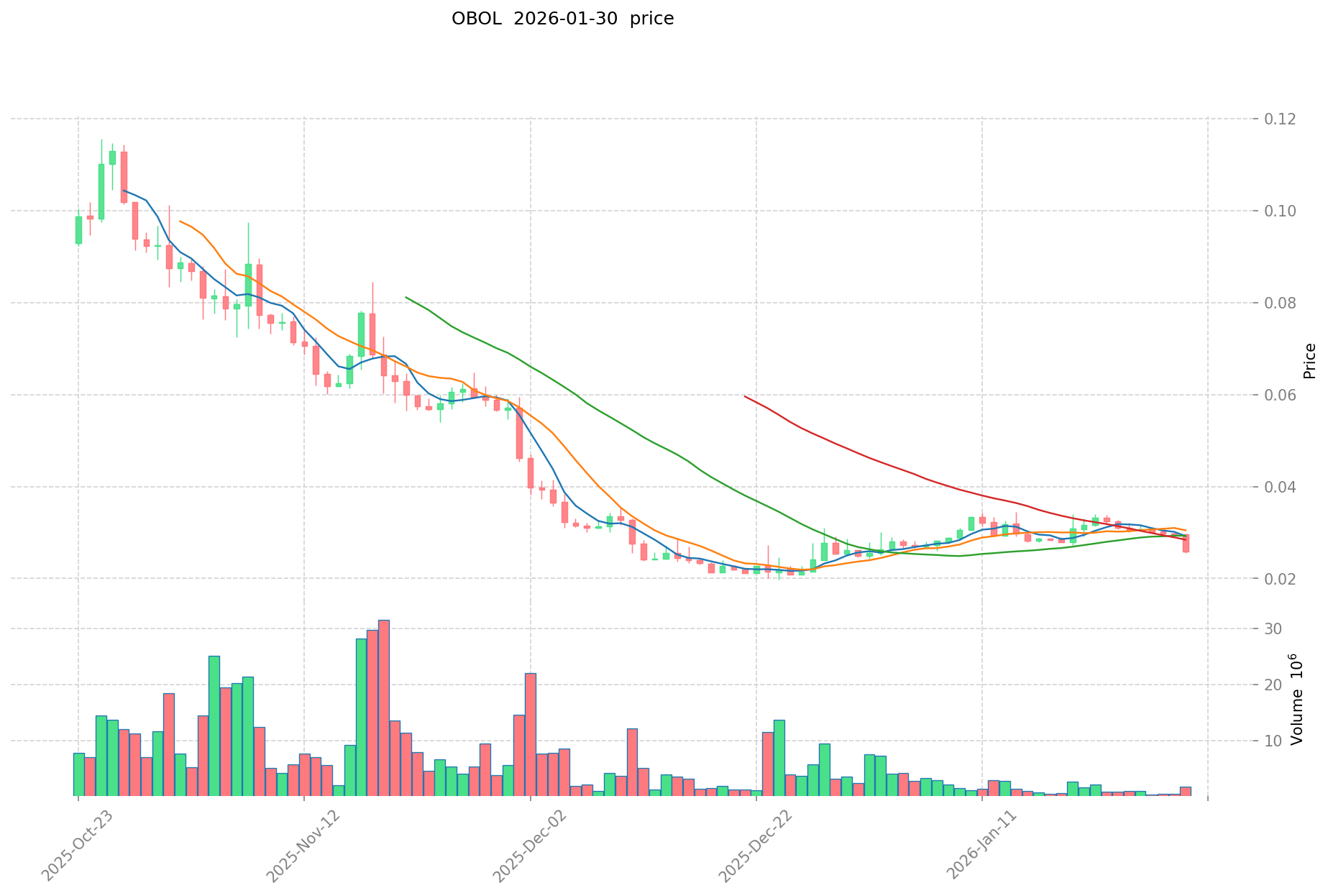
I. Obol (OBOL) Price History Review and Current Investment Value Status
- 2025: Token launch on May 7, 2025 → Price reached $0.4211 in initial trading phase
- 2025-2026: Market correction phase → Price declined from $0.4211 to $0.01973 during December 2025
- 2026: Market stabilization period → Price recovered to $0.0258 as of January 30, 2026
Current OBOL Investment Market Status (January 2026)
- OBOL current price: $0.0258
- Market sentiment (Fear & Greed Index): Data indicates cautious market conditions
- 24-hour trading volume: $48,746.51
- Institutional investor holdings: Over 800 decentralized operators globally participate in running Obol Distributed Validators (DVs), securing more than $1 billion on mainnet
Click to view real-time OBOL market price
II. Core Factors Influencing Whether OBOL is a Good Investment (Is Obol(OBOL) a Good Investment)
Supply Mechanism and Scarcity (OBOL Investment Scarcity)
- Supply Structure → Impacts Price and Investment Value
- OBOL has a maximum supply of 500,000,000 tokens, with a circulating supply of 144,410,000 tokens as of January 30, 2026, representing approximately 28.88% of the total supply.
- The relatively low circulating supply ratio suggests potential future token releases, which may influence supply dynamics and price behavior over time.
- The token utilization rate in the market is approximately 28.88%, indicating that a significant portion of tokens remains locked or reserved.
- Investment Significance: Supply scarcity and controlled token release schedules are factors that may influence long-term investment considerations, though they do not guarantee price appreciation.
Institutional Investment and Mainstream Adoption (Institutional Investment in OBOL)
- Institutional Holding Trends: As of January 30, 2026, OBOL has 6,444 token holders, reflecting a relatively small holder base compared to more established digital assets.
- Ecosystem Adoption: Obol operates as a decentralized infrastructure provider, supporting over 800 decentralized operators globally who run Obol Distributed Validators (DVs) securing more than $1 billion on mainnet. This operational scale demonstrates practical adoption within the Ethereum staking ecosystem.
- Market Presence: OBOL is listed on 14 exchanges, indicating moderate accessibility for investors. The project's integration with Ethereum's infrastructure positions it within a major blockchain ecosystem, though broader enterprise or institutional adoption data is not available in the provided materials.
Macroeconomic Environment's Impact on OBOL Investment
- Market Volatility Context: As a small-cap, low-liquidity altcoin, OBOL exhibits susceptibility to significant price fluctuations. The token experienced a 24-hour decline of 12.83% and a 7-day decline of 20.24% as of January 30, 2026, reflecting sensitivity to broader market conditions.
- Risk Considerations: Small-cap digital assets like OBOL tend to be more responsive to macroeconomic shifts, including changes in risk appetite, regulatory developments, and overall crypto market sentiment.
- Investment Environment: The token's performance may be influenced by broader factors affecting digital asset markets, including monetary policy changes, inflation trends, and geopolitical uncertainties, though specific impacts on OBOL are not detailed in the available materials.
Technology and Ecosystem Development (Technology & Ecosystem for OBOL Investment)
- Distributed Validator Technology: Obol's core offering is its Distributed Validator (DV) technology, which aims to provide better performance, reduced risks, and potentially higher rewards compared to traditional validators. This technology is designed to enable high-performance, slashing-resistant validators for Ethereum staking.
- Modular Infrastructure Framework: The Obol Stack is described as a modular, plug-and-play framework that facilitates deployment and management of Ethereum nodes, AI agents, AVSs (Actively Validated Services), and other decentralized infrastructure components.
- Ecosystem Expansion: According to the Obol Q4 2025 Ecosystem Report, the project has established milestones aimed at advancing staking infrastructure and supporting Ethereum's decentralization objectives. The project positions itself to support various decentralized systems including Layer 1 and Layer 2 blockchains, DePIN, and AI agents.
- Long-term Value Considerations: The project's focus on decentralized infrastructure and validator technology represents a specialized niche within the Ethereum ecosystem, with investment value potentially tied to the growth and adoption of Ethereum staking and related infrastructure services.
III. OBOL Future Investment Forecast and Price Outlook (Is Obol (OBOL) worth investing in 2026-2031)
Short-term Investment Forecast (2026, short-term OBOL investment outlook)
- Conservative forecast: $0.0135 - $0.026
- Neutral forecast: $0.026 - $0.032
- Optimistic forecast: $0.032 - $0.038
Mid-term Investment Outlook (2027-2028, mid-term Obol (OBOL) investment forecast)
- Market stage expectation: The token may experience gradual growth as the ecosystem matures and distributed validator adoption potentially expands within the Ethereum staking infrastructure landscape.
- Investment return forecast:
- 2027: $0.023 - $0.047
- 2028: $0.035 - $0.045
- Key catalysts: Expansion of decentralized validator network adoption, potential integration with additional Layer 1 and Layer 2 protocols, and broader institutional participation in distributed staking solutions.
Long-term Investment Outlook (Is OBOL a good long-term investment?)
- Base scenario: $0.027 - $0.060 (assuming steady ecosystem development and moderate adoption of distributed validator technology)
- Optimistic scenario: $0.042 - $0.078 (assuming accelerated adoption across multiple blockchain networks and enhanced utility within decentralized infrastructure)
- Risk scenario: Below $0.020 (in case of prolonged market downturns or significant competitive pressure from alternative staking solutions)
Click to view OBOL long-term investment and price forecast: Price Prediction
2026-01-30 - 2031 Long-term Outlook
- Base scenario: $0.027 - $0.061 USD (corresponding to steady progress and gradual mainstream application enhancement)
- Optimistic scenario: $0.042 - $0.078 USD (corresponding to large-scale adoption and favorable market conditions)
- Transformational scenario: Above $0.078 USD (if the ecosystem achieves breakthrough developments and mainstream adoption)
- 2031-12-31 predicted high: $0.078 USD (based on optimistic development assumptions)
Disclaimer: The above forecasts are based on historical data analysis and market trends, and do not constitute investment advice. Cryptocurrency markets involve substantial risks, and past performance does not guarantee future results. Investors should conduct independent research and consider their risk tolerance before making investment decisions.
| Year |
Predicted High Price |
Predicted Average Price |
Predicted Low Price |
Price Change |
| 2026 |
0.0381759 |
0.02597 |
0.0135044 |
0 |
| 2027 |
0.046826507 |
0.03207295 |
0.0234132535 |
24 |
| 2028 |
0.044578193205 |
0.0394497285 |
0.035110258365 |
52 |
| 2029 |
0.060079964019075 |
0.0420139608525 |
0.0268889349456 |
62 |
| 2030 |
0.07197621703446 |
0.051046962435787 |
0.044921326943493 |
97 |
| 2031 |
0.078119718963607 |
0.061511589735123 |
0.059051126145718 |
138 |
IV. OBOL Investment Strategy and Risk Management (How to invest in OBOL)
Investment Strategy (OBOL investment strategy)
Long-term Holding (HODL OBOL)
For conservative investors seeking steady exposure to decentralized infrastructure projects, a long-term holding strategy may be considered. This approach involves accumulating OBOL tokens during market corrections and maintaining positions through market cycles. Given the project's focus on distributed validators and decentralized operator ecosystems, long-term holders may benefit from the potential growth of Ethereum staking infrastructure adoption.
Active Trading
Active traders can leverage technical analysis and market momentum strategies when trading OBOL. Key considerations include:
- Monitoring 24-hour trading volume fluctuations
- Identifying support and resistance levels based on recent price movements
- Implementing stop-loss orders to manage downside exposure
- Tracking correlation with broader crypto market trends and Ethereum ecosystem developments
Risk Management (Risk management for OBOL investment)
Asset Allocation Ratios
Conservative Investors: Consider allocating 1-3% of crypto portfolio to OBOL, maintaining majority holdings in established assets like Bitcoin and Ethereum.
Moderate Investors: May allocate 3-7% to infrastructure tokens like OBOL as part of a diversified crypto portfolio.
Aggressive Investors: Could consider 7-15% allocation, combined with active position management and market timing strategies.
Risk Hedging Solutions
- Maintain diversified portfolio across multiple asset classes (Layer 1 protocols, DeFi tokens, stablecoins)
- Consider using stablecoin positions to preserve capital during volatile periods
- Implement dollar-cost averaging to reduce timing risk
- Monitor position sizing relative to overall portfolio volatility
Secure Storage
Cold Wallet Solutions: For long-term holdings, consider hardware wallets such as Ledger or Trezor to store OBOL tokens securely offline.
Hot Wallet Management: For active trading, use reputable software wallets with multi-factor authentication enabled. Since OBOL operates on the ERC-20 standard, any Ethereum-compatible wallet can store these tokens.
Best Practices:
- Never store recovery phrases digitally
- Use separate wallets for trading and long-term storage
- Regularly verify wallet addresses before transactions
- Consider multi-signature wallet setups for larger holdings
V. OBOL Investment Risks and Challenges (Risks of investing in OBOL)
Market Risks
High Volatility: OBOL has demonstrated significant price fluctuations, with recent data showing a 24-hour change of -12.83% and a 7-day decline of -20.24%. The token's relatively low market capitalization increases susceptibility to sharp price movements.
Liquidity Concerns: With a 24-hour trading volume of approximately $48,746, OBOL may experience liquidity constraints during periods of high market stress, potentially leading to wider bid-ask spreads and slippage during large transactions.
Price Manipulation Potential: Lower market cap tokens can be more vulnerable to coordinated trading activities that may impact short-term price discovery.
Regulatory Risks
Jurisdictional Uncertainty: Different countries maintain varying regulatory frameworks for crypto assets. Changes in regulatory stance toward staking infrastructure projects could impact OBOL's operational environment.
Compliance Requirements: Evolving regulations regarding decentralized infrastructure services may introduce new compliance obligations for the Obol Collective ecosystem.
Cross-border Operations: The global nature of the Obol network, with over 800 decentralized operators worldwide, exposes the project to multiple regulatory jurisdictions simultaneously.
Technical Risks
Smart Contract Vulnerabilities: As an ERC-20 token, OBOL relies on smart contract security. Potential code vulnerabilities could expose holders to risks of exploits or unauthorized access.
Network Dependency: OBOL's infrastructure operates primarily on Ethereum, meaning network congestion, high gas fees, or technical issues on Ethereum could impact OBOL operations.
Upgrade Implementation: The development and deployment of new features for the Obol Stack and Distributed Validators carry inherent technical risks, including potential bugs or compatibility issues during upgrades.
Validator Performance: The security and effectiveness of Distributed Validators depend on proper configuration and maintenance by decentralized operators. Technical failures or misconfigurations could affect the overall ecosystem reliability.
VI. Conclusion: Is OBOL a Good Investment?
Investment Value Summary
OBOL represents exposure to the growing decentralized infrastructure sector, particularly focused on Ethereum staking and validator technology. The project's emphasis on distributed validators and its ecosystem of over 800 operators suggest potential for long-term development. However, the token has experienced substantial price volatility, with significant short-term fluctuations and a circulating supply representing only 19.25% of total supply.
Investor Recommendations
✅ Beginners: Consider dollar-cost averaging with small allocations and prioritize secure storage solutions using hardware wallets. Focus on understanding the project fundamentals before increasing position sizes.
✅ Experienced Investors: May implement swing trading strategies based on technical analysis while maintaining a core long-term position. Diversify across multiple infrastructure projects to reduce concentration risk.
✅ Institutional Investors: Could evaluate strategic allocation to decentralized infrastructure themes as part of a broader crypto portfolio strategy, with appropriate position sizing and risk management protocols.
⚠️ Disclaimer: Cryptocurrency investments carry substantial risk, including potential loss of principal. Market conditions can change rapidly, and past performance does not indicate future results. This content is for informational purposes only and does not constitute investment advice. Investors should conduct independent research and consult qualified financial advisors before making investment decisions.
VII. FAQ
Q1: What is Obol (OBOL) and what problem does it solve in the blockchain ecosystem?
Obol (OBOL) is an ERC-20 token representing a decentralized infrastructure project focused on distributed validator technology for Ethereum and Web3 ecosystems. The project addresses the centralization risks and single points of failure inherent in traditional validator setups by enabling distributed validators (DVs) that spread validation responsibilities across multiple operators. As of January 30, 2026, over 800 decentralized operators run Obol Distributed Validators securing more than $1 billion on mainnet, demonstrating practical adoption of this technology within Ethereum's staking infrastructure.
Q2: Is OBOL suitable for beginner cryptocurrency investors?
OBOL presents higher risks for beginners due to its small market capitalization ($3.73 million), low liquidity (24-hour trading volume of $48,746), and significant price volatility (recent 24-hour decline of 12.83%). Beginners considering OBOL should start with minimal allocations (1-3% of crypto portfolio), implement dollar-cost averaging strategies to reduce timing risk, and prioritize secure storage using hardware wallets. Understanding the project's technical infrastructure and competitive positioning within the decentralized validator sector is essential before making investment decisions.
Q3: How does OBOL's supply structure affect its investment potential?
OBOL has a maximum supply of 500,000,000 tokens with only 144,410,000 tokens (approximately 28.88%) currently in circulation as of January 30, 2026. This relatively low circulating supply ratio indicates that a significant portion of tokens remains locked or reserved for future release, which may influence supply dynamics and price behavior over time. Controlled token release schedules can impact long-term investment considerations, though they do not guarantee price appreciation. Investors should monitor token unlock events and vesting schedules as potential catalysts for supply-side pressure.
Q4: What are the primary risks associated with investing in OBOL?
The main risks include: (1) High volatility – OBOL experienced a 7-day decline of 20.24% and demonstrates susceptibility to sharp price movements due to its low market cap; (2) Liquidity constraints – low trading volumes may result in wider bid-ask spreads and slippage during large transactions; (3) Technical risks – as an ERC-20 token dependent on Ethereum infrastructure, OBOL faces potential smart contract vulnerabilities, network congestion impacts, and validator performance issues; (4) Regulatory uncertainty – evolving regulations regarding staking infrastructure and cross-border operations across 800+ global operators may introduce compliance challenges; (5) Competition – alternative staking solutions and distributed validator technologies may affect OBOL's market position.
Q5: What is the long-term investment outlook for OBOL through 2031?
Based on market analysis, OBOL's long-term outlook presents multiple scenarios: Base scenario projects $0.027 - $0.061 USD by 2031, assuming steady ecosystem development and moderate adoption of distributed validator technology; Optimistic scenario suggests $0.042 - $0.078 USD, assuming accelerated adoption across multiple blockchain networks and enhanced utility within decentralized infrastructure; Risk scenario indicates prices below $0.020 in case of prolonged market downturns or significant competitive pressure. The 2031 predicted high of $0.078 USD represents a potential 138% increase from 2026 baseline, though this forecast depends on successful technology adoption, ecosystem expansion, and favorable market conditions.
Q6: How should investors store OBOL tokens securely?
For long-term holdings, investors should use hardware wallets (cold storage) such as Ledger or Trezor to store OBOL tokens securely offline, minimizing exposure to online threats. For active trading, software wallets (hot wallets) with multi-factor authentication are appropriate, ensuring compatibility with the ERC-20 standard. Best practices include: never storing recovery phrases digitally, using separate wallets for trading versus long-term storage, regularly verifying wallet addresses before transactions, and considering multi-signature wallet setups for larger holdings. Since OBOL operates on the Ethereum blockchain, any Ethereum-compatible wallet can accommodate these tokens.
Q7: What investment strategy is most appropriate for OBOL?
The optimal strategy depends on investor profile: Conservative investors should consider long-term holding (HODL) with 1-3% portfolio allocation, accumulating during market corrections and maintaining positions through cycles to benefit from potential Ethereum staking infrastructure growth. Moderate investors may allocate 3-7% while implementing dollar-cost averaging to reduce timing risk. Aggressive investors could consider 7-15% allocation combined with active trading strategies, monitoring technical indicators, support/resistance levels, and correlation with broader crypto market trends. All strategies should incorporate risk management through diversified portfolios, stablecoin hedging positions, and appropriate stop-loss orders.
Q8: What factors could drive OBOL's price appreciation in 2026-2027?
Key catalysts include: (1) Ecosystem expansion – increased adoption of Obol Distributed Validators beyond the current 800 operators, particularly within Ethereum staking infrastructure; (2) Technology integration – successful deployment of the Obol Stack across additional Layer 1 and Layer 2 protocols, DePIN, and AI agent infrastructure; (3) Institutional participation – broader enterprise adoption of distributed staking solutions as Ethereum's decentralization initiatives advance; (4) Market conditions – favorable macroeconomic environment and increased risk appetite in crypto markets; (5) Validator performance – demonstrated reliability and superior performance metrics compared to traditional validators, potentially driving organic demand for OBOL tokens within the ecosystem.
* The information is not intended to be and does not constitute financial advice or any other recommendation of any sort offered or endorsed by Gate.