OctaSpace (OCTA) operates as a decentralized computing services provider on a native Layer 1 blockchain, targeting the rapidly evolving DePIN (Decentralized Physical Infrastructure Networks) sector. As of January 28, 2026, OCTA trades at $0.1447 with a $6.15 million market capitalization, having declined 81.93% over the past year from its $1.9758 peak. This comprehensive analysis evaluates OCTA's investment potential through tokenomics assessment (88.5% circulating supply ratio), market dynamics, and price forecasts ranging from conservative $0.12-$0.14 (2026) to optimistic $0.31-$0.46 (2030). The article addresses core investment strategies including long-term HODL approaches and active trading, while identifying critical risks: high volatility, limited institutional adoption with only $37,195.88 daily volume on 3 exchanges, regulatory uncertainties in decentralized computing, and intense DePIN sector competition. Recommended for investors seeking exposure to decentralized infrastructure with high risk toler
Introduction: OctaSpace (OCTA) Investment Status and Market Outlook
OCTA is a notable asset in the cryptocurrency space, having been launched in 2023. As a decentralized computing services provider backed by a native Layer 1 blockchain, OctaSpace focuses on the DePIN (Decentralized Physical Infrastructure Networks) sector. As of January 28, 2026, OCTA maintains a market capitalization of approximately $6.15 million, with a circulating supply of around 42.48 million tokens, and the current price stands at approximately $0.1447. Positioned as a multifaceted platform offering computing resources from standard compute to bespoke solutions, OCTA has attracted attention from investors evaluating "Is OctaSpace (OCTA) a good investment?" This article provides a comprehensive analysis of OCTA's investment attributes, historical price movements, future price projections, and associated investment risks to serve as a reference for investors.
I. OctaSpace (OCTA) Price History Review and Current Investment Value Status
- 2024: On September 29, OCTA reached a significant price level of $1.9758 → Marked notable volatility in investor returns
- 2024: On September 15, OCTA recorded a price level of $0.1 → Price experienced substantial fluctuation
- 2024: During the market cycle → Price declined from approximately $1.98 to around $0.14
Current OCTA Investment Market Status (January 2026)
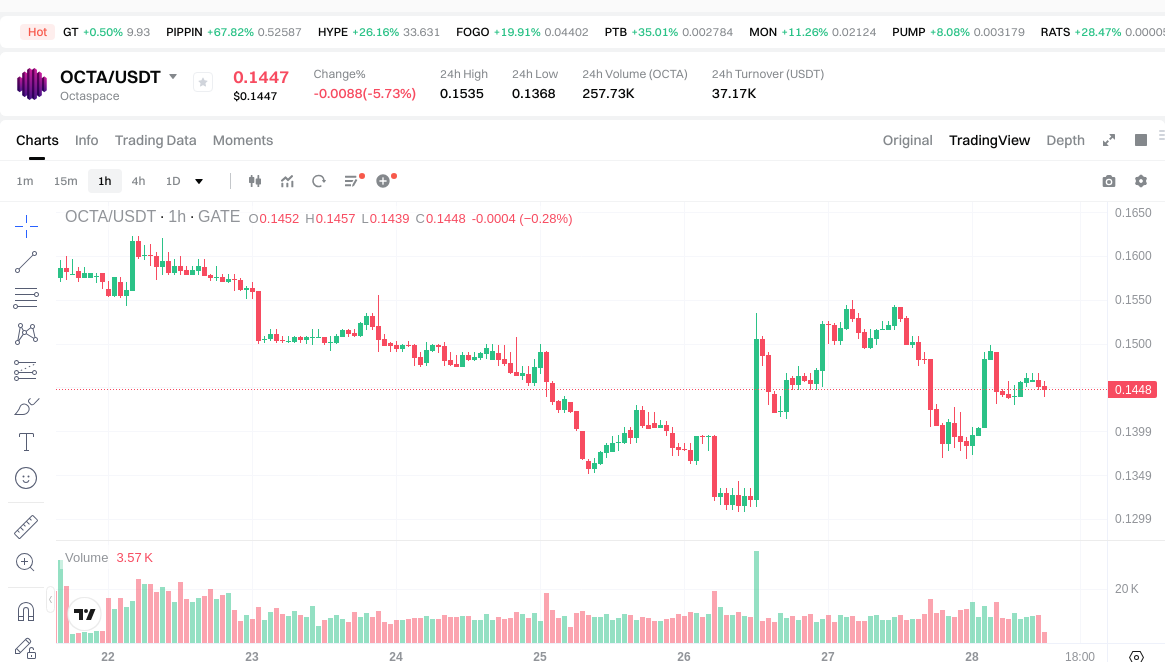
- OCTA Current Price: $0.1447
- Market Sentiment: Data indicates neutral market positioning with 24-hour price change of -4.65%
- 24-Hour Trading Volume: $37,195.88
- Market Capitalization: $6,146,728.52
Click to view real-time OCTA market price
II. Core Factors Affecting Whether OCTA is a Good Investment
Supply Mechanism and Scarcity (OCTA investment scarcity)
- Max Supply of 48,000,000 OCTA with 42,479,119.025 currently circulating (88.5% of max supply) → impacts price dynamics and investment value
- Historical price movement: OCTA traded at $0.1745 at launch in April 2023, reached $1.9758 in September 2024, and has since declined to $0.1447 as of 28 January 2026
- Investment significance: With approximately 88.5% of maximum supply already in circulation, the relatively high circulating supply ratio may influence the scarcity-driven value proposition differently compared to assets with lower circulation ratios
Institutional Investment and Mainstream Adoption (Institutional investment in OCTA)
- Market capitalization of $6,146,728.52 positions OCTA at rank 1426 with 0.00015% market dominance, indicating limited institutional presence
- Currently listed on 3 exchanges with 24-hour trading volume of $37,195.88, suggesting modest trading activity
- No publicly disclosed major institutional holdings or enterprise-level adoption has been identified in available materials
Macroeconomic Environment Impact on OCTA Investment
- Broader market conditions affect altcoin investment attractiveness, with OCTA showing -81.93% decline over the past year
- As a smaller market cap asset, OCTA may experience amplified volatility during shifts in monetary policy or risk appetite
- Market sentiment indicator showing neutral positioning (value: 1) suggests balanced investor outlook amid broader economic uncertainties
Technology and Ecosystem Development (Technology & Ecosystem for OCTA investment)
- Native L1 blockchain architecture: OctaSpace operates as a Layer 1 blockchain providing decentralized computing services
- Decentralized Physical Infrastructure Network (DePIN) positioning: Offers computing resources ranging from standard compute to customized ready-to-launch solutions
- Democratization of computing access: Platform designed for cost-effective and user-friendly access to computing resources, targeting both individuals and organizations
- Ecosystem scope: Multifaceted service provider with tools and infrastructure aimed at empowering users with decentralized computing capabilities
III. OCTA Future Investment Forecast and Price Outlook (Is OctaSpace(OCTA) worth investing in 2026-2030)
Short-term Investment Forecast (2026, short-term OCTA investment outlook)
- Conservative Forecast: $0.12 - $0.14
- Neutral Forecast: $0.14 - $0.16
- Optimistic Forecast: $0.15 - $0.19
Mid-term Investment Outlook (2027-2028, mid-term OctaSpace(OCTA) investment forecast)
- Market Phase Expectation: OCTA may enter a gradual recovery phase as the decentralized computing services market continues to develop and the project expands its ecosystem.
- Investment Return Forecast:
- 2027: $0.15 - $0.25
- 2028: $0.17 - $0.26
- Key Catalysts: Ecosystem expansion, increased adoption of decentralized computing solutions, and potential technological improvements to the L1 blockchain infrastructure.
Long-term Investment Outlook (Is OCTA a good long-term investment?)
- Base Scenario: $0.21 - $0.37 (assuming steady ecosystem growth and moderate market conditions)
- Optimistic Scenario: $0.31 - $0.46 (assuming accelerated adoption of DePIN services and favorable market sentiment)
- Risk Scenario: $0.09 - $0.18 (under challenging market conditions or slower-than-expected adoption)
View OCTA long-term investment and price forecast: Price Prediction
2026-01-28 - 2030 Long-term Outlook
- Base Scenario: $0.21 - $0.37 (corresponding to steady progress and gradual mainstream application growth)
- Optimistic Scenario: $0.31 - $0.46 (corresponding to large-scale adoption and favorable market environment)
- Transformative Scenario: Above $0.46 (in case of breakthrough ecosystem developments and mainstream adoption)
- 2030-12-31 Forecast High: $0.37 (based on optimistic development assumptions)
Disclaimer: Price forecasts are based on historical data and market analysis models. Cryptocurrency markets are highly volatile and unpredictable. These projections should not be considered as investment advice. Actual prices may differ significantly from forecasts due to various market factors, technological developments, regulatory changes, and macroeconomic conditions. Investors should conduct their own research and consider their risk tolerance before making investment decisions.
| Year |
Predicted High Price |
Predicted Average Price |
Predicted Low Price |
Price Change |
| 2026 |
0.156276 |
0.1447 |
0.118654 |
0 |
| 2027 |
0.19412952 |
0.150488 |
0.0827684 |
4 |
| 2028 |
0.2550169648 |
0.17230876 |
0.094769818 |
19 |
| 2029 |
0.286308235616 |
0.2136628624 |
0.126061088816 |
47 |
| 2030 |
0.36997861253184 |
0.249985549008 |
0.13249234097424 |
72 |
| 2031 |
0.455673658731782 |
0.30998208076992 |
0.179789606846553 |
114 |
IV. OCTA Investment Strategy and Risk Management (How to invest in OctaSpace)
Investment Strategy (OCTA investment strategy)
Long-term Holding (HODL OCTA)
For conservative investors, a long-term holding strategy may be considered for OCTA tokens. This approach involves purchasing and retaining OCTA over an extended period, potentially benefiting from the project's development and ecosystem expansion. Given OctaSpace's positioning as a decentralized computing services provider backed by a native L1 blockchain, long-term holders may focus on the project's fundamental value proposition in the DePIN (Decentralized Physical Infrastructure Network) sector.
Investors adopting this strategy should monitor OctaSpace's progress in expanding its computing services, user adoption rates, and technological developments. The circulating supply currently represents approximately 88.5% of the fully diluted market capitalization, suggesting relatively high token circulation in the market.
Active Trading
Active traders may employ technical analysis and swing trading strategies with OCTA. The token has demonstrated notable price volatility, with a 24-hour high of $0.1535 and low of $0.1368 as of January 28, 2026. Historical data shows the token reached a peak of $1.9758 on September 29, 2024, and a low of $0.1 on September 15, 2024.
Traders should consider the following technical factors:
- Recent price movements show a decline of 4.65% over 24 hours and 7.43% over 7 days
- 24-hour trading volume stands at approximately $37,195.88
- The token is currently trading at $0.1447, representing a significant decrease from its all-time high
Risk Management (Risk management for OCTA investment)
Asset Allocation Ratio
Conservative Investors: May allocate 1-3% of their cryptocurrency portfolio to OCTA, treating it as a high-risk, speculative asset within a diversified portfolio.
Aggressive Investors: Could consider allocating 5-10% of their cryptocurrency holdings to OCTA, accepting higher volatility in pursuit of potential returns from the DePIN sector.
Professional Investors: May employ dynamic allocation strategies, adjusting positions based on market conditions, technical indicators, and fundamental developments in the OctaSpace ecosystem.
Risk Hedging Solutions
Investors can implement several risk management approaches:
- Multi-asset Portfolio: Combine OCTA holdings with established cryptocurrencies and traditional assets to reduce overall portfolio volatility
- Position Sizing: Limit exposure to OCTA based on individual risk tolerance and financial circumstances
- Stop-loss Orders: Implement predetermined exit points to limit potential losses during adverse market movements
- Dollar-cost Averaging: Spread purchases over time to mitigate the impact of short-term price fluctuations
Secure Storage
Cold Wallet Storage: For long-term holdings, investors should consider storing OCTA tokens in cold wallets that remain offline, significantly reducing exposure to online security threats.
Hot Wallet Usage: For active trading, maintain only necessary amounts in hot wallets connected to exchanges or trading platforms.
Hardware Wallet Recommendations: Hardware wallets provide a balance between security and accessibility. Investors should research compatible hardware wallet solutions that support OCTA tokens and follow proper setup and backup procedures.
Security Best Practices:
- Enable two-factor authentication on all exchange accounts
- Store recovery phrases securely and offline
- Regularly update wallet software and firmware
- Verify transaction addresses before confirming transfers
V. OCTA Investment Risks and Challenges (Risks of investing in OctaSpace)
Market Risk
High Volatility: OCTA has demonstrated significant price volatility. The token's price has declined approximately 81.93% over the past year, from higher levels to the current price of $0.1447. The 24-hour price range shows fluctuations between $0.1368 and $0.1535, indicating ongoing volatility.
Price Fluctuations: Short-term price movements remain unpredictable, with recent performance showing:
- 1-hour change: +0.21%
- 24-hour change: -4.65%
- 7-day change: -7.43%
- 30-day change: -9.74%
Liquidity Considerations: With a 24-hour trading volume of approximately $37,195.88 and a relatively small market capitalization of around $6.15 million, OCTA may experience liquidity challenges during periods of high trading activity.
Market Manipulation Concerns: Lower market cap assets may be more susceptible to price manipulation through coordinated trading activities. The limited number of exchanges (3) listing OCTA could potentially concentrate trading activity.
Regulatory Risk
Jurisdictional Uncertainty: Cryptocurrency regulations vary significantly across different countries and regions. OctaSpace, as a decentralized computing services provider, may face regulatory scrutiny in various jurisdictions, particularly concerning:
- Classification of decentralized computing services
- Token classification and securities regulations
- Cross-border data and computing service regulations
Compliance Requirements: Evolving regulatory frameworks may require OctaSpace to implement additional compliance measures, potentially affecting operational costs and service delivery.
Policy Changes: Sudden regulatory announcements or policy shifts in major markets could impact OCTA's price and accessibility for investors in affected regions.
Technical Risk
Network Security: As a native L1 blockchain project, OctaSpace faces inherent security challenges associated with maintaining a decentralized network. Potential vulnerabilities could include:
- Smart contract exploits
- Consensus mechanism vulnerabilities
- Network attacks or disruptions
Upgrade Risks: Blockchain upgrades and protocol changes carry execution risks. Failed upgrades or unexpected issues during implementation could temporarily disrupt network operations or affect token functionality.
Competition: The decentralized computing and DePIN sectors feature numerous competing projects. OctaSpace must continuously innovate and maintain technological competitiveness to sustain its market position.
Adoption Uncertainty: The success of OctaSpace depends on user adoption of its decentralized computing services. Slower than anticipated adoption could impact the token's long-term value proposition.
VI. Conclusion: Is OctaSpace a Good Investment?
Investment Value Summary
OctaSpace (OCTA) represents an investment in the DePIN sector, specifically focusing on decentralized computing services backed by a native L1 blockchain. The project aims to democratize access to computing resources through a cost-effective and user-friendly ecosystem.
Long-term Considerations: The project's positioning in the decentralized computing space may offer potential opportunities as the sector develops. However, investors should note the token's significant decline of approximately 81.93% over the past year and current price of $0.1447, substantially below its all-time high of $1.9758.
Short-term Volatility: Recent performance indicators show continued price fluctuations, with declines across multiple timeframes (24-hour: -4.65%, 7-day: -7.43%, 30-day: -9.74%). This volatility pattern suggests that short-term price movements remain uncertain and potentially challenging for investors seeking stability.
Investor Recommendations
✅ Beginners:
- Consider dollar-cost averaging strategies to mitigate the impact of price volatility
- Prioritize secure storage solutions, preferably hardware wallets or reputable cold storage options
- Limit initial exposure to a small percentage of overall investment portfolio
- Conduct thorough research on OctaSpace's technology and use cases before investing
✅ Experienced Investors:
- May employ swing trading strategies based on technical analysis of OCTA's price patterns
- Implement risk management through position sizing and stop-loss orders
- Consider OCTA as part of a diversified cryptocurrency portfolio rather than a concentrated position
- Monitor OctaSpace's development progress and ecosystem growth metrics
✅ Institutional Investors:
- Evaluate OctaSpace's role within broader DePIN sector exposure
- Consider strategic allocation as part of alternative asset diversification
- Assess technical infrastructure and governance mechanisms
- Monitor regulatory developments affecting decentralized computing services
⚠️ Disclaimer: Cryptocurrency investments carry substantial risk due to price volatility, regulatory uncertainty, and technological challenges. This content is provided for informational purposes only and does not constitute investment advice, financial advice, trading advice, or any other type of advice. Investors should conduct independent research and consult with qualified financial advisors before making investment decisions. Past performance does not guarantee future results.
VII. FAQ
Q1: What is OctaSpace (OCTA) and what makes it unique as an investment?
OctaSpace is a decentralized computing services provider backed by a native Layer 1 blockchain, positioning itself within the DePIN (Decentralized Physical Infrastructure Networks) sector. Launched in April 2023, OCTA distinguishes itself by offering democratized access to computing resources ranging from standard compute to customized ready-to-launch solutions. As of January 28, 2026, OCTA trades at approximately $0.1447 with a market capitalization of $6.15 million. The platform's unique value proposition lies in its multifaceted ecosystem designed to provide cost-effective and user-friendly computing infrastructure, targeting both individuals and organizations seeking decentralized alternatives to traditional cloud computing services.
Q2: How has OCTA performed historically and what is its current market status?
OCTA has experienced significant price volatility since its launch. The token started at $0.1745 in April 2023, reached an all-time high of $1.9758 on September 29, 2024, and has since declined approximately 81.93% to its current price of $0.1447. As of January 28, 2026, OCTA holds a market rank of 1426 with a 24-hour trading volume of $37,195.88. The circulating supply represents approximately 88.5% of the maximum supply of 48 million tokens. Recent performance shows continued downward pressure with a 24-hour decline of 4.65%, 7-day decline of 7.43%, and 30-day decline of 9.74%, indicating ongoing market challenges and price uncertainty.
Q3: What are the price forecasts for OCTA in the short-term and long-term?
Short-term forecasts for 2026 suggest a conservative range of $0.12-$0.14, neutral range of $0.14-$0.16, and optimistic range of $0.15-$0.19. Mid-term projections indicate potential recovery with 2027 estimates of $0.15-$0.25 and 2028 estimates of $0.17-$0.26, contingent on ecosystem expansion and increased adoption. Long-term outlook through 2030 presents a base scenario of $0.21-$0.37, optimistic scenario of $0.31-$0.46, and risk scenario of $0.09-$0.18. The 2030 forecast high reaches $0.37 under optimistic development assumptions. However, these projections should not be considered investment advice, as cryptocurrency markets remain highly volatile and actual prices may differ significantly from forecasts due to market factors, technological developments, and regulatory changes.
Q4: What investment strategies are recommended for OCTA holders?
For conservative investors, a long-term holding (HODL) strategy may be appropriate, allocating 1-3% of cryptocurrency portfolio to OCTA while monitoring ecosystem development and user adoption. Aggressive investors might consider 5-10% allocation with acceptance of higher volatility. Active traders can employ swing trading strategies based on technical analysis, noting OCTA's demonstrated volatility with 24-hour price ranges between $0.1368 and $0.1535. Risk management should include position sizing, stop-loss orders, and dollar-cost averaging to mitigate short-term fluctuations. Secure storage is critical: cold wallet storage for long-term holdings, hardware wallets for balanced security and accessibility, and hot wallets only for necessary trading amounts. All investors should enable two-factor authentication and maintain proper backup procedures for recovery phrases.
Q5: What are the primary risks associated with investing in OCTA?
OCTA investment carries substantial risks across multiple dimensions. Market risk includes high volatility with an 81.93% decline over the past year, limited liquidity with only $37,195.88 in 24-hour trading volume, and potential manipulation concerns given the relatively small market cap of $6.15 million and listing on only 3 exchanges. Regulatory risk encompasses jurisdictional uncertainty regarding decentralized computing services classification, evolving compliance requirements, and potential policy changes in major markets. Technical risk involves network security challenges inherent to L1 blockchain infrastructure, smart contract vulnerabilities, upgrade execution risks, and intense competition within the DePIN sector. Additionally, adoption uncertainty poses challenges as the project's success depends on user acceptance of decentralized computing services, which may proceed slower than anticipated.
Q6: How does OCTA's tokenomics affect its investment value?
OCTA's tokenomics feature a maximum supply of 48 million tokens with approximately 42.48 million currently circulating, representing 88.5% of max supply. This relatively high circulation ratio affects scarcity-driven value dynamics differently compared to assets with lower circulation percentages. The significant portion already in circulation suggests limited supply-side pressure from future token releases, but also indicates less potential for scarcity-driven price appreciation. With a fully diluted market capitalization close to the current market cap, investors face minimal dilution risk from additional token emissions. However, the modest trading volume and limited exchange listings may impact liquidity during periods of high trading activity, potentially leading to price slippage for larger transactions.
Q7: What role does institutional adoption play in OCTA's investment potential?
Currently, OCTA demonstrates limited institutional presence, with a market capitalization of $6.15 million positioning it at rank 1426 with only 0.00015% market dominance. No publicly disclosed major institutional holdings or enterprise-level adoption has been identified in available materials. The token is listed on only 3 exchanges with modest 24-hour trading volume of $37,195.88, suggesting limited institutional interest at present. For OCTA to achieve significant price appreciation, increased institutional adoption would likely be necessary, potentially through partnerships with enterprises seeking decentralized computing solutions or recognition from institutional investors diversifying into the DePIN sector. The current absence of substantial institutional backing represents both a risk factor and potential opportunity should institutional interest develop as the decentralized computing market matures.
Q8: Is OctaSpace suitable for beginner cryptocurrency investors?
OctaSpace presents significant challenges for beginner investors due to its high volatility, limited liquidity, and relatively small market presence. With an 81.93% decline over the past year and continued price fluctuations across multiple timeframes, OCTA demonstrates risk characteristics that may be difficult for beginners to navigate. However, beginners interested in gaining exposure to the DePIN sector through OCTA should employ strict risk management: limit allocation to 1-3% of cryptocurrency portfolio, utilize dollar-cost averaging to mitigate volatility impact, prioritize secure storage through hardware wallets or cold storage, and conduct thorough research on OctaSpace's technology and use cases. Beginners must understand that cryptocurrency investments carry substantial risk, and OCTA's speculative nature requires acceptance of potential total loss. Consulting with qualified financial advisors before investment is strongly recommended.
* The information is not intended to be and does not constitute financial advice or any other recommendation of any sort offered or endorsed by Gate.