This comprehensive guide examines whether OKB represents a viable investment opportunity for cryptocurrency investors. OKB, a utility token of the OKX ecosystem, maintains a market cap of $2.44 billion and currently trades at $116.32 as of January 2026. The article analyzes OKB's fixed supply mechanism of 21 million tokens, institutional adoption patterns, and historical price performance to establish its investment value. It presents short-term and long-term price scenarios across conservative, neutral, and optimistic frameworks through 2031. The guide details multiple investment strategies including long-term holding and active trading, with risk management approaches for different investor profiles. Critical risk factors—including market volatility, regulatory uncertainties, technical migration challenges, and platform dependency—are thoroughly examined. Suitable for beginners through institutional investors, this resource provides actionable investment recommendations with proper risk disclaimers while ad
Introduction: OKB's Investment Position and Market Outlook
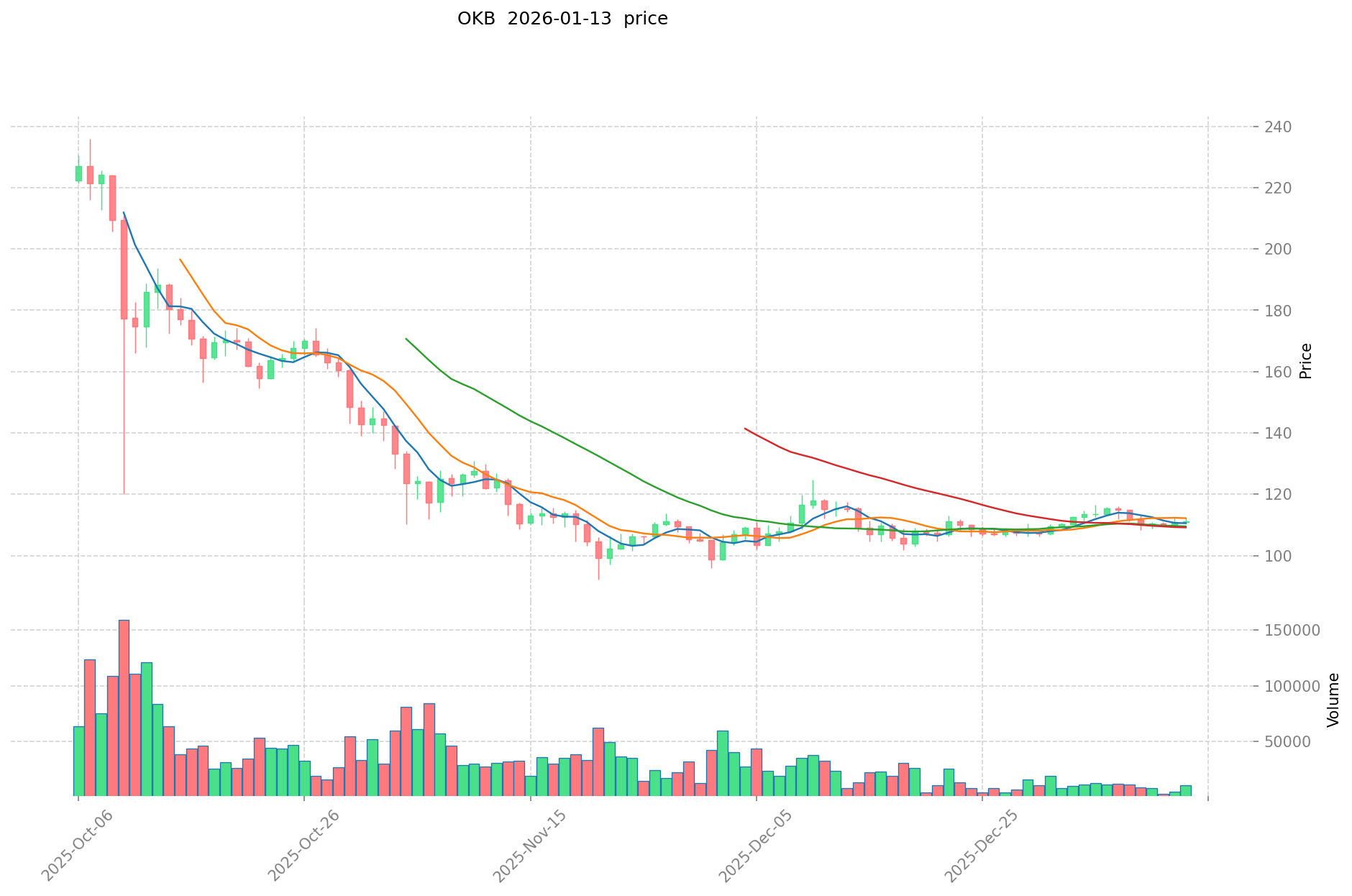
OKB is a significant asset in the cryptocurrency field, issued by the OK Blockchain Foundation as a global utility token. As of January 14, 2026, OKB holds a market capitalization of approximately $2.44 billion, with a circulating supply of 21 million tokens and a current price around $116.32. Initially based on the Ethereum ERC 20 protocol, OKB serves as a key component of the OKX ecosystem, utilized across the OKX platform and its invested blockchain projects. The token ranks 45th in the cryptocurrency market by market cap, representing a 0.073% market share. With its positioning as a platform utility token and ecosystem participation incentive, OKB has gradually become a focal point for investors considering cryptocurrency investment opportunities. This article provides a comprehensive analysis of OKB's investment characteristics, historical price movements, future price considerations, and associated risks to offer reference information for investors.
I. OKB Price History Review and Current Investment Value Status
- 2019: OKB reached a low point around $0.58 in January, marking the early stage of its market cycle
- 2025: Following the announcement of token burn and X Layer integration, OKB price experienced significant volatility, with the price reaching $144 within one hour, representing an increase of over 186%
- Recent period: OKB demonstrated notable price fluctuations, with the price surging above $55 driven by market speculation regarding potential strategic developments
Current OKB Investment Market Status (January 2026)
- Current OKB price: $116.32
- 24-hour price change: +3.88%
- 24-hour trading volume: $3,842,136.87
- Market capitalization: $2,442,720,000
- Circulating supply: 21,000,000 OKB (100% of total supply)
- Price range (24h): $110.38 - $117.24
Click to view real-time OKB market price
II. Core Factors Influencing Whether OKB is a Good Investment
Supply Mechanism and Scarcity (OKB Investment Scarcity)
- Fixed supply mechanism → impacts price and investment value
- OKB has a maximum supply of 21,000,000 tokens with 100% currently in circulation, establishing a clear scarcity model
- Historical context: OKB's price has experienced significant fluctuations since its launch at $1 in January 2018, with notable price movements observed in 2025
- Investment significance: the fixed supply cap represents a fundamental characteristic that may support long-term investment considerations, as no additional tokens can be created beyond the established maximum
Institutional Investment and Mainstream Adoption (Institutional Investment in OKB)
- Platform integration: OKB serves as a core component of the OKX ecosystem and is utilized across the platform and its invested projects
- Holder base: As of January 2026, OKB has 51,417 holders, indicating a distributed ownership structure
- Strategic positioning: OKB Foundation maintains strategic cooperation with OKX, integrating the token into the exchange's operational framework
- Distribution approach: OKX implements a platform sharing plan to gradually distribute 60% of OKB to users over time, encouraging ecosystem participation
Macroeconomic Environment's Impact on OKB Investment
- Market performance context: In 2025, OKB demonstrated notable price appreciation, with one analysis indicating an increase during that period
- Broader market positioning: As of January 2026, OKB holds a market ranking of #45 with a market capitalization of approximately $2.44 billion and a market dominance of 0.073%
- Trading activity: 24-hour trading volume stands at approximately $3.84 million across 15 exchanges, reflecting ongoing market liquidity
Technology and Ecosystem Development (Technology & Ecosystem for OKB Investment)
- Technical foundation: OKB was initially issued based on the Ethereum ERC-20 protocol
- Planned migration: The token is intended to migrate to OKChain, a proprietary public blockchain developed by the OK Blockchain Foundation
- Ecosystem integration: OKB functions as a utility token within the OKX platform ecosystem and is applied to blockchain ecosystem projects invested by OKX
- Platform development: OKX continues to introduce updates and new features that may influence the token's utility and ecosystem growth
III. OKB Future Investment Forecast and Price Outlook (Is OKB(OKB) worth investing in 2026-2031)
Short-term Investment Forecast (2026, short-term OKB investment outlook)
- Conservative Forecast: $108.82 - $115.77
- Neutral Forecast: $110.96 - $116.32
- Optimistic Forecast: $115.77 - $165.55
Mid-term Investment Outlook (2027-2029, mid-term OKB(OKB) investment forecast)
- Market Phase Expectation: OKB may experience gradual growth during this period, with potential expansion in the OKX ecosystem and broader utility integration across DeFi platforms.
- Investment Return Forecast:
- 2027: $88.62 - $171.61
- 2028: $112.42 - $210.78
- 2029: $133.92 - $225.65
- Key Catalysts: Platform ecosystem development, user adoption rates, integration with DeFi protocols, and overall cryptocurrency market sentiment.
Long-term Investment Outlook (Is OKB a good long-term investment?)
- Base Scenario: $177.96 - $249.56 (assuming steady ecosystem growth and moderate market conditions through 2031)
- Optimistic Scenario: $249.56 - $294.56 (assuming accelerated adoption, successful platform innovations, and favorable regulatory environment)
- Risk Scenario: $129.77 - $177.96 (under challenging market conditions or competitive pressure)
Click to view OKB long-term investment and price prediction: Price Prediction
2026-01-14 - 2031 Long-term Outlook
- Base Scenario: $177.96 - $249.56 (corresponding to steady progress and gradual mainstream application growth)
- Optimistic Scenario: $249.56 - $294.56 (corresponding to large-scale adoption and favorable market environment)
- Transformative Scenario: Above $294.56 (in case of breakthrough ecosystem developments and mainstream adoption)
- 2031-12-31 Forecast High: $294.56 (based on optimistic development assumptions)
Disclaimer: These forecasts are based on current market data and predictive models. Cryptocurrency investments carry substantial risks, and price predictions should not be considered as investment advice. Market conditions, regulatory changes, technological developments, and other factors may significantly impact actual prices. Investors should conduct thorough research and consider their risk tolerance before making investment decisions.
| Year |
Predicted High Price |
Predicted Average Price |
Predicted Low Price |
Price Change |
| 2026 |
165.5511 |
115.77 |
108.8238 |
0 |
| 2027 |
171.605871 |
140.66055 |
88.6161465 |
20 |
| 2028 |
210.779834175 |
156.1332105 |
112.41591156 |
34 |
| 2029 |
225.651522475125 |
183.4565223375 |
133.923261306375 |
57 |
| 2030 |
294.55779226509 |
204.5540224063125 |
177.961999493491875 |
75 |
| 2031 |
291.980411582770462 |
249.55590733570125 |
129.76907181456465 |
114 |
IV. OKB Investment Strategy and Risk Management (How to invest in OKB)
Investment Strategy (OKB investment strategy)
Long-term Holding (HODL OKB)
Long-term holding represents a conservative investment approach suitable for investors seeking steady exposure to the OKX ecosystem. This strategy involves acquiring OKB tokens and maintaining positions through market cycles, potentially benefiting from the platform's growth and ecosystem expansion. Given OKB's role as a utility token within the OKX platform and its associated projects, long-term holders may participate in platform developments and ecosystem initiatives. However, investors should consider the token's price volatility and conduct thorough research before committing to extended holding periods.
Active Trading
Active trading strategies involve frequent position adjustments based on technical analysis and market momentum. Traders may utilize chart patterns, volume indicators, and price action to identify entry and exit points. OKB's 24-hour trading volume of approximately 3.84 million tokens suggests reasonable liquidity for active trading strategies. However, this approach requires significant time commitment, technical expertise, and risk management discipline.
Risk Management (Risk management for OKB investment)
Asset Allocation Ratios
- Conservative Investors: May consider allocating 2-5% of their cryptocurrency portfolio to OKB, maintaining a diversified approach across multiple assets
- Moderate Investors: Could allocate 5-15% of their crypto holdings to OKB, balancing growth potential with diversification
- Professional Investors: May consider higher allocations of 15-30% based on comprehensive analysis and risk tolerance
These percentages serve as general references and should be adjusted according to individual financial situations and investment objectives.
Risk Hedging Strategies
Investors may consider implementing multi-asset portfolio approaches to mitigate concentration risk. Diversification across different cryptocurrency categories, including established networks, DeFi protocols, and platform tokens, can help balance portfolio volatility. Additionally, some investors incorporate traditional financial instruments or stablecoins as hedging tools to manage exposure during periods of heightened market uncertainty.
Secure Storage
Cold Wallets: For long-term holdings, cold storage solutions provide enhanced security by keeping private keys offline. Hardware wallets from established manufacturers offer robust protection against online threats.
Hot Wallets: For active trading and regular transactions, hot wallets provide convenient access while maintaining reasonable security standards. Users should enable two-factor authentication and follow security best practices.
Hardware Wallet Recommendations: Established hardware wallet providers offer secure storage solutions with user-friendly interfaces. Investors should purchase devices directly from official sources and verify authenticity before use.
V. OKB Investment Risks and Challenges (Risks of investing in OKB)
Market Risks
Price Volatility: OKB experiences significant price fluctuations characteristic of cryptocurrency markets. The token has recorded movements of 3.88% over 24 hours and various percentage changes across different timeframes. Investors should prepare for substantial short-term price swings that may test risk tolerance.
Liquidity Considerations: While OKB maintains trading presence on multiple exchanges, liquidity conditions can vary across different platforms and market conditions, potentially affecting execution prices during significant market movements.
Regulatory Risks
Jurisdictional Uncertainties: Cryptocurrency regulations differ significantly across countries and continue to evolve. Changes in regulatory frameworks may affect OKB's accessibility, trading conditions, or utility within different markets. Investors should monitor regulatory developments in their jurisdictions and assess potential impacts on their holdings.
Compliance Requirements: Platform tokens like OKB may face varying compliance standards across different regions, potentially affecting their operational scope and user accessibility.
Technical Risks
Network Security: As with all blockchain-based assets, OKB faces potential security challenges including smart contract vulnerabilities, network attacks, and technical exploits. While established platforms typically implement security measures, no system is entirely immune to technical risks.
Migration Considerations: According to available information, OKB's planned migration to OKChain represents a technical transition that involves inherent execution risks. Such migrations require careful planning and implementation to ensure smooth token transfers and maintain network functionality.
Platform Dependency: OKB's utility is closely tied to the OKX platform and its ecosystem projects. Technical issues, operational challenges, or platform-specific developments may affect token utility and value.
VI. Conclusion: Is OKB a Good Investment?
Investment Value Summary
OKB presents investment characteristics tied to its role within the OKX ecosystem and broader platform utility. The token demonstrates certain market presence with a circulating supply of 21 million tokens and representation across multiple exchanges. However, the cryptocurrency market's inherent volatility means prices may experience substantial fluctuations in both short and long timeframes.
The token's performance reflects various factors including platform developments, market sentiment, and broader cryptocurrency trends. While some investors may view platform tokens as potential long-term holdings, price movements remain subject to numerous variables beyond direct control.
Investor Recommendations
✅ Beginners: Consider starting with small, regular investments (dollar-cost averaging) to mitigate timing risk. Prioritize secure storage solutions and focus on understanding the token's utility before increasing exposure. Allocate only funds you can afford to lose given cryptocurrency volatility.
✅ Experienced Investors: May explore combining systematic accumulation with tactical position adjustments based on market analysis. Consider portfolio diversification across multiple assets and implement risk management protocols including stop-loss strategies and position sizing.
✅ Institutional Investors: Could evaluate OKB as part of broader cryptocurrency exposure strategies, conducting thorough due diligence on platform fundamentals, tokenomics, and ecosystem developments. Consider implementing structured investment frameworks with defined risk parameters and regular portfolio rebalancing.
⚠️ Important Notice: Cryptocurrency investments carry substantial risk due to price volatility, regulatory uncertainties, and technical challenges. This content provides informational analysis only and does not constitute investment advice, financial guidance, or recommendations to buy, sell, or hold any asset. Investors should conduct independent research, assess their risk tolerance, and consult qualified financial professionals before making investment decisions. Past performance does not indicate future results.
VII. FAQ
Q1: What is OKB and what makes it different from other exchange tokens?
OKB is the global utility token issued by the OK Blockchain Foundation, serving as the core component of the OKX ecosystem. Unlike many exchange tokens, OKB features a fixed maximum supply of 21 million tokens (100% currently in circulation), establishing clear scarcity. The token was initially based on Ethereum's ERC-20 protocol with plans to migrate to OKChain, a proprietary blockchain. OKB functions across the OKX platform and its invested blockchain projects, with the platform implementing a sharing plan to gradually distribute 60% of tokens to users over time, encouraging ecosystem participation.
Q2: Is OKB a good short-term investment in 2026?
Short-term investment potential varies based on risk tolerance and market conditions. Current forecasts suggest a price range of $108.82 - $165.55 for 2026, with the conservative estimate at $108.82 - $115.77 and optimistic scenario reaching $115.77 - $165.55. However, OKB demonstrates significant price volatility, with 24-hour changes of 3.88% and historical movements exceeding 186% during major announcements. Short-term investors should prepare for substantial price swings and implement appropriate risk management strategies. The token's performance depends on platform developments, market sentiment, and broader cryptocurrency trends.
Q3: How does OKB's fixed supply mechanism affect its long-term investment value?
OKB's maximum supply cap of 21 million tokens creates fundamental scarcity, as no additional tokens can be created beyond this limit. With 100% of the supply currently in circulation, this fixed mechanism eliminates inflation concerns associated with continuous token issuance. This scarcity model may support long-term value preservation, similar to other fixed-supply cryptocurrencies. However, the actual impact on investment value depends on multiple factors including ecosystem growth, platform adoption, user demand, and overall market conditions. The fixed supply represents a structural characteristic rather than a guarantee of price appreciation.
Q4: What are the main risks associated with investing in OKB?
OKB investment involves several key risk categories: (1) Market risks - significant price volatility with 24-hour fluctuations and varying liquidity conditions across exchanges; (2) Regulatory risks - evolving cryptocurrency regulations across jurisdictions may affect token accessibility and trading conditions; (3) Technical risks - potential security challenges including smart contract vulnerabilities, network attacks, and migration risks associated with the planned transition to OKChain; (4) Platform dependency - OKB's utility is closely tied to OKX platform performance, meaning technical issues or operational challenges may impact token value. Investors should only allocate funds they can afford to lose.
Q5: What investment strategy is most suitable for OKB holders?
The optimal strategy depends on investor profile and objectives. Conservative investors may consider allocating 2-5% of their cryptocurrency portfolio to OKB using long-term holding (HODL) strategies, participating in platform ecosystem growth over extended periods. Moderate investors could allocate 5-15% while potentially combining systematic accumulation with tactical adjustments. Professional investors may consider 15-30% allocations with active trading strategies based on technical analysis. All approaches should incorporate proper risk management including diversification across multiple assets, secure storage solutions (cold wallets for long-term holdings, hot wallets for active trading), and position sizing appropriate to individual risk tolerance.
Q6: How does OKB's current market position compare to other cryptocurrencies?
As of January 2026, OKB ranks #45 in the cryptocurrency market with a market capitalization of approximately $2.44 billion, representing 0.073% market dominance. The token has 51,417 holders and trades on 15 exchanges with 24-hour volume around $3.84 million. This positioning indicates established presence in the platform token category, though smaller than leading cryptocurrencies. The current price of $116.32 reflects market valuation of OKB's utility within the OKX ecosystem and broader cryptocurrency sentiment. Investors should consider this market position when evaluating potential growth trajectories and competitive positioning.
Q7: What price range can investors expect for OKB by 2030-2031?
Long-term forecasts suggest varying scenarios based on ecosystem development and market conditions. For 2030, the base scenario projects $177.96 - $249.56, assuming steady platform growth and moderate market conditions. The optimistic scenario ranges from $249.56 - $294.56, contingent upon accelerated adoption and favorable regulatory environment. By 2031, predictions indicate a high of $294.56 under optimistic assumptions, with average price around $249.56. However, these forecasts carry significant uncertainty due to cryptocurrency market volatility, regulatory changes, technological developments, and unforeseen factors. Past performance does not indicate future results, and actual prices may differ substantially from predictions.
Q8: What security measures should OKB investors implement?
Security implementation should match investment approach and holding timeframe. For long-term holdings, cold storage solutions using hardware wallets provide enhanced security by keeping private keys offline - investors should purchase devices directly from official manufacturers and verify authenticity. For active trading requiring regular access, hot wallets offer convenience while maintaining reasonable security through two-factor authentication and security best practices. Investors should never share private keys, use strong unique passwords, enable all available security features, and consider diversifying storage across multiple wallets to mitigate single-point failure risks. Regular security audits of wallet software and awareness of phishing attempts are essential protective measures.
* The information is not intended to be and does not constitute financial advice or any other recommendation of any sort offered or endorsed by Gate.