OKZOO (AIOT) represents an emerging decentralized environmental data network powered by AIoT machines, currently trading at $0.07024 with a $7.81 million market cap on Gate exchange and 8 other platforms. This comprehensive analysis evaluates whether AIOT constitutes a viable investment by examining its price history, revealing a peak of $1.85 in September 2025 followed by significant recent decline, alongside current market metrics including 638,303 token holders and limited 24-hour trading volume of $67,654. The article addresses core investment factors including the token's 11.12% circulating supply ratio creating future dilution risk, technology infrastructure positioning, and macroeconomic volatility patterns. Investment forecasts range from conservative $0.0506-$0.0703 short-term targets to optimistic $0.1051-$0.1273 long-term scenarios by 2031, contingent upon ecosystem adoption acceleration. Risk management strategies differentiate between beginner, experienced, and institutional investor approaches,
Introduction: OKZOO (AIOT) Investment Position and Market Outlook
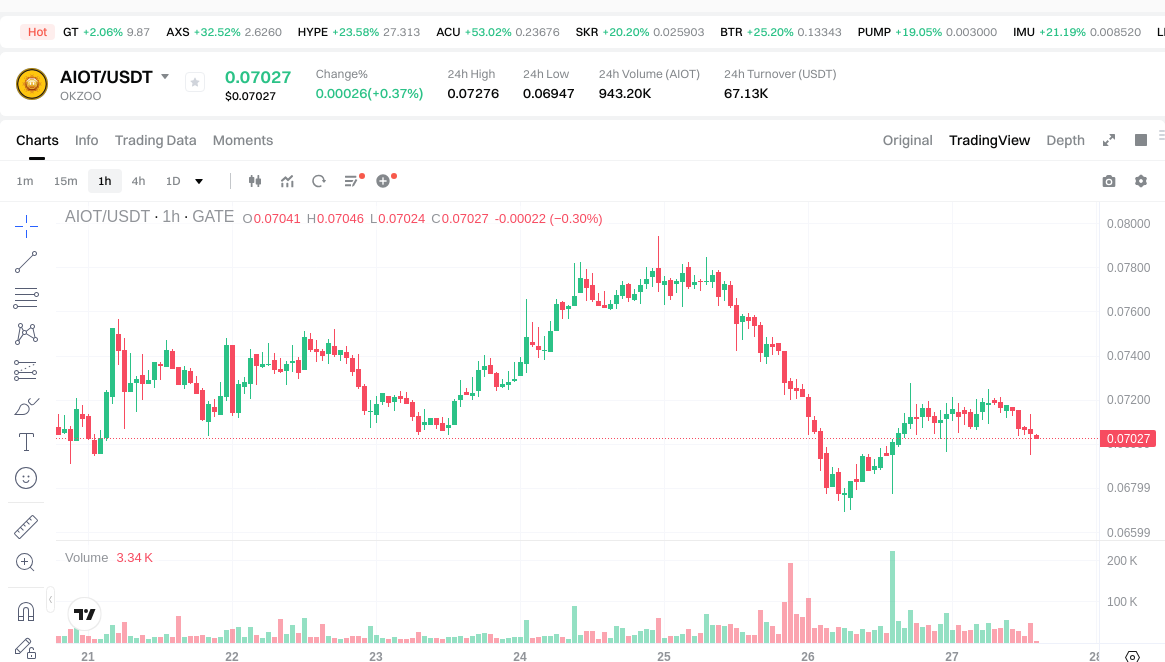
AIOT represents a notable asset in the cryptocurrency sector, positioning itself as the world's first urban-scale decentralized environmental data network powered by advanced AIoT machines. As of January 27, 2026, AIOT maintains a market capitalization of approximately $7.81 million with a circulating supply of 111.2 million tokens. The current trading price stands at $0.07024, reflecting recent market dynamics with a 24-hour trading volume of $67,654. The token holder base has grown to 638,303 participants, indicating expanding community engagement.
With its unique positioning in the decentralized environmental data sector, AIOT has attracted attention from investors examining "Is OKZOO (AIOT) a good investment?" The token's market performance shows a 1.8% increase over the past 24 hours, though it has experienced a 4% decline over the past week and a 32.93% decrease over the past 30 days. The fully diluted market cap reaches $70.24 million, with a circulating supply ratio of 11.12% from a maximum supply of 1 billion tokens.
This analysis examines AIOT's investment characteristics, historical price movements, future outlook considerations, and associated risk factors to provide reference information for market participants. The token operates on the BSC network and is currently available on 9 exchanges, offering accessibility to interested parties in the cryptocurrency market.
I. AIOT Price History Review and Current Investment Value Status
- 2025: AIOT experienced significant price volatility during its early market phase, with notable fluctuations observed between August and September
- September 2025: The token reached a price level of $1.85 on September 6, 2025, representing a period of heightened market activity
- August 2025: Price declined to $0.01 on August 30, 2025, reflecting broader market correction dynamics
Current AIOT Investment Market Status (January 2026)
- AIOT current price: $0.07024
- Market capitalization: Approximately $7.81 million
- 24-hour trading volume: $67,654.21
- Circulating supply: 111.2 million AIOT tokens
- Market dominance: 0.0022%
- Price performance (24H): +1.8%
- Price performance (7D): -4%
- Price performance (30D): -32.93%
- Token holder count: 638,303 addresses
Click to view real-time AIOT market price
II. Core Factors Affecting Whether AIOT is a Good Investment
Supply Mechanism and Scarcity (AIOT Investment Scarcity)
- Total supply of 1,000,000,000 tokens with 111,200,000 in circulation (11.12% circulating ratio) → influences price dynamics and investment potential
- Market cap to fully diluted valuation ratio at 11.12% suggests significant room for supply expansion
- Investment significance: the current circulating supply represents a relatively small portion of total supply, which may affect long-term scarcity considerations
Institutional Investment and Mainstream Adoption (Institutional Investment in AIOT)
- Holder base: 638,303 addresses hold AIOT tokens, indicating growing community participation
- Trading availability: listed on 9 exchanges, providing accessibility for institutional and retail investors
- User base expansion: the project has attracted attention within the decentralized environmental data network sector
Macroeconomic Environment's Impact on AIOT Investment
- Market performance indicators: 24-hour trading volume of $67,654.21 reflects current liquidity conditions
- Market dominance at 0.0022% positions AIOT as an emerging asset within the broader crypto market
- Price volatility patterns: 1-hour change of +0.33%, 24-hour change of +1.8%, contrasted with 7-day decline of -4% and 30-day decline of -32.93%, illustrating short-term fluctuations amid longer-term adjustments
Technology and Ecosystem Development (Technology & Ecosystem for AIOT Investment)
- Core technology: operates as a decentralized environmental data network powered by advanced AIoT (Artificial Intelligence of Things) machines at urban scale
- Infrastructure deployment: contract address on BSC (Binance Smart Chain) facilitates ecosystem integration and transaction efficiency
- Ecosystem positioning: focuses on environmental data collection and decentralized network applications, which may support long-term utility development
III. AIOT Future Investment Forecast and Price Outlook (Is OKZOO(AIOT) worth investing in 2026-2031)
Short-term Investment Forecast (2026, short-term AIOT investment outlook)
- Conservative forecast: $0.0506 - $0.0703
- Neutral forecast: $0.0703 - $0.0745
- Optimistic forecast: $0.0703 - $0.0745
Mid-term Investment Outlook (2027-2029, mid-term OKZOO(AIOT) investment forecast)
- Market stage expectation: The token may experience moderate growth phases as the decentralized environmental data network expands its urban-scale deployment and AIoT device integration.
- Investment return forecast:
- 2027: $0.0616 - $0.0978
- 2028: $0.0774 - $0.0987
- 2029: $0.0662 - $0.1094
- Key catalysts: Expansion of AIoT device network, increased adoption of decentralized environmental data solutions, and potential partnerships within the smart city ecosystem.
Long-term Investment Outlook (Is AIOT a good long-term investment?)
- Base scenario: $0.0624 - $0.1097 (assuming steady network growth and moderate market conditions)
- Optimistic scenario: $0.1051 - $0.1273 (assuming accelerated adoption and favorable regulatory environment for decentralized data networks)
- Risk scenario: Below $0.05 (under adverse market conditions or significant competitive pressure)
Click to view AIOT long-term investment and price forecast: Price Prediction
2026-01-27 - 2031 Long-term Outlook
- Base scenario: $0.0624 - $0.1006 (corresponding to steady progress and gradual mainstream application adoption)
- Optimistic scenario: $0.1051 - $0.1273 (corresponding to large-scale adoption and favorable market environment)
- Transformative scenario: Above $0.13 (such as breakthrough progress in ecosystem development and mainstream popularization)
- 2031-12-31 forecast high: $0.1273 (based on optimistic development assumptions)
Disclaimer: Price forecasts are based on historical data and market analysis patterns. Cryptocurrency markets are highly volatile and subject to numerous unpredictable factors. These projections should not be construed as investment advice, and investors should conduct their own research and risk assessment before making any investment decisions.
| Year |
Predicted High Price |
Predicted Average Price |
Predicted Low Price |
Price Change |
| 2026 |
0.0745392 |
0.07032 |
0.0506304 |
0 |
| 2027 |
0.09777996 |
0.0724296 |
0.06156516 |
3 |
| 2028 |
0.0987215448 |
0.08510478 |
0.0774453498 |
21 |
| 2029 |
0.109376663256 |
0.0919131624 |
0.066177476928 |
30 |
| 2030 |
0.10970295498252 |
0.100644912828 |
0.06239984595336 |
43 |
| 2031 |
0.127260460025364 |
0.10517393390526 |
0.053638706291682 |
49 |
IV. OKZOO Investment Strategy and Risk Management (How to invest in AIoT tokens)
Investment Methodology (OKZOO investment strategy)
-
Long-term Holding (HODL OKZOO): Suitable for conservative investors seeking exposure to decentralized environmental data networks. Given OKZOO's positioning as an urban-scale AIoT-driven project, long-term holders may consider the gradual expansion of environmental monitoring infrastructure and potential network effects.
-
Active Trading: Depends on technical analysis and swing trading strategies. OKZOO has demonstrated notable price volatility, with recent fluctuations including a 1-hour change of 0.33%, 24-hour change of 1.8%, and 7-day decline of -4%. Active traders may capitalize on these short-term movements within the $0.06907-$0.07276 range observed in recent 24-hour periods.
Risk Management (Risk management for OKZOO investment)
V. OKZOO Investment Risks and Challenges (Risks of investing in AIoT tokens)
-
Market Risk: OKZOO exhibits high volatility characteristics, with 30-day price decline of -32.93% and 1-year performance showing -29.16% change. The market capitalization of $7,810,688 and relatively low trading volume of $67,654 may contribute to liquidity constraints and price sensitivity.
-
Regulatory Risk: Decentralized environmental data networks may face varying regulatory frameworks across jurisdictions. Policy uncertainties regarding data collection, privacy standards, and AIoT device deployment could impact project viability.
-
Technical Risk:
- Smart contract vulnerabilities associated with BSC-based deployment (contract address: 0x55ad16bd573b3365f43a9daeb0cc66a73821b4a5)
- Network security considerations for AIoT infrastructure
- Potential challenges in technology upgrade implementation
- Only 11.12% circulating supply (111,200,000 out of 1,000,000,000 max supply) suggests significant future dilution risk
VI. Conclusion: Is AIoT Token a Good Investment?
-
Investment Value Summary: OKZOO operates in the emerging intersection of AIoT and decentralized data networks, representing a specialized sector with potential development opportunities. However, recent performance indicators show substantial price volatility and notable declines across multiple timeframes.
-
Investor Recommendations:
✅ Beginners: Consider dollar-cost averaging approach with secure wallet storage; start with minimal allocation to understand market dynamics
✅ Experienced Investors: Employ swing trading strategies while maintaining diversified portfolio allocation; monitor circulating supply expansion
✅ Institutional Investors: Conduct thorough due diligence on AIoT infrastructure deployment progress; strategic positioning should account for sector-specific risks
⚠️ Disclaimer: Cryptocurrency investments carry high risk. This content is for informational purposes only and does not constitute investment advice. Investors should conduct independent research and consult with financial professionals before making investment decisions.
VII. FAQ
Q1: What is the current circulating supply of AIOT tokens and how does it affect investment value?
AIOT has 111.2 million tokens in circulation, representing only 11.12% of its maximum supply of 1 billion tokens. This low circulating ratio creates both opportunities and risks for investors. On one hand, the limited current supply may support price stability in the near term. On the other hand, the substantial remaining 88.88% of tokens represents significant future dilution potential, which could exert downward pressure on price as additional tokens enter circulation. Investors should carefully monitor the token release schedule and consider this factor when evaluating long-term holding strategies.
Q2: How has AIOT performed recently and what does this indicate about short-term investment prospects?
AIOT has demonstrated mixed short-term performance with a 1.8% gain over 24 hours but a 4% decline over the past week and a significant 32.93% decrease over 30 days. The current price of $0.07024 sits well below its September 2025 peak of $1.85, indicating substantial correction from historical highs. This volatility pattern suggests that short-term traders may find opportunities in price fluctuations, but conservative investors should approach with caution given the recent downward momentum and relatively low 24-hour trading volume of $67,654.
Q3: What makes AIOT different from other cryptocurrency investments?
AIOT positions itself as the world's first urban-scale decentralized environmental data network powered by AIoT (Artificial Intelligence of Things) machines. Unlike general-purpose cryptocurrencies, AIOT focuses specifically on environmental data collection and decentralized network applications within smart city ecosystems. This specialized positioning differentiates it from broader market assets but also creates concentration risk within a niche sector. The project's success depends heavily on adoption of decentralized environmental monitoring infrastructure and partnerships within the urban IoT space.
Q4: Is AIOT suitable for long-term investment compared to short-term trading?
Long-term AIOT investment suitability depends on individual risk tolerance and sector outlook. Conservative long-term holders face challenges including the 11.12% circulating supply ratio (suggesting future dilution), market dominance of only 0.0022%, and year-over-year decline of 29.16%. However, the expanding holder base of 638,303 addresses indicates growing community engagement. Price forecasts suggest potential recovery to $0.1051-$0.1273 by 2031 under optimistic scenarios, but this assumes successful infrastructure deployment and favorable market conditions. Short-term traders may find opportunities in the token's demonstrated volatility patterns, though liquidity constraints should be considered given the moderate trading volume.
Q5: What are the primary risks investors should consider before buying AIOT?
Investors face several key risks: (1) Dilution risk - only 11.12% of total supply is circulating, meaning substantial token releases could pressure prices; (2) Liquidity risk - daily trading volume of $67,654 and market cap of $7.81 million indicate limited market depth, potentially causing significant price slippage; (3) Volatility risk - recent 30-day decline of 32.93% demonstrates high price fluctuation potential; (4) Regulatory uncertainty - decentralized environmental data collection faces evolving regulatory frameworks across jurisdictions; (5) Technology risk - smart contract vulnerabilities and AIoT infrastructure security challenges require ongoing monitoring.
Q6: How should different investor types approach AIOT allocation?
Investment allocation should align with experience level and risk tolerance. Beginners should limit AIOT exposure to 1-3% of portfolio value, utilize dollar-cost averaging to manage volatility, and prioritize secure storage in hardware or cold wallets. Experienced investors may consider 5-10% allocation with active monitoring, employing swing trading strategies to capitalize on short-term price movements within the established volatility ranges. Institutional investors should conduct comprehensive due diligence on AIoT infrastructure deployment progress, evaluate correlation with broader environmental technology sectors, and implement strategic hedging positions to manage concentration risk in this specialized market segment.
Q7: What price levels should investors monitor for AIOT entry and exit strategies?
Based on recent market behavior and forecasting models, key price levels include: Support zones around $0.0506-$0.0616, which align with conservative 2026-2027 forecasts and may present accumulation opportunities for long-term investors. Resistance levels at $0.0745-$0.0978 correspond to neutral-to-optimistic short-term targets and potential profit-taking zones for active traders. Critical threshold at $0.05 represents a risk scenario level, below which fundamental reassessment may be warranted. Investors should implement stop-loss orders based on individual risk tolerance, considering that AIOT has demonstrated capacity for rapid movements, as evidenced by its decline from $1.85 in September 2025 to current levels.
Q8: Where can investors trade AIOT and what are the accessibility considerations?
AIOT is currently available on 9 cryptocurrency exchanges, operating on the BSC (Binance Smart Chain) network with contract address 0x55ad16bd573b3365f43a9daeb0cc66a73821b4a5. While multi-exchange availability provides accessibility options, the relatively low 24-hour trading volume of $67,654 distributed across these platforms may result in liquidity fragmentation. Investors should verify exchange reputation, security measures, and trading pairs before execution. The BSC deployment offers lower transaction costs compared to Ethereum-based alternatives, but investors should maintain awareness of network-specific risks and ensure wallet compatibility before initiating transactions.
* The information is not intended to be and does not constitute financial advice or any other recommendation of any sort offered or endorsed by Gate.