This comprehensive analysis examines whether Open Campus (EDU) represents a viable investment opportunity within the Web3 education protocol sector. Covering EDU's journey from $0.05 launch price in April 2023 to current trading levels around $0.16224 (January 2026), the article evaluates historical performance, current market metrics ($105.37M market cap, 649.47M circulating supply), and institutional backing including Nasdaq-listed ANPA's $50M acquisition. The analysis addresses core investment factors including tokenomics, ecosystem development, EDU Chain infrastructure, and strategic partnerships like OC Afrika x Base Bridge expansion. Price forecasts range from conservative ($0.1446) to optimistic ($0.2782) for 2026, with long-term projections through 2031 presented across multiple scenarios. Essential sections cover investment strategies for different risk profiles, comprehensive risk management frameworks including portfolio allocation guidelines, and critical risk factors spanning market volatility, r
Introduction: Open Campus (EDU) Investment Position and Market Outlook
EDU is a significant asset in the cryptocurrency space. Since its launch in 2023, it has achieved notable development in the Web3 education protocol sector. As of January 17, 2026, Open Campus holds a market capitalization of approximately $105.37 million, with a circulating supply of around 649.47 million tokens, and the current price is maintained at approximately $0.16224. With its positioning as a Web3 education protocol platform that enables teachers and creators to tokenize and monetize educational content, EDU has gradually become a focal point for investors discussing "Is Open Campus (EDU) a good investment?" This article will comprehensively analyze EDU's investment value, historical trends, future price predictions, and investment risks to provide reference for investors.
I. Open Campus (EDU) Historical Price Review and Current Investment Value
- April 2023: EDU launched at a price of $0.05, marking its entry into the Web3 education protocol market.
- May 2023: Token experienced significant upward momentum, reaching $1.54956 on May 29, 2023, representing a substantial gain from its initial offering price.
- 2023-2024: Following the initial surge, EDU entered a consolidation phase with price fluctuations reflecting broader market conditions and ecosystem development milestones.
- October 2025: Price declined to $0.04239, representing a correction from previous levels as market conditions evolved.
- 2025 Performance: Over the past year, EDU demonstrated recovery with an increase, though still trading below earlier levels, as the Open Campus ecosystem continued expanding its educational platform offerings.
Current Investment Market Status (January 2026)
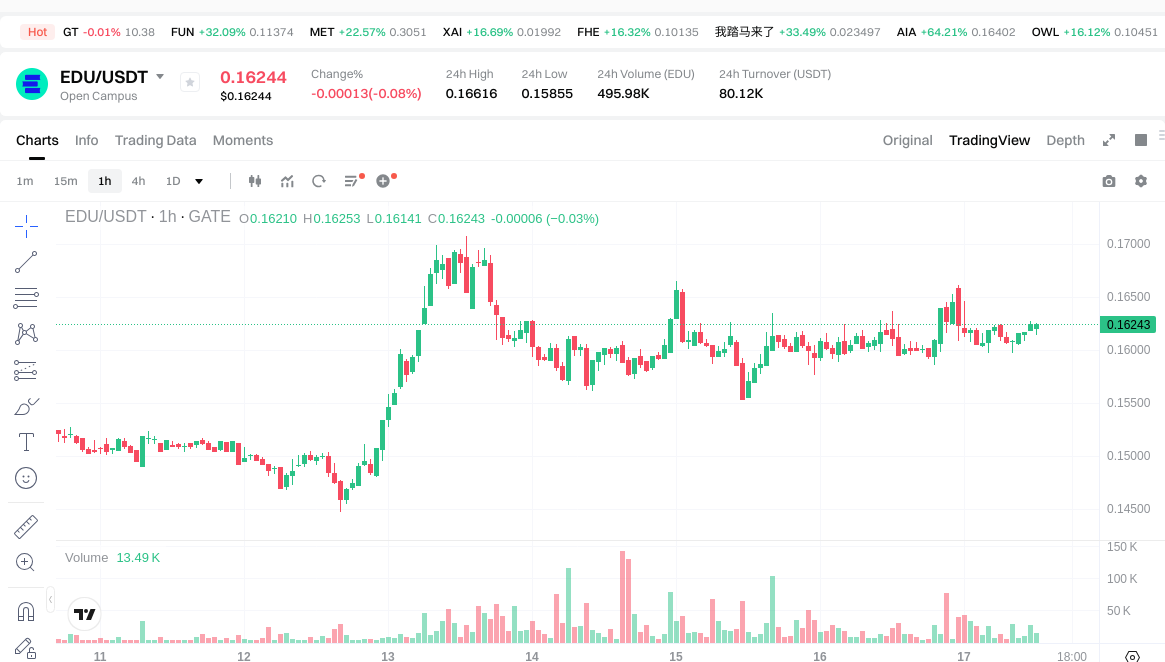
- Current Price: $0.16224
- 24-Hour Trading Volume: $79,620.66
- Market Capitalization: $105.37 million
- Circulating Supply: 649.47 million EDU (64.95% of total supply)
- Fully Diluted Valuation: $162.24 million
- Recent Price Movement:
- 1-Hour Change: -0.18%
- 24-Hour Change: 0%
- 7-Day Change: +8.76%
- 30-Day Change: +21.98%
- 1-Year Change: -69.86%
- Token Holder Base: Approximately 16,586 holders
- Exchange Availability: Listed on 21 exchanges
Click to view real-time EDU market price
II. Core Factors Influencing Whether EDU is a Good Investment
Supply Mechanism and Scarcity (EDU Investment Scarcity)
- Total and Circulating Supply: Open Campus (EDU) has a maximum supply of 1,000,000,000 tokens, with a circulating supply of 649,465,242 tokens as of January 17, 2026, representing approximately 64.95% of the total supply. The fixed maximum supply structure introduces a degree of scarcity that may support long-term price stability.
- Market Cap to FDV Ratio: The circulating market capitalization stands at $105,369,240.86, while the fully diluted valuation (FDV) is $162,240,000, resulting in a market cap to FDV ratio of 64.95%. This indicates a moderate level of token unlocking still ahead, which could influence future price dynamics as additional tokens enter circulation.
- Investment Significance: The controlled supply mechanism and ongoing token release schedule are factors that may contribute to the project's valuation framework, though future unlocks warrant monitoring by investors.
Institutional Investment and Mainstream Adoption (Institutional Investment in EDU)
- Institutional Backing: According to available market analysis, a notable institutional development occurred in 2025 when Nasdaq-listed ANPA made a $50 million buy-in of EDU tokens. This transaction is noted in forecasts as a factor that could potentially tighten supply and influence market dynamics.
- Ecosystem Partnerships: Open Campus has established strategic partnerships to expand its educational ecosystem. Notably, the OC Afrika x Base Bridge partnership aims to promote onchain education initiatives across the African continent, advancing EDU Chain's mission to increase accessibility and adoption of onchain learning and financing opportunities.
- Platform Adoption: The EDU token serves as the native utility token within the Open Campus ecosystem, utilized for governance, payment for educational products and services (such as those provided by TinyTap), on-chain revenue sharing among contributors, user acquisition incentives, and content ownership through Publisher NFTs. The breadth of utility functions may contribute to adoption within the Web3 education sector.
Technology and Ecosystem Development (Technology & Ecosystem for EDU Investment)
- EDU Chain Infrastructure: Open Campus has developed EDU Chain, a blockchain infrastructure designed to support Web3-enabled education platforms. In June 2025, the project released OC Kickstart, an open-source application framework that integrates core EDU Chain features such as Open Campus ID and Achievements, enabling projects to launch with reduced technical barriers.
- Developer Support Programs: The Open Campus Codex Hackathon Series represents a multi-event program supporting application development on EDU Chain, with a total prize pool of $1 million. Additionally, the Open Campus Incubator (OC-I) operates as a 12-week remote program supporting developers of winning projects in building and scaling applications on EDU Chain.
- Ecosystem Expansion Tools: The introduction of Publisher NFTs allows users to acquire co-publishing rights, creating a mechanism for content ownership and monetization within the platform. These tools aim to expand the utility and engagement within the Open Campus ecosystem.
- Long-term Positioning: According to market analyses, EDU's positioning within the Web3 education and DeSci (Decentralized Science) sectors represents a unique value proposition. If the project maintains transparency, grows DAO engagement, and successfully scales its ecosystem through EDU Chain, it may develop into a recognized infrastructure for digital education by 2030. However, such outcomes remain subject to market conditions and execution capabilities.
III. EDU Future Investment Forecast and Price Outlook (Is Open Campus(EDU) worth investing in 2026-2031)
Short-term Investment Forecast (2026, short-term EDU investment outlook)
- Conservative forecast: $0.1446 - $0.1625
- Neutral forecast: $0.1625 - $0.1770
- Optimistic forecast: $0.1770 - $0.2782
Mid-term Investment Outlook (2027-2028, mid-term Open Campus(EDU) investment forecast)
- Market stage expectation: EDU may enter a phase of gradual recovery and consolidation, with potential for moderate price appreciation as the Web3 education protocol ecosystem develops.
- Investment return forecast:
- 2027: $0.1273 - $0.2054
- 2028: $0.1519 - $0.2326
- Key catalysts: Protocol adoption growth, expansion of educational content creators on the platform, integration with ecosystem partners, and overall market sentiment toward Web3 education solutions.
Long-term Investment Outlook (Is EDU a good long-term investment?)
- Base scenario: $0.1388 - $0.2589 (assuming steady ecosystem development and moderate market conditions)
- Optimistic scenario: $0.2047 - $0.2605 (assuming enhanced protocol adoption and favorable market environment)
- Risk scenario: $0.1273 - $0.1932 (under challenging market conditions or slower ecosystem growth)
For detailed EDU long-term investment and price forecasts, visit: Price Prediction
2026-01-17 - 2031 Long-term Outlook
- Base scenario: $0.1388 - $0.2589 (corresponding to steady progress and gradual mainstream application growth)
- Optimistic scenario: $0.2047 - $0.2605 (corresponding to large-scale adoption and favorable market environment)
- Transformative scenario: Above $0.2605 (if ecosystem achieves breakthrough developments and mainstream penetration)
- 2031-12-31 forecast high: $0.2545 (based on optimistic development assumptions)
Disclaimer: These forecasts are based on historical data analysis and statistical models. Cryptocurrency markets are highly volatile and unpredictable. Past performance does not guarantee future results. Investors should conduct their own research and consider their risk tolerance before making investment decisions.
| Year |
Predicted High Price |
Predicted Average Price |
Predicted Low Price |
Price Change |
| 2026 |
0.1770487 |
0.16243 |
0.1445627 |
0 |
| 2027 |
0.2053846135 |
0.16973935 |
0.1273045125 |
4 |
| 2028 |
0.23257685737 |
0.18756198175 |
0.1519252052175 |
15 |
| 2029 |
0.2604860802544 |
0.21006941956 |
0.1932638659952 |
29 |
| 2030 |
0.25880552489792 |
0.2352777499072 |
0.138813872445248 |
45 |
| 2031 |
0.254452886524636 |
0.24704163740256 |
0.143284149693484 |
52 |
IV. Open Campus (EDU) Investment Strategy and Risk Management (How to invest in Web3 Education Protocol Tokens)
Investment Strategy (EDU investment strategy)
-
Long-term Holding (HODL EDU): Suitable for conservative investors who believe in the long-term development of Web3 education protocols. EDU serves multiple functions within the Open Campus ecosystem, including governance, payment, on-chain revenue sharing, user acquisition, and content ownership. Investors focusing on the education technology sector may consider accumulating EDU during market corrections.
-
Active Trading: For experienced traders who rely on technical analysis and swing trading strategies. EDU has demonstrated notable price volatility, with 7-day and 30-day price changes of +8.76% and +21.98% respectively as of January 17, 2026. Traders may capitalize on short-term price movements by monitoring support levels around $0.15855 (24h low) and resistance near $0.16616 (24h high).
Risk Management (Risk management for EDU investment)
-
Asset Allocation Ratio:
- Conservative investors: Allocate no more than 2-5% of crypto portfolio to EDU
- Moderate investors: Allocate 5-10% of crypto portfolio to EDU
- Aggressive investors: May allocate 10-15% of crypto portfolio to EDU with proper risk controls
-
Risk Hedging Strategy: Diversify holdings across multiple sectors including DeFi, Layer 1/Layer 2 protocols, and stable assets. Consider using stablecoins as hedging instruments during periods of heightened market uncertainty.
-
Secure Storage:
- Hot wallets (MetaMask, Trust Wallet) for active trading and small amounts
- Cold wallets and hardware wallets (Ledger, Trezor) for long-term holdings
- Store EDU on BSC-compatible wallets, as the token operates on the BNB Smart Chain
V. EDU Investment Risks and Challenges (Risks of investing in Web3 Education Protocol Tokens)
-
Market Risks: EDU exhibits significant price volatility, with a 1-year decline of -69.86% from its all-time high of $1.54956 (May 29, 2023) to current levels around $0.16224. The 24-hour trading volume of approximately $79,620 suggests relatively limited liquidity compared to major cryptocurrencies, which may result in price slippage during large transactions.
-
Regulatory Risks: Web3 education platforms and utility tokens face evolving regulatory frameworks across different jurisdictions. Changes in securities laws, education technology regulations, or crypto asset classifications could impact EDU's operational model and token utility.
-
Technical Risks:
- Smart contract vulnerabilities on the BSC network could expose users to security breaches
- Protocol upgrade failures or governance disputes may affect token value
- Dependency on ecosystem partners (such as TinyTap) creates concentration risk
- Competition from other Web3 education platforms may fragment market share
-
Adoption Risks: The success of EDU depends on widespread adoption by educators, content creators, and learners. Slow user acquisition or limited engagement within the Open Campus ecosystem could impact token demand and utility.
VI. Conclusion: Is Web3 Education Protocol Token a Good Investment?
-
Investment Value Summary: Open Campus (EDU) represents a specialized investment in the Web3 education sector, with utility spanning governance, payments, revenue sharing, and content ownership. The token has shown positive momentum over recent periods (+8.76% in 7 days, +21.98% in 30 days), though it remains significantly below its historical peak. The circulating supply represents 64.95% of max supply, with a market cap to fully diluted valuation ratio of 64.95%.
-
Investor Recommendations:
✅ Beginners: Consider dollar-cost averaging (DCA) strategy to accumulate EDU gradually, store tokens in secure hardware wallets, and avoid over-concentration in any single asset. Start with educational research about the Open Campus ecosystem before committing capital.
✅ Experienced Investors: Utilize swing trading strategies based on technical indicators, maintain diversified portfolio allocation across multiple crypto sectors, and monitor ecosystem developments including partner platform metrics and DAO governance activities.
✅ Institutional Investors: Evaluate EDU as a strategic allocation within education technology and Web3 infrastructure themes. Consider long-term position building aligned with sector growth thesis, while maintaining appropriate risk management frameworks.
⚠️ Disclaimer: Cryptocurrency investments carry substantial risk due to market volatility, regulatory uncertainty, and technological complexity. This content is for informational purposes only and does not constitute investment advice. Investors should conduct independent research and consult qualified financial advisors before making investment decisions.
VII. FAQ
Q1: What is Open Campus (EDU) and why is it considered a unique cryptocurrency investment?
Open Campus (EDU) is a Web3 education protocol token that enables teachers and content creators to tokenize and monetize educational content. Unlike traditional cryptocurrencies focused solely on financial transactions, EDU serves multiple utility functions within its ecosystem including governance, payment for educational products (such as TinyTap services), on-chain revenue sharing among contributors, user acquisition incentives, and content ownership through Publisher NFTs. The token operates on BNB Smart Chain with a fixed maximum supply of 1 billion tokens, of which approximately 64.95% (649.47 million) is currently in circulation as of January 17, 2026. Its unique positioning in the Web3 education and DeSci (Decentralized Science) sectors differentiates it from general-purpose cryptocurrencies.
Q2: How has EDU performed historically and what is its current market status?
EDU launched in April 2023 at $0.05 and experienced significant growth, reaching an all-time high of $1.54956 on May 29, 2023. However, the token has since corrected substantially, currently trading around $0.16224 as of January 17, 2026, representing a -69.86% decline from its peak over the past year. Recent performance shows positive momentum with a +8.76% increase over 7 days and +21.98% gain over 30 days. The token maintains a market capitalization of approximately $105.37 million with a 24-hour trading volume of $79,620, listed on 21 exchanges with approximately 16,586 token holders.
Q3: What are the price predictions for EDU in the short, medium, and long term?
Short-term forecasts for 2026 range from $0.1446 (conservative) to $0.2782 (optimistic), with a neutral range of $0.1625 - $0.1770. Medium-term predictions show gradual recovery potential, with 2027 estimates between $0.1273 - $0.2054 and 2028 projections ranging from $0.1519 - $0.2326. Long-term outlook through 2031 presents multiple scenarios: a base scenario of $0.1388 - $0.2589 under steady ecosystem development, an optimistic scenario of $0.2047 - $0.2605 with enhanced adoption, and a transformative scenario exceeding $0.2605 if breakthrough developments occur. The 2031 predicted high reaches $0.2545, though these forecasts are based on statistical models and historical data that cannot guarantee future performance in the highly volatile cryptocurrency market.
Q4: What investment strategy should I adopt when investing in EDU?
Investment strategy depends on your risk profile and experience level. Conservative long-term holders (HODL strategy) should allocate only 2-5% of their crypto portfolio to EDU, focusing on accumulation during market corrections while believing in Web3 education protocol development. Moderate investors may allocate 5-10% with a balanced approach, while aggressive traders comfortable with volatility might allocate 10-15% with proper risk controls. Active traders can capitalize on EDU's price volatility (recent support around $0.15855 and resistance near $0.16616) using technical analysis and swing trading strategies. Beginners should employ dollar-cost averaging (DCA) to gradually build positions, store tokens in secure hardware wallets for long-term holdings, and use hot wallets only for active trading amounts.
Q5: What are the major risks associated with investing in EDU?
EDU investment carries multiple risk categories. Market risks include significant price volatility (demonstrated by the -69.86% decline from all-time high) and relatively limited liquidity with $79,620 in 24-hour trading volume, which may cause price slippage during large transactions. Regulatory risks stem from evolving frameworks affecting Web3 education platforms and utility tokens across different jurisdictions. Technical risks involve potential smart contract vulnerabilities on BSC network, protocol upgrade failures, governance disputes, and dependency on ecosystem partners like TinyTap creating concentration risk. Adoption risks are critical, as EDU's success depends on widespread uptake by educators, content creators, and learners—slow user acquisition could negatively impact token demand and utility.
Q6: How does EDU's token supply mechanism affect its investment value?
EDU operates with a fixed maximum supply of 1 billion tokens, providing a degree of scarcity that may support long-term price stability. Currently, 649.47 million tokens (64.95%) are in circulation, with the remaining 35.05% yet to be released. The market capitalization to fully diluted valuation (FDV) ratio stands at 64.95%, indicating moderate token unlocking still ahead. This controlled supply mechanism can influence future price dynamics as additional tokens enter circulation—investors should monitor the unlock schedule as increased supply without corresponding demand growth could create downward price pressure. The tokenomics structure represents both an opportunity (scarcity element) and a risk (future dilution) that requires careful consideration in investment decisions.
Q7: What institutional developments and partnerships support EDU's investment potential?
Notable institutional backing emerged in 2025 when Nasdaq-listed ANPA executed a $50 million purchase of EDU tokens, potentially tightening supply and influencing market dynamics. Strategic partnerships include the OC Afrika x Base Bridge initiative promoting onchain education across Africa, advancing EDU Chain's mission to increase accessibility of onchain learning and financing opportunities. The ecosystem has developed EDU Chain infrastructure with OC Kickstart, an open-source application framework integrating core features like Open Campus ID and Achievements. Developer support programs include the Open Campus Codex Hackathon Series with $1 million in prizes and the Open Campus Incubator (OC-I), a 12-week remote program supporting winning projects in building and scaling applications on EDU Chain.
Q8: Who should consider investing in EDU and what precautions should they take?
Beginners should start with educational research about the Open Campus ecosystem, employ dollar-cost averaging strategies, store tokens in secure hardware wallets (Ledger, Trezor for long-term holdings), and avoid over-concentration by limiting EDU to 2-5% of their crypto portfolio. Experienced investors can utilize swing trading strategies based on technical indicators, maintain diversified portfolio allocation across multiple crypto sectors, and actively monitor ecosystem developments including platform metrics and DAO governance activities. Institutional investors may evaluate EDU as a strategic allocation within education technology and Web3 infrastructure themes, considering long-term position building aligned with sector growth thesis while maintaining appropriate risk management frameworks. All investor types must recognize that cryptocurrency investments carry substantial risk due to market volatility, regulatory uncertainty, and technological complexity—independent research and consultation with qualified financial advisors is essential before making investment decisions.
* The information is not intended to be and does not constitute financial advice or any other recommendation of any sort offered or endorsed by Gate.