Opulous (OPUL) is a blockchain-based platform launched in September 2021 that bridges NFT and DeFi with the music industry, enabling musicians to access funding through music copyright-backed NFTs and crypto loans. As of January 31, 2026, OPUL trades at $0.005637 with a market capitalization of approximately $2.82 million and a fixed supply of 500 million tokens. This comprehensive analysis examines OPUL's investment potential by evaluating its price history (declining 90.04% over one year), core investment factors including tokenomics and ecosystem development across multiple blockchains (Ethereum, Algorand, Arbitrum, BSC), and market predictions through 2031. The article provides detailed investment strategies tailored for beginners, experienced traders, and institutional investors, emphasizing risk management through appropriate position sizing (1-3% for conservative investors) and portfolio diversification. Key risks include substantial price volatility, regulatory uncertainties spanning cryptocurrency an
Introduction: Opulous (OPUL) Investment Status and Market Outlook
OPUL is a notable asset in the cryptocurrency field, launched in September 2021, and has made significant progress in bridging NFT and DeFi with the music industry. As of January 31, 2026, Opulous has a market capitalization of approximately $2.82 million, with a circulating supply of 500 million tokens, and the current price is around $0.005637. With its positioning as a platform that changes how musicians access funding and provides a launchpad for music copyright-backed NFTs and crypto loans, OPUL has gradually become a focal point when investors discuss "Is Opulous (OPUL) a good investment?" This article will comprehensively analyze OPUL's investment value, historical trends, future price predictions, and investment risks to provide reference for investors.
I. Price History Review and Current Investment Value Status of OPUL
- 2021: Token launch in September 2021 at $0.075 → OPUL reached $7.56 in November 2021, representing significant growth within the first months of trading
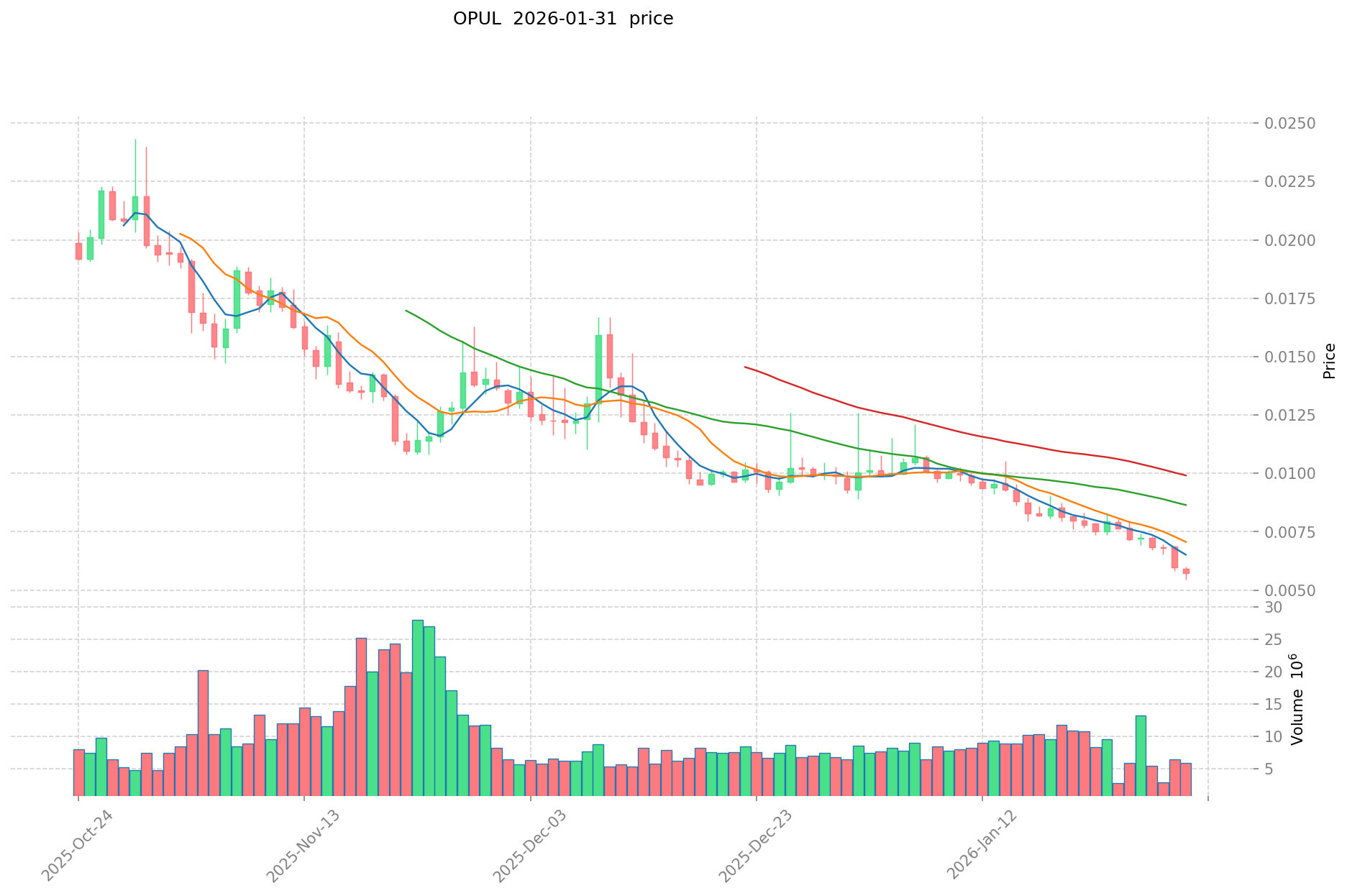
- 2021-2026: Market volatility cycle → Price declined from November 2021 levels to $0.00554501 recorded on January 30, 2026
- 2026: Current trading period → OPUL shows -90.039% change over 1-year period, with -39.25% decline over 30 days
Current OPUL Investment Market Status (January 2026)
- Current OPUL price: $0.005637 (as of January 31, 2026)
- Market sentiment (Fear & Greed Index): Market emotion indicator shows level 1
- 24-hour trading volume: $29,805.23
- Token holders: 5,632 addresses
- Market capitalization: $2,818,500 with 100% circulating supply (500,000,000 OPUL)
- Recent price movements: -0.48% (1H), -1.33% (24H), -28.93% (7D)
- 24-hour price range: $0.005443 - $0.005976
Click to view real-time OPUL market price
II. Core Factors Affecting Whether OPUL is a Good Investment
Supply Mechanism and Scarcity (OPUL Investment Scarcity)
- Fixed Supply Structure → Influences Price and Investment Value
- Opulous (OPUL) has a maximum supply of 500,000,000 tokens, with 100% of the supply currently in circulation. This fixed supply cap creates a deflationary framework where no additional tokens can be minted, establishing a foundation for potential scarcity-driven value appreciation.
- The token's circulating supply matches its total supply, indicating complete distribution without locked or reserved allocations. This transparency in supply structure provides clarity for investment assessment.
- Investment Significance: The fixed supply mechanism serves as a fundamental characteristic that may support long-term investment considerations, as supply constraints can influence price dynamics in response to demand fluctuations.
Institutional Investment and Mainstream Adoption (Institutional Investment in OPUL)
- Holder Base Analysis: As of current data, Opulous has approximately 5,632 token holders, indicating a relatively limited distribution network compared to more established crypto assets.
- The project is listed on 5 exchanges, suggesting modest but present market accessibility. This level of exchange integration provides basic liquidity channels for potential investors.
- The platform's focus on music industry applications through NFT and DeFi integration represents a niche market positioning. The success of this adoption strategy depends on the continued interest and participation of musicians and music industry stakeholders.
Macroeconomic Environment's Impact on OPUL Investment
- Market Correlation Factors: As a digital asset within the broader cryptocurrency ecosystem, OPUL's investment performance is subject to general market sentiment and macroeconomic conditions affecting the crypto sector.
- During periods of monetary policy tightening or rising interest rates, risk assets including cryptocurrencies may face reduced investment appeal as traditional safe-haven assets become more attractive on a risk-adjusted basis.
- Global economic uncertainty and varying regulatory approaches toward digital assets across jurisdictions can influence investor sentiment and market dynamics for tokens like OPUL.
Technology and Ecosystem Development (Technology & Ecosystem for OPUL Investment)
- Multi-Chain Deployment: OPUL tokens are deployed across multiple blockchain networks including Ethereum (ETH), Algorand (ALGO), Arbitrum (ARBEVM), and Binance Smart Chain (BSC). This multi-chain presence potentially enhances accessibility and interoperability within different blockchain ecosystems.
- Platform Functionality: Opulous provides infrastructure for music copyright-backed NFTs and crypto-based financing solutions for musicians. The platform's value proposition centers on transforming traditional music industry funding mechanisms through blockchain technology.
- Ecosystem Application Scope: The project's success as an investment depends significantly on the adoption rate of its music-focused DeFi and NFT applications. Market acceptance within the music industry and the platform's ability to attract both artists and investors will be critical factors in determining long-term investment viability.
III. OPUL Future Investment Predictions and Price Outlook (Is Opulous(OPUL) worth investing in 2026-2031)
Short-term Investment Prediction (2026, short-term OPUL investment outlook)
- Conservative forecast: $0.00298761 - $0.005637
- Neutral forecast: $0.005637 - $0.00760995
- Optimistic forecast: $0.005637 - $0.00760995
Mid-term Investment Outlook (2027-2029, mid-term Opulous(OPUL) investment forecast)
- Market stage expectation: OPUL may experience a gradual price recovery phase during 2027-2029, with potential growth influenced by broader market conditions and platform development progress.
- Investment return prediction:
- 2027: $0.005828658 - $0.008478048
- 2028: $0.004756979745 - $0.008834390955
- 2029: $0.007291392842475 - $0.01065034909575
- Key catalysts: Platform adoption in the music industry, NFT market trends, DeFi ecosystem development, and overall crypto market sentiment.
Long-term Investment Outlook (Is OPUL a good long-term investment?)
- Baseline scenario: $0.007719946504935 - $0.013284262352891 (assumes steady platform development and moderate market conditions)
- Optimistic scenario: $0.011352862507258 - $0.016915765135814 (assumes increased adoption, favorable regulatory environment, and strong music industry partnerships)
- Risk scenario: Below $0.005637 (under adverse market conditions or slower-than-expected platform adoption)
Click to view OPUL long-term investment and price prediction: Price Prediction
2026-01-31 - 2031 Long-term Outlook
- Baseline scenario: $0.007719946504935 - $0.013284262352891 (corresponds to steady progress and gradual mainstream application growth)
- Optimistic scenario: $0.011352862507258 - $0.016915765135814 (corresponds to large-scale adoption and favorable market environment)
- Transformative scenario: Above $0.016915765135814 (if ecosystem achieves breakthrough progress and mainstream popularization)
- 2031-12-31 predicted high: $0.016915765135814 (based on optimistic development assumptions)
Disclaimer: The above predictions are based on historical data analysis and market trend assessments. Cryptocurrency markets are highly volatile and subject to various unpredictable factors. These forecasts should not be considered as financial advice. Investors should conduct their own research and consider their risk tolerance before making any investment decisions.
| Year |
Predicted High Price |
Predicted Average Price |
Predicted Low Price |
Price Change |
| 2026 |
0.00760995 |
0.005637 |
0.00298761 |
0 |
| 2027 |
0.008478048 |
0.006623475 |
0.005828658 |
17 |
| 2028 |
0.008834390955 |
0.0075507615 |
0.004756979745 |
33 |
| 2029 |
0.01065034909575 |
0.0081925762275 |
0.007291392842475 |
45 |
| 2030 |
0.013284262352891 |
0.009421462661625 |
0.008196672515613 |
67 |
| 2031 |
0.016915765135814 |
0.011352862507258 |
0.007719946504935 |
101 |
IV. Opulous Investment Strategy and Risk Management (How to invest in Opulous)
Investment Methodology (Opulous investment strategy)
Long-term Holding (HODL Opulous)
Long-term holding may be suitable for investors who believe in the fundamental value proposition of bringing NFT and DeFi solutions to the music industry. This approach focuses on Opulous's potential to transform how musicians access funding through music copyright-backed NFTs and crypto loans. Investors adopting this strategy typically tolerate short-term price fluctuations while focusing on the project's long-term development and adoption within the music sector.
Active Trading
Active trading of OPUL relies on technical analysis and swing trading opportunities. Given the token's price volatility, with 24-hour fluctuations ranging between $0.005443 and $0.005976, traders may identify entry and exit points based on technical indicators and market momentum. The relatively modest 24-hour trading volume of approximately $29,805 should be considered when executing larger position sizes.
Risk Management (Risk management for Opulous investment)
Asset Allocation Ratios
- Conservative Investors: May limit OPUL exposure to 1-3% of their crypto portfolio due to its smaller market capitalization of approximately $2.82 million and ranking position around #1865
- Aggressive Investors: Could allocate 5-10% while accepting higher volatility risks associated with lower-cap tokens
- Professional Investors: May take strategic positions of 3-7% with active monitoring and rebalancing based on market conditions and project developments
Risk Hedging Solutions
Investors should consider:
- Multi-asset portfolio diversification across different crypto categories to reduce concentration risk
- Position sizing appropriate to the token's volatility profile, noting the 28.93% decline over 7 days and 39.25% decline over 30 days
- Hedging instruments where available to mitigate downside exposure
Secure Storage
OPUL tokens exist on multiple chains including Ethereum (ETH), Algorand (ALGO), Arbitrum (ARBEVM), and Binance Smart Chain (BSC). Storage recommendations include:
- Cold Wallets: Hardware wallets supporting multiple chains for long-term holdings
- Hot Wallets: Reputable software wallets for active trading amounts only
- Multi-signature setups for larger holdings where supported
V. Opulous Investment Risks and Challenges (Risks of investing in Opulous)
Market Risks
OPUL demonstrates considerable price volatility. The token has experienced a decline of approximately 90.04% over one year, with its current price of $0.005637 near its all-time low of $0.00554501 recorded on January 30, 2026. This compares to an all-time high of $7.56 reached on November 18, 2021, representing a decline from peak values. The relatively low trading volume of approximately $29,805 over 24 hours may contribute to price volatility and potential liquidity challenges during larger transactions.
Regulatory Risks
As a project intersecting cryptocurrency, NFTs, and music rights, Opulous operates in a regulatory environment that varies significantly across jurisdictions. Different countries maintain distinct approaches to:
- Cryptocurrency classification and taxation
- NFT regulatory frameworks
- Music rights and intellectual property laws
- Securities regulations that may apply to music copyright-backed tokens
Regulatory developments in any of these areas could impact the project's operations and token value.
Technical Risks
Operating across multiple blockchain networks (Ethereum, Algorand, Arbitrum, and Binance Smart Chain) introduces:
- Cross-chain bridge vulnerabilities and security considerations
- Smart contract risks across different platforms
- Network congestion and transaction cost variations
- Potential challenges in coordinating upgrades across multiple chains
The integration of NFT technology with music copyright systems also presents technical implementation challenges that require ongoing development and maintenance.
VI. Conclusion: Is Opulous a Good Investment?
Investment Value Summary
Opulous presents a specialized investment opportunity in the intersection of music industry financing and blockchain technology. The project addresses a specific use case by providing musicians with alternative funding mechanisms through music copyright-backed NFTs and crypto loans. However, the token has experienced substantial price declines, with a one-year performance showing approximately 90.04% decrease and current prices near historical lows. The market capitalization of approximately $2.82 million and modest trading volumes indicate a smaller-scale project with associated liquidity considerations.
Investor Recommendations
✅ Beginners: Consider dollar-cost averaging with very small position sizes given the volatility profile. Prioritize secure wallet storage across the relevant blockchain networks. Thoroughly research the project's fundamentals and the music industry DeFi sector before investing.
✅ Experienced Investors: May explore swing trading opportunities based on technical analysis while maintaining strict position sizing relative to portfolio. Diversify across multiple crypto categories to manage concentration risk. Monitor project developments and adoption metrics within the music industry.
✅ Institutional Investors: May consider strategic positions as part of a specialized music-industry blockchain portfolio. Conduct comprehensive due diligence on the project's business model, partnerships, and competitive landscape. Implement professional risk management frameworks appropriate for lower-liquidity assets.
⚠️ Disclaimer: Cryptocurrency investments carry substantial risk. OPUL has demonstrated significant price volatility and substantial declines from historical peaks. This content is for informational purposes only and does not constitute investment advice. Conduct independent research and consult with qualified financial professionals before making investment decisions.
VII. FAQ
Q1: What is Opulous (OPUL) and what makes it unique in the cryptocurrency market?
Opulous (OPUL) is a cryptocurrency token launched in September 2021 that bridges NFT and DeFi with the music industry. The platform uniquely provides musicians with access to funding through music copyright-backed NFTs and crypto loans, differentiating it from general-purpose cryptocurrencies. OPUL operates across multiple blockchain networks including Ethereum, Algorand, Arbitrum, and Binance Smart Chain, with a fixed maximum supply of 500 million tokens. As of January 31, 2026, it maintains a market capitalization of approximately $2.82 million and trades at around $0.005637.
Q2: Is Opulous (OPUL) a good investment in 2026?
The investment suitability of OPUL depends on individual risk tolerance and portfolio strategy. The token has experienced significant price volatility, declining approximately 90.04% over one year from previous highs, with current prices near historical lows of $0.00554501. For conservative investors, OPUL represents a high-risk, speculative position that might warrant only 1-3% portfolio allocation if considering exposure. The project's success depends on adoption within the music industry and broader crypto market conditions. Short-term forecasts for 2026 suggest potential trading ranges between $0.00298761 and $0.00760995 depending on market scenarios.
Q3: What is the price prediction for OPUL from 2026 to 2031?
Based on market analysis and historical trends, OPUL price predictions vary significantly depending on adoption scenarios. For 2026, the baseline forecast ranges from $0.00298761 to $0.005637, with optimistic scenarios reaching $0.00760995. Mid-term predictions for 2027-2029 suggest gradual recovery, with 2029 potentially seeing prices between $0.007291392842475 and $0.01065034909575. Long-term forecasts for 2031 project a potential high of $0.016915765135814 under optimistic conditions, representing a 101% increase from 2026 baseline. However, these predictions remain speculative and subject to significant market volatility, platform adoption rates, and overall cryptocurrency market conditions.
Q4: What are the main risks of investing in Opulous?
Investing in OPUL carries several significant risks. Market risks include substantial price volatility, with the token experiencing a 90.04% decline over one year and a 28.93% drop over seven days, coupled with relatively low trading volume of approximately $29,805 daily, which may impact liquidity. Regulatory risks arise from the project's intersection with cryptocurrency, NFT, and music rights regulations across multiple jurisdictions. Technical risks include vulnerabilities associated with operating across multiple blockchain networks (Ethereum, Algorand, Arbitrum, BSC), smart contract risks, and the complexity of integrating NFT technology with music copyright systems. The small market capitalization and limited holder base of 5,632 addresses also indicate concentration and adoption challenges.
Q5: How should investors manage their OPUL investment portfolio?
Effective OPUL portfolio management requires strict position sizing based on risk tolerance. Conservative investors should limit exposure to 1-3% of their crypto portfolio, while aggressive investors might allocate 5-10% accepting higher volatility. Professional investors may consider 3-7% strategic positions with active monitoring. Diversification across different crypto categories is essential to reduce concentration risk. For secure storage, investors should use hardware wallets (cold storage) for long-term holdings and reputable software wallets only for active trading amounts, considering that OPUL operates on multiple chains. Regular rebalancing based on market conditions and project developments is recommended, along with hedging instruments where available to mitigate downside exposure.
Q6: What factors could drive OPUL's future price performance?
Several key factors may influence OPUL's future price trajectory. The fixed supply of 500 million tokens creates a deflationary framework that could support value appreciation if demand increases. Platform adoption within the music industry remains critical, as the project's success depends on musicians and industry stakeholders embracing its NFT and DeFi funding solutions. Broader cryptocurrency market sentiment and macroeconomic conditions, including monetary policy and regulatory developments, will significantly impact performance. Technical ecosystem development, including successful multi-chain operations and partnership announcements, could serve as positive catalysts. Additionally, NFT market trends and the growth of DeFi applications in creative industries will affect investor interest and token utility.
Q7: How does Opulous compare to other music-industry blockchain projects?
Opulous distinguishes itself through its specific focus on music copyright-backed NFTs and crypto loans for musicians, occupying a niche position in the blockchain-music intersection. With a current market capitalization of approximately $2.82 million and ranking around #1865, OPUL represents a smaller-scale project compared to more established cryptocurrencies. The token's multi-chain deployment across Ethereum, Algorand, Arbitrum, and Binance Smart Chain provides broader accessibility than single-chain competitors. However, the limited holder base of 5,632 addresses and modest exchange listings (5 exchanges) suggest relatively early-stage market penetration. Investors should evaluate OPUL within the context of the emerging music-industry DeFi sector, considering both its specialized use case and the challenges inherent in smaller-cap cryptocurrency projects.
Q8: What investment strategy is most suitable for OPUL?
The optimal OPUL investment strategy depends on individual goals and risk tolerance. Long-term holding (HODL) may suit investors believing in the fundamental value proposition of transforming music industry funding through blockchain, accepting short-term volatility while focusing on potential long-term adoption. This approach tolerates the current low prices near historical minimums while anticipating ecosystem development. Active trading strategies can capitalize on OPUL's significant price swings, with 24-hour ranges between $0.005443 and $0.005976, though traders must account for relatively low liquidity. Dollar-cost averaging presents a risk-mitigation approach for accumulating positions during volatile periods. Regardless of strategy, investors should implement strict stop-losses, maintain appropriate position sizing relative to portfolio size, and regularly monitor project developments and music industry adoption metrics.
* The information is not intended to be and does not constitute financial advice or any other recommendation of any sort offered or endorsed by Gate.