This comprehensive guide evaluates whether Oraichain Token (ORAI) represents a viable investment opportunity, analyzing its current market position at $0.4487 with a $8.7 million market cap. The article examines ORAI's core value proposition as a decentralized oracle platform integrating AI APIs with smart contracts, while reviewing its dramatic 94% year-over-year decline from historical peaks. Through detailed price forecasts spanning 2026-2031, the analysis presents conservative, neutral, and optimistic scenarios ranging from $0.40 to $1.01, supplemented by investment strategies tailored for beginners, experienced traders, and institutional investors. The guide emphasizes critical risk factors including extreme volatility, regulatory uncertainty, and technical vulnerabilities affecting AI-blockchain integration projects. Comprehensive sections on tokenomics, asset allocation ratios, secure storage solutions via hardware wallets, and hedging strategies provide practical frameworks for managing ORAI exposure
Introduction: Oraichain Token (ORAI)'s Investment Position and Market Prospects
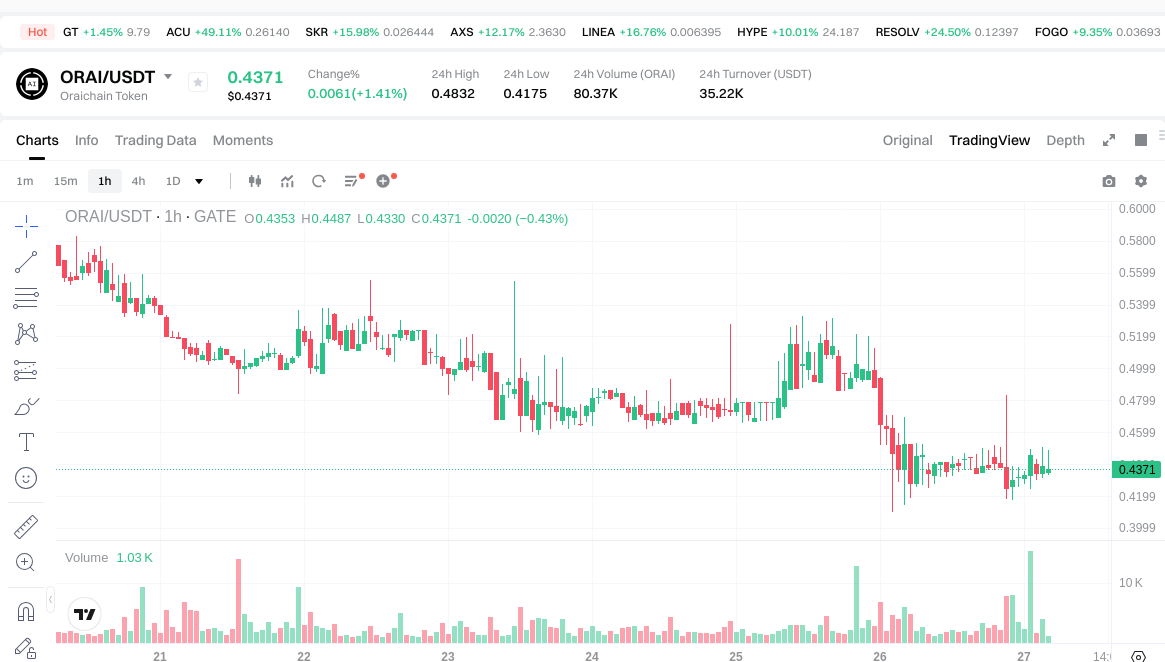
ORAI is a notable asset in the cryptocurrency field. Oraichain serves as a data oracle platform that aggregates and connects AI APIs to smart contracts and conventional applications. As of January 27, 2026, ORAI has a market capitalization of approximately $8.70 million, with a circulating supply of around 19.39 million tokens, and the current price is maintained at approximately $0.4487. With its positioning as a decentralized oracle network validator protection token, ORAI has gradually become a focal point for investors discussing "Is Oraichain Token (ORAI) a good investment?" The token is utilized for validator staking, transaction fees, and participation in Oraichain governance. This article will comprehensively analyze ORAI's investment value, historical trends, future price predictions, and investment risks to provide reference for investors.
I. Oraichain Token (ORAI) Price History Review and Current Investment Value
- February 2021: ORAI reached a notable price level of $105.76 during the early cryptocurrency market expansion phase, representing a period of heightened market enthusiasm for oracle and AI-focused blockchain projects.
- 2021-2026 Period: The token experienced substantial price fluctuations, declining from higher valuation levels to $0.4487 as of January 2026, reflecting broader market corrections and shifts in investor sentiment toward oracle-based infrastructure projects.
- January 2026: ORAI recorded a price range between $0.4142 and $0.4832 within a 24-hour trading period, indicating continued volatility in the current market environment.
Current ORAI Investment Market Status (January 2026)
- Current ORAI Price: $0.4487
- 24-Hour Price Change: -0.41%
- 24-Hour Trading Volume: $35,557.51
- Market Capitalization: $8,698,773.70
- Circulating Supply: 19,386,614 ORAI tokens
- Total Supply: 19,619,751 ORAI tokens
- Maximum Supply: 86,000,000 ORAI tokens
- Market Cap to Fully Diluted Valuation Ratio: 22.54%
- Token Holder Count: 14,185 addresses
- Available Trading Platforms: 6 exchanges
Click to view real-time ORAI market price
II. Core Factors Influencing Whether ORAI is a Good Investment (Is Oraichain Token(ORAI) a Good Investment)
Supply Mechanism and Scarcity (ORAI investment scarcity)
- Supply Design → Influences Price and Investment Value
- Oraichain Token (ORAI) operates with a circulating supply of approximately 19.39 million tokens out of a total supply of 19.62 million, representing a circulation ratio of 22.54%. The maximum supply is capped at 86 million tokens, establishing a defined scarcity model.
- The controlled supply mechanism contributes to the token's economic structure, where limited circulation relative to maximum supply may influence long-term value considerations.
- Investment Perspective: Scarcity frameworks can serve as foundational elements in evaluating long-term investment potential, though market dynamics involve multiple variables beyond supply metrics.
Institutional Investment and Mainstream Adoption (Institutional investment in ORAI)
- Holder Distribution Trends: Data indicates approximately 14,185 holders, suggesting a dispersed ownership structure within the ORAI ecosystem.
- Exchange Presence: ORAI is listed on 6 exchanges, providing accessibility channels for various investor segments.
- Market Share Position: ORAI maintains a market dominance of 0.00028%, reflecting its position within the broader cryptocurrency landscape.
Macroeconomic Environment Impact on ORAI Investment
- Monetary Policy and Interest Rate Changes → Affect Investment Attractiveness
- Shifts in global monetary conditions and interest rate adjustments can influence capital allocation decisions across cryptocurrency assets, including ORAI.
- Evolving regulatory frameworks and policy developments in different jurisdictions may affect the operational environment for blockchain projects.
Technology and Ecosystem Development (Technology & Ecosystem for ORAI investment)
- Oracle AI Technology Integration: Oraichain functions as a data oracle platform that aggregates and connects AI APIs to smart contracts and conventional applications, employing oracle AI technology currently implemented on the yAI.Finance platform.
- Decentralized Oracle Network: The ORAI token serves multiple functions within the ecosystem, including validator staking, transaction fee payments, and participation in Oraichain governance mechanisms.
- Cross-chain Functionality: The token operates across multiple blockchain environments, with a contract address on the Ethereum network (0x4c11249814f11b9346808179cf06e71ac328c1b5), while maintaining its native Oraichain scan infrastructure.
- Ecosystem Applications: The integration of AI-driven oracle services with smart contract functionality represents the project's technical positioning within the decentralized application landscape.
III. ORAI Future Investment Outlook and Price Forecast (Is Oraichain Token(ORAI) worth investing in 2026-2031)
Short-term Investment Outlook (2026, short-term ORAI investment outlook)
Based on available market analysis, ORAI's near-term trading scenarios present varied possibilities. Conservative projections suggest a price range of $0.40269 - $0.43471, reflecting cautious market sentiment. Neutral forecasts indicate potential stabilization around $0.433 - $0.448155, assuming moderate market activity. Optimistic scenarios point toward a range of $0.46331 - $0.59604615, contingent upon favorable market conditions and increased adoption of AI-integrated oracle solutions.
Mid-term Investment Outlook (2027-2029, mid-term Oraichain Token(ORAI) investment forecast)
- Market Stage Expectations: The period between 2027 and 2029 may represent a developmental phase for ORAI, with potential fluctuations driven by broader market dynamics and technological advancements in AI-blockchain integration.
- Investment Return Projections:
- 2027: $0.43471035 - $0.59604615
- 2028: $0.28715531625 - $0.5534266095
- 2029: $0.27963706797 - $0.763624300995
- Key Catalysts: Factors that could influence mid-term performance include developments in decentralized oracle networks, AI API integration expansion, and broader adoption within DeFi ecosystems.
Long-term Investment Outlook (Is ORAI a good long-term investment?)
- Baseline Scenario: $0.344867791709925 - $0.780832735947 (assuming gradual market maturation and steady technological progress)
- Optimistic Scenario: $1.009226311211497 (contingent upon significant ecosystem expansion and favorable regulatory environment)
- Risk Scenario: Below $0.27963706797 (in cases of adverse market conditions or technological challenges)
For detailed ORAI long-term investment and price forecasts: Price Prediction
2026-01-27 - 2031 Long-term Outlook
- Base Scenario: $0.40269 - $0.6506939466225 (corresponding to steady progress and gradual mainstream application growth)
- Optimistic Scenario: $0.71576334128475 - $1.009226311211497 (corresponding to large-scale adoption and favorable market environment)
- Transformative Scenario: Above $1.009226311211497 (if the ecosystem achieves breakthrough developments and mainstream penetration)
- 2031-12-31 Projected High: $1.009226311211497 (based on optimistic development assumptions)
Disclaimer: The above projections are based on statistical models and historical patterns as of January 27, 2026. Actual market performance may differ substantially due to numerous unpredictable factors including regulatory changes, technological developments, market sentiment shifts, and macroeconomic conditions. These forecasts should not be construed as financial advice or guarantees of future performance. Investors should conduct independent research and consider their own risk tolerance before making investment decisions.
| Year |
Predicted High Price |
Predicted Average Price |
Predicted Low Price |
Price Change |
| 2026 |
0.46331 |
0.433 |
0.40269 |
-3 |
| 2027 |
0.59604615 |
0.448155 |
0.43471035 |
0 |
| 2028 |
0.5534266095 |
0.522100575 |
0.28715531625 |
16 |
| 2029 |
0.763624300995 |
0.53776359225 |
0.27963706797 |
19 |
| 2030 |
0.780832735947 |
0.6506939466225 |
0.344867791709925 |
45 |
| 2031 |
1.009226311211497 |
0.71576334128475 |
0.37219693746807 |
59 |
IV. ORAI Investment Strategy and Risk Management (How to invest in Oraichain Token)
Investment Methodology (ORAI investment strategy)
Long-term Holding (HODL ORAI): Suitable for Conservative Investors
Long-term holding remains a viable strategy for investors who believe in Oraichain's fundamental value proposition as a data oracle platform integrating AI APIs with smart contracts. This approach minimizes exposure to short-term price fluctuations and trading costs. Given ORAI's significant price decline of 94.01% over the past year, investors considering this strategy should conduct thorough due diligence on the project's technological development, ecosystem growth, and competitive positioning within the oracle and AI sectors.
Conservative investors pursuing a HODL strategy should consider dollar-cost averaging to mitigate timing risk, particularly given the token's high volatility evidenced by its historical price range from $0.427683 to $105.76.
Active Trading: Technical Analysis and Swing Trading
Active traders may capitalize on ORAI's price volatility, which has shown substantial movement across different timeframes. The 24-hour trading volume of approximately $35,557 indicates moderate liquidity for tactical trading opportunities. Technical traders should monitor key price levels, with recent 24-hour ranges between $0.4142 and $0.4832 providing reference points for support and resistance.
Swing traders should be aware of the token's pronounced bearish trend, with losses of 24.44% over 7 days and 36.51% over 30 days, suggesting careful risk management is essential when establishing positions.
Risk Management (Risk management for ORAI investment)
Asset Allocation Ratios: Conservative / Aggressive / Professional Investors
-
Conservative Investors: Given ORAI's high volatility and substantial year-over-year decline, conservative portfolios should limit exposure to 1-3% of total crypto holdings, with no more than 0.5% of overall investment portfolio allocated to this asset.
-
Aggressive Investors: Those with higher risk tolerance and conviction in Oraichain's long-term potential may allocate 5-10% of their cryptocurrency portfolio to ORAI, while maintaining diversification across multiple blockchain sectors.
-
Professional Investors: Institutional or experienced traders with sophisticated risk management systems may consider higher allocations, but should implement strict stop-loss protocols and position sizing based on volatility metrics.
Investors should implement comprehensive hedging strategies:
-
Portfolio Diversification: Combine ORAI holdings with established cryptocurrencies, stablecoins, and assets from uncorrelated sectors to reduce concentration risk.
-
Hedging Instruments: Consider using derivatives or correlated assets to offset potential downside exposure, particularly given ORAI's high beta characteristics.
-
Rebalancing Protocols: Establish predetermined thresholds for portfolio rebalancing to maintain target allocation percentages and lock in gains during price recoveries.
Secure Storage: Hot/Cold Wallets + Hardware Wallet Recommendations
Proper custody solutions are critical for ORAI holdings:
-
Cold Storage: For long-term holdings, hardware wallets provide optimal security by keeping private keys offline and protected from online threats.
-
Hot Wallets: Maintain only trading amounts in exchange wallets or software wallets for active management, minimizing exposure to platform-related risks.
-
Multi-signature Solutions: For larger holdings, consider multi-signature wallets requiring multiple approvals for transactions, adding an additional security layer.
Investors should also verify the contract address (0x4c11249814f11b9346808179cf06e71ac328c1b5 on Ethereum) when interacting with ORAI tokens to avoid scam tokens.
V. ORAI Investment Risks and Challenges (Risks of investing in Oraichain Token)
Market Risk: High Volatility and Price Manipulation
ORAI exhibits extreme volatility characteristics, as evidenced by its historical price trajectory from an all-time high of $105.76 in February 2021 to a recent low of $0.427683 in January 2026. This represents a decline of over 99% from peak levels, highlighting the substantial market risk inherent in holding this asset.
The token's relatively modest market capitalization of approximately $8.7 million and 24-hour trading volume of around $35,557 suggest limited liquidity compared to major cryptocurrencies. This low liquidity profile increases susceptibility to price manipulation and large slippage during significant transactions. The token's availability on only 6 exchanges further constrains trading depth and price discovery mechanisms.
Investors should be cognizant that such volatility can result in rapid and substantial capital losses, particularly during adverse market conditions or sector-specific downturns affecting oracle or AI-focused blockchain projects.
Regulatory Risk: Policy Uncertainty Across Jurisdictions
As with most cryptocurrency projects, Oraichain faces regulatory uncertainty that varies significantly across different jurisdictions. The integration of artificial intelligence APIs with blockchain technology may attract additional scrutiny from regulators concerned with data privacy, algorithmic transparency, and cross-border data flows.
The evolving regulatory landscape for cryptocurrencies globally presents ongoing challenges:
- Potential classification changes could affect ORAI's legal status and tradability in major markets
- Regulatory actions against oracle services or AI applications in blockchain could impact project viability
- Compliance requirements may increase operational costs and limit geographic expansion
Investors should monitor regulatory developments in their jurisdiction and assess how changes in crypto policy frameworks might affect their ability to hold, trade, or utilize ORAI tokens.
Technical Risk: Network Security Vulnerabilities and Upgrade Failures
Oraichain's infrastructure, which combines oracle services with AI technology, presents multiple technical risk vectors:
-
Smart Contract Vulnerabilities: The platform's smart contract architecture may contain undiscovered security flaws that could be exploited, potentially resulting in loss of funds or network disruption.
-
Oracle Reliability: As a data oracle platform, the accuracy and tamper-resistance of data feeds are critical. Failures in oracle mechanisms could undermine trust in the platform and affect dependent applications.
-
Network Upgrades: Protocol upgrades and technical implementations carry execution risk. Failed upgrades or contentious forks could fragment the community and negatively impact token value.
-
Dependency Risks: Integration with external AI APIs creates dependencies on third-party services, introducing potential points of failure or performance degradation.
The relatively small holder base of 14,185 addresses suggests limited network effect and potentially constrained developer activity, which may impact the project's ability to address technical challenges promptly.
VI. Conclusion: Is Oraichain Token a Good Investment?
Investment Value Summary
ORAI presents a high-risk, high-reward investment profile characterized by significant technological ambition in combining oracle services with artificial intelligence capabilities. However, the token's performance metrics indicate substantial challenges, with a 94.01% decline over the past year and persistent downward pressure across multiple timeframes.
The project's focus on AI-driven oracle solutions addresses a potentially valuable niche in the blockchain ecosystem, but faces intense competition from established oracle providers and emerging AI-blockchain integration projects. The limited circulating supply of 19.39 million tokens (22.54% of maximum supply) could theoretically provide upside potential if demand increases, though current market dynamics suggest weak investor sentiment.
Investor Recommendations
✅ Beginners: New cryptocurrency investors should approach ORAI with significant caution. If considering exposure, implement strict dollar-cost averaging strategies with minimal allocation percentages, and prioritize secure storage using hardware wallets. Beginners should thoroughly research the oracle and AI sectors before committing capital.
✅ Experienced Investors: Those with crypto market experience may consider ORAI for tactical trading opportunities based on technical analysis, maintaining strict stop-loss disciplines and position sizing appropriate to the asset's volatility profile. Portfolio allocation should remain conservative, balanced with more established digital assets and hedged through diversification strategies.
✅ Institutional Investors: Professional investors with sophisticated risk management frameworks might evaluate ORAI within a broader thesis on oracle infrastructure and AI-blockchain convergence. Any strategic allocation should be supported by comprehensive due diligence on project fundamentals, competitive positioning, and long-term viability, while maintaining appropriate hedging strategies.
⚠️ Disclaimer: Cryptocurrency investments carry substantial risk of loss. The information presented in this analysis is for educational purposes only and does not constitute financial, investment, or trading advice. ORAI's extreme volatility and significant historical decline indicate elevated risk levels. Investors should conduct independent research, assess their risk tolerance, and consider consulting with qualified financial advisors before making investment decisions. Past performance does not guarantee future results.
VII. FAQ
Q1: What is ORAI and what makes it different from other oracle projects?
ORAI is the native token of Oraichain, a decentralized data oracle platform that uniquely integrates AI APIs with smart contracts and conventional applications. Unlike traditional oracle solutions, Oraichain specifically focuses on bridging artificial intelligence capabilities with blockchain technology, enabling smart contracts to access AI-powered data feeds and computational services. The token serves multiple functions including validator staking, transaction fee payments, and participation in governance decisions within the Oraichain ecosystem.
Q2: Is ORAI a good investment for beginners in 2026?
ORAI presents significant risks for beginners and should be approached with extreme caution. The token has experienced a 94.01% decline over the past year and exhibits high volatility with a 24-hour price range between $0.4142 and $0.4832. New investors considering ORAI should limit exposure to 1-3% of their total crypto holdings, implement dollar-cost averaging strategies to mitigate timing risk, and prioritize secure storage using hardware wallets. Comprehensive research into oracle technology and AI-blockchain integration is essential before committing capital.
Q3: What are the main risks associated with investing in ORAI?
ORAI carries three primary risk categories. First, market risk is evidenced by extreme volatility and a 99% decline from its all-time high of $105.76, combined with limited liquidity ($35,557 daily trading volume) that increases susceptibility to price manipulation. Second, regulatory uncertainty affects AI-blockchain integration projects, with potential policy changes impacting token utility and tradability. Third, technical risks include smart contract vulnerabilities, oracle reliability concerns, and dependencies on external AI APIs that could compromise network performance or security.
Q4: What is ORAI's price prediction for 2026-2031?
Based on statistical models and market analysis, ORAI's price projections vary significantly across scenarios. For 2026, conservative estimates suggest a range of $0.40269-$0.43471, while optimistic scenarios point toward $0.46331-$0.59604615. Long-term projections for 2031 indicate a base scenario of $0.37219693-$0.71576334, with optimistic forecasts reaching $1.009226311. However, these predictions should not be construed as guarantees, as actual performance depends on numerous unpredictable factors including technological developments, regulatory changes, and broader market conditions.
Q5: How should I store my ORAI tokens securely?
Secure storage of ORAI tokens requires a multi-layered approach. For long-term holdings, hardware wallets provide optimal security by keeping private keys offline and protected from online threats. Maintain only active trading amounts in exchange wallets or software wallets to minimize exposure to platform-related risks. For larger holdings, consider multi-signature solutions requiring multiple approvals for transactions. Always verify the contract address (0x4c11249814f11b9346808179cf06e71ac328c1b5 on Ethereum) when interacting with ORAI tokens to avoid scam tokens, and implement regular security audits of your storage solutions.
Q6: What factors could drive ORAI's price higher in the future?
Several catalysts could potentially influence ORAI's upward price movement. Expansion of the AI-blockchain integration ecosystem and increased adoption of Oraichain's oracle services within DeFi applications could enhance token utility and demand. Technological advancements in AI API integration, improvements in oracle network security, and successful implementation of cross-chain functionality may strengthen investor confidence. Additionally, broader market recovery in the cryptocurrency sector, favorable regulatory developments for oracle projects, and strategic partnerships with major blockchain platforms could provide positive momentum. However, investors should recognize that these factors remain speculative and subject to significant uncertainty.
Q7: How does ORAI's tokenomics affect its investment potential?
ORAI operates with a circulating supply of approximately 19.39 million tokens out of a maximum supply capped at 86 million, representing a circulation ratio of 22.54%. This controlled supply mechanism establishes a defined scarcity model that could theoretically support long-term value appreciation if demand increases. The token's distribution across 14,185 holders suggests a dispersed ownership structure, which may reduce concentration risk but also indicates limited network effects compared to more widely adopted projects. The significant gap between circulating and maximum supply means future token releases could create selling pressure, making it essential for investors to monitor emission schedules and their potential impact on price dynamics.
Q8: What trading strategies are suitable for ORAI given its volatility?
Given ORAI's extreme volatility and bearish trend (24.44% loss over 7 days, 36.51% over 30 days), traders should implement disciplined strategies. Long-term holders (HODL approach) should employ dollar-cost averaging to mitigate timing risk and maintain strict position sizing limits within diversified portfolios. Active traders may capitalize on price swings using technical analysis, monitoring key support and resistance levels within recent ranges ($0.4142-$0.4832), while implementing rigorous stop-loss protocols to protect capital. Swing traders should focus on shorter timeframes to manage exposure, given the token's pronounced downward momentum. All strategies require comprehensive risk management, including hedging through portfolio diversification, position sizing based on volatility metrics, and predetermined rebalancing thresholds to maintain target allocations.
* The information is not intended to be and does not constitute financial advice or any other recommendation of any sort offered or endorsed by Gate.