This comprehensive analysis evaluates whether Orbler (ORBR) is a good investment for 2026-2031. ORBR is a play-to-earn gaming token operating on Ethereum with a current market cap of $45.47 million and trading at $0.04477. The article examines ORBR's price history, showing significant volatility from its $44.91 peak in April 2022, alongside core investment factors including tokenomics, ecosystem development, and market adoption metrics. Short-term price forecasts range from $0.029-$0.065, while long-term projections extend to $0.148 by 2031 under optimistic scenarios. The analysis emphasizes substantial risks including market volatility (-80.56% annually), limited liquidity ($12,885 daily volume), and regulatory uncertainties in blockchain gaming. Investment recommendations stratify by investor type, with conservative allocation of 1-2% portfolio exposure advised for beginners, while experienced investors may employ diversified gaming token strategies. The token presents high-risk, speculative opportunities p
Introduction: Orbler (ORBR) Investment Position and Market Prospects
ORBR is a cryptocurrency asset in the digital asset space, designed as the native token for Orbler, a real-time defense blockchain game accessible to global players. As of January 19, 2026, ORBR holds a market capitalization of approximately $45.47 million, with a circulating supply of around 1.02 billion tokens. The current trading price stands at approximately $0.04477, representing a market share of 0.0027% in the cryptocurrency ecosystem. Positioned as a Play-to-Earn (P2E) gaming token, ORBR has become a subject of discussion among investors evaluating "Is Orbler (ORBR) a good investment?" This article provides a comprehensive analysis of ORBR's investment characteristics, historical price movements, future price projections, and associated risks to serve as a reference for potential investors.
ORBR operates within the blockchain gaming sector, where players engage with NFT-based dragons (Orbler) and upgradeable Orbs featuring unique elements, levels, and skills. The token facilitates in-game mechanics for both player-versus-player (PVP) and player-versus-environment (PVE) battles. With a total supply capped at 2 billion tokens and approximately 50.78% currently in circulation, ORBR's tokenomics reflect a structured distribution model. The project's early-stage funding rounds included seed rounds at $0.008, private rounds at $0.01, and a public offering at $0.025, establishing initial valuation benchmarks.
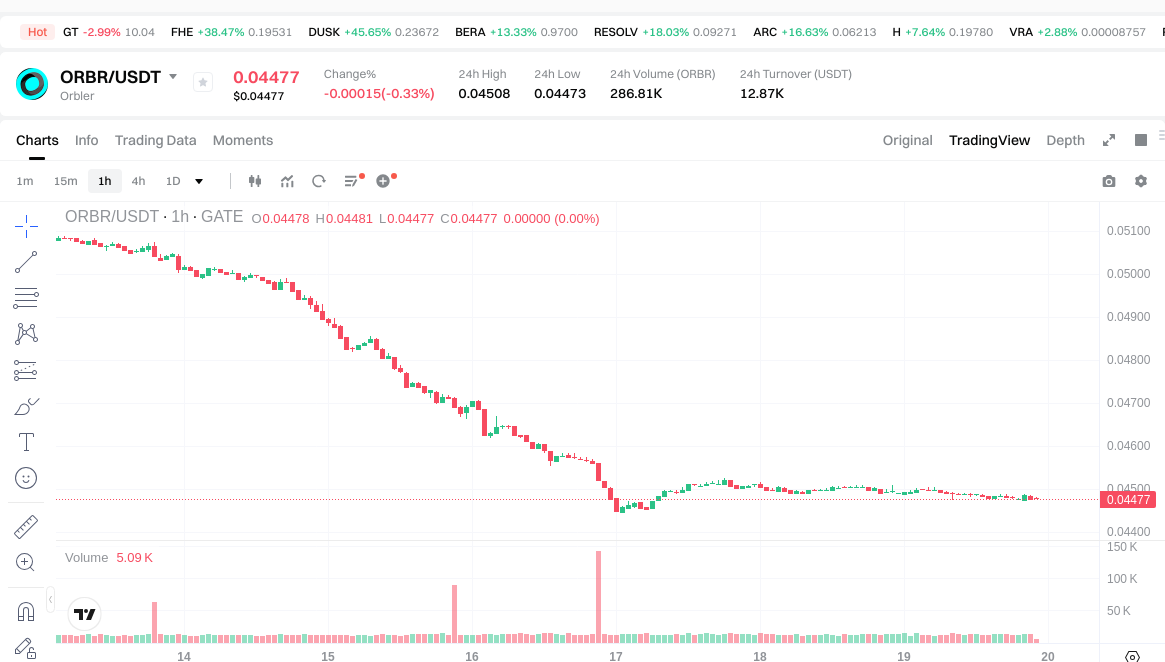
Recent market data indicates ORBR has experienced notable price fluctuations, with a 24-hour trading volume of approximately $12,885 and price changes of -0.31% over 24 hours, -11.93% over 7 days, and -31.11% over 30 days. The token is deployed on the Ethereum blockchain as an ERC-20 token, with its contract address verified on Etherscan. With 760 holders recorded and trading availability on one exchange platform, ORBR demonstrates a developing but concentrated user base within the blockchain gaming community.
I. Orbler (ORBR) Price History Review and Current Investment Status
- 2022: On April 10, ORBR reached a price level of $44.91, marking a notable phase in its market trajectory → Early-stage participants experienced considerable price appreciation during this period
- 2025: The token has undergone significant price adjustment → ORBR traded around $0.04477 as of January 19, 2026, reflecting substantial volatility from previous levels
- Market Cycle Evolution: The asset has experienced price fluctuations → From elevated price points in 2022 to subsequent consolidation phases, demonstrating characteristic crypto market cyclicality
Current ORBR Investment Market Status (January 2026)
- ORBR current price: $0.04477 (as of January 19, 2026)
- 24-hour trading volume: $12,885.10
- Market capitalization: $45,467,818.80
- Circulating supply: 1,015,586,750 ORBR (50.78% of total supply)
- Total supply: 2,000,000,000 ORBR
- Token holder count: 760 addresses
Click to view real-time ORBR market price
II. Core Factors Affecting Whether ORBR is a Good Investment (Is Orbler(ORBR) a Good Investment)
Supply Mechanism and Scarcity (ORBR investment scarcity)
- Maximum supply capped at 2,000,000,000 ORBR → influences price dynamics and investment value
- Current circulating supply of 1,015,586,750 ORBR represents approximately 50.78% of total supply → moderate scarcity level
- Historical context: ORBR reached a previous peak of $44.91 in April 2022, while recording a low of $0.04375621 in December 2025
- Investment significance: the fixed maximum supply mechanism provides a degree of scarcity that could support long-term investment considerations
Institutional Investment and Mainstream Adoption (Institutional investment in ORBR)
- Holder count: 760 addresses currently hold ORBR tokens → reflects limited adoption scale
- Exchange availability: ORBR is listed on 1 exchange platform → indicates modest liquidity channels
- Market capitalization ranking at #558 with $45,467,818.80 market cap → positions ORBR as a mid-to-lower tier digital asset
- Trading volume of $12,885.10 in 24 hours → suggests relatively modest market activity
Macroeconomic Environment's Impact on ORBR Investment
- Market performance: ORBR declined 0.31% in 24 hours, 11.93% over 7 days, and 31.11% over 30 days → reflects near-term downward pressure
- Annual performance: 80.56% decline over the past year → indicates significant volatility and risk factors
- Market share: 0.0027% of total crypto market → demonstrates limited market presence
- Price volatility range: 24-hour high of $0.04508 and low of $0.04473 → shows active price fluctuations
Technology and Ecosystem Development (Technology & Ecosystem for ORBR investment)
- Blockchain infrastructure: ORBR operates as an ERC-20 token on the Ethereum network (contract address: 0xdA30f261a962d5AAe94C9ecd170544600d193766)
- Gaming ecosystem: Orbler is a real-time defense blockchain game where players can enjoy PVP and PVE battles → provides utility-driven value proposition
- NFT integration: features upgradeable Orbler dragon NFTs and ORB elements with unique grades, skills, and elemental values → enhances gameplay mechanics and potential token utility
- Strategic gameplay: players must carefully select orbs for their decks, utilizing elemental synergies → creates engagement-driven demand for ORBR tokens
III. ORBR Future Investment Outlook and Price Forecast (Is Orbler(ORBR) worth investing in 2026-2031)
Short-term Investment Outlook (2026, short-term ORBR investment outlook)
Based on available market data and technical analysis signals, the short-term outlook for ORBR presents the following scenarios:
- Conservative forecast: $0.029 - $0.045
- Neutral forecast: $0.045 - $0.055
- Optimistic forecast: $0.055 - $0.065
Technical indicators currently show bearish signals across multiple timeframes, with SMA indicators suggesting selling pressure. The 24-hour trading volume stands at approximately $12,885, indicating relatively limited market activity. Recent price movements show a decline of 0.31% in 24 hours and 11.93% over the past 7 days, reflecting near-term volatility.
Mid-term Investment Forecast (2027-2029, mid-term Orbler(ORBR) investment forecast)
-
Market stage expectation: The mid-term period may witness gradual ecosystem development as the project continues to establish its position within the blockchain gaming sector. Market sentiment and broader crypto market conditions will likely influence price trajectories.
-
Investment return projection:
- 2027: $0.048 - $0.078
- 2028: $0.042 - $0.096
- 2029: $0.071 - $0.087
-
Key catalysts: Potential catalysts include expansion of the user base in the play-to-earn gaming segment, enhancements to NFT utility within the Orbler ecosystem, and broader adoption of blockchain gaming platforms. Market recovery phases and increased trading volume could also serve as positive drivers.
Long-term Investment Outlook (Is ORBR a good long-term investment?)
- Base scenario: $0.061 - $0.116 (assumes steady ecosystem growth and sustained user engagement in blockchain gaming)
- Optimistic scenario: $0.076 - $0.148 (assumes accelerated adoption, favorable market conditions, and successful implementation of platform upgrades)
- Risk scenario: Below $0.029 (under conditions of prolonged market downturn, limited user growth, or increased competitive pressure)
For more details on ORBR long-term investment and price predictions: Price Prediction
2026-01-19 to 2031 Long-term Outlook
- Base scenario: $0.06 - $0.10 USD (corresponding to steady progress and gradual mainstream application growth)
- Optimistic scenario: $0.10 - $0.15 USD (corresponding to large-scale adoption and favorable market environment)
- Transformative scenario: Above $0.15 USD (if the ecosystem achieves breakthrough developments and mainstream adoption)
- 2031-12-31 predicted high: $0.148 USD (based on optimistic development assumptions)
Disclaimer: The forecasts provided are based on historical data, technical analysis, and market trends available as of January 19, 2026. Cryptocurrency markets are highly volatile and subject to numerous unpredictable factors. These projections should not be considered as financial advice or guarantees of future performance. Past performance does not indicate future results. Investors should conduct their own research and consult with financial professionals before making investment decisions.
| Year |
Predicted High Price |
Predicted Average Price |
Predicted Low Price |
Price Change |
| 2026 |
0.064931 |
0.04478 |
0.029107 |
0 |
| 2027 |
0.07789481 |
0.0548555 |
0.04827284 |
22 |
| 2028 |
0.0955802232 |
0.066375155 |
0.0424800992 |
48 |
| 2029 |
0.086646127337 |
0.0809776891 |
0.071260366408 |
80 |
| 2030 |
0.116498552423715 |
0.0838119082185 |
0.061182692999505 |
87 |
| 2031 |
0.148229740875239 |
0.100155230321107 |
0.076117975044041 |
123 |
IV. ORBR Investment Strategy and Risk Management (How to invest in blockchain gaming tokens)
Investment Methodology (ORBR investment strategy)
-
Long-term Holding (HODL ORBR): Suitable for conservative investors who believe in the long-term development potential of blockchain gaming and play-to-earn (P2E) models. This strategy requires patience through market volatility cycles.
-
Active Trading: Relies on technical analysis and swing trading operations. Traders may monitor price movements within identified support ($0.04375) and resistance levels, utilizing market sentiment indicators and volume patterns to execute short-term positions.
Risk Management (Risk management for ORBR investment)
V. ORBR Investment Risks and Challenges (Risks of investing in blockchain gaming tokens)
-
Market Risk: ORBR demonstrates substantial price volatility, with recent declines of 11.93% (7D), 31.11% (30D), and 80.56% (1Y). The token has experienced significant drawdowns from its previous levels, indicating high-volatility characteristics common in gaming tokens.
-
Regulatory Risk: Blockchain gaming and P2E models face evolving regulatory frameworks across different jurisdictions. Policy uncertainty regarding gaming tokens, NFT classifications, and play-to-earn mechanics may impact project operations and token utility.
-
Technical Risk:
- Smart contract vulnerabilities on Ethereum network
- Game development and update execution risks
- NFT integration technical challenges
- Platform security considerations with limited holder base (760 holders)
-
Liquidity Risk: With a relatively modest 24-hour trading volume of $12,885 and circulation on limited exchanges, liquidity constraints may affect order execution and price stability during volatile periods.
-
Gaming Sector Risk: Competitive landscape in blockchain gaming space, player retention challenges, and evolving gaming preferences may affect long-term adoption and token utility.
VI. Conclusion: Is blockchain gaming token a Good Investment?
-
Investment Value Summary: ORBR represents exposure to the blockchain gaming and P2E sector, with unique tower defense gameplay mechanics and NFT integration features. The token shows characteristics of early-stage gaming projects, with considerable price volatility and developing ecosystem metrics. The circulating supply represents approximately 50.78% of maximum supply (1,015,586,750 of 2,000,000,000 tokens).
-
Investor Recommendations:
✅ Beginners: Consider small position sizing with dollar-cost averaging approach; prioritize secure wallet storage solutions compatible with ERC-20 tokens; conduct thorough research on gaming mechanics and tokenomics before allocation.
✅ Experienced Investors: May employ swing trading strategies based on technical analysis; implement portfolio diversification across multiple gaming tokens; monitor game development progress and community engagement metrics.
✅ Institutional Investors: Evaluate as part of broader blockchain gaming sector exposure; consider limited liquidity factors in position sizing; assess long-term gaming industry trends and competitive positioning.
⚠️ Disclaimer: Cryptocurrency investments carry substantial risk, particularly in emerging sectors like blockchain gaming. This content is for informational purposes only and does not constitute investment advice. Investors should conduct independent research and consider their risk tolerance before making investment decisions.
VII. FAQ
Q1: Is Orbler (ORBR) a good investment for 2026?
ORBR presents a high-risk, speculative investment opportunity primarily suited for risk-tolerant investors familiar with blockchain gaming tokens. With a current market cap of $45.47 million and significant recent declines (-80.56% annually), the token demonstrates considerable volatility characteristic of early-stage gaming projects. The investment thesis depends heavily on the play-to-earn gaming sector's growth trajectory and the project's ability to expand its user base beyond the current 760 token holders. Conservative investors should limit exposure to 1-2% of their portfolio, while those with higher risk tolerance might allocate up to 5-10%. The token's utility within the Orbler tower defense gaming ecosystem provides fundamental value, but limited liquidity ($12,885 24H volume) and exchange availability (1 platform) pose execution challenges for larger positions.
Q2: What are the main risks associated with investing in ORBR?
ORBR carries multiple investment risks that require careful consideration. Market risk remains primary, evidenced by dramatic price fluctuations from $44.91 in April 2022 to the current $0.04477 level, representing severe drawdowns. Liquidity risk is substantial with modest daily trading volume and limited exchange listings, potentially causing slippage during entry or exit. Regulatory uncertainty surrounding play-to-earn models and NFT classifications across jurisdictions poses policy-related threats. Technical vulnerabilities inherent in smart contracts on the Ethereum network, coupled with game development execution risks, create operational concerns. Additionally, the competitive blockchain gaming landscape and challenges in sustaining player engagement present sector-specific risks that could impact long-term token utility and demand.
Q3: How does ORBR's tokenomics affect its investment potential?
ORBR's tokenomics structure features a maximum supply capped at 2 billion tokens, with approximately 1.02 billion tokens (50.78%) currently in circulation, establishing a moderate scarcity framework. The distribution model included seed rounds at $0.008, private rounds at $0.01, and public offerings at $0.025, creating various entry price points for early participants. This fixed supply mechanism theoretically provides deflationary pressure as adoption increases, though the remaining 49.22% of uncirculated tokens represents potential future supply that could influence price dynamics. The token's utility within the gaming ecosystem—facilitating PVP and PVE battles, NFT upgrades, and strategic gameplay mechanics—provides fundamental demand drivers beyond speculative trading. However, with only 760 holders and limited exchange availability, the realized network effects remain constrained, suggesting that tokenomics alone cannot drive value without corresponding ecosystem growth and user adoption.
Q4: What price levels should investors monitor for ORBR in the short term?
Technical analysis suggests several critical price levels for ORBR monitoring in 2026. The immediate support zone sits around $0.04375, representing the recorded low from December 2025, which serves as a psychological floor for near-term price action. Resistance appears at $0.055-$0.065 based on recent consolidation patterns and neutral-to-optimistic forecasts. The 24-hour trading range of $0.04473 to $0.04508 indicates tight current volatility, though broader timeframes show more substantial movements. Bearish SMA indicators across multiple timeframes suggest caution for immediate entries. For swing trading strategies, investors might consider accumulation zones near $0.029-$0.045 (conservative forecast range) while monitoring volume expansion as a confirmation signal. Exit targets could be positioned at $0.055-$0.065 (optimistic short-term range), though limited liquidity necessitates careful order sizing to minimize market impact.
Q5: How does ORBR compare to other blockchain gaming tokens as an investment?
ORBR occupies a niche position within the blockchain gaming sector, ranking #558 by market capitalization with a relatively modest $45.47 million valuation. This places it in the small-cap gaming token category, contrasting with larger gaming tokens that command hundreds of millions in market cap. The token's play-to-earn mechanics and tower defense gameplay differentiate it from standard gaming tokens, offering unique NFT-based dragon characters and upgradeable ORB elements. However, its limited holder base (760 addresses) and single exchange listing represent constraints compared to more widely distributed gaming tokens with multi-platform availability. The project's focus on real-time strategy gameplay targeting global audiences provides potential differentiation, though competitive pressures from established gaming tokens with larger communities and development resources remain significant. Investment consideration should weigh ORBR's specialized gaming niche and early-stage positioning against its limited liquidity and market penetration relative to sector leaders.
Q6: What catalysts could drive ORBR price appreciation in 2027-2029?
Several potential catalysts could influence ORBR's mid-term price trajectory between 2027-2029, with forecasts ranging from $0.042 to $0.096 depending on scenario outcomes. Primary drivers include expansion of the play-to-earn gaming user base, particularly if blockchain gaming achieves broader mainstream adoption beyond current crypto-native audiences. Enhanced NFT utility within the Orbler ecosystem—such as new dragon types, expanded upgrade mechanics, or cross-platform integration—could increase token demand and retention. Strategic partnerships with gaming platforms or integration into larger gaming metaverses would expand distribution channels beyond the current single exchange listing. Technical improvements to gameplay mechanics, reduced transaction costs on Ethereum, or potential Layer 2 integration could enhance user experience and reduce friction. Market recovery phases in the broader cryptocurrency sector typically benefit gaming tokens, potentially driving renewed interest and capital inflows. Community growth metrics, measured through holder expansion beyond current 760 addresses and increased trading volumes, would signal strengthening network effects supporting valuation appreciation.
Q7: What storage solutions are recommended for ORBR tokens?
ORBR token storage strategy should align with investment timeframe and trading activity patterns. For long-term holders employing HODL strategies, hardware wallets compatible with ERC-20 tokens provide optimal security, given ORBR's Ethereum-based contract address (0xdA30f261a962d5AAe94C9ecd170544600d193766). Cold storage solutions minimize exposure to online vulnerabilities while maintaining full custody control. Active traders requiring frequent access may utilize hot wallets on supported exchanges for trading portions, though this introduces custodial risks and requires trust in platform security measures. A hybrid approach—maintaining core holdings in hardware wallets while keeping smaller trading allocations in exchange wallets—balances security with operational flexibility. Given the limited number of holders (760) and modest trading volumes, investors should verify exchange security credentials and withdrawal processes before significant allocations. Software wallets supporting ERC-20 tokens offer middle-ground solutions with enhanced security over exchange custody while maintaining reasonable accessibility, particularly suitable for medium-term holders who may need occasional liquidity access.
Q8: Should institutional investors consider ORBR for portfolio allocation?
Institutional consideration of ORBR requires evaluation within broader blockchain gaming sector exposure strategies rather than as a standalone allocation. The token's small market cap ($45.47 million), limited liquidity ($12,885 daily volume), and single exchange listing present operational challenges for institutional position sizes, potentially causing significant market impact during entry or exit. However, as part of a diversified gaming token basket strategy, ORBR's specialized tower defense mechanics and NFT integration offer differentiated exposure to play-to-earn subsectors. Institutional investors might approach ORBR through venture-style allocation frameworks, recognizing its early-stage characteristics and corresponding risk-return profile. Position sizing should account for liquidity constraints—likely limiting allocations to amounts that represent minimal daily volume multiples to ensure orderly execution. Due diligence should emphasize game development progress, user retention metrics, competitive positioning analysis, and regulatory compliance across operational jurisdictions. The 49.22% unlocked token supply warrants monitoring for potential dilution impacts. Institutions with gaming sector specialization or broader blockchain ecosystem mandates may find strategic value, while generalist funds might prioritize more liquid gaming token alternatives with established market presence and deeper order books.
* The information is not intended to be and does not constitute financial advice or any other recommendation of any sort offered or endorsed by Gate.