This comprehensive analysis evaluates whether Orbs (ORBS) represents a viable investment opportunity in 2024-2026. As a hybrid commercial public chain utilizing rPoS consensus protocol, Orbs addresses blockchain scalability challenges for mainstream consumer applications in payments, gaming, and social platforms. The article examines ORBS token fundamentals including its $51.5 million market capitalization, current price of $0.010526, and historical volatility ranging from $0.00469 to $0.360. Investors will discover detailed investment strategies for conservative, aggressive, and professional participants, complemented by multi-year price forecasts through 2031 and comprehensive risk assessments covering market volatility, regulatory uncertainty, and technical vulnerabilities. The analysis provides critical insights into token supply dynamics, ecosystem development, and hedging solutions on Gate exchange, enabling informed investment decisions aligned with individual risk tolerance and financial objectives.
Introduction: Orbs (ORBS) Investment Position and Market Prospects
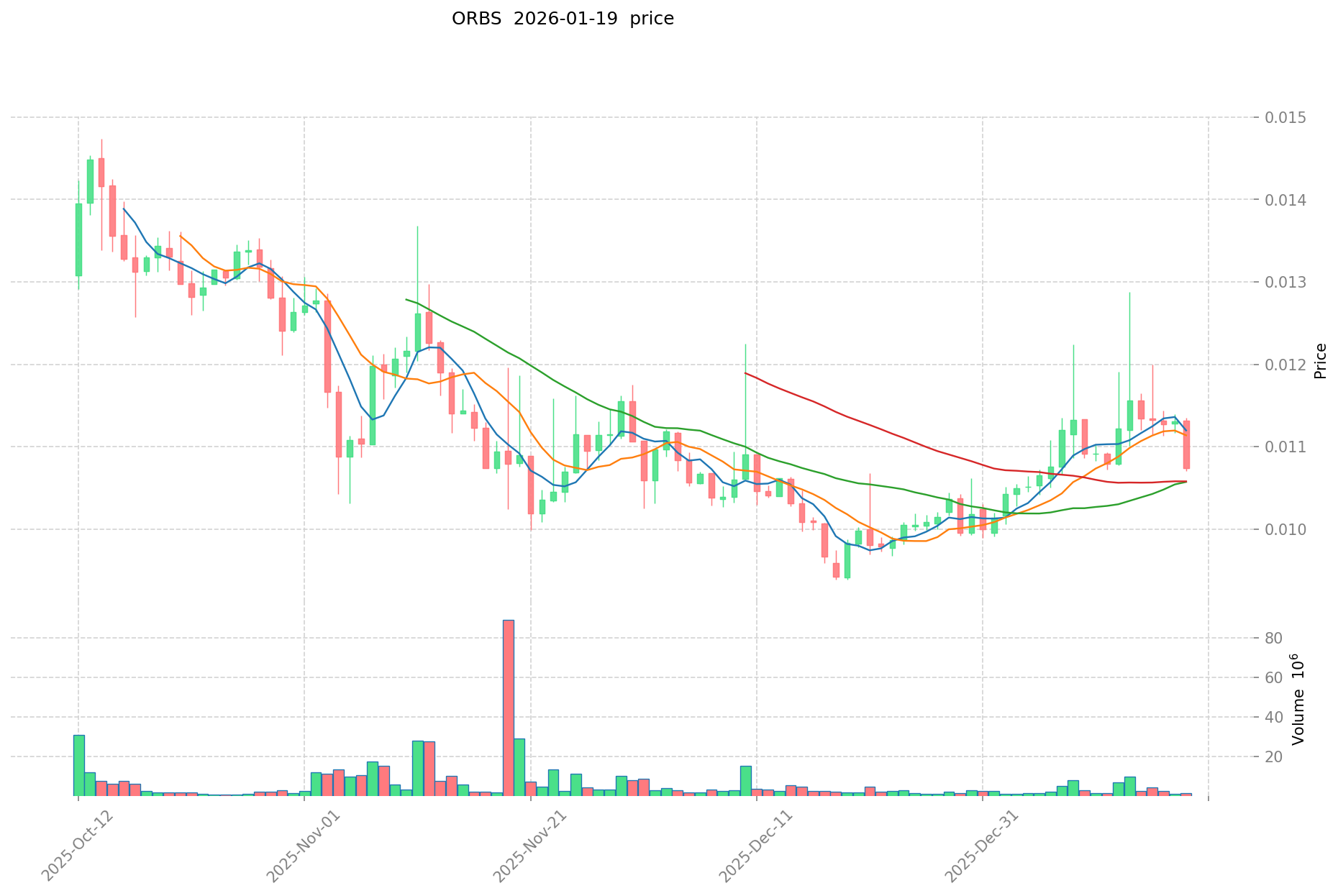
Orbs (ORBS) represents a significant asset in the cryptocurrency landscape, serving as a decentralized blockchain infrastructure designed to support mainstream applications across various sectors. As of January 19, 2026, Orbs maintains a market capitalization of approximately 51.50 million USD, with a circulating supply of around 4.89 billion tokens. The current trading price stands at approximately 0.010526 USD, reflecting recent market dynamics including a 6.81% increase over the past 30 days, though experiencing a 5.83% decline in the last 24 hours. With its positioning as a hybrid commercial public chain that implements the rPoS consensus protocol, Orbs has established itself within the blockchain infrastructure sector, addressing scalability challenges for decentralized applications. The project holds rank 515 in the cryptocurrency market, commanding a market share of 0.0032% and maintaining a circulating supply ratio of approximately 48.92% of its total supply of 10 billion tokens. Since its launch in April 2019, Orbs has experienced notable price volatility, reaching a peak of 0.360443 USD on March 16, 2021, while recording a low of 0.00469039 USD in December 2019. This article provides a comprehensive analysis of Orbs' investment attributes, historical performance patterns, future price considerations, and associated risk factors to assist investors in evaluating whether Orbs (ORBS) aligns with their investment strategies.
I. Orbs (ORBS) Price History Review and Current Investment Value Status
- 2021: Price reached elevated levels during the cryptocurrency market expansion → Investors experienced significant fluctuations in portfolio valuation
- 2018-2019: Project launch and initial market entry → ORBS token initiated trading activities with baseline price establishment
- 2019-2026: Multi-year market cycle → Price movement from peak trading levels to current range around $0.010526
Current ORBS Investment Market Status (January 2026)
- ORBS current price: $0.010526
- Market sentiment (Fear & Greed Index): Not provided in available materials
- 24-hour trading volume: $22,677.27
- Institutional investor holdings: Data indicates approximately 8,899 holders with circulating supply of 4.89 billion tokens
Click to view real-time ORBS market price
II. Core Factors Affecting Whether ORBS is a Good Investment
Supply Mechanism and Scarcity (ORBS Investment Scarcity)
- Total Supply: 10 billion ORBS tokens with a maximum supply cap of 10 billion tokens → fixed supply structure may influence long-term value dynamics
- Circulating Supply: approximately 4.89 billion tokens (48.92% of total supply) as of January 19, 2026 → significant portion remains non-circulating, which could affect future supply dynamics
- Historical Price Range: ORBS has traded between $0.00469039 (December 20, 2019) and $0.360443 (March 16, 2021), demonstrating substantial volatility in its price history
- Investment Consideration: The fixed maximum supply of 10 billion tokens provides a defined scarcity model, though nearly half of the total supply remains outside current circulation
Institutional Investment and Mainstream Adoption (Institutional Investment in ORBS)
- Holder Base: approximately 8,899 holders as of January 2026, indicating a relatively modest community size for a project launched in 2019
- Exchange Availability: listed on 15 exchanges, providing multiple access points for investors
- Mainstream Adoption: Orbs positions itself as blockchain infrastructure designed for established consumer brands and their business requirements, though specific enterprise partnership details are not extensively documented in available materials
Macroeconomic Environment's Impact on ORBS Investment
- Market Performance: ORBS has experienced significant price volatility, with a 1-year decline of 63.23% as of January 19, 2026, reflecting broader market pressures
- Market Capitalization: $51.50 million (ranked #515 in the crypto market), representing a micro-cap classification that may exhibit heightened sensitivity to macroeconomic conditions
- Trading Volume: 24-hour trading volume of approximately $22,677 suggests moderate liquidity levels
- Market Share: 0.0032% of total cryptocurrency market capitalization, indicating limited market presence relative to larger digital assets
Technology and Ecosystem Development (Technology & Ecosystem for ORBS Investment)
- Technical Architecture: Orbs operates as a hybrid commercial public chain utilizing the rPoS (randomized Proof-of-Stake) consensus protocol, designed to provide high security and decentralization with fewer nodes
- Scalability Solutions: The platform assigns dedicated channels to each decentralized application (dApp), intended to help developers avoid errors and overloads while maintaining focus on application development
- Cross-Chain Functionality: ORBS tokens can be traded on the Ethereum network (contract address: 0xff56cc6b1e6ded347aa0b7676c85ab0b3d08b0fa), providing interoperability with the Ethereum ecosystem
- Target Use Cases: The project aims to support mainstream applications in payments, social platforms, gaming, and online advertising sectors, though specific implementation examples are not extensively detailed in available materials
- Development Activity: GitHub repository available at orbs-network/nebula, though specific metrics on development activity and recent upgrades are not provided in the reference materials
III. ORBS Future Investment Forecast and Price Outlook (Is Orbs(ORBS) worth investing in 2026-2031)
Short-term Investment Forecast (2026, short-term ORBS investment outlook)
- Conservative forecast: $0.0084256 - $0.010532
- Neutral forecast: $0.0095 - $0.011
- Optimistic forecast: $0.011 - $0.01137456
Mid-term Investment Outlook (2027-2029, mid-term Orbs(ORBS) investment forecast)
-
Market stage expectation: The mid-term period may witness gradual development influenced by global digital currency regulatory dynamics and technological progress in the sector. Price movements are anticipated to reflect moderate growth patterns, with potential fluctuations based on market conditions and ecosystem developments.
-
Investment return forecast:
- 2027: $0.0084340256 - $0.0118295424
- 2028: $0.008999214848 - $0.01196098176
- 2029: $0.0080565755712 - $0.013427625952
-
Key catalysts: Global regulatory developments, technological advancements in the blockchain infrastructure sector, and broader market sentiment toward decentralized applications and scalability solutions.
Long-term Investment Outlook (Is ORBS a good long-term investment?)
- Base scenario: $0.012 - $0.014 (assuming steady ecosystem development and maintained market position)
- Optimistic scenario: $0.018 - $0.019 (assuming favorable regulatory environment and increased adoption)
- Risk scenario: $0.008 - $0.010 (under adverse market conditions or increased competition)
Click to view ORBS long-term investment and price forecast: Price Prediction
2026-2031 Long-term Outlook
- Base scenario: $0.010532 - $0.01330502588896 USD (corresponding to steady progress and gradual mainstream application enhancement)
- Optimistic scenario: $0.01405814056192 - $0.018627036244544 USD (corresponding to large-scale adoption and favorable market environment)
- Transformative scenario: Above $0.019 USD (in case of breakthrough ecosystem developments and mainstream adoption)
- 2031-12-31 projected high: $0.018627036244544 USD (based on optimistic development assumptions)
Disclaimer: The forecasts presented are based on analysis of available market data and predictive models. Cryptocurrency markets are highly volatile and subject to numerous unpredictable factors. These projections should not be considered as financial advice or guarantees of future performance. Market conditions, regulatory changes, technological developments, and other variables may significantly impact actual outcomes. Investors should conduct their own research and consider their risk tolerance before making investment decisions.
| Year |
Predicted High Price |
Predicted Average Price |
Predicted Low Price |
Price Change |
| 2026 |
0.01137456 |
0.010532 |
0.0084256 |
0 |
| 2027 |
0.0118295424 |
0.01095328 |
0.0084340256 |
4 |
| 2028 |
0.01196098176 |
0.0113914112 |
0.008999214848 |
8 |
| 2029 |
0.013427625952 |
0.01167619648 |
0.0080565755712 |
10 |
| 2030 |
0.01405814056192 |
0.012551911216 |
0.01204983476736 |
19 |
| 2031 |
0.018627036244544 |
0.01330502588896 |
0.011575372523395 |
26 |
IV. Orbs Investment Strategy and Risk Management (How to invest in Orbs)
Investment Methodology (Orbs investment strategy)
Long-term Holding (HODL Orbs): Suitable for Steady Investors
Long-term holding represents a passive investment approach where investors purchase ORBS tokens and maintain positions over extended periods, typically years rather than months. This strategy may be appropriate for investors who have confidence in the project's fundamental infrastructure value proposition and are willing to withstand short-term price fluctuations. Given that Orbs operates as a blockchain infrastructure specifically designed for established consumer brands with business, technical, and legal requirements, long-term holders generally focus on the project's adoption trajectory and partnership developments rather than daily price movements.
For steady investors considering this approach, key factors include monitoring the project's progress in expanding scalability solutions for other projects, tracking the adoption of its rpoS consensus protocol, and evaluating the growth in dedicated channels assigned to decentralized applications. The current circulating supply of approximately 4.89 billion tokens out of a maximum supply of 10 billion suggests that roughly 48.92% of tokens are in circulation, which investors should consider when assessing potential dilution effects.
Active Trading: Relying on Technical Analysis and Swing Operations
Active trading strategies for ORBS involve more frequent buying and selling decisions based on technical indicators, price patterns, and market momentum. Traders employing this methodology typically analyze chart formations, volume trends, and key support/resistance levels to identify entry and exit points. Recent price data shows ORBS trading with a 24-hour high of $0.011266 and a 24-hour low of $0.010343, demonstrating intraday volatility that active traders may seek to capitalize on.
Swing trading approaches might focus on the token's medium-term price movements, such as the 30-day performance showing a 6.81% increase, while being mindful of the broader trend indicated by the 1-year decline of 63.23%. Technical traders should be aware that ORBS is listed on 15 exchanges, which can impact liquidity and price discovery across different trading venues.
Risk Management (Risk management for Orbs investment)
Asset Allocation Ratio: Conservative / Aggressive / Professional Investors
Conservative Investors: For risk-averse participants, allocation to ORBS within a cryptocurrency portfolio might represent a small percentage, potentially 1-3% of total crypto holdings or an even smaller fraction of overall investment capital. Conservative investors typically prioritize capital preservation and may view infrastructure tokens like ORBS as a speculative component within a diversified portfolio.
Aggressive Investors: Those with higher risk tolerance and conviction in blockchain infrastructure projects might allocate 5-15% of their cryptocurrency portfolio to ORBS. Aggressive investors generally have sufficient capital reserves to withstand potential losses and typically maintain longer time horizons that allow them to weather market volatility.
Professional Investors: Institutional or professional market participants may approach ORBS allocation through more sophisticated frameworks, potentially including position sizing based on volatility metrics, correlation analysis with other blockchain infrastructure assets, and dynamic rebalancing strategies. Professional allocations often incorporate risk-adjusted return expectations and may range widely depending on specific investment mandates and risk parameters.
Diversification across multiple blockchain infrastructure projects, layer-1 protocols, and different cryptocurrency categories can help mitigate concentration risk in ORBS holdings. Investors might consider balancing ORBS exposure with holdings in established cryptocurrencies, stablecoins, or traditional financial assets depending on their overall investment objectives.
For those with access to derivatives markets, hedging strategies could include options contracts or futures positions that provide downside protection, though such instruments may not be available for all tokens and typically involve additional complexity and costs. Alternative hedging approaches might include maintaining stablecoin reserves for opportunistic rebalancing during price dislocations or implementing systematic profit-taking protocols during favorable price movements.
Secure Storage: Cold and Hot Wallets + Hardware Wallet Recommendations
Given that ORBS operates as an ERC-20 token on the Ethereum network (contract address: 0xff56cc6b1e6ded347aa0b7676c85ab0b3d08b0fa), investors have multiple storage options:
Cold Storage Solutions: Hardware wallets such as Ledger and Trezor devices support ERC-20 tokens and provide offline storage that significantly reduces exposure to online threats. Cold storage is generally recommended for long-term holdings that do not require frequent access.
Hot Wallet Options: Software wallets including MetaMask, Trust Wallet, and other Ethereum-compatible applications offer convenient access for active trading or regular transactions. However, hot wallets maintain internet connectivity, which introduces additional security considerations.
Security Best Practices: Regardless of wallet choice, investors should implement fundamental security measures including secure backup of recovery phrases, use of strong unique passwords, enabling two-factor authentication where available, and verification of contract addresses before transactions.
V. Orbs Investment Risks and Challenges (Risks of investing in Orbs)
Market Risk: High Volatility and Price Manipulation
ORBS exhibits characteristics common to many cryptocurrency assets, including substantial price volatility. Historical data indicates that the token has experienced significant price ranges, with an all-time high of $0.360443 recorded on March 16, 2021, and an all-time low of $0.00469039 on December 20, 2019. The current price of approximately $0.010526 represents a considerable distance from historical peaks, illustrating the magnitude of potential price fluctuations.
Recent performance metrics demonstrate ongoing volatility, with a 24-hour decline of 5.83% and a 1-year decline of 63.23%. The token's 24-hour trading volume of approximately $22,677 and market capitalization of roughly $51.5 million suggest relatively limited liquidity compared to major cryptocurrencies, which may contribute to increased price sensitivity and potential susceptibility to large trades affecting market prices.
The market cap to fully diluted valuation ratio of approximately 48.92% indicates that roughly half of the total token supply remains to be distributed, which represents a potential source of future selling pressure that investors should consider in their risk assessment.
Regulatory Risk: Policy Uncertainty Across Different Countries
Blockchain infrastructure projects like Orbs operate in an evolving regulatory environment where legal frameworks vary significantly across jurisdictions. Different countries maintain diverse approaches to cryptocurrency regulation, ranging from supportive frameworks to restrictive policies or outright prohibitions.
Regulatory developments can impact various aspects of ORBS utility and value, including:
- Classification determinations that affect how the token is treated under securities, commodities, or other regulatory frameworks
- Exchange listing requirements and compliance obligations that may affect token accessibility
- Tax treatment variations across jurisdictions that influence investor net returns
- Potential restrictions on certain use cases or applications that the Orbs network facilitates
The project's focus on serving established consumer brands means that regulatory compliance considerations for partner organizations may indirectly affect Orbs adoption and utility. Investors should monitor regulatory developments in jurisdictions relevant to their personal circumstances and where Orbs maintains significant operational presence.
Technical Risk: Network Security Vulnerabilities and Upgrade Failures
As blockchain infrastructure, Orbs faces technical risks inherent to distributed systems and cryptographic protocols. The project employs an rpoS (randomized proof-of-stake) consensus protocol, which offers advantages in terms of security, complete decentralization, and efficiency with fewer nodes. However, like any consensus mechanism, it must be continuously maintained and potentially updated to address emerging security considerations.
Since ORBS tokens exist as ERC-20 contracts on the Ethereum network, they inherit both benefits and risks from the underlying Ethereum infrastructure. Smart contract vulnerabilities, whether in the token contract itself or in applications that integrate ORBS, could potentially impact token functionality or security.
The project's technical architecture includes dedicated channels for each decentralized application to help prevent errors, overloads, and other problems. While this design approach aims to enhance reliability, complex systems inevitably face potential technical challenges including:
- Protocol upgrade coordination and implementation risks
- Potential bugs or vulnerabilities discovered in existing code
- Network performance issues during periods of high utilization
- Integration challenges with partner applications and services
Investors should be aware that technical issues, if they occur, could temporarily or permanently affect token utility and market value.
VI. Conclusion: Is Orbs a Good Investment?
Investment Value Summary
Orbs represents a blockchain infrastructure project focused on providing scalability solutions and dedicated channels for decentralized applications, particularly targeting established consumer brands with specific business, technical, and legal requirements. The project's technical approach, including its rpoS consensus protocol and architecture designed to prevent common application issues, addresses real challenges in blockchain adoption.
From a market perspective, ORBS has experienced substantial price volatility, with the current price significantly below historical peaks recorded in 2021. The token's 1-year performance decline of 63.23% contrasts with a 30-day gain of 6.81%, illustrating the fluctuating nature of market sentiment. With a market capitalization of approximately $51.5 million and listing on 15 exchanges, ORBS maintains modest but established market presence.
The project's value proposition centers on its infrastructure capabilities rather than speculative narratives, which may appeal to investors seeking exposure to blockchain scaling solutions. However, the market cap to fully diluted valuation ratio of roughly 48.92% indicates that a substantial portion of total token supply has yet to enter circulation.
Investor Recommendations
✅ Beginners: For those new to cryptocurrency investment, consider implementing a dollar-cost averaging approach with small, regular purchases rather than large lump-sum investments. Prioritize secure storage using reputable wallet solutions, and invest only amounts you can afford to lose entirely. Focus on understanding the project's fundamental technology and use cases rather than short-term price movements. Ensure proper backup of wallet recovery phrases and practice sending small test transactions before moving larger amounts.
✅ Experienced Investors: Those with established cryptocurrency portfolios might approach ORBS through swing trading strategies that capitalize on medium-term price movements while maintaining core long-term positions. Consider position sizing based on overall portfolio risk parameters and correlation with other holdings. Monitor technical indicators, project development milestones, and partnership announcements that may affect token utility and market sentiment. Implement systematic rebalancing protocols to manage exposure as prices fluctuate.
✅ Institutional Investors: Professional participants may evaluate ORBS as a strategic infrastructure allocation within broader blockchain investment mandates. Consider the project's positioning within the competitive landscape of scaling solutions and infrastructure providers. Assess token distribution schedules, vesting arrangements, and potential dilution effects from the remaining unvested supply. Evaluate risk-adjusted return expectations using volatility metrics and correlation analysis with other digital assets in the portfolio.
⚠️ Notice: Cryptocurrency investment carries high risk, and this article is for reference only and does not constitute investment advice. Market conditions can change rapidly, and past performance does not indicate future results. Investors should conduct thorough due diligence, consider their personal financial circumstances and risk tolerance, and potentially consult with qualified financial advisors before making investment decisions. The regulatory environment for digital assets continues to evolve, and investors should stay informed about developments that may affect their holdings.
VII. FAQ
Q1: What is the current market position of Orbs (ORBS) and how has its price performed historically?
As of January 19, 2026, Orbs (ORBS) is priced at approximately $0.010526 with a market capitalization of $51.50 million, ranking #515 in the cryptocurrency market. The token has experienced significant volatility throughout its history, reaching an all-time high of $0.360443 on March 16, 2021, and an all-time low of $0.00469039 on December 20, 2019. Recent performance shows a 1-year decline of 63.23%, though the token has gained 6.81% over the past 30 days. With approximately 4.89 billion tokens in circulation out of a maximum supply of 10 billion, ORBS maintains a circulating supply ratio of 48.92%, meaning roughly half of the total supply remains to be distributed into the market.
Q2: What technology and consensus mechanism does Orbs use?
Orbs operates as a hybrid commercial public chain utilizing the rPoS (randomized Proof-of-Stake) consensus protocol, which is designed to provide high security and complete decentralization with fewer nodes compared to traditional proof-of-stake systems. The platform's architecture assigns dedicated channels to each decentralized application (dApp), which helps developers avoid errors, overloads, and other technical problems while maintaining focus on application development. Additionally, ORBS functions as an ERC-20 token on the Ethereum network (contract address: 0xff56cc6b1e6ded347aa0b7676c85ab0b3d08b0fa), providing interoperability with the Ethereum ecosystem and allowing users to leverage established Ethereum wallet infrastructure for token storage and transactions.
Q3: What are the main investment risks associated with ORBS?
ORBS investment carries several significant risks that potential investors should consider. Market risk is substantial, evidenced by the token's high volatility and 63.23% decline over the past year, combined with relatively limited liquidity (24-hour trading volume of approximately $22,677). Regulatory risk remains a concern as blockchain infrastructure projects operate in an evolving legal landscape with varying frameworks across jurisdictions, which could affect token accessibility and utility. Technical risks include potential network security vulnerabilities, smart contract bugs, and protocol upgrade challenges inherent to distributed systems. Additionally, with approximately 51% of total token supply not yet in circulation, future token releases could create selling pressure that impacts price. The project's modest market capitalization of $51.5 million also indicates heightened sensitivity to market conditions compared to larger, more established cryptocurrencies.
Q4: What investment strategies are suitable for different types of ORBS investors?
Investment strategies for ORBS should be tailored to investor experience and risk tolerance. Conservative investors might allocate only 1-3% of their cryptocurrency portfolio to ORBS, focusing on long-term holding (HODL) strategies while using cold storage solutions like hardware wallets (Ledger or Trezor) for security. Aggressive investors with higher risk tolerance could allocate 5-15% of their crypto holdings to ORBS, potentially employing swing trading strategies that capitalize on medium-term price movements while maintaining core positions. Professional investors may implement more sophisticated approaches including position sizing based on volatility metrics, correlation analysis with other blockchain infrastructure assets, and dynamic rebalancing strategies. Regardless of approach, all investors should implement proper risk management through diversified portfolios, secure storage practices, and investment amounts limited to what they can afford to lose entirely.
Q5: What is the price forecast for ORBS from 2026 to 2031?
Price forecasts for ORBS through 2031 vary based on different scenarios and market conditions. For 2026, projections range from a conservative estimate of $0.0084256-$0.010532 to an optimistic forecast of $0.011-$0.01137456. Mid-term projections for 2027-2029 show gradual development with potential price ranges from $0.0084340256 in 2027 to $0.013427625952 by 2029 under optimistic conditions. Long-term outlook through 2031 presents a base scenario of $0.012-$0.014 (assuming steady ecosystem development), an optimistic scenario of $0.018-$0.019 (under favorable regulatory environment and increased adoption), and a risk scenario of $0.008-$0.010 (under adverse market conditions). The projected high for December 31, 2031 is $0.018627036244544 based on optimistic development assumptions. However, these forecasts are subject to significant uncertainty and should not be considered guarantees, as cryptocurrency markets remain highly volatile and influenced by numerous unpredictable factors.
Q6: Who are the target users and what use cases does Orbs support?
Orbs specifically targets established consumer brands and mainstream applications that require blockchain infrastructure with specific business, technical, and legal requirements. The platform is designed to support applications across multiple sectors including payments, social platforms, gaming, and online advertising. The project's architecture provides dedicated channels for each decentralized application, which helps prevent common issues like errors and overloads while allowing developers to focus on building their applications rather than managing underlying infrastructure complexities. This positioning differentiates Orbs from general-purpose blockchain platforms by specifically addressing the scalability and reliability needs of commercial applications that require consistent performance and compliance capabilities. As of January 2026, the project maintains approximately 8,899 holders and is listed on 15 exchanges, indicating modest but established adoption within its target market segment.
Q7: How does ORBS token supply and distribution affect investment considerations?
ORBS has a fixed maximum supply of 10 billion tokens, with approximately 4.89 billion tokens currently in circulation as of January 19, 2026, representing a circulating supply ratio of 48.92%. This means that roughly 51% of the total token supply has not yet entered the market, which represents a significant consideration for investors. The remaining non-circulating tokens could potentially create future selling pressure if released into circulation, affecting price dynamics and investor returns. The fixed maximum supply provides a defined scarcity model similar to other capped cryptocurrencies, though the substantial portion of unvested supply distinguishes it from projects with higher circulation ratios. Investors should factor this token distribution schedule into their valuation analysis and risk assessment, particularly when comparing ORBS to other blockchain infrastructure projects with different tokenomics structures. The gradual release of remaining supply may impact long-term price appreciation potential and should be monitored alongside project development milestones and partnership announcements.
* The information is not intended to be and does not constitute financial advice or any other recommendation of any sort offered or endorsed by Gate.