This comprehensive analysis evaluates Orca (ORCA), a Solana-based decentralized exchange protocol, as an investment opportunity through 2031. The article examines ORCA's market position with a circulating market cap of $71.14 million and current price of $1.1825, reviewing its significant price volatility—ranging from an all-time high of $20.33 to $0.351125. It addresses core investment factors including tokenomics (60.16% circulating supply), competitive positioning within the Solana DeFi ecosystem, and macroeconomic influences. The analysis provides price forecasts across multiple scenarios, presents differentiated investment strategies for conservative, experienced, and institutional investors, and thoroughly evaluates risks including market volatility, regulatory uncertainty, and technical vulnerabilities. Real-time market data and trading opportunities are available on Gate. The article concludes with comprehensive risk management recommendations and frequently asked questions to guide investment decisio
Introduction: Orca (ORCA) Investment Position and Market Prospects
ORCA is a notable asset in the cryptocurrency space, launched in August 2021 as an automated market maker (AMM) on the Solana blockchain. As of January 2026, Orca holds a market capitalization of approximately 71.14 million USD with a circulating supply of around 60.16 million tokens, maintaining a current price near 1.18 USD. With its positioning as a fast and user-friendly decentralized exchange platform, Orca has gradually become a focal point for investors discussing "Is Orca (ORCA) a good investment?" The token is currently ranked 437th in the cryptocurrency market, with a market share of 0.0026% and trading volume across 28 exchanges. This article comprehensively analyzes Orca's investment value, historical trends, future price projections, and investment risks to provide reference for investors.
I. Orca (ORCA) Price History Review and Current Investment Value Status
- 2021: Launched in August with an initial price of $2.12, followed by significant growth → ORCA reached $20.33 in October 2021, representing substantial early investor returns during the DeFi expansion phase
- 2022: Market downturn cycle → Price declined from elevated levels to $0.35 in June 2022, reflecting broader cryptocurrency market corrections
- 2023-2024: Recovery and consolidation period → ORCA price fluctuated between lower ranges as the Solana ecosystem experienced renewed development activity
- 2025: Recent performance shows moderate volatility → ORCA traded around $1.18 with observable short-term price movements
Current ORCA Investment Market Status (January 2026)
- ORCA current price: $1.1825
- Market sentiment (Fear & Greed Index): Data not available in provided materials
- 24-hour trading volume: $40,162.41
- Institutional investor holdings: Data not available in provided materials
Click to view real-time ORCA market price
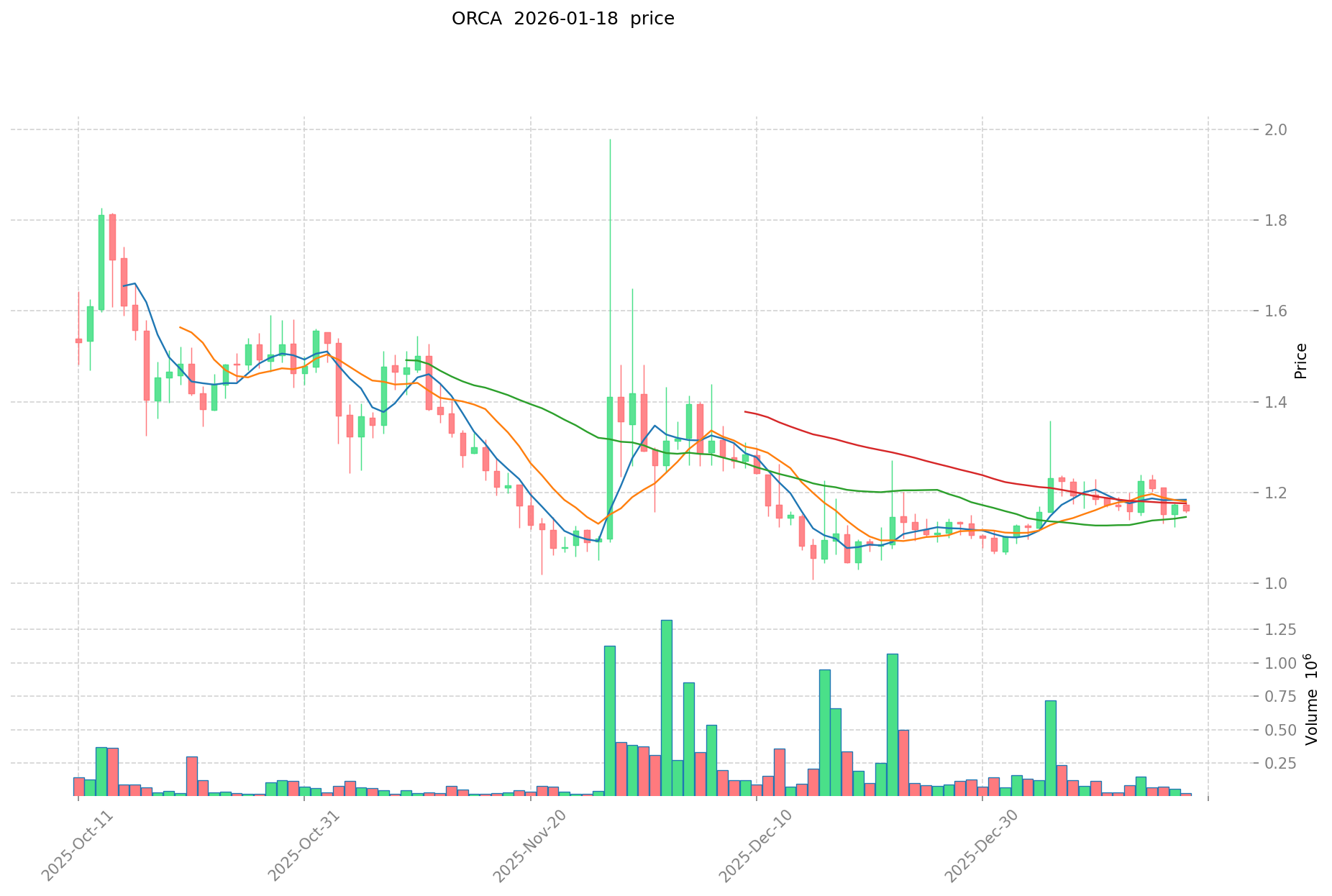
II. Core Factors Influencing Whether ORCA is a Good Investment
Supply Mechanism and Scarcity (ORCA Investment Scarcity)
- Supply Structure: Orca has a maximum supply of 100,000,000 ORCA tokens, with approximately 60,157,178 tokens currently in circulation (60.16% of max supply). The total supply stands at 74,999,601 tokens.
- Circulating Supply Dynamics: The current market cap to fully diluted valuation ratio of 60.16% indicates that a portion of tokens remains unlocked, which could influence future supply dynamics and pricing pressure.
- Investment Implication: The defined maximum supply cap provides a framework for potential scarcity, though the significant portion of tokens yet to enter circulation (approximately 40%) represents a consideration for investors evaluating long-term value retention.
Market Position and Adoption (Institutional Investment in ORCA)
- Market Standing: As of January 18, 2026, ORCA ranks 437th by market capitalization with a total market cap of approximately $88.69 million and a circulating market cap of $71.14 million.
- Platform Specifics: Orca operates as an automated market maker (AMM) on the Solana blockchain, positioning itself within the decentralized finance (DeFi) sector. The platform was developed by a team focused on blockchain protocol engineering and user-centric digital experience design.
- Ecosystem Consideration: The project's integration within the Solana ecosystem and its role as a DeFi protocol contribute to its positioning within the broader cryptocurrency landscape.
Macroeconomic and Market Environment Impact on ORCA Investment
- Market Sentiment Dependency: Analysis suggests that ORCA's price performance may be influenced by broader cryptocurrency market conditions, including movements in major digital assets and overall investor sentiment toward DeFi protocols.
- Regulatory Considerations: Changes in regulatory frameworks affecting DeFi protocols could impact Orca's operational environment and market valuation.
- Volatility Profile: ORCA has demonstrated significant price volatility, with its price ranging from a recorded low of $0.351125 to a recorded high of $20.33, reflecting sensitivity to market conditions and sector-specific developments.
Technology and Ecosystem Development (Technology & Ecosystem for ORCA Investment)
- Platform Functionality: Orca provides automated market maker services on Solana, focusing on transaction speed and user experience within the DeFi space.
- DeFi Integration: The platform's role in facilitating decentralized trading and liquidity provision positions it within the evolving DeFi ecosystem on Solana.
- Technological Foundation: Built on Solana's blockchain infrastructure, the platform's performance characteristics are linked to the underlying network's technical capabilities and development trajectory.
III. ORCA Future Investment Forecast and Price Outlook (Is Orca(ORCA) worth investing in 2026-2031)
Short-term Investment Forecast (2026, short-term ORCA investment outlook)
- Conservative forecast: $0.99 - $1.18
- Neutral forecast: $1.18 - $1.32
- Optimistic forecast: $1.32 - $1.47
Mid-term Investment Outlook (2027-2028, mid-term Orca(ORCA) investment forecast)
-
Market stage expectations: During the 2027-2028 period, ORCA may experience moderate growth momentum, with price trajectories influenced by the overall development of the Solana ecosystem and broader decentralized exchange (DEX) adoption trends.
-
Investment return forecast:
- 2027: $1.07 - $1.39
- 2028: $0.80 - $1.48
-
Key catalysts: Solana ecosystem expansion, increased trading volume on the Orca platform, competitive positioning within the DEX landscape, and potential protocol upgrades may serve as primary drivers for price movement during this period.
Long-term Investment Outlook (Is ORCA a good long-term investment?)
- Baseline scenario: $1.05 - $1.65 (assuming steady ecosystem development and moderate market conditions)
- Optimistic scenario: $1.46 - $2.22 (assuming accelerated adoption of Solana-based DeFi platforms and favorable market sentiment)
- Risk scenario: $0.80 - $1.05 (under conditions of heightened market volatility or reduced platform competitiveness)
Click to view ORCA long-term investment and price forecast: Price Prediction
2026-01-18 - 2031 Long-term Outlook
- Base scenario: $1.05 - $1.65 (corresponding to steady progress and gradual mainstream application growth)
- Optimistic scenario: $1.46 - $2.22 (corresponding to large-scale adoption and favorable market conditions)
- Transformative scenario: Above $2.22 (in case of breakthrough ecosystem developments and mainstream adoption)
- 2031-12-31 forecast high: $2.22 (based on optimistic development assumptions)
Disclaimer: The forecasts presented above are based on historical data analysis and current market trends. Cryptocurrency markets are highly volatile and subject to numerous unpredictable factors. These projections should not be construed as investment advice, and past performance does not guarantee future results. Investors should conduct their own research and consider their risk tolerance before making any investment decisions.
| Year |
Predicted High Price |
Predicted Average Price |
Predicted Low Price |
Price Change |
| 2026 |
1.47275 |
1.1782 |
0.989688 |
0 |
| 2027 |
1.39174875 |
1.325475 |
1.07363475 |
12 |
| 2028 |
1.48088694375 |
1.358611875 |
0.80158100625 |
14 |
| 2029 |
1.646909314875 |
1.419749409375 |
0.89444212790625 |
20 |
| 2030 |
1.64066241747375 |
1.533329362125 |
1.45666289401875 |
29 |
| 2031 |
2.221794245719125 |
1.586995889799375 |
1.047417287267587 |
34 |
IV. Orca Investment Strategy and Risk Management (How to invest in DEX tokens)
Investment Methodology (Orca investment strategy)
Long-term Holding (HODL Orca)
For conservative investors seeking exposure to Solana's decentralized exchange ecosystem, a long-term holding strategy may be considered. This approach typically involves:
- Accumulating ORCA tokens during market corrections
- Monitoring the development progress of the Orca protocol
- Evaluating the growth of trading volume and user adoption on the platform
- Assessing the competitive landscape of Solana-based AMMs
Long-term holders should remain aware that ORCA has experienced significant price fluctuations, with an all-time high of $20.33 (October 2021) and an all-time low of $0.351125 (June 2022). As of January 18, 2026, the token trades at $1.1825, representing a substantial decline from its peak.
Active Trading
For traders with experience in technical analysis, ORCA presents opportunities for:
- Swing trading based on price momentum and volume patterns
- Range trading within established support and resistance levels
- Volatility-based strategies capitalizing on the token's price movements
Recent price trends show:
- 1-hour change: +1.03%
- 24-hour change: +1.9%
- 7-day change: +0.63%
- 30-day change: +9.86%
- 1-year change: -68.74%
These figures indicate both short-term stability and significant long-term volatility, requiring careful risk management for active traders.
Risk Management (Risk management for Orca investment)
Asset Allocation Ratios
Conservative Investors:
- Suggested allocation: 1-3% of cryptocurrency portfolio
- Focus on established assets with majority holdings in larger-cap cryptocurrencies
- Limited exposure to DEX governance tokens
Aggressive Investors:
- Potential allocation: 5-10% of cryptocurrency portfolio
- Higher tolerance for volatility in exchange for potential growth
- Active monitoring of protocol developments and market conditions
Professional Investors:
- Strategic allocation based on comprehensive DeFi portfolio construction
- Hedging strategies incorporating options or correlated assets
- Regular rebalancing based on market conditions and protocol metrics
Risk Hedging Strategies
- Diversified Portfolio Construction: Combine ORCA with other Solana ecosystem tokens, established DEX tokens, and major cryptocurrencies
- Stablecoin Reserves: Maintain liquid stablecoin positions for opportunistic accumulation during market downturns
- Position Sizing: Limit individual position size to mitigate concentration risk
- Stop-loss Implementation: Establish clear exit criteria for active trading positions
Secure Storage Solutions
Cold Wallet Storage:
- Hardware wallets compatible with Solana tokens (Ledger, Trezor with Solana support)
- Paper wallet generation for long-term holding
- Multi-signature wallet solutions for institutional holdings
Hot Wallet Considerations:
- Phantom, Solflare, or other reputable Solana-compatible wallets for active trading
- Enable two-factor authentication and security features
- Limit hot wallet balances to amounts needed for immediate transactions
- Regular security audits and wallet software updates
V. Orca Investment Risks and Challenges (Risks of investing in DEX tokens)
Market Risks
High Volatility:
ORCA has demonstrated substantial price fluctuations, with a 1-year decline of 68.74% as of January 2026. The 24-hour trading range of $1.1549 to $1.199 represents approximately 3.8% intraday volatility. The current price of $1.1825 remains significantly below the all-time high of $20.33, reflecting the high-risk nature of DEX governance tokens.
Market Capitalization Considerations:
With a market capitalization of approximately $71.14 million and market dominance of 0.0026%, ORCA represents a relatively small-cap asset within the cryptocurrency market. The circulating supply of 60.16 million tokens represents approximately 60.16% of the total supply, with a maximum supply capped at 100 million tokens.
Liquidity Concerns:
24-hour trading volume stands at $40,162.41, which represents approximately 0.056% of the market capitalization. Lower liquidity may result in wider bid-ask spreads and potential price slippage during larger transactions.
Regulatory Risks
Global Policy Uncertainty:
Decentralized exchange protocols face evolving regulatory frameworks across jurisdictions:
- United States: Ongoing regulatory discussions regarding DeFi protocols and their classification
- European Union: Implementation of Markets in Crypto-Assets (MiCA) regulation affecting DeFi operations
- Asia-Pacific Region: Varying approaches to DeFi regulation with some jurisdictions implementing restrictive measures
Compliance Challenges:
- Potential requirements for KYC/AML procedures on DEX platforms
- Evolving securities regulations that may impact governance token classifications
- Cross-border transaction monitoring and reporting requirements
Technical Risks
Network Security:
- Smart contract vulnerabilities that could potentially be exploited
- Dependence on Solana network stability and performance
- Historical Solana network outages that have affected protocol operations
Protocol-Specific Risks:
- Competition from other Solana-based AMMs and cross-chain DEX protocols
- Liquidity migration risks to competing platforms
- Governance decisions that may not align with all token holders' interests
Technology Upgrade Risks:
- Protocol updates that may introduce bugs or unexpected behaviors
- Potential hard fork scenarios affecting token value
- Integration challenges with evolving Solana protocol upgrades
VI. Conclusion: Is DEX Token a Good Investment?
Investment Value Summary
ORCA represents a governance token for a decentralized exchange protocol operating on the Solana blockchain. The token has shown mixed performance characteristics, with short-term price stability (30-day gain of 9.86%) contrasted against significant long-term volatility (1-year decline of 68.74%). The project operates within the competitive Solana DeFi ecosystem, with approximately 89,636 token holders as of January 2026.
Key considerations for potential investors include:
- Market positioning within the Solana ecosystem
- Relatively small market capitalization and modest liquidity
- Substantial price decline from historical highs
- Ongoing development by the project team
- Competitive landscape of alternative DEX protocols
Investor Recommendations
✅ Beginners:
- Consider dollar-cost averaging (DCA) to mitigate timing risk
- Prioritize secure storage using hardware wallets or reputable software wallets with strong security features
- Limit position size to an amount comfortable with potential loss
- Conduct thorough research on DEX protocols and their tokenomics before investment
- Avoid leverage or margin trading due to high volatility
✅ Experienced Investors:
- Implement swing trading strategies based on technical analysis and market conditions
- Construct diversified cryptocurrency portfolios including multiple DeFi protocols
- Monitor on-chain metrics including trading volume, liquidity pool sizes, and user activity
- Establish clear entry and exit criteria aligned with risk tolerance
- Consider correlation with broader Solana ecosystem performance
✅ Institutional Investors:
- Evaluate strategic allocation within broader DeFi investment thesis
- Conduct comprehensive due diligence on protocol security audits and team credentials
- Implement sophisticated risk management frameworks including hedging strategies
- Consider lock-up periods and governance participation in investment strategy
- Assess regulatory compliance requirements across operating jurisdictions
⚠️ Disclaimer: Cryptocurrency investments involve substantial risk, including the potential loss of principal. Price volatility, regulatory uncertainty, technical vulnerabilities, and market manipulation are inherent risks in digital asset markets. This analysis is provided for informational purposes only and does not constitute investment advice, financial advice, trading advice, or recommendations. Investors should conduct independent research and consult with qualified financial advisors before making investment decisions. Past performance does not guarantee future results.
VII. FAQ
Q1: What is the current market capitalization and trading volume of ORCA, and what does this indicate about its liquidity?
As of January 18, 2026, ORCA has a circulating market capitalization of approximately $71.14 million with a 24-hour trading volume of $40,162.41, indicating relatively limited liquidity for investors.
The market capitalization places ORCA at rank 437 in the cryptocurrency market with a market dominance of 0.0026%. The 24-hour trading volume represents approximately 0.056% of the total market capitalization, which is considered low compared to more liquid assets. This limited liquidity may result in wider bid-ask spreads and potential price slippage during larger transactions, particularly for institutional investors or traders executing significant orders. The token is available across 28 exchanges, which provides some distribution but may fragment liquidity across multiple venues.
Q2: How has ORCA's price performed historically, and what were the key periods of volatility?
ORCA has experienced substantial price volatility since its launch in August 2021, declining approximately 94.2% from its all-time high of $20.33 to the current price of $1.1825.
The token's price history shows distinct phases: it reached its peak of $20.33 in October 2021 during the DeFi expansion period, then declined to $0.351125 in June 2022 amid broader cryptocurrency market corrections. Recent performance shows a 1-year decline of 68.74%, though short-term metrics indicate some stability with a 30-day gain of 9.86%. This historical volatility reflects both the broader cryptocurrency market conditions and the competitive dynamics within the Solana DeFi ecosystem.
Q3: What is ORCA's tokenomics structure, and how might it impact future price dynamics?
ORCA has a maximum supply of 100 million tokens, with approximately 60.16 million tokens (60.16%) currently in circulation, meaning nearly 40% of tokens remain to be released into the market.
This supply structure presents considerations for investors evaluating long-term value retention. The defined maximum supply cap provides a framework for potential scarcity, which could support price appreciation if demand increases. However, the significant portion of tokens yet to enter circulation represents potential future selling pressure that could impact price performance. The current circulating supply of 60,157,178 tokens results in a market cap to fully diluted valuation ratio of 60.16%, indicating that investors should monitor future token unlock schedules and their potential effect on market dynamics.
Q4: What are the primary risks associated with investing in ORCA?
The primary risks include high price volatility (68.74% decline over one year), limited liquidity (24-hour volume of $40,162.41), regulatory uncertainty affecting DeFi protocols, and technical vulnerabilities inherent in smart contract platforms.
Market risks stem from ORCA's small-cap nature with a market capitalization of approximately $71 million and low market dominance of 0.0026%. Regulatory risks include evolving frameworks such as the EU's MiCA regulation and potential classification changes for DeFi governance tokens. Technical risks encompass smart contract vulnerabilities, dependence on Solana network stability (which has experienced historical outages), and competition from other DEX protocols. Additionally, the token's dependence on the broader Solana ecosystem means that negative developments affecting Solana could disproportionately impact ORCA's value.
Q5: What investment strategies are appropriate for different investor types considering ORCA?
Conservative investors should limit allocation to 1-3% of their cryptocurrency portfolio using dollar-cost averaging, while aggressive investors might consider 5-10% allocation with active monitoring of protocol developments.
For beginners, recommended strategies include implementing dollar-cost averaging to mitigate timing risk, prioritizing secure storage solutions such as hardware wallets compatible with Solana (Ledger, Trezor), and avoiding leverage due to high volatility. Experienced investors may employ swing trading strategies based on technical analysis, diversify across multiple DeFi protocols, and monitor on-chain metrics including trading volume and liquidity pool sizes. Institutional investors should conduct comprehensive due diligence on protocol security audits, implement sophisticated risk management frameworks with hedging strategies, and assess regulatory compliance requirements across operating jurisdictions.
Q6: What is the price forecast for ORCA through 2031, and what factors could influence these projections?
Price forecasts suggest a range of $1.05-$1.65 in the baseline scenario by 2031, with an optimistic scenario reaching $2.22, though these projections are subject to significant uncertainty and market volatility.
Short-term forecasts for 2026 range from $0.99 to $1.47 depending on market conditions. Mid-term outlooks for 2027-2028 project prices between $0.80 and $1.48, influenced by Solana ecosystem expansion and DEX adoption trends. Long-term forecasts through 2031 assume steady ecosystem development, with the optimistic scenario predicting $1.46-$2.22 based on accelerated adoption of Solana-based DeFi platforms. Key factors influencing these projections include broader cryptocurrency market sentiment, regulatory developments affecting DeFi protocols, competitive positioning within the DEX landscape, protocol upgrades, and overall Solana network growth.
Q7: How does ORCA's position within the Solana ecosystem affect its investment potential?
ORCA operates as an automated market maker (AMM) on the Solana blockchain, positioning itself within the Solana DeFi ecosystem with approximately 89,636 token holders as of January 2026.
The platform's integration within Solana provides both opportunities and dependencies. Benefits include access to Solana's high-speed transaction processing and growing DeFi user base. However, the platform's performance and value proposition are inherently linked to Solana's network stability, development trajectory, and overall ecosystem health. Historical Solana network outages have affected protocol operations, demonstrating this dependency. Competition from other Solana-based AMMs and cross-chain DEX protocols presents ongoing challenges to market share and liquidity retention. The platform's focus on transaction speed and user experience within the DeFi space positions it within the evolving competitive landscape of decentralized exchanges.
Q8: What security considerations should investors prioritize when holding ORCA tokens?
Investors should prioritize cold storage solutions using hardware wallets compatible with Solana (Ledger, Trezor with Solana support) for long-term holdings, while limiting hot wallet balances to amounts needed for immediate transactions.
For cold storage, hardware wallets provide the highest security level for significant holdings, with multi-signature wallet solutions recommended for institutional investors. Hot wallet options such as Phantom or Solflare should be used only for active trading amounts, with two-factor authentication and regular security audits enabled. Paper wallet generation offers an alternative for long-term storage without hardware devices. Regardless of storage method, investors should regularly update wallet software, verify receiving addresses before transactions, and avoid sharing private keys or seed phrases. The relatively low liquidity and limited trading volume of ORCA make secure storage particularly important, as recovering from security breaches may be more challenging compared to more liquid assets.
* The information is not intended to be and does not constitute financial advice or any other recommendation of any sort offered or endorsed by Gate.