Orchid (OXT) is a blockchain-based privacy token operating on Ethereum, currently trading at $0.022 with a market cap of $12.99 million as of January 2026. This comprehensive analysis evaluates OXT's investment potential through price history analysis showing a 97.9% decline from its April 2021 peak of $1.026, current market fundamentals including 591.54 million circulating supply, and future price forecasts ranging from conservative to optimistic scenarios through 2031. The article examines core investment factors including tokenomics with unlimited maximum supply, institutional adoption across 22 exchanges, and the decentralized VPN ecosystem powered by OXT tokens. Investment strategies range from conservative HODL approaches to active trading, with detailed risk management recommendations and allocation ratios for different investor types. Critical risks include high volatility (-79.13% annually), regulatory uncertainty around privacy technologies, and technical dependencies on Ethereum infrastructure. Whi
Introduction: Orchid (OXT)'s Investment Position and Market Outlook
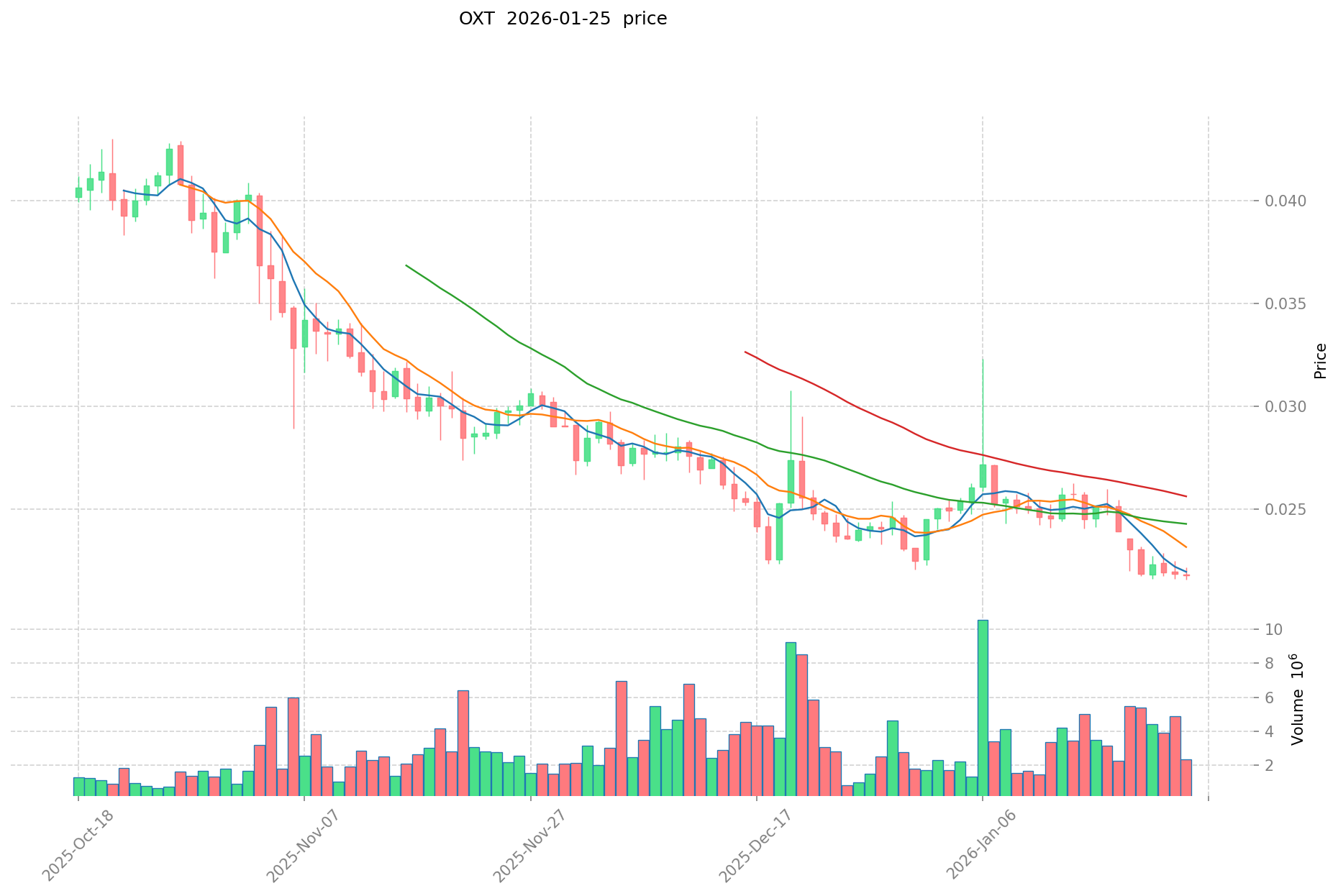
OXT is a noteworthy asset in the cryptocurrency field. Since its launch in 2019, it has made progress in the decentralized VPN and privacy services sector. As of January 2026, Orchid's market capitalization stands at approximately $12.99 million, with a circulating supply of around 591.54 million tokens, and the current price is maintained at around $0.02197. With its positioning as a next-generation VPN and privacy tool, OXT has gradually become a focal point for investors when discussing "Is Orchid (OXT) a good investment?" This article will comprehensively analyze OXT's investment value, historical trends, future price forecasts, and investment risks to provide reference for investors.
I. Orchid (OXT) Price History Review and Current Investment Value
- 2021: Reached peak trading levels in April → Price attained $1.026 before subsequent correction
- 2021-2026: Extended market adjustment period → OXT experienced significant decline, with price reducing by approximately 97.9% from April 2021 levels to current trading range
- 2026: Current market cycle positioning → Trading near $0.022, representing multi-year support levels
Current OXT Investment Market Status (January 2026)
- OXT current price: $0.02197
- 24-hour trading volume: $55,559.70
- Market capitalization: $12,996,237.70
- Circulating supply: 591,544,728.95 OXT (59.15% of total supply)
- Market dominance: 0.00069%
Click to view real-time OXT market price
II. Core Factors Affecting Whether OXT is a Good Investment (Is Orchid(OXT) a Good Investment)
Supply Mechanism and Scarcity (OXT investment scarcity)
- Maximum supply of OXT is unlimited (∞), with a total supply of 1,000,000,000 tokens and a current circulating supply of approximately 591,544,729 tokens (59.15% of total supply) → affects price dynamics and investment valuation
- Historical price volatility shows OXT traded at $1.026 in April 2021 and reached a price level near $0.0216 in January 2026, demonstrating significant price fluctuation patterns
- Investment significance: The unlimited maximum supply may present challenges to long-term scarcity-based value appreciation compared to fixed-supply digital assets
Institutional Investment and Mainstream Adoption (Institutional investment in OXT)
- OXT is currently listed on 22 exchanges, indicating a moderate level of market accessibility
- The token holder base comprises approximately 49,987 addresses, reflecting the breadth of distribution and community participation
- Market capitalization stands at approximately $12.996 million with a fully diluted valuation of $21.97 million, representing a relatively modest market position (0.00069% market dominance)
Macroeconomic Environment Impact on OXT Investment
- Monetary policy shifts and interest rate changes → may alter investment attractiveness across digital asset markets, potentially affecting OXT valuations
- Inflation environments and the digital asset hedge narrative → OXT's positioning within the VPN and privacy technology sector may respond differently compared to store-of-value focused digital assets
- Geopolitical uncertainty and privacy concerns → could potentially enhance demand for privacy-focused solutions like Orchid Protocol
Technology and Ecosystem Development (Technology & Ecosystem for OXT investment)
- Ethereum blockchain foundation: OXT operates as an ERC-20 token (contract address: 0x4575f41308EC1483f3d399aa9a2826d74Da13Deb), leveraging Ethereum's network infrastructure for bandwidth marketplace operations
- Staking mechanism implementation: The protocol utilizes a staking-based system where node operators and users interact through OXT token economics for bandwidth services
- Decentralized VPN application: The bandwidth marketplace model where users pay node operators with OXT tokens for privacy services represents a practical utility-driven ecosystem
III. OXT Future Investment Forecast and Price Outlook (Is Orchid(OXT) worth investing in 2026-2031)
Short-term Investment Forecast (2026, short-term OXT investment outlook)
- Conservative Forecast: $0.015435 - $0.02205
- Neutral Forecast: $0.02205 - $0.0297675
- Optimistic Forecast: $0.0297675 and above
Mid-term Investment Outlook (2027-2029, mid-term Orchid(OXT) investment forecast)
-
Market Stage Expectation: The token may experience moderate fluctuations as the decentralized VPN market evolves and network adoption progresses. Price movements could reflect broader cryptocurrency market cycles and shifts in privacy-focused service demand.
-
Investment Return Forecast:
- 2027: $0.0251314875 - $0.036790425
- 2028: $0.021631215375 - $0.032290075125
- 2029: $0.016864510595625 - $0.03754740094875
-
Key Catalysts: Expansion of node provider network, evolution of bandwidth marketplace dynamics, developments in Ethereum blockchain ecosystem, shifts in global privacy regulations, and competitive positioning within decentralized VPN services.
Long-term Investment Outlook (Is Orchid a good long-term investment?)
- Base Scenario: $0.027391385839161 - $0.049597571066793 (assuming steady ecosystem development and sustained demand for decentralized privacy solutions)
- Optimistic Scenario: $0.042140593598709 - $0.049597571066793 (assuming accelerated adoption of bandwidth marketplace and favorable regulatory environment for privacy technologies)
- Risk Scenario: Below $0.02161676 (under conditions of intensified competition, significant technological disruption, or prolonged bearish cryptocurrency market cycles)
Click to view OXT long-term investment and price forecast: Price Prediction
2026-01-25 - 2031 Long-term Outlook
- Base Scenario: $0.027391385839161 - $0.042140593598709 (corresponding to steady progress and gradual mainstream application enhancement)
- Optimistic Scenario: $0.042140593598709 - $0.049597571066793 (corresponding to large-scale adoption and favorable market environment)
- Transformative Scenario: Above $0.049597571066793 (if ecosystem achieves breakthrough development and mainstream popularization)
- 2031-12-31 Forecast High: $0.049597571066793 (based on optimistic development assumptions)
Disclaimer: The forecast is based on historical data and market analysis. Cryptocurrency investments carry significant risks. Past performance does not guarantee future results. Investors should conduct independent research and assess their risk tolerance before making investment decisions.
| Year |
Predicted High Price |
Predicted Average Price |
Predicted Low Price |
Price Change |
| 2026 |
0.0297675 |
0.02205 |
0.015435 |
0 |
| 2027 |
0.036790425 |
0.02590875 |
0.0251314875 |
17 |
| 2028 |
0.032290075125 |
0.0313495875 |
0.021631215375 |
42 |
| 2029 |
0.03754740094875 |
0.0318198313125 |
0.016864510595625 |
44 |
| 2030 |
0.049597571066793 |
0.034683616130625 |
0.0277468929045 |
57 |
| 2031 |
0.044247623278644 |
0.042140593598709 |
0.027391385839161 |
91 |
IV. OXT Investment Strategy and Risk Management (How to invest in privacy-focused VPN tokens)
Investment Methodology (OXT investment strategy)
Long-term Holding (HODL OXT)
Long-term holding represents a suitable approach for conservative investors seeking exposure to privacy-focused blockchain infrastructure. This strategy involves acquiring OXT tokens and maintaining positions through market cycles, based on the fundamental value proposition of decentralized VPN services. Investors following this methodology typically focus on the project's technological development, network growth metrics, and adoption trends within the privacy technology sector.
Active Trading
Active trading strategies for OXT rely on technical analysis and swing trading methodologies. Traders utilizing this approach monitor price movements, volume patterns, and market sentiment indicators to identify entry and exit points. Given the token's price volatility, with 24-hour fluctuations of 0.27% and 7-day movements of -12.12%, technical traders may find opportunities in short to medium-term price swings. This strategy requires continuous market monitoring and understanding of broader cryptocurrency market dynamics.
Risk Management (Risk management for OXT investment)
Asset Allocation Ratios
Conservative Investors: May consider allocating 1-3% of their cryptocurrency portfolio to OXT, maintaining the majority of holdings in established assets. This approach limits exposure while allowing participation in the privacy technology sector.
Aggressive Investors: Could allocate 5-10% of their crypto portfolio to OXT, accepting higher risk in exchange for potential returns from niche sector growth.
Professional Investors: May employ dynamic allocation strategies ranging from 3-15%, adjusting positions based on market conditions, technical indicators, and fundamental developments in the Orchid Protocol ecosystem.
Risk Hedging Approaches
Diversified portfolio construction serves as a primary risk mitigation strategy. Investors may combine OXT holdings with:
- Established cryptocurrencies to balance volatility exposure
- Assets from different blockchain sectors to reduce correlation risk
- Stablecoin positions to maintain liquidity for opportunistic rebalancing
Hedging instruments, where available, may include options contracts or derivative products on major exchanges, though liquidity considerations apply to lower market cap tokens.
Secure Storage Solutions
Cold Wallet Storage: For long-term holdings, hardware wallets such as Ledger or Trezor provide offline security. Given OXT's Ethereum-based standard (contract address: 0x4575f41308EC1483f3d399aa9a2826d74Da13Deb), any ERC-20 compatible hardware wallet supports secure storage.
Hot Wallet Considerations: For active traders, exchange wallets or software wallets like MetaMask offer accessibility, though with increased security trade-offs. Implementing two-factor authentication and withdrawal whitelisting enhances security for frequently accessed holdings.
Storage Best Practices: Distributing holdings across multiple wallet types based on usage frequency, maintaining secure backup procedures for recovery phrases, and regularly updating wallet firmware represent fundamental security measures.
V. OXT Investment Risks and Challenges (Risks of investing in privacy-focused VPN tokens)
Market Risk
High Volatility: OXT exhibits significant price fluctuations, with recorded changes of -12.12% over 7 days and -79.13% over one year. The 24-hour trading volume of approximately 55,559.70 units against a circulating supply of 591,544,728 tokens indicates relatively limited liquidity compared to major cryptocurrencies. Price movements may experience amplified volatility during periods of low trading activity.
Price Manipulation Potential: With a market capitalization of approximately 12.99 million and trading presence on 22 exchanges, the token's market depth may be susceptible to large order impacts. The market cap to fully diluted valuation ratio of 59.15% suggests significant token supply remains outside current circulation, potentially affecting price dynamics upon future releases.
Regulatory Risk
Regulatory uncertainty presents challenges across different jurisdictions. Privacy-focused technologies face varying regulatory approaches globally:
Jurisdictional Variations: Different countries maintain distinct regulatory frameworks for privacy technologies and VPN services. Policy developments affecting either cryptocurrency classification or privacy service regulations could impact OXT's utility and adoption.
Compliance Evolution: Regulatory requirements for blockchain-based privacy services continue evolving. Changes in data privacy laws, anti-money laundering regulations, or cryptocurrency taxation policies may affect the Orchid Protocol's operational framework and, consequently, token utility.
Technical Risk
Network Security: The Ethereum-based infrastructure introduces dependency on underlying blockchain security. Smart contract vulnerabilities, though mitigatable through auditing, represent inherent risks in blockchain-based bandwidth markets.
Protocol Upgrades: Technical developments and protocol modifications carry implementation risks. Network upgrades, changes to the staking mechanism, or bandwidth market adjustments require successful execution to maintain system functionality and user confidence.
Infrastructure Dependencies: The project's reliance on node providers and Ethereum blockchain functionality means external technical issues could affect service delivery and token utility.
VI. Conclusion: Is privacy-focused VPN token a Good Investment?
Investment Value Assessment
OXT presents investment characteristics tied to the decentralized privacy technology sector. The token's market performance shows substantial volatility, with short-term fluctuations and longer-term downward trends (-79.13% over one year) reflecting both broader cryptocurrency market conditions and sector-specific challenges. The circulating supply ratio of 59.15% and total supply of 1,000,000,000 tokens indicate ongoing token distribution dynamics that investors should consider.
The project's fundamental proposition—providing decentralized VPN services through blockchain technology—addresses growing privacy concerns, though market adoption and competitive positioning remain key factors affecting long-term value.
Investor Recommendations
For Beginners
✅ Dollar-Cost Averaging: Implement systematic small purchases over extended periods to mitigate timing risk and average entry costs across market cycles.
✅ Secure Storage Priority: Utilize hardware wallets or reputable cold storage solutions for holdings intended for long-term investment horizons.
✅ Educational Foundation: Develop understanding of both cryptocurrency fundamentals and privacy technology sector dynamics before committing significant capital.
For Experienced Investors
✅ Swing Trading Opportunities: Monitor technical indicators and volume patterns to identify potential entry and exit points within volatility ranges.
✅ Portfolio Integration: Consider OXT as a specialized allocation within a diversified cryptocurrency portfolio, maintaining exposure to established assets alongside niche sector positions.
✅ Active Monitoring: Track protocol developments, network metrics, and competitive landscape changes affecting the decentralized VPN market.
For Institutional Investors
✅ Strategic Positioning: Evaluate OXT within thematic allocations to privacy technology or decentralized infrastructure sectors, assessing correlation benefits and risk-adjusted return potential.
✅ Due Diligence Framework: Conduct comprehensive analysis of protocol economics, governance structures, competitive positioning, and regulatory landscape before establishing positions.
✅ Liquidity Planning: Structure entry and exit strategies accounting for market depth limitations and potential price impact of larger transactions.
⚠️ Important Notice: Cryptocurrency investments involve substantial risk, including the potential for complete loss of invested capital. Price volatility, regulatory uncertainty, and technological risks characterize this asset class. This analysis provides informational context only and does not constitute investment advice. Investors should conduct independent research, assess personal risk tolerance, and consider consulting qualified financial advisors before making investment decisions.
VII. FAQ
Q1: What is the current market position of Orchid (OXT) and how has its price performed historically?
As of January 2026, OXT trades at approximately $0.02197 with a market capitalization of $12.99 million and a circulating supply of 591.54 million tokens (59.15% of total supply). The token has experienced significant price volatility since its launch, reaching a peak of $1.026 in April 2021 before declining approximately 97.9% to current levels. The 24-hour trading volume stands at $55,559.70, indicating moderate liquidity across 22 exchanges. This price trajectory reflects both broader cryptocurrency market cycles and sector-specific challenges in decentralized privacy services adoption.
Q2: What makes OXT different from traditional VPN services and how does its tokenomics work?
OXT operates as an ERC-20 token powering a decentralized bandwidth marketplace on the Ethereum blockchain. Unlike traditional subscription-based VPN services, Orchid utilizes a pay-as-you-go model where users pay node operators with OXT tokens for bandwidth services. The protocol implements a staking mechanism where node providers stake OXT to participate in the network. With a total supply of 1,000,000,000 tokens and unlimited maximum supply, the tokenomics differ from fixed-supply cryptocurrencies, which may affect long-term scarcity-based value appreciation dynamics.
Q3: What are the primary risks associated with investing in OXT?
OXT presents three major risk categories. Market risk includes high volatility (7-day decline of -12.12%, 1-year decline of -79.13%) and limited liquidity relative to major cryptocurrencies, making the token susceptible to price manipulation. Regulatory risk stems from evolving privacy technology regulations across different jurisdictions, which could impact the protocol's operational framework. Technical risk encompasses smart contract vulnerabilities, dependency on Ethereum blockchain security, and potential protocol upgrade complications. The relatively small market cap of $12.99 million amplifies these risks compared to established cryptocurrencies.
Q4: What is the price forecast for OXT in the short-term and long-term?
Short-term forecasts for 2026 range from conservative ($0.015435-$0.02205) to optimistic ($0.0297675 and above) scenarios. Mid-term projections show potential fluctuations with 2027 estimates between $0.0251314875-$0.036790425, 2028 at $0.021631215375-$0.032290075125, and 2029 at $0.016864510595625-$0.03754740094875. Long-term outlook through 2031 presents a base scenario of $0.027391385839161-$0.049597571066793, assuming steady ecosystem development. The optimistic 2031 high reaches $0.049597571066793, though these forecasts depend on adoption rates, competitive positioning, and broader cryptocurrency market conditions.
Q5: What investment strategies are suitable for different types of OXT investors?
Conservative investors should consider 1-3% portfolio allocation with long-term holding (HODL) strategies focused on fundamental value, utilizing cold wallet storage for security. Aggressive investors may allocate 5-10% of crypto portfolios, employing active trading strategies that leverage technical analysis and swing trading methodologies to capitalize on price volatility. Professional investors might use dynamic allocation (3-15%) with diversified portfolio construction including established cryptocurrencies, different blockchain sectors, and stablecoin positions for rebalancing opportunities. All strategies require understanding of privacy technology sector dynamics and appropriate risk management.
Q6: How does OXT's unlimited supply affect its investment potential compared to fixed-supply cryptocurrencies?
OXT's unlimited maximum supply structure differentiates it from fixed-supply digital assets like Bitcoin. With a total supply of 1,000,000,000 tokens and current circulation of 591,544,729 (59.15%), approximately 40.85% of tokens remain outside circulation, potentially affecting future price dynamics. The unlimited maximum supply may present challenges to long-term scarcity-based value appreciation theories that apply to capped-supply cryptocurrencies. However, the token's utility within the bandwidth marketplace—where OXT facilitates actual service transactions—provides demand drivers independent of artificial scarcity mechanisms.
Q7: What role do institutional investors play in OXT's market and what should they consider?
Institutional participation in OXT remains modest given its $12.99 million market cap and 0.00069% market dominance. The token holder base of approximately 49,987 addresses reflects community distribution but limited institutional presence. Institutional investors should conduct comprehensive due diligence on protocol economics, governance structures, competitive positioning, and regulatory landscape. Strategic positioning within thematic allocations to privacy technology or decentralized infrastructure sectors requires careful liquidity planning, as market depth limitations may cause price impact during larger transactions. Risk-adjusted return assessments should account for correlation benefits within diversified digital asset portfolios.
Q8: What catalysts could drive OXT price appreciation in the next 3-5 years?
Key catalysts include expansion of the node provider network, evolution of bandwidth marketplace dynamics, and developments in the Ethereum blockchain ecosystem. Shifts in global privacy regulations favoring decentralized VPN services could enhance demand. Competitive positioning improvements within decentralized privacy services and broader cryptocurrency market bull cycles represent additional positive factors. Technological breakthroughs in protocol efficiency or user experience could accelerate adoption. However, materialization of these catalysts remains uncertain, and adverse developments in any area could negatively impact price performance.
* The information is not intended to be and does not constitute financial advice or any other recommendation of any sort offered or endorsed by Gate.