Orderly Network (ORDER) is an omnichain liquidity infrastructure project for DeFi derivatives trading, consolidating orders across multiple blockchains into a unified orderbook. Launched in August 2024, ORDER currently trades at $0.08251 with a market cap of $17.56 million, ranking 933rd globally. This comprehensive analysis examines ORDER's investment potential by evaluating its technical architecture built on OP Stack with Celestia and LayerZero integration, historical price performance ranging from $0.02 to $0.497, and supply dynamics with only 21.29% of tokens circulating. The article provides price forecasts across conservative, neutral, and optimistic scenarios through 2031, while detailing investment strategies suitable for different investor profiles. Key topics include risk management approaches, regulatory and technical challenges, market volatility considerations, and secure token storage solutions. Whether analyzing short-term trading opportunities or long-term portfolio positioning, this guide ad
Introduction: Orderly Network (ORDER) Investment Position and Market Outlook
ORDER is a significant asset in the cryptocurrency field. Since its launch in 2024, it has made notable progress in the cloud liquidity infrastructure sector. As of January 2026, ORDER has a market capitalization of approximately $17.56 million, with a circulating supply of about 212.87 million tokens, and the current price is maintained around $0.08251. With its positioning as a cloud liquidity infrastructure for omnichain derivatives trading, ORDER has gradually become a focal point for investors discussing "Is Orderly Network (ORDER) a good investment?" This article will comprehensively analyze ORDER's investment value, historical trends, future price predictions, and investment risks to provide reference for investors.
Orderly Network is designed to consolidate orders from multiple chains into a unified shared orderbook, creating an integrated liquidity ecosystem that aims to improve trading efficiency, provide deeper liquidity, and offer tighter spreads. The project's omnichain backbone enables developers to create comprehensive financial products for both retail and professional traders. Built on the OP Stack, Orderly Chain leverages Celestia's data availability and LayerZero's cross-chain messaging protocol to serve as the settlement layer and ledger for transactions.
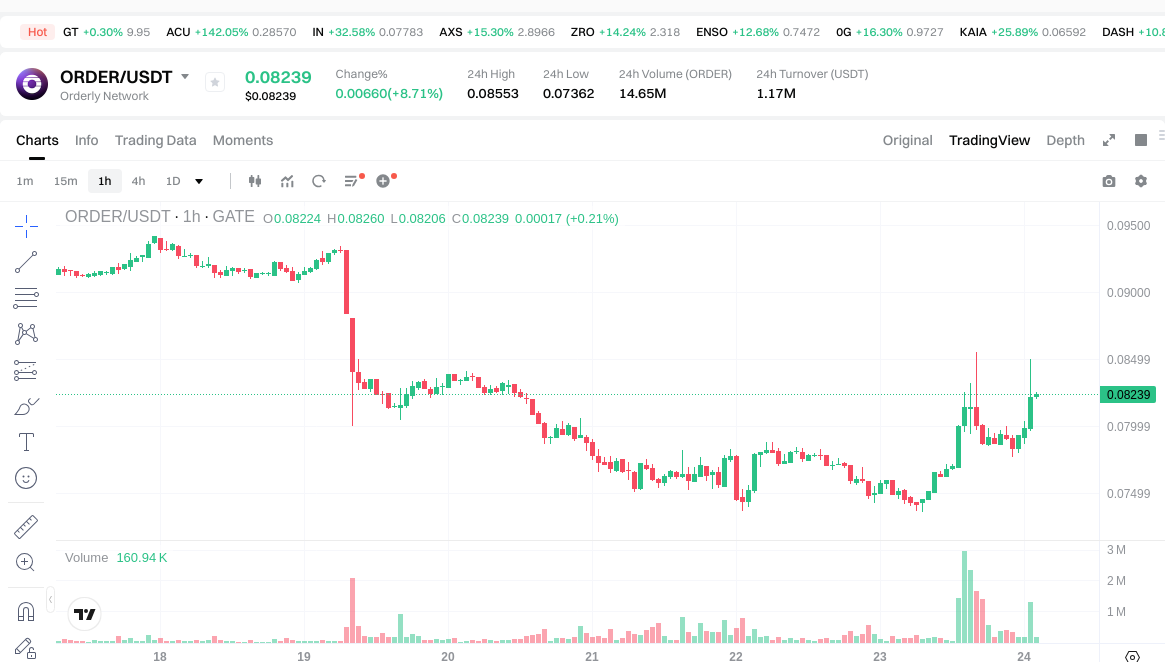
As of January 24, 2026, ORDER ranks 933rd in market capitalization, accounting for 0.0025% of the total crypto market. The token has shown a 24-hour price change of 8.97%, with a trading volume of approximately $1.17 million. The circulating supply represents 21.29% of the maximum supply of 1 billion tokens, with a fully diluted market cap of $82.51 million. The token is held by approximately 27,862 holders and is listed on 27 exchanges.
I. Orderly Network (ORDER) Price History Review and Current Investment Value
- August 2024: Token Launch → ORDER debuted at $0.2, establishing initial market presence
- August 2024: Market Adjustment Period → Price experienced significant volatility, reaching a notable low of $0.02
- October 2025: Market Recovery Phase → ORDER demonstrated upward momentum, climbing to $0.497
- 2024-2025: Market Cycle Dynamics → Price fluctuated between different levels as the project developed its infrastructure
Current ORDER Investment Market Status (January 2026)
- ORDER Current Price: $0.08251
- 24-Hour Trading Volume: $1,171,852.40
- Market Capitalization: $17,563,582.82
- Circulating Supply: 212,866,111 ORDER (21.29% of total supply)
- Price Changes: +3.29% (1H), +8.97% (24H), -8.86% (7D), -19.15% (30D)
Click to view real-time ORDER market price
II. Core Factors Influencing Whether ORDER is a Good Investment (Is Orderly Network(ORDER) a Good Investment)
Supply Mechanism and Scarcity (ORDER investment scarcity)
- Supply mechanism: ORDER has a maximum supply of 1,000,000,000 tokens with a current circulating supply of 212,866,111 tokens, representing approximately 21.29% of total supply → impacts price dynamics and investment value
- Scarcity consideration: The controlled token release schedule, with over 78% of tokens yet to enter circulation, creates a potential supply overhang that investors should monitor
- Investment implication: Understanding the token unlock schedule and emission rate is essential for assessing long-term investment potential
Institutional Investment and Mainstream Adoption (Institutional investment in ORDER)
- Holder base: ORDER currently has 27,862 holders, indicating a growing but still developing community base
- Exchange presence: The token is listed on 27 exchanges, providing adequate liquidity channels for investors
- Ecosystem positioning: As a cloud liquidity infrastructure designed to consolidate orderbook liquidity across multiple chains, ORDER's adoption depends on builder integration and protocol usage
Macroeconomic Environment's Impact on ORDER Investment
- Market conditions: Cryptocurrency markets remain sensitive to global monetary policy shifts, interest rate changes, and regulatory developments
- Risk-on sentiment: As an infrastructure token in the DeFi space, ORDER's performance may correlate with broader risk appetite in digital asset markets
- Sector-specific factors: Cross-chain liquidity solutions face competition from alternative protocols, requiring continued innovation to maintain relevance
Technology and Ecosystem Development (Technology & Ecosystem for ORDER investment)
- Technical infrastructure: Orderly Chain is built on OP Stack, leveraging Celestia's data availability and LayerZero's cross-chain messaging protocol to serve as the settlement layer
- Unified orderbook model: By consolidating orders into a single shared orderbook across multiple chains, the protocol aims to improve trading efficiency and provide deeper liquidity with tighter spreads
- Developer empowerment: The omnichain architecture enables developers to build comprehensive financial products without cross-chain bridging risks, potentially expanding the ecosystem's long-term value proposition
- DeFi integration: As a liquidity infrastructure layer, ORDER's investment value is tied to adoption by decentralized exchanges, derivatives platforms, and trading applications built on its protocol
III. ORDER Future Investment Forecast and Price Outlook (Is Orderly Network (ORDER) worth investing in 2026-2031)
Short-term Investment Forecast (2026, short-term ORDER investment outlook)
- Conservative forecast: $0.0560 - $0.0700
- Neutral forecast: $0.0750 - $0.0823
- Optimistic forecast: $0.0850 - $0.0881
Mid-term Investment Outlook (2027-2028, mid-term Orderly Network (ORDER) investment forecast)
- Market phase expectation: During this period, ORDER may experience moderate growth as the project continues to develop its omnichain liquidity infrastructure and expand its ecosystem partnerships.
- Investment return forecast:
- 2027: $0.0784 - $0.1125
- 2028: $0.0741 - $0.1275
- Key catalysts: Development of cross-chain trading capabilities, expansion of DeFi product offerings on the platform, and potential integration with additional blockchain networks through LayerZero protocol.
Long-term Investment Outlook (Is ORDER a good long-term investment?)
- Base scenario: $0.0667 - $0.1504 (assuming steady development of the Orderly Chain infrastructure and moderate adoption of omnichain liquidity solutions)
- Optimistic scenario: $0.1247 - $0.1976 (assuming successful expansion of cross-chain trading ecosystem and increased adoption among developers and traders)
- Risk scenario: $0.0560 - $0.0741 (in case of delayed technical developments or increased competition in the DeFi liquidity space)
Click to view ORDER long-term investment and price forecast: Price Prediction
2026-01-24 - 2031 Long-term Outlook
- Base scenario: $0.0667 - $0.1504 (corresponding to steady progress and gradual mainstream application growth)
- Optimistic scenario: $0.1247 - $0.1976 (corresponding to large-scale adoption and favorable market conditions)
- Transformative scenario: Above $0.1976 (in case of breakthrough ecosystem developments and mainstream adoption)
- 2031-12-31 predicted high: $0.1976 (based on optimistic development assumptions)
Disclaimer: This analysis is for informational purposes only and does not constitute investment advice. Cryptocurrency markets are highly volatile and past performance does not guarantee future results. Investors should conduct their own research and consider their risk tolerance before making investment decisions.
| Year |
Predicted High Price |
Predicted Average Price |
Predicted Low Price |
Price Change |
| 2026 |
0.0880717 |
0.08231 |
0.0559708 |
0 |
| 2027 |
0.112451922 |
0.08519085 |
0.078375582 |
3 |
| 2028 |
0.12747958794 |
0.098821386 |
0.0741160395 |
19 |
| 2029 |
0.1165450015791 |
0.11315048697 |
0.0667587873123 |
37 |
| 2030 |
0.15045054499966 |
0.11484774427455 |
0.086135808205912 |
39 |
| 2031 |
0.197647225509286 |
0.132649144637105 |
0.124690195958878 |
60 |
IV. ORDER Investment Strategy and Risk Management (How to invest in Orderly Network)
Investment Strategy (ORDER investment strategy)
Long-term Holding (HODL ORDER)
Long-term holding may be suitable for investors who believe in the fundamental value of omnichain liquidity infrastructure. This strategy involves acquiring ORDER tokens and holding them through market cycles, based on confidence in Orderly Network's technology development and ecosystem expansion. Investors adopting this approach typically focus less on short-term price movements and more on the project's long-term potential in the DeFi derivatives market.
Active Trading
Active trading strategies rely on technical analysis and swing trading techniques. Given ORDER's price volatility (with 24-hour changes of 8.97% and 7-day movements of -8.86%), traders may identify opportunities through chart patterns, volume analysis, and momentum indicators. This approach requires continuous market monitoring and understanding of ORDER's trading dynamics across its 27 listed exchanges.
Risk Management (Risk management for ORDER investment)
Asset Allocation Ratios
- Conservative Investors: May consider allocating 1-3% of their crypto portfolio to ORDER, maintaining diversification across established assets
- Aggressive Investors: Could allocate 5-10% to ORDER as part of a DeFi-focused portfolio, accepting higher volatility for potential returns
- Professional Investors: Might implement dynamic allocation strategies based on market conditions, technical indicators, and fundamental developments in the Orderly ecosystem
Risk Hedging Strategies
- Multi-Asset Portfolio: Combining ORDER with other crypto assets, stablecoins, and potentially traditional assets to reduce concentration risk
- Risk Management Tools: Utilizing stop-loss orders, position sizing techniques, and potentially derivatives products where available for downside protection
- Diversification Across Infrastructure Tokens: Balancing ORDER holdings with other DeFi infrastructure projects to spread sector-specific risks
Secure Storage
- Cold and Hot Wallet Solutions: For long-term holdings, hardware wallets such as Ledger or Trezor are recommended for storing ORDER tokens (ERC-20 standard on Ethereum). Hot wallets may be used for active trading positions
- Multi-Signature Wallets: Institutional investors may consider multi-signature solutions for enhanced security
- Custody Considerations: Verify wallet compatibility with ERC-20 tokens and maintain secure backup of recovery phrases
V. ORDER Investment Risks and Challenges (Risks of investing in Orderly Network)
Market Risks
- High Volatility: ORDER has experienced significant price fluctuations, including a 1-year decline of -73.58% and 24-hour volatility ranging from $0.07362 to $0.08553. The token's price history shows movement from an all-time high of $0.497 (October 2025) to an all-time low of $0.02 (August 2024)
- Limited Market Capitalization: With a market cap of approximately $17.56 million and market dominance of 0.0025%, ORDER has relatively low liquidity compared to established cryptocurrencies, which may result in larger price swings
- Trading Volume Considerations: Daily trading volume of approximately $1.17 million may present liquidity constraints for larger position entries or exits
Regulatory Risks
- Policy Uncertainty: As a DeFi infrastructure project operating across multiple blockchain networks, Orderly Network may face regulatory scrutiny in various jurisdictions regarding derivatives trading, cross-chain operations, and decentralized finance activities
- Compliance Evolution: Changing regulatory frameworks for crypto assets globally could impact ORDER's utility, trading availability, or project operations
- Cross-Chain Regulatory Complexity: The omnichain nature of Orderly Network introduces additional regulatory considerations across different blockchain ecosystems
Technical Risks
- Network Security: As an infrastructure project built on OP Stack utilizing Celestia's data availability and LayerZero's messaging protocol, Orderly Network depends on multiple underlying technologies, creating potential vulnerability points
- Smart Contract Risks: Potential vulnerabilities in smart contracts could affect ORDER token functionality or ecosystem security
- Integration Dependencies: The project's reliance on third-party protocols (OP Stack, Celestia, LayerZero) introduces dependencies that could impact performance or security
- Technology Evolution: The rapidly evolving DeFi landscape may require continuous upgrades, which carry implementation risks
Project-Specific Risks
- Token Distribution: With only 21.29% of maximum supply currently circulating (212.87 million out of 1 billion total supply), future token releases could create selling pressure
- Competitive Landscape: The DeFi derivatives and liquidity infrastructure sector faces competition from established and emerging projects
- Adoption Challenges: Success depends on attracting developers and users to build on and utilize the Orderly Network infrastructure
VI. Conclusion: Is Orderly Network a Good Investment?
Investment Value Summary
Orderly Network (ORDER) represents an infrastructure-focused project in the omnichain liquidity and DeFi derivatives sector. The token has experienced considerable price volatility, with significant movements both upward and downward since its August 2024 launch. The project's technological approach, combining OP Stack, Celestia, and LayerZero, positions it within the emerging cross-chain DeFi infrastructure space. However, with a market cap ranking of 933 and limited circulating supply (21.29% of total), the token carries characteristics of an early-stage crypto asset.
Investor Recommendations
✅ New Investors:
- Consider starting with small, regular purchases (dollar-cost averaging) rather than large lump-sum investments
- Prioritize secure storage using hardware wallets compatible with ERC-20 tokens
- Allocate only funds you can afford to lose given the high volatility profile
- Research the underlying technology and Orderly Network's development progress before investing
✅ Experienced Investors:
- May explore swing trading opportunities based on technical analysis, given ORDER's price volatility patterns
- Consider ORDER as part of a diversified DeFi infrastructure portfolio alongside other sector assets
- Monitor token unlock schedules and circulating supply changes that could impact price dynamics
- Track ecosystem development metrics such as total value locked, developer activity, and partnership announcements
✅ Institutional Investors:
- Could evaluate ORDER as a strategic allocation within a broader crypto infrastructure investment thesis
- Conduct thorough due diligence on technology architecture, team capabilities, and competitive positioning
- Consider appropriate position sizing relative to liquidity constraints (current market cap ~$17.56 million)
- Implement structured risk management frameworks accounting for ORDER's volatility profile
⚠️ Important Notice: Cryptocurrency investments carry substantial risk, including the potential for complete loss of capital. ORDER has demonstrated extreme price volatility, declining -73.58% over one year while showing short-term gains. This content is provided for informational purposes only and does not constitute investment advice, financial advice, trading advice, or any other type of advice. Always conduct your own research and consult with qualified financial professionals before making investment decisions.
VII. FAQ
Q1: What is Orderly Network (ORDER) and what makes it unique in the DeFi space?
Orderly Network is a cloud liquidity infrastructure designed for omnichain derivatives trading that consolidates orders from multiple blockchain networks into a unified shared orderbook. Built on the OP Stack and leveraging Celestia's data availability with LayerZero's cross-chain messaging protocol, ORDER creates an integrated liquidity ecosystem that improves trading efficiency, provides deeper liquidity, and offers tighter spreads. What distinguishes Orderly from other DeFi projects is its omnichain architecture that eliminates cross-chain bridging risks while enabling developers to build comprehensive financial products for both retail and professional traders on a single liquidity layer.
Q2: What has been ORDER's price performance since its launch?
ORDER launched in August 2024 at $0.2 and has experienced significant volatility throughout its market history. The token reached an all-time low of $0.02 in August 2024 and peaked at $0.497 in October 2025. As of January 2026, ORDER trades at approximately $0.08251, showing a 1-year decline of -73.58%. Recent performance indicates positive short-term momentum with 24-hour gains of 8.97%, though the 30-day performance shows a decline of -19.15%. This volatility pattern reflects both the early-stage nature of the project and broader market conditions affecting infrastructure tokens in the DeFi sector.
Q3: How much should I invest in ORDER as part of my cryptocurrency portfolio?
Investment allocation in ORDER should depend on your risk tolerance and investment goals. Conservative investors may consider allocating 1-3% of their crypto portfolio to ORDER while maintaining diversification across established assets. Aggressive investors comfortable with higher volatility could allocate 5-10% as part of a DeFi-focused portfolio. Professional investors might implement dynamic allocation strategies based on market conditions and fundamental developments. Given ORDER's high volatility profile and early-stage characteristics, it is crucial to invest only funds you can afford to lose and maintain proper risk management through diversification, position sizing, and secure storage practices.
Q4: What are the main risks associated with investing in ORDER?
ORDER carries several significant investment risks. Market risks include extreme price volatility, with movements ranging from $0.02 to $0.497 in its short history, limited market capitalization of $17.56 million creating liquidity constraints, and relatively low trading volume of $1.17 million daily. Technical risks involve dependencies on multiple underlying protocols (OP Stack, Celestia, LayerZero), smart contract vulnerabilities, and the need for continuous technology upgrades. Additionally, only 21.29% of ORDER's maximum supply is currently circulating, meaning future token releases could create substantial selling pressure. The project also faces regulatory uncertainties regarding DeFi derivatives and cross-chain operations, plus competitive pressures from other liquidity infrastructure projects.
Q5: Is ORDER a good long-term investment for 2026-2031?
ORDER's long-term investment potential depends on multiple factors including ecosystem adoption, technology development, and market conditions. Price forecasts suggest a base scenario range of $0.0667 - $0.1504 by 2031 under steady development assumptions, with an optimistic scenario reaching $0.1247 - $0.1976 if the project achieves significant ecosystem expansion and adoption. However, ORDER currently ranks 933rd by market capitalization with only 0.0025% market dominance, indicating it remains an early-stage, high-risk asset. Long-term investment success will depend on Orderly Network's ability to attract developers and users to its omnichain liquidity infrastructure, navigate competitive pressures in the DeFi space, and execute its technical roadmap while managing the gradual release of locked tokens.
Q6: How can I securely store and manage my ORDER tokens?
ORDER is an ERC-20 token on the Ethereum network, requiring compatible wallets for secure storage. For long-term holdings, hardware wallets such as Ledger or Trezor offer the highest security level through offline private key storage. Hot wallets like MetaMask may be suitable for active trading positions but carry higher security risks. When setting up storage, verify wallet compatibility with ERC-20 tokens, securely backup your recovery phrases in multiple physical locations, and never share private keys or seed phrases. Institutional investors should consider multi-signature wallet solutions for enhanced security. Always transfer a small test amount first to confirm wallet functionality before moving larger holdings, and keep your wallet software updated to protect against potential vulnerabilities.
Q7: What factors should I monitor to evaluate ORDER's investment potential?
Key metrics to track include ORDER's market fundamentals such as price movements, trading volume trends, and changes in holder count (currently 27,862). Monitor token supply dynamics, particularly the release schedule of the remaining 78% of locked tokens that could impact price. Evaluate ecosystem development indicators including total value locked (TVL) in the Orderly Network, number of developers building on the platform, and integration partnerships with DeFi protocols. Track technical developments such as upgrades to the omnichain infrastructure, security audit results, and performance metrics of the OP Stack-based Orderly Chain. Additionally, watch broader market conditions including regulatory developments affecting DeFi derivatives, competition from alternative cross-chain liquidity solutions, and overall risk sentiment in cryptocurrency markets that correlates with infrastructure token performance.
Q8: What investment strategies work best for ORDER given its volatility profile?
Two primary strategies suit ORDER's characteristics. The long-term holding (HODL) approach is appropriate for investors believing in Orderly Network's fundamental value proposition as omnichain liquidity infrastructure. This strategy involves acquiring tokens and holding through market cycles, focusing on 3-5 year potential rather than short-term price movements. Alternatively, active trading strategies can capitalize on ORDER's significant volatility, with 24-hour changes of 8.97% and larger weekly swings offering swing trading opportunities. Traders using this approach should employ technical analysis tools, set strict stop-loss levels, and monitor ORDER's trading patterns across its 27 listed exchanges. Regardless of strategy, implement proper risk management through position sizing (never risking more than 1-5% of portfolio on a single trade), diversification across multiple assets, and maintaining emergency funds separate from crypto investments.
* The information is not intended to be and does not constitute financial advice or any other recommendation of any sort offered or endorsed by Gate.