Origin Protocol (OGN) is an established DeFi governance and yield token launched in January 2020, currently trading at $0.03043 with a market cap of $20.1 million. The comprehensive analysis examines OGN's investment viability through multiple dimensions: historical price performance showing an 69.52% decline from peak, current market position across 26 exchanges with 45,410 holders, and tokenomics featuring an innovative staking mechanism converting OGN to xOGN for governance rights and reward distribution. The article evaluates core investment factors including supply scarcity (660.6M circulating from 1.41B max supply), ecosystem development through Origin's multichain DeFi architecture, and revenue-sharing model distributing 50% fees to stakers. Price forecasts range from conservative scenarios at $0.0295-$0.0304 through 2026 to optimistic long-term projections reaching $0.0660 by 2031. Investment strategies accommodate different risk profiles from conservative dollar-cost averaging to active trading, whil
Introduction: Origin Protocol (OGN)'s Investment Position and Market Outlook
Origin Protocol (OGN) represents a significant asset in the cryptocurrency space, having been launched in January 2020 as one of Ethereum's long-standing DeFi projects. As of January 23, 2026, OGN maintains a market capitalization of approximately $20.10 million, with a circulating supply of 660.60 million tokens and a current trading price around $0.03043. With its positioning as a governance and value-accrual token within a multichain DeFi ecosystem, OGN has become a focal point for investors exploring the question "Is Origin Protocol (OGN) a good investment?" The token's unique staking mechanism, which allows users to convert OGN to xOGN for governance rights and economic rewards, distinguishes it within the decentralized finance landscape. Recent market performance shows mixed signals, with a 0.49% increase over the past 30 days, though the token has experienced volatility with an 8.09% decline over the past week. This analysis examines OGN's investment value, historical price movements, future price projections, and associated investment risks to provide a comprehensive reference for potential investors navigating the evolving DeFi sector.
I. OGN Price History Review and Current Investment Value Status
Origin Protocol (OGN) launched in January 2020 with an initial offering price of $0.4. The token experienced notable price fluctuations throughout its trading history:
- 2021: Market expansion phase → OGN reached $3.35 in April 2021, representing significant appreciation from its launch price
- 2025: Market correction period → Price declined to lower levels, with the token recording $0.02590906 in October 2025
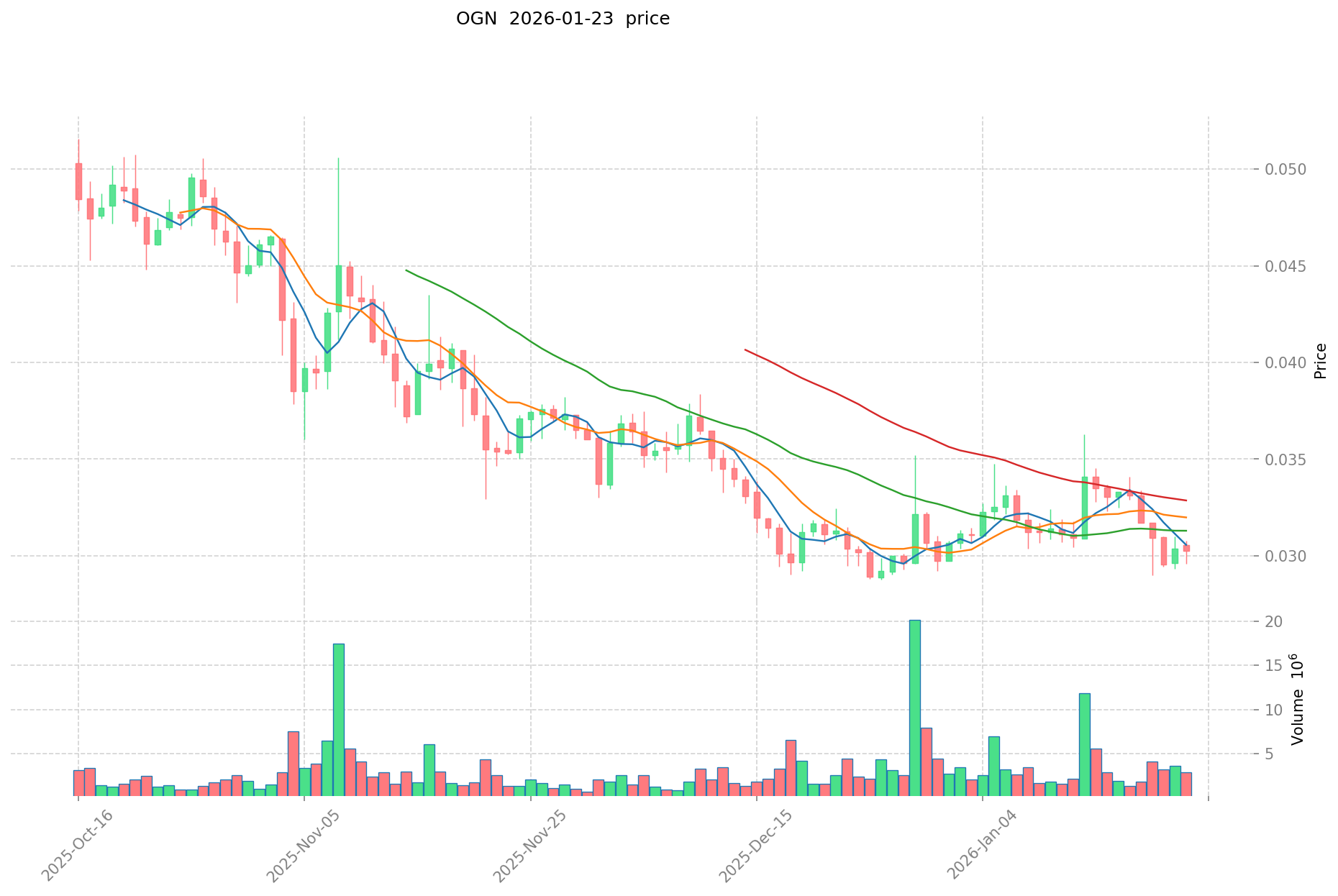
- Recent performance: From late 2025 to early 2026 → Price stabilized around the $0.03 range, showing relatively modest volatility
Current OGN Investment Market Status (January 2026)
- OGN current price: $0.03043
- Market sentiment (Fear & Greed Index): Data not available in provided materials
- 24-hour trading volume: $83,702.74
- Institutional investor holdings: Data not available in provided materials
- Market capitalization: $20,102,064.69
- Circulating supply: 660,600,220 OGN (46.86% of maximum supply)
- Token holders: 45,410 addresses
- Listed exchanges: 26 platforms
Click to view real-time OGN market price
Recent Price Movement Analysis
- 1-hour change: +0.26%
- 24-hour change: -0.35%
- 7-day change: -8.09%
- 30-day change: +0.49%
- 1-year change: -69.52%
The token's market dominance stands at 0.0013%, with a market cap to fully diluted valuation ratio of 46.86%. Trading activity shows the 24-hour price range between $0.0296 (low) and $0.03077 (high).
II. Core Factors Affecting Whether OGN is a Good Investment (Is Origin Protocol(OGN) a Good Investment)
Supply Mechanism and Scarcity (OGN investment scarcity)
- Supply Mechanism → Influences price and investment value
- OGN has a maximum supply of 1,409,664,846 tokens, with approximately 660,600,220 tokens currently in circulation (representing about 46.86% of the total supply).
- The controlled supply design may contribute to scarcity dynamics as adoption increases.
- Historical Context: Price movements have historically been influenced by supply dynamics and market conditions, with significant fluctuations observed over time.
- Investment Significance: The scarcity mechanism, combined with token utility in governance and staking, represents a key consideration for long-term investment evaluation.
Institutional Investment and Mainstream Adoption (Institutional investment in OGN)
- Institutional Holding Trends: Specific institutional holding data is not available in the provided materials.
- Adoption Metrics: OGN is listed on 26 exchanges and has approximately 45,410 holders as of the latest data.
- Policy Environment: The regulatory landscape for DeFi protocols continues to evolve, which may influence institutional participation and adoption trajectories.
Macroeconomic Environment's Impact on OGN Investment
- Monetary Policy and Interest Rates → May alter investment attractiveness relative to traditional assets
- Changes in global monetary conditions can affect risk appetite for DeFi tokens like OGN.
- Inflation Environment: As a DeFi protocol token with yield-generating features, OGN's utility in inflationary contexts differs from traditional store-of-value assets.
- Geopolitical Uncertainty → May influence broader cryptocurrency market sentiment and DeFi adoption patterns.
Technology and Ecosystem Development (Technology & Ecosystem for OGN investment)
- Staking Mechanism: OGN can be locked for periods ranging from 1 month to 1 year, with stakers receiving xOGN that grants voting and economic rights.
- This mechanism creates utility and potential yield opportunities for token holders.
- Revenue Distribution Model: Origin takes performance fees from its yield-generating products, with 50% distributed to OGN stakers as additional rewards and 50% used to purchase flywheel tokens to boost underlying protocol yields.
- This dual-incentive structure may support long-term value accrual.
- Governance Framework: OGN stakers comprise the Origin DAO, which votes on proposals and treasury allocations through fully on-chain governance.
- Decentralized governance may enhance community engagement and protocol sustainability.
- Multichain Functionality: Origin Protocol features a multichain capability set, designed to be permissionless and composable for integration with various DeFi primitives.
- This architectural approach may expand use cases and ecosystem reach.
- DeFi Ecosystem Integration: As one of Ethereum's longstanding DeFi projects, Origin Protocol's products are built to streamline rewards and facilitate deep integration within the broader DeFi landscape.
III. OGN Future Investment Forecast and Price Outlook (Is Origin Protocol(OGN) worth investing in 2026-2031)
Short-term Investment Forecast (2026, short-term OGN investment outlook)
- Conservative forecast: $0.0295 - $0.0304
- Neutral forecast: $0.0304 - $0.0350
- Optimistic forecast: $0.0350 - $0.0435
Mid-term Investment Outlook (2027-2029, mid-term Origin Protocol(OGN) investment forecast)
-
Market stage expectation: During this period, OGN may experience gradual development as the DeFi ecosystem continues to mature. The staking mechanism and governance features could potentially attract more participants to the Origin Protocol ecosystem.
-
Investment return forecast:
- 2027: $0.0292 - $0.0510
- 2028: $0.0233 - $0.0519
- 2029: $0.0321 - $0.0575
-
Key catalysts: Expansion of Origin Protocol's product suite, increased adoption of staking mechanisms, development of multichain capabilities, and broader DeFi market trends.
Long-term Investment Outlook (Is OGN a good long-term investment?)
- Base scenario: $0.0432 - $0.0527 (assuming steady ecosystem development and stable market conditions)
- Optimistic scenario: $0.0527 - $0.0660 (assuming increased DeFi adoption and favorable regulatory environment)
- Risk scenario: $0.0233 - $0.0321 (under adverse market conditions or competitive pressure)
Click to view OGN long-term investment and price forecast: Price Prediction
2026-01-23 - 2031 Long-term Outlook
- Base scenario: $0.0432 - $0.0527 (corresponding to steady progress and gradual mainstream application growth)
- Optimistic scenario: $0.0527 - $0.0660 (corresponding to large-scale adoption and favorable market environment)
- Transformational scenario: Above $0.0660 (if the ecosystem achieves breakthrough progress and mainstream penetration)
- 2031-12-31 predicted high: $0.0660 (based on optimistic development assumptions)
Disclaimer: This analysis is for informational purposes only and should not be considered as investment advice. Cryptocurrency markets are highly volatile and unpredictable. Past performance does not guarantee future results. Investors should conduct their own research and consider their risk tolerance before making any investment decisions.
| Year |
Predicted High Price |
Predicted Average Price |
Predicted Low Price |
Price Change |
| 2026 |
0.0435006 |
0.03042 |
0.0295074 |
0 |
| 2027 |
0.051005214 |
0.0369603 |
0.029198637 |
21 |
| 2028 |
0.05189965326 |
0.043982757 |
0.02331086121 |
44 |
| 2029 |
0.057529446156 |
0.04794120513 |
0.0321206074371 |
57 |
| 2030 |
0.05906356472016 |
0.052735325643 |
0.04324296702726 |
73 |
| 2031 |
0.065961345314264 |
0.05589944518158 |
0.052545478470685 |
83 |
IV. OGN Investment Strategy and Risk Management (How to invest in Origin Protocol)
Investment Methodology (OGN investment strategy)
Long-term Holding (HODL OGN): Suitable for Conservative Investors
For investors seeking a steady approach, long-term holding of OGN may align with a belief in Origin Protocol's multi-chain DeFi ecosystem development. This strategy involves acquiring OGN tokens and holding them through market cycles, potentially participating in the staking mechanism to earn xOGN and associated rewards. The staking model allows locking periods ranging from 1 month to 1 year, with longer commitments yielding proportionally more xOGN. Long-term holders may benefit from governance participation through the Origin DAO and economic rights across Origin's product suite. However, investors should note the token's historical price volatility, with current trading at $0.03043 compared to its all-time high of $3.35 recorded on April 8, 2021.
Active Trading: Relying on Technical Analysis and Swing Operations
Active traders may approach OGN through technical analysis and short-term market movements. With 24-hour trading volume of approximately $83,702 and price fluctuations between $0.0296 (24h low) and $0.03077 (24h high), the token demonstrates intraday volatility that some traders attempt to capitalize on. Recent performance shows -0.35% change over 24 hours, -8.09% over 7 days, and +0.49% over 30 days. Active trading strategies require monitoring market sentiment, on-chain metrics, and broader DeFi sector trends. Traders should be aware that OGN's relatively modest market capitalization of approximately $20.1 million and trading availability across 26 exchanges may influence liquidity conditions.
Risk Management (Risk management for OGN investment)
Asset Allocation Ratio: Conservative / Aggressive / Professional Investors
- Conservative Investors: May consider allocating 1-3% of their cryptocurrency portfolio to OGN, treating it as a speculative position within a broader digital asset strategy. This approach limits exposure while maintaining participation in the DeFi governance token sector.
- Aggressive Investors: Might allocate 5-10% to OGN, accepting higher risk in exchange for potential upside from Origin Protocol's ecosystem development and staking rewards distribution model.
- Professional Investors: Could employ dynamic allocation strategies, adjusting positions based on protocol metrics, treasury performance, and competitive landscape analysis within the yield aggregation space.
Risk Hedging Solutions: Multi-asset Portfolio + Hedging Tools
Investors may consider diversifying beyond OGN into correlated and uncorrelated assets to manage portfolio risk. Strategies include:
- Maintaining exposure to established cryptocurrencies alongside smaller-cap DeFi tokens
- Balancing OGN positions with stablecoin holdings to preserve capital during volatile periods
- Utilizing decentralized finance protocols for yield generation across multiple platforms
- Monitoring correlation with broader Ethereum-based DeFi projects, as Origin Protocol operates primarily on Ethereum
Secure Storage: Hot and Cold Wallets + Hardware Wallet Recommendations
Given OGN's ERC-20 token standard (contract address: 0x8207c1ffc5b6804f6024322ccf34f29c3541ae26 on Ethereum), investors have multiple storage options:
- Hardware Wallets: Physical devices offering offline storage for long-term holdings, reducing exposure to online vulnerabilities
- Cold Wallets: Air-gapped solutions for maximum security, suitable for substantial holdings not intended for active trading or staking
- Hot Wallets: Software-based wallets enabling convenient access for staking participation and governance activities, though with higher security considerations
- Staking Considerations: Investors participating in OGN staking should evaluate the security of staking interfaces and smart contract audits, as locked tokens require trust in the protocol's technical infrastructure
V. OGN Investment Risks and Challenges (Risks of investing in Origin Protocol)
Market Risk: High Volatility and Price Manipulation
OGN exhibits significant price volatility characteristic of smaller-cap cryptocurrency assets. The token has experienced a -69.52% decline over the past year and trades substantially below its historical peak. With a current price of $0.03043 compared to its all-time high of $3.35, investors face considerable drawdown risk. The token's market capitalization of approximately $20.1 million represents 0.0013% market share, indicating limited liquidity relative to major cryptocurrencies. This smaller market presence may contribute to price sensitivity during periods of concentrated buying or selling activity. The circulating supply represents 46.86% of the maximum supply (660.6 million out of 1.41 billion tokens), with potential future token releases possibly affecting supply-demand dynamics.
Regulatory Risk: Policy Uncertainty Across Different Jurisdictions
As a DeFi governance token, OGN operates within an evolving regulatory landscape. Different jurisdictions maintain varying approaches to cryptocurrency classification, DeFi protocol oversight, and token governance mechanisms. Changes in regulatory frameworks regarding:
- Token classification and securities law application
- DeFi protocol compliance requirements
- Staking and yield generation taxation
- Cross-border digital asset transfers
- DAO governance structure recognition
These factors may impact Origin Protocol's operational flexibility and OGN's utility across different markets. Investors should monitor regulatory developments in jurisdictions relevant to their circumstances.
Technical Risk: Network Security Vulnerabilities and Upgrade Failures
Origin Protocol's technical infrastructure presents several risk vectors:
- Smart Contract Risk: The staking mechanism, reward distribution system, and governance contracts require ongoing security maintenance. Vulnerabilities in these systems could affect locked OGN holdings or reward mechanisms.
- Integration Risk: As a permissionless and composable protocol designed for integration with other DeFi primitives, Origin's functionality depends partly on external protocol security and performance.
- Multi-chain Complexity: While Origin Protocol features multi-chain capabilities, managing cross-chain operations introduces additional technical considerations and potential points of failure.
- Upgrade and Governance Risk: Protocol changes require community governance through the Origin DAO. Contentious upgrades or governance disputes could impact protocol development or token value.
VI. Conclusion: Is Origin Protocol a Good Investment?
Investment Value Summary: OGN presents characteristics of an established DeFi governance token with specific utility within Origin Protocol's yield ecosystem. The token's staking mechanism provides economic and governance participation for holders, while the protocol's focus on yield generation and on-chain governance reflects broader DeFi sector trends. However, significant price decline over the past year (-69.52%) and substantial distance from historical highs indicate considerable market challenges and risk factors.
Investor Recommendations:
✅ Beginners: Consider dollar-cost averaging with small allocations and secure wallet storage. Familiarize yourself with Origin Protocol's staking mechanism and governance processes before committing substantial capital. Recognize that OGN represents a higher-risk category within cryptocurrency markets.
✅ Experienced Investors: May explore swing trading opportunities based on technical analysis while maintaining awareness of liquidity constraints. Consider staking participation for xOGN rewards if aligned with longer-term conviction in Origin Protocol's development trajectory. Evaluate OGN within a diversified DeFi token portfolio rather than as an isolated position.
✅ Institutional Investors: Conduct thorough due diligence on Origin Protocol's treasury management, protocol metrics, competitive positioning, and governance structure. Assess token unlock schedules and circulating supply dynamics. Consider OGN as a potential strategic allocation within a broader DeFi governance token thesis, with appropriate position sizing relative to liquidity profiles.
⚠️ Disclaimer: Cryptocurrency investment carries substantial risk, including potential total loss of capital. This content is provided for informational purposes only and does not constitute investment advice. Investors should conduct independent research and consult qualified financial advisors before making investment decisions.
VII. FAQ
Q1: What is Origin Protocol (OGN) and what makes it unique in the DeFi space?
Origin Protocol (OGN) is a governance and value-accrual token within a multichain DeFi ecosystem, launched in January 2020 as one of Ethereum's established DeFi projects. What distinguishes OGN is its innovative staking mechanism that allows users to convert OGN to xOGN by locking tokens for periods ranging from 1 month to 1 year, granting both governance rights through the Origin DAO and economic rewards. The protocol operates with a unique revenue distribution model where 50% of performance fees are distributed to OGN stakers as additional rewards, while the remaining 50% purchases flywheel tokens to boost underlying protocol yields. This dual-incentive structure, combined with its permissionless and composable architecture designed for integration with various DeFi primitives, positions OGN as a utility token with both governance participation and yield-generation capabilities across Origin Protocol's product suite.
Q2: How has OGN performed historically and what is its current market position?
OGN launched at $0.4 in January 2020 and reached its all-time high of $3.35 in April 2021, representing significant appreciation during the 2021 crypto bull market. However, the token has experienced substantial decline since then, currently trading at approximately $0.03043 as of January 23, 2026—a 69.52% decrease over the past year. The token maintains a market capitalization of approximately $20.10 million with a circulating supply of 660.60 million tokens (46.86% of the maximum supply of 1.41 billion). Recent short-term performance shows mixed signals: +0.26% over 1 hour, -0.35% over 24 hours, -8.09% over 7 days, and +0.49% over 30 days. OGN is listed on 26 exchanges with approximately 45,410 token holders and a 24-hour trading volume of $83,702.74, representing a market dominance of 0.0013%.
Q3: What is the staking mechanism for OGN and what rewards can holders expect?
The OGN staking mechanism allows token holders to lock their OGN for predetermined periods ranging from 1 month to 1 year, with longer commitment periods yielding proportionally more xOGN tokens. xOGN represents voting and economic rights within the Origin ecosystem, granting holders governance participation in the Origin DAO and access to economic rewards. The reward structure operates through Origin Protocol's performance fee model: when the protocol generates fees from its yield-generating products, 50% is distributed to OGN stakers as additional rewards, while 50% is used to purchase flywheel tokens to boost underlying protocol yields. This creates a dual-benefit system where stakers receive both direct reward distributions and indirect benefits from enhanced protocol performance. Stakers also gain voting power on protocol proposals and treasury allocations through fully on-chain governance mechanisms.
Q4: What are the primary risks associated with investing in OGN?
Investing in OGN carries several significant risks. Market risk includes high volatility, with the token declining 69.52% over the past year and trading 91% below its all-time high, while its relatively small market cap of $20.1 million (0.0013% market share) may contribute to price manipulation vulnerability and limited liquidity. Regulatory risk stems from evolving DeFi oversight frameworks across different jurisdictions, potentially affecting token classification, staking mechanisms, DAO governance recognition, and cross-border operations. Technical risks include smart contract vulnerabilities in staking and reward distribution systems, integration dependencies with external DeFi protocols, multi-chain operational complexity, and potential governance disputes that could impact protocol development. Additionally, the circulating supply represents only 46.86% of maximum supply, meaning future token releases could affect supply-demand dynamics and price performance.
Q5: What are the price forecasts for OGN from 2026 to 2031?
Price forecasts for OGN vary based on different scenarios and timeframes. For 2026, conservative estimates range from $0.0295 to $0.0304, neutral forecasts suggest $0.0304 to $0.0350, and optimistic projections reach $0.0350 to $0.0435. Mid-term outlooks show gradual progression: 2027 ($0.0292-$0.0510), 2028 ($0.0233-$0.0519), and 2029 ($0.0321-$0.0575). Long-term forecasts for 2030-2031 under a base scenario range from $0.0432 to $0.0527, assuming steady ecosystem development. Optimistic scenarios project $0.0527 to $0.0660 with increased DeFi adoption and favorable regulations, while risk scenarios suggest $0.0233 to $0.0321 under adverse conditions. The 2031 predicted high reaches $0.0660, representing an 83% increase from current levels. However, these projections should be viewed cautiously given cryptocurrency market volatility and the speculative nature of long-term price forecasting.
Q6: Which investment strategy is most suitable for different types of OGN investors?
Investment strategies for OGN should align with investor experience and risk tolerance. Beginners should consider dollar-cost averaging with 1-3% portfolio allocation, focusing on secure wallet storage and familiarizing themselves with Origin Protocol's staking and governance mechanisms before committing substantial capital. Experienced investors might allocate 5-10% to OGN, exploring swing trading opportunities based on technical analysis while monitoring the token's 24-hour price range ($0.0296-$0.03077) and participating in staking for xOGN rewards if aligned with longer-term conviction. Professional investors could employ dynamic allocation strategies, adjusting positions based on protocol metrics, treasury performance, and competitive landscape analysis within the yield aggregation space. Long-term holding (HODL) suits conservative investors who believe in Origin Protocol's multi-chain DeFi ecosystem development and are willing to participate in staking for governance rights and economic rewards despite historical volatility.
Q7: How does OGN's governance model work and what rights do token holders have?
OGN operates through a decentralized autonomous organization (DAO) governance model where OGN stakers collectively comprise the Origin DAO. By staking OGN tokens and receiving xOGN, holders gain voting rights on protocol proposals and treasury allocation decisions through fully on-chain governance mechanisms. The governance framework is designed to be permissionless and community-driven, allowing stakeholders to participate in key decisions affecting Origin Protocol's development direction, parameter adjustments, and resource distribution. The amount of voting power corresponds to the quantity and duration of OGN staked—longer lock-up periods generate more xOGN, thus granting greater governance influence. This structure aligns token holder incentives with protocol success while promoting active community engagement in ecosystem development. The on-chain nature of governance ensures transparency and verifiability of all voting activities and proposal outcomes.
Q8: What factors should investors monitor when evaluating OGN's future potential?
Investors should monitor several key factors when assessing OGN's investment potential. Ecosystem development metrics include adoption rates of Origin Protocol's yield-generating products, total value locked (TVL) in staking contracts, and expansion of multichain capabilities. Market indicators encompass trading volume trends across 26 listed exchanges, token holder growth beyond the current 45,410 addresses, and correlation with broader DeFi sector performance. Protocol-specific metrics involve governance participation rates, treasury management effectiveness, and the performance fee revenue generation that funds staker rewards. Technical developments include smart contract audits, security assessments, and successful implementation of protocol upgrades. Regulatory landscape changes affecting DeFi protocols, staking mechanisms, and DAO governance across different jurisdictions require ongoing monitoring. Competitive positioning within the yield aggregation and DeFi governance token sectors, including comparisons with similar protocols, provides context for evaluating OGN's relative strength and market differentiation.
* The information is not intended to be and does not constitute financial advice or any other recommendation of any sort offered or endorsed by Gate.