OriginTrail (TRAC) operates as a verifiable knowledge infrastructure ecosystem designed to combat misinformation across supply chain, AI, and real-world asset applications. With a market capitalization of $188.70 million (ranking #247) and current price of $0.4219, TRAC presents a mid-cap cryptocurrency opportunity within the blockchain verification sector. This comprehensive analysis evaluates TRAC's investment value through historical price performance, core technological factors, 2026-2031 price scenarios ranging from $0.24 to $0.82, and diversified investment strategies. Key investment drivers include fixed 500 million token supply, enterprise partnerships across construction and healthcare sectors, and positioning within growing AI verification markets. However, investors must carefully evaluate market volatility (-46.05% annually), regulatory uncertainties, and technical dependencies on Ethereum infrastructure. Suitable for long-term holders and experienced traders on Gate, TRAC requires thorough due di
Introduction: OriginTrail (TRAC) Investment Position and Market Outlook
TRAC is a notable asset in the cryptocurrency sector, launched in February 2018, and has gained recognition in the fields of AI-verifiable internet infrastructure and supply chain data management. As of January 16, 2026, OriginTrail holds a market capitalization of approximately $188.70 million, with a circulating supply of around 447.27 million tokens, and the current price maintains at approximately $0.4219. With its positioning as a "Verifiable Internet for AI" ecosystem, TRAC has gradually become a focal point for investors discussing "Is OriginTrail (TRAC) a good investment?" This article will comprehensively analyze TRAC's investment value, historical trends, future price outlook, and investment risks to provide reference for investors.
OriginTrail operates as an ecosystem designed to combat misinformation through verifiable information tracking, initially serving global supply chains and now expanding into AI knowledge ecosystems. The technology finds applications across real-world assets (RWAs), search engines, question-answering systems, and knowledge-dependent applications. With support from world-class organizations, OriginTrail continues to develop its trusted knowledge network across multiple industries including asset tokenization, construction, healthcare, and the metaverse.
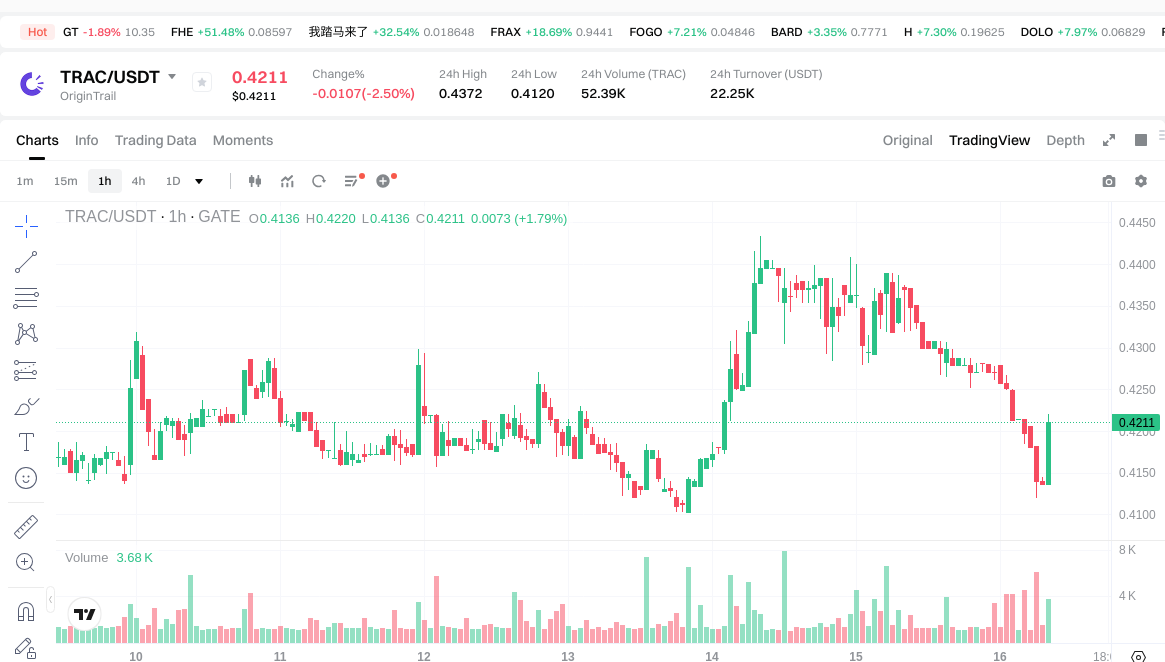
Currently ranked 247th by market capitalization with a market dominance of 0.0062%, TRAC has experienced varying price movements across different timeframes. The token showed a 2.01% increase over the past hour and a 1.47% gain over the past seven days, while experiencing a 3.1% decline in the past 24 hours. Over the past year, the price has decreased by 46.052%. The token's circulating supply represents approximately 89.45% of the maximum supply of 500 million tokens, with approximately 22,998 holders as of the latest data.
This analysis will examine the fundamental characteristics of OriginTrail, evaluate its technological framework and market positioning, assess historical price performance, explore potential future price scenarios, and identify key risk factors that investors should consider when evaluating TRAC as part of their portfolio strategy.
I. OriginTrail (TRAC) Price History Review and Current Investment Value
- 2025: Price reached $0.54 on December 10, 2025 → Subsequent price adjustment led to decline
- 2025: Price dropped to $0.372 on December 23, 2025 → Market experienced significant volatility
- Recent period: Price fluctuated from $0.54 to $0.372 → Market showed notable price movement
Current TRAC Investment Market Status (January 2026)
- Current TRAC price: $0.4219
- Market sentiment (Fear & Greed Index): Data not available in provided materials
- 24-hour trading volume: $22,258.62
- Institutional investor holdings: Data not available in provided materials
Click to view real-time TRAC market price
II. Core Factors Influencing Whether TRAC is a Good Investment
Supply Mechanism and Scarcity (TRAC Investment Scarcity)
- Fixed supply cap: TRAC has a maximum supply of 500,000,000 tokens, with approximately 447,274,118 tokens (89.45%) currently in circulation. This finite supply structure may contribute to potential value appreciation as adoption grows.
- Supply dynamics: The circulating supply represents a substantial portion of the total supply, indicating most tokens are already in the market. This distribution pattern can influence price behavior and investment considerations.
- Investment significance: The predetermined supply limit, combined with potential increasing demand from enterprise adoption in supply chain and AI verification applications, forms a foundational element for long-term investment evaluation.
Institutional Investment and Mainstream Adoption (Institutional Investment in TRAC)
- Holder base: TRAC currently has 22,998 holders, suggesting a distributed ownership structure across retail and potentially institutional participants.
- Enterprise partnerships: The project is supported by world-class organizations across multiple industries including asset tokenization, construction, healthcare, and metaverse applications, which may enhance its investment profile.
- Sector positioning: OriginTrail's focus on verifiable AI and blockchain integration positions it within growing technology sectors that may attract institutional interest as these markets mature.
Macroeconomic Environment Impact on TRAC Investment
- Market correlation: TRAC's 24-hour price movement of -3.1% reflects sensitivity to broader cryptocurrency market conditions and macroeconomic factors.
- Risk-on asset characteristics: As a mid-cap cryptocurrency (ranking #247), TRAC tends to exhibit higher volatility compared to larger digital assets, responding to changes in market sentiment and economic policy.
- Technology sector exposure: The project's connection to AI and enterprise blockchain applications creates exposure to technology sector trends and regulatory developments in these domains.
Technology and Ecosystem Development (Technology & Ecosystem for TRAC Investment)
- Verifiable Internet for AI: OriginTrail's core technology focuses on building infrastructure to combat misinformation through verifiable information tracking, addressing a growing need as AI adoption accelerates.
- Knowledge graph infrastructure: The decentralized knowledge graph technology enables applications in real-world assets (RWAs), search engines, and AI systems, potentially expanding use cases.
- Multi-industry applications: The technology's applicability across supply chain management, asset tokenization, healthcare, and metaverse sectors provides multiple pathways for ecosystem growth and investment value development.
- ERC20 standard deployment: TRAC operates on the Ethereum network, benefiting from established infrastructure while also facing network congestion and fee considerations that can impact ecosystem activity.
III. TRAC Future Investment Forecast and Price Outlook (Is OriginTrail(TRAC) worth investing in 2026-2031)
Short-term Investment Outlook (2026, short-term TRAC investment outlook)
- Conservative forecast: $0.24 - $0.42
- Neutral forecast: $0.42 - $0.47
- Optimistic forecast: $0.47 - $0.53
Mid-term Investment Outlook (2027-2028, mid-term OriginTrail(TRAC) investment forecast)
- Market stage expectation: The period may witness gradual ecosystem development and potential adoption expansion across supply chain and AI verification use cases.
- Investment return forecast:
- 2027: $0.46 - $0.50
- 2028: $0.40 - $0.66
- Key catalysts: Technological advancement in verifiable internet infrastructure, partnership expansion in enterprise sectors, and growing demand for AI-driven data verification solutions.
Long-term Investment Outlook (Is TRAC a good long-term investment?)
- Base scenario: $0.55 - $0.72 (assuming steady ecosystem growth and moderate adoption in knowledge verification applications)
- Optimistic scenario: $0.65 - $0.82 (assuming accelerated enterprise adoption and favorable market conditions for blockchain-based verification solutions)
- Risk scenario: $0.40 - $0.62 (in the event of market headwinds or slower-than-expected technology adoption)
Click to view TRAC long-term investment and price forecast: Price Prediction
2026-2031 Long-term Outlook
- Base scenario: $0.40 - $0.71 USD (corresponding to steady progress and gradual mainstream application adoption)
- Optimistic scenario: $0.55 - $0.82 USD (corresponding to large-scale adoption and favorable market environment)
- Transformative scenario: Above $0.82 USD (if the ecosystem achieves breakthrough development and mainstream adoption)
- 2031-12-31 projected high: $0.74 USD (based on optimistic development assumptions)
Disclaimer: The forecasts presented are based on historical data patterns and market analysis models. Cryptocurrency markets are highly volatile and subject to numerous unpredictable factors. These projections should not be considered as investment advice, and actual prices may differ significantly from predictions. Investors should conduct their own research and consider their risk tolerance before making investment decisions.
| Year |
Predicted High Price |
Predicted Average Price |
Predicted Low Price |
Price Change |
| 2026 |
0.534797 |
0.4211 |
0.235816 |
0 |
| 2027 |
0.501845925 |
0.4779485 |
0.45883056 |
13 |
| 2028 |
0.65646226475 |
0.4898972125 |
0.396816742125 |
16 |
| 2029 |
0.6534249020325 |
0.573179738625 |
0.4585437909 |
35 |
| 2030 |
0.815692086037237 |
0.61330232032875 |
0.551972088295875 |
45 |
| 2031 |
0.735932119278483 |
0.714497203182993 |
0.621612566769204 |
69 |
IV. OriginTrail (TRAC) Investment Strategy and Risk Management (How to invest in OriginTrail)
Investment Methodology (OriginTrail investment strategy)
Investors considering OriginTrail (TRAC) exposure may evaluate different approaches based on their risk tolerance and investment horizons:
-
Long-term Holding (HODL OriginTrail): This approach may suit investors focused on the long-term development of verifiable knowledge infrastructure and AI-related applications. Given OriginTrail's positioning in supply chain verification and real-world asset (RWA) tokenization, some investors view it as a strategic allocation within decentralized knowledge networks.
-
Active Trading: More experienced participants may utilize technical analysis and chart patterns to identify potential entry and exit points. OriginTrail has demonstrated price volatility, with historical data showing a high of $0.54 (December 10, 2025) and a low of $0.372 (December 23, 2025). Recent performance indicates a 1-hour change of +2.01%, a 24-hour change of -3.1%, and a 7-day change of +1.47%. Traders may monitor these fluctuations alongside broader market sentiment.
Risk Management (Risk management for OriginTrail investment)
-
Asset Allocation Ratios: Different investor profiles may consider varied exposure levels:
- Conservative investors: May limit exposure to a smaller percentage of their overall portfolio, typically focusing on established assets
- Moderate investors: Could allocate a measured portion to projects with specific use cases like OriginTrail
- Professional investors: May conduct deeper due diligence on technological developments and ecosystem partnerships before determining allocation
-
Risk Hedging Approaches: Diversification across multiple asset classes and blockchain ecosystems may help manage concentration risk. Some investors incorporate stablecoins or traditional hedging instruments alongside crypto holdings.
-
Secure Storage: Security considerations include:
- Cold storage solutions for long-term holdings
- Hardware wallets from reputable manufacturers
- Multi-signature wallets for larger allocations
- Regular security audits of storage practices
V. OriginTrail (TRAC) Investment Risks and Challenges (Risks of investing in OriginTrail)
Market Risk
OriginTrail exhibits notable price volatility characteristics. The token has experienced a 1-year decline of -46.052%, while showing shorter-term fluctuations including a 30-day increase of +2.48%. With a 24-hour trading volume of approximately $22.26 million and a market capitalization around $188.70 million, the asset's liquidity profile warrants consideration. The current market cap to fully diluted valuation ratio stands at 89.45%, indicating a relatively high circulating supply percentage (89.45% of max supply).
Regulatory Risk
Jurisdictional frameworks for blockchain-based verification systems and knowledge networks continue to evolve. Different territories maintain varying approaches to:
- Data verification and provenance tracking systems
- Tokenized asset classifications
- Cross-border data sharing protocols
- AI-related technology regulations
These regulatory uncertainties may influence project development timelines and market accessibility.
Technical Risk
As a project operating on Ethereum infrastructure (contract address: 0xaa7a9ca87d3694b5755f213b5d04094b8d0f0a6f), OriginTrail inherits certain network-dependent considerations:
- Smart contract security and potential vulnerabilities
- Network congestion and transaction costs on the underlying blockchain
- Protocol upgrade implementations and backwards compatibility
- Integration dependencies with partner ecosystems
The project's focus on verifiable knowledge networks and AI applications introduces additional technical complexity that requires ongoing maintenance and development.
VI. Conclusion: Is OriginTrail a Good Investment?
Investment Value Summary
OriginTrail positions itself within the intersection of verifiable data infrastructure, AI knowledge systems, and real-world asset applications. The project has established partnerships across supply chain, healthcare, construction, and asset tokenization sectors. Current market data shows:
- Market cap: approximately $188.70 million
- Ranking: #247 among tracked cryptocurrencies
- Circulating supply: 447.27 million TRAC (89.45% of max supply)
- Recent price volatility with annual decline offset by recent monthly gains
The token's performance reflects broader market dynamics and sector-specific developments in verifiable knowledge infrastructure.
Investor Considerations
✅ New Participants: May consider starting with smaller allocations, utilizing dollar-cost averaging strategies, and prioritizing secure storage solutions through hardware wallets or reputable custody services.
✅ Experienced Investors: Could evaluate technical patterns and market cycles for potential position sizing, while maintaining diversification across multiple blockchain ecosystems and use cases.
✅ Institutional Participants: May conduct comprehensive due diligence on technological roadmaps, partnership developments, and sector-specific adoption metrics before determining strategic allocation sizes.
⚠️ Important Notice: Cryptocurrency investments carry substantial risk including potential total loss of capital. Historical performance does not indicate future results. This analysis provides informational context only and does not constitute investment advice. Investors should conduct independent research and consult qualified financial advisors before making investment decisions.
VII. FAQ
Q1: What is OriginTrail (TRAC) and what problem does it solve?
OriginTrail is a blockchain-based ecosystem designed to combat misinformation through verifiable information tracking, initially serving global supply chains and now expanding into AI knowledge verification. It operates as a "Verifiable Internet for AI" that enables trustworthy data tracking across real-world assets (RWAs), search engines, knowledge-dependent applications, and enterprise systems. The platform addresses the growing challenge of information authenticity in an era of AI-generated content and complex supply chains, providing infrastructure for organizations to verify and track knowledge across multiple industries including asset tokenization, construction, healthcare, and the metaverse.
Q2: How has TRAC performed historically and what is its current market position?
TRAC has experienced significant volatility with a 1-year decline of -46.052%, though it showed recent recovery with a 30-day increase of +2.48% and a 7-day gain of +1.47%. As of January 16, 2026, the token trades at approximately $0.4219 with a market capitalization of $188.70 million, ranking #247 among cryptocurrencies. The token reached a recent high of $0.54 on December 10, 2025, before experiencing correction to $0.372 on December 23, 2025. With approximately 447.27 million tokens in circulation (89.45% of the 500 million maximum supply) and around 22,998 holders, TRAC maintains a relatively established distribution pattern within the mid-cap cryptocurrency segment.
Q3: What are the key factors influencing TRAC's investment value?
Several core factors affect TRAC's investment potential: (1) Fixed supply mechanism with a maximum cap of 500 million tokens creating scarcity dynamics; (2) Enterprise partnerships across multiple industries including supply chain, healthcare, and asset tokenization sectors; (3) Technological positioning at the intersection of AI verification and blockchain infrastructure; (4) ERC20 deployment on Ethereum providing established network infrastructure; (5) Exposure to growing sectors like real-world asset tokenization and AI-driven applications; (6) Market correlation with broader cryptocurrency sentiment and macroeconomic conditions. These elements combine to create both opportunities and risks for potential investors evaluating TRAC's long-term value proposition.
Q4: What are the price forecasts for TRAC through 2031?
Price predictions vary significantly based on adoption scenarios. For 2026, forecasts range from $0.24 (conservative) to $0.53 (optimistic). Mid-term projections suggest 2027 prices between $0.46-$0.50 and 2028 between $0.40-$0.66. Long-term 2031 forecasts indicate a potential range of $0.40-$0.82, with the optimistic scenario projecting a high of approximately $0.74. The base scenario for 2026-2031 spans $0.40-$0.71, reflecting steady ecosystem growth, while transformative scenarios could push prices above $0.82 if breakthrough adoption occurs. However, these projections carry substantial uncertainty and depend on factors including technology adoption, market conditions, regulatory developments, and partnership execution.
Q5: What are the primary risks associated with investing in TRAC?
TRAC investment carries multiple risk categories: (1) Market risk including high volatility, demonstrated by the 46% annual decline and frequent price fluctuations; (2) Liquidity considerations with a 24-hour trading volume of approximately $22.26 million; (3) Regulatory uncertainty surrounding blockchain verification systems, data provenance protocols, and AI-related technologies across different jurisdictions; (4) Technical risks including smart contract vulnerabilities, Ethereum network dependency, and complex protocol upgrade requirements; (5) Adoption risk related to enterprise integration timelines and competitive landscape in verifiable knowledge infrastructure. The cryptocurrency's mid-cap status (#247 ranking) and sector-specific focus introduce concentration risk that requires careful portfolio management and diversification strategies.
Q6: What investment strategies are suitable for different types of TRAC investors?
Investment approaches vary by investor profile. Long-term holders (HODLers) may focus on strategic allocation within decentralized knowledge networks, emphasizing the project's positioning in supply chain verification and RWA tokenization. Active traders might utilize technical analysis to navigate the demonstrated volatility, referencing recent price movements (ranging from $0.372 to $0.54). Conservative investors typically limit exposure to smaller portfolio percentages, moderate investors allocate measured portions based on specific use case evaluation, while professional investors conduct comprehensive due diligence on technological roadmaps and partnership developments. Risk management should include appropriate asset allocation ratios, diversification across blockchain ecosystems, and secure storage practices using hardware wallets or multi-signature solutions for larger holdings.
Q7: How does OriginTrail's technology differentiate it from other blockchain projects?
OriginTrail distinguishes itself through its focus on verifiable knowledge graph infrastructure specifically designed to combat misinformation in AI systems. Unlike general-purpose blockchains, TRAC specializes in creating trusted knowledge networks that enable applications in real-world asset tracking, enterprise data verification, and AI-dependent systems. The project operates across multiple industries including supply chain management, healthcare, construction, and metaverse applications, providing specialized infrastructure rather than competing as a general smart contract platform. Its deployment as an ERC20 token on Ethereum allows it to leverage established network effects while focusing development resources on knowledge verification protocols and enterprise integration, positioning it within a specific niche of blockchain-based data integrity solutions.
Q8: What indicators should investors monitor when evaluating TRAC?
Key monitoring metrics include: (1) Price performance across multiple timeframes (1-hour, 24-hour, 7-day, and longer periods) to assess volatility patterns; (2) Trading volume relative to market cap for liquidity assessment; (3) Holder count trends indicating adoption breadth; (4) Partnership announcements and enterprise integration progress across target industries; (5) Technology development milestones and protocol upgrades; (6) Ethereum network conditions affecting transaction costs and user experience; (7) Regulatory developments in data verification and AI-related legislation; (8) Broader cryptocurrency market sentiment and correlation patterns; (9) Competing projects in verifiable knowledge infrastructure; (10) Token supply dynamics including any changes in circulating supply relative to the 500 million maximum cap. These indicators provide a comprehensive framework for ongoing investment evaluation.
* The information is not intended to be and does not constitute financial advice or any other recommendation of any sort offered or endorsed by Gate.