This comprehensive analysis examines Osmosis (OSMO), an advanced AMM protocol built on Cosmos SDK, evaluating its investment viability through multiple dimensions. The article reviews OSMO's price history from launch at $1.041 in 2021 to current levels of $0.05602 in January 2026, analyzing core factors including tokenomics, ecosystem development, and macroeconomic influences. The content provides detailed price scenarios across timeframes, investment strategies encompassing long-term holding and active trading, and risk management frameworks for varying investor profiles. Additionally, it addresses market risks, regulatory uncertainties, and technical challenges while offering specific guidance for beginners, experienced traders, and institutional investors. The analysis concludes with actionable recommendations and FAQ responses addressing key investment considerations.
Introduction: Osmosis (OSMO) Investment Position and Market Outlook
OSMO is an important asset in the cryptocurrency field. Since its launch in 2021, it has made notable progress in the decentralized finance (DeFi) sector. As of January 2026, Osmosis maintains a market capitalization of approximately $42.55 million, with a circulating supply of around 759.49 million tokens, and the current price is maintained at approximately $0.056. Built on the Cosmos SDK as an advanced automated market maker (AMM) protocol, Osmosis allows developers to design, build, and deploy customized AMMs. The OSMO token serves as a governance token, providing token holders with a decentralized coordination method to determine the strategic direction and future changes of the Osmosis protocol. With its positioning as a customizable DeFi infrastructure, OSMO has gradually become a focal point for investors discussing "Is Osmosis (OSMO) a good investment?" This article will comprehensively analyze the investment value, historical trends, future price predictions, and investment risks of OSMO to provide reference for investors.
I. Osmosis (OSMO) Price History Review and Current Investment Value Status
- 2021: OSMO launched with an initial price of approximately $1.041, marking the project's entry into the cryptocurrency market.
- 2022: During the bull market cycle, OSMO reached a significant price level of $11.25 on March 4, 2022, representing substantial gains for early investors.
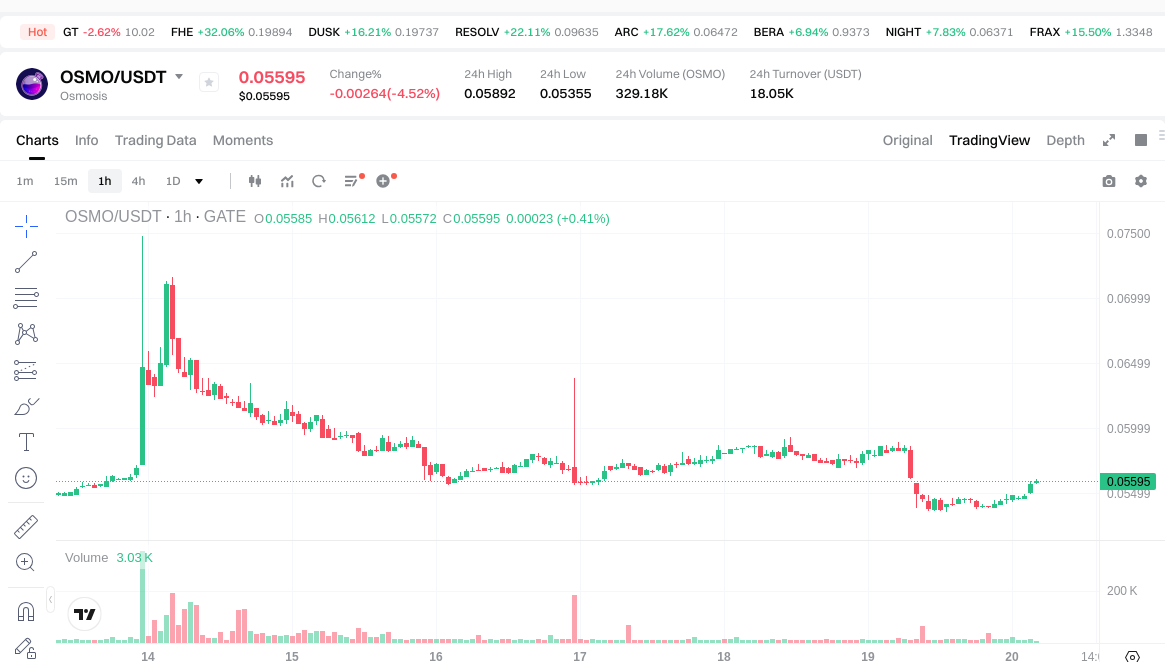
- 2025: Market conditions shifted, with OSMO experiencing notable price fluctuations. On January 1, 2025, the token traded at approximately $0.04890959, followed by price movements that brought it to $0.05602 by January 20, 2026.
Current OSMO Investment Market Status (January 2026)
- OSMO current price: $0.05602
- 24-hour trading volume: $18,079.88 thousand
- Market capitalization: $42.55 million
- Circulating supply: 759.49 million OSMO (representing 75.95% of total supply)
- Fully diluted market cap: $55.20 million
Click to view real-time OSMO market price
II. Core Factors Influencing Whether OSMO is a Good Investment
Supply Mechanism and Scarcity (OSMO Investment Scarcity)
- OSMO has a maximum supply of 1,000,000,000 tokens, with approximately 759,486,300 tokens currently circulating, representing a circulation ratio of 75.95%. The remaining uncirculated tokens may gradually enter the market over time, potentially affecting long-term scarcity dynamics.
- The current market cap to fully diluted valuation (FDV) ratio stands at 75.95%, indicating that a significant portion of the total supply is already in circulation. This relatively high circulation ratio may moderate supply-driven price pressures compared to projects with lower circulation ratios.
- Investment significance: The defined maximum supply provides a degree of predictability regarding future token availability, which may be considered by investors evaluating long-term scarcity characteristics.
Institutional Investment and Mainstream Adoption (Institutional Investment in OSMO)
- OSMO is listed on 22 exchanges, providing accessibility to a range of market participants. The token's market dominance stands at 0.0016%, reflecting its position within the broader cryptocurrency market.
- As an advanced automated market maker (AMM) protocol built using the Cosmos SDK, Osmosis enables developers to design, build, and deploy customized AMMs, which may attract development activity and ecosystem participation.
- Regulatory environments and policy frameworks in different jurisdictions continue to evolve, potentially influencing the adoption trajectory and investment considerations for OSMO and similar decentralized finance (DeFi) protocols.
Macroeconomic Environment's Impact on OSMO Investment
- Global monetary policy shifts, including interest rate adjustments by major central banks, may influence investor risk appetite for digital assets, including OSMO. Tightening monetary conditions could reduce liquidity available for speculative assets, while accommodative policies might support increased participation.
- In periods of elevated inflation, some market participants explore digital assets as alternative portfolio components. However, OSMO's specific role in such strategies depends on individual investor perspectives and risk tolerance.
- Geopolitical developments and economic uncertainties may affect overall cryptocurrency market sentiment, potentially impacting investor interest in DeFi protocols like Osmosis.
Technology and Ecosystem Development (Technology & Ecosystem for OSMO Investment)
- Osmosis functions as an advanced AMM protocol within the Cosmos ecosystem, allowing for customizable liquidity pool parameters and token swap mechanisms. Ongoing technical developments may enhance platform capabilities and user experience.
- The platform supports various DeFi activities including token swaps, liquidity provision, and staking. Governance is facilitated through the OSMO token, enabling token holders to participate in protocol decision-making processes.
- The growth of DeFi applications, cross-chain interoperability solutions, and broader blockchain ecosystem developments may influence the utility and adoption of Osmosis, potentially affecting considerations for long-term value assessment.
III. OSMO Future Investment Prediction and Price Outlook (Is Osmosis(OSMO) worth investing in 2026-2031)
Short-term Investment Prediction (2026, short-term OSMO investment outlook)
- Conservative Prediction: $0.0396 - $0.0558
- Neutral Prediction: $0.0558 - $0.0678
- Optimistic Prediction: $0.0678 - $0.0798
Mid-term Investment Outlook (2027-2029, mid-term Osmosis(OSMO) investment forecast)
-
Market Stage Expectation: The mid-term period may witness gradual ecosystem development and potential expansion in decentralized exchange services adoption, with price movements reflecting evolving market dynamics and protocol developments.
-
Investment Return Prediction:
- 2027: $0.0576 - $0.0902
- 2028: $0.0482 - $0.1130
- 2029: $0.0518 - $0.1402
-
Key Catalysts: Protocol upgrades, growth in decentralized exchange adoption, broader cryptocurrency market trends, and developments within the Cosmos ecosystem.
Long-term Investment Outlook (Is OSMO a good long-term investment?)
- Base Scenario: $0.0758 - $0.1440 (under conditions of steady ecosystem growth and moderate market expansion)
- Optimistic Scenario: $0.1180 - $0.1700 (assuming accelerated adoption and favorable market conditions)
- Risk Scenario: $0.0396 - $0.0906 (under challenging market conditions or development setbacks)
Click to view OSMO long-term investment and price prediction: Price Prediction
2026-2031 Long-term Outlook
- Base Scenario: $0.0558 - $0.1181 USD (corresponding to steady progress and gradual mainstream application enhancement)
- Optimistic Scenario: $0.0791 - $0.1700 USD (corresponding to large-scale adoption and favorable market environment)
- Transformative Scenario: Above $0.1700 USD (such as breakthrough progress in ecosystem and mainstream popularization)
- 2031-12-31 Predicted High: $0.1671 USD (based on optimistic development assumptions)
Disclaimer: These predictions are based on historical data and market analysis models. Cryptocurrency markets are highly volatile and subject to various risk factors. Past performance does not guarantee future results. Investors should conduct thorough research and consider their risk tolerance before making investment decisions.
| Year |
Predicted High Price |
Predicted Average Price |
Predicted Low Price |
Price Change |
| 2026 |
0.0798226 |
0.05582 |
0.0396322 |
0 |
| 2027 |
0.090202329 |
0.0678213 |
0.057648105 |
21 |
| 2028 |
0.112986894735 |
0.0790118145 |
0.048197206845 |
41 |
| 2029 |
0.14015905774155 |
0.0959993546175 |
0.05183965149345 |
71 |
| 2030 |
0.170034056898516 |
0.118079206179525 |
0.075570691954896 |
110 |
| 2031 |
0.167105692585263 |
0.14405663153902 |
0.090755677869582 |
157 |
IV. Osmosis Investment Strategy and Risk Management (How to invest in Osmosis)
Investment Methodology (Osmosis investment strategy)
Long-term Holding (HODL OSMO)
Long-term holding strategies may be suitable for investors with a stable risk appetite. This approach involves acquiring OSMO tokens and holding them through market cycles, focusing on the protocol's fundamental development rather than short-term price movements. Investors adopting this strategy typically monitor the project's technological progress, governance participation rates, and ecosystem expansion.
Active Trading
Active trading strategies rely on technical analysis and swing trading techniques. Traders may utilize price action patterns, volume indicators, and support/resistance levels to identify entry and exit points. Given OSMO's 24-hour volatility of -3.91% and trading range between $0.05355 and $0.05892, short-term traders should employ strict position sizing and stop-loss mechanisms.
Risk Management (Risk management for OSMO investment)
Asset Allocation Ratio
- Conservative investors: May consider allocating 1-3% of their cryptocurrency portfolio to OSMO, maintaining larger positions in established assets
- Aggressive investors: Could allocate 5-10% of their portfolio to OSMO, accepting higher volatility for potential growth exposure
- Professional investors: May employ dynamic allocation strategies based on market conditions, technical indicators, and protocol developments
Risk Hedging Solutions
Investors can implement risk mitigation through diversified asset portfolios that include multiple blockchain protocols and sectors. Correlation analysis with other Cosmos ecosystem tokens may inform hedging decisions. Position sizing should account for OSMO's historical volatility, with its 1-year performance showing -87.7% decline.
Secure Storage
- Hot wallets: Suitable for active trading amounts, enabling quick access to liquidity on exchanges
- Cold wallets: Recommended for long-term holdings, providing enhanced security through offline storage
- Hardware wallets: Offer robust protection against online threats while maintaining user control of private keys
V. Osmosis Investment Risks and Challenges (Risks of investing in Osmosis)
Market Risk
OSMO exhibits significant price volatility, with its current price of $0.05602 representing a substantial decline from its all-time high of $11.25 recorded on March 4, 2022. The token has experienced a 1-year decline of -87.7%, demonstrating the inherent volatility in the cryptocurrency market. Market participants should be aware that low market capitalization assets (current market cap: $42,546,422.526) may be subject to pronounced price swings driven by relatively small trading volumes.
Regulatory Risk
Cryptocurrency regulations vary significantly across jurisdictions and continue to evolve. Changes in regulatory frameworks, tax treatments, or classification of digital assets could impact OSMO's accessibility, trading volumes, and valuation. Investors should monitor regulatory developments in their respective jurisdictions and assess how policy changes might affect their holdings.
Technical Risk
As a protocol built on the Cosmos SDK, Osmosis faces technical risks including potential smart contract vulnerabilities, network congestion, and protocol upgrade complications. The decentralized nature of the protocol means that governance decisions regarding technical changes are made collectively by token holders, which may introduce implementation delays or disagreements within the community.
VI. Conclusion: Is Osmosis a Good Investment?
Investment Value Summary
Osmosis presents a unique value proposition as an advanced AMM protocol within the Cosmos ecosystem, offering customizable liquidity solutions. However, the token's performance has been challenged, with significant depreciation from historical peaks and a current market dominance of 0.0016%. The circulating supply represents 75.95% of the maximum supply, indicating limited supply-side pressure from future token releases.
Investor Recommendations
✅ Beginners: Consider dollar-cost averaging to mitigate timing risk, and prioritize secure storage solutions such as hardware wallets. Start with small position sizes while learning about the protocol's mechanics and governance model.
✅ Experienced Investors: May employ swing trading strategies during periods of elevated volatility, while maintaining a core long-term position. Portfolio diversification across multiple DeFi protocols and blockchain ecosystems can help manage concentration risk.
✅ Institutional Investors: Could evaluate OSMO as part of a strategic allocation to Cosmos ecosystem protocols, considering its role in inter-blockchain communication and liquidity provision. Due diligence should include analysis of protocol metrics, development activity, and competitive positioning.
⚠️ Disclaimer: Cryptocurrency investments carry substantial risk, including the potential loss of principal. This content is provided for informational purposes only and does not constitute investment advice. Investors should conduct independent research and consult with qualified financial advisors before making investment decisions.
VII. FAQ
Q1: Is Osmosis (OSMO) a good investment for beginners in 2026?
For beginners, OSMO presents both opportunities and significant risks. The token's current price of $0.05602 represents a substantial decline from its all-time high of $11.25, indicating high volatility. Beginners should start with small position sizes (1-3% of their cryptocurrency portfolio) and employ dollar-cost averaging to mitigate timing risk. While Osmosis offers unique DeFi functionality within the Cosmos ecosystem, the 87.7% decline over the past year demonstrates the need for careful risk assessment. Secure storage solutions such as hardware wallets are essential for protecting long-term holdings.
Q2: What is the realistic price prediction for OSMO by 2031?
Based on current market analysis, OSMO's price trajectory through 2031 varies significantly across different scenarios. The base scenario projects a range of $0.0558 to $0.1181, assuming steady ecosystem growth and moderate market expansion. The optimistic scenario suggests $0.0791 to $0.1700, contingent upon accelerated adoption and favorable market conditions. The predicted high for December 31, 2031, stands at $0.1671, representing a potential 198% increase from current levels. However, these projections are subject to numerous variables including protocol development, regulatory changes, and broader cryptocurrency market dynamics.
Q3: How does OSMO's tokenomics affect its long-term investment potential?
OSMO's tokenomics feature a maximum supply of 1 billion tokens, with 759.49 million (75.95%) currently in circulation. This relatively high circulation ratio of 75.95% indicates that most tokens are already available in the market, potentially moderating future supply-driven price pressures compared to projects with lower circulation ratios. The defined maximum supply provides predictability regarding future token availability, which may appeal to long-term investors evaluating scarcity characteristics. However, the remaining 24.05% of tokens entering circulation could create additional selling pressure over time.
Q4: What are the main risks associated with investing in Osmosis?
OSMO investments face three primary risk categories: market risk, regulatory risk, and technical risk. Market risk is evident in the token's 87.7% decline over the past year and its low market dominance of 0.0016%, making it susceptible to pronounced price swings. Regulatory risk stems from evolving cryptocurrency frameworks across different jurisdictions, which could impact accessibility and valuation. Technical risks include potential smart contract vulnerabilities, network congestion, and protocol upgrade complications. The decentralized governance model may also introduce implementation delays or community disagreements that affect protocol development.
Q5: How should investors allocate OSMO in their cryptocurrency portfolio?
Portfolio allocation for OSMO should align with individual risk tolerance and investment objectives. Conservative investors may consider allocating 1-3% of their cryptocurrency portfolio to OSMO, maintaining larger positions in established assets like Bitcoin or Ethereum. Aggressive investors could allocate 5-10% of their portfolio, accepting higher volatility for potential growth exposure. Professional investors may employ dynamic allocation strategies based on market conditions, technical indicators, and protocol developments. Diversification across multiple blockchain protocols and sectors can help manage concentration risk and reduce exposure to single-asset volatility.
Q6: What factors could drive OSMO's price growth in the coming years?
Several catalysts could potentially influence OSMO's price trajectory through 2031. Protocol upgrades and technical improvements may enhance platform capabilities and user experience, attracting more developers and users to the ecosystem. Growth in decentralized exchange adoption and increased DeFi activity could drive demand for OSMO's AMM services. Broader cryptocurrency market trends, particularly bull market cycles, may create favorable conditions for alternative tokens. Developments within the Cosmos ecosystem, including improved cross-chain interoperability and inter-blockchain communication, could enhance OSMO's utility and adoption. However, these positive catalysts must be balanced against ongoing competitive pressures and market uncertainties.
Q7: Is OSMO suitable for active trading or long-term holding?
Both strategies have merit depending on investor goals and expertise. Long-term holding (HODL) may suit investors with stable risk appetites who focus on the protocol's fundamental development rather than short-term price movements. This approach involves monitoring technological progress, governance participation, and ecosystem expansion. Active trading strategies rely on technical analysis and swing trading techniques, utilizing OSMO's volatility patterns, volume indicators, and support/resistance levels. Given the token's 24-hour volatility and historical price movements, active traders should employ strict position sizing and stop-loss mechanisms. The choice between strategies should reflect individual trading experience, time commitment, and risk tolerance.
Q8: How does Osmosis compare to other DeFi protocols as an investment?
Osmosis distinguishes itself as an advanced AMM protocol built on the Cosmos SDK, offering customizable liquidity pool parameters that differentiate it from standard AMM platforms. However, its market capitalization of $42.55 million and market dominance of 0.0016% position it as a smaller player compared to established DeFi protocols. The token's severe depreciation from its all-time high contrasts with some competitors that have maintained stronger price stability. Investors comparing OSMO to other DeFi protocols should evaluate factors including total value locked (TVL), trading volume trends, development activity, and competitive advantages within the Cosmos ecosystem versus alternative blockchain platforms.
* The information is not intended to be and does not constitute financial advice or any other recommendation of any sort offered or endorsed by Gate.