This comprehensive analysis examines whether Owlto Finance (OWL) represents a sound investment opportunity in 2024-2031. OWL is an AI-powered interoperability protocol facilitating cross-chain transfers for native tokens, stablecoins, and real-world assets, serving over 3 million users across 200+ countries with more than 13 million transactions completed. Currently trading at $0.09284 with institutional backing from Matrixport, Bixin Ventures, and others, OWL presents both significant growth potential and substantial risks. The analysis evaluates tokenomics, price history showing extreme volatility (ranging $0.04452-$0.12642), institutional adoption metrics, and technical infrastructure while addressing market, regulatory, and technical risks. Price projections range from $0.10-$0.20 by 2031 under favorable scenarios. Comprehensive investment strategies for conservative, aggressive, and professional investors are provided, alongside detailed risk management guidance for trading on Gate and secure wallet stor
Introduction: Owlto Finance (OWL) Investment Landscape and Market Outlook
OWL is a notable digital asset in the cryptocurrency sector. As an AI-powered interoperability protocol, Owlto Finance facilitates cross-chain transfers and execution for native tokens, stablecoins, and real-world assets (RWA) across various ecosystems. As of January 21, 2026, OWL maintains a market capitalization of approximately $30.64 million with a circulating supply of 330 million tokens, trading at around $0.09284. The project has demonstrated considerable adoption, with its on-chain platform serving over 3 million users across more than 200 countries and regions, processing over 13 million transactions. Backed by institutional investors including Matrixport, Bixin Ventures, CEIC, Presto Labs, Skyland, Blocore, and SNZ, OWL has established a presence within the blockchain interoperability space. With 81,966 token holders and trading availability across 11 exchanges, the asset has garnered attention from market participants evaluating "Is Owlto Finance (OWL) a good investment?" This analysis examines OWL's investment characteristics, historical price movements, future price projections, and associated risks to provide reference information for investors.
I. Cryptocurrency (OWL) Price History Review and Current Investment Value
- 2026: Token Launch and Initial Market Activity → OWL debuted on January 15, 2026, with price movements reflecting early market discovery phase
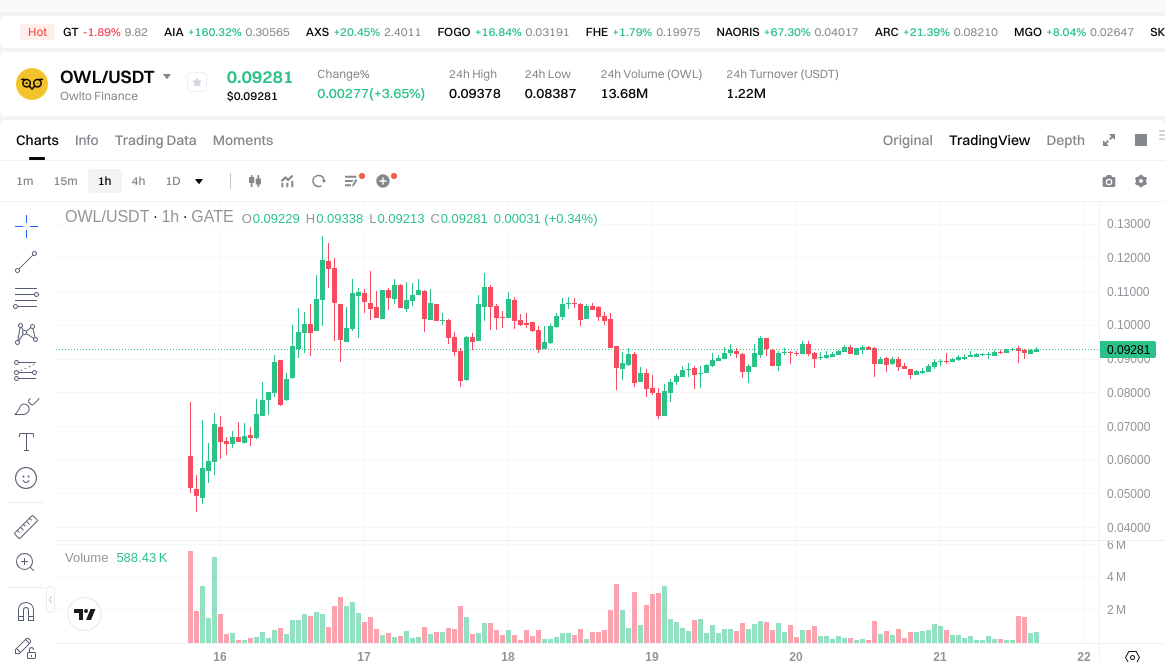
- January 2026: Market Volatility Period → OWL experienced price fluctuations ranging from $0.04452 to $0.12642 during its initial trading days
- Recent Week: Notable Price Movement → The token demonstrated a 30.16% change over a 7-day period, indicating considerable market activity
Current OWL Investment Market Status (January 2026)
- OWL Current Price: $0.09284
- Market Sentiment (Fear & Greed Index): Data not available
- 24-Hour Trading Volume: $1,213,695.01
- Institutional Investor Holdings: The project has received backing from notable institutions including Matrixport, Bixin Ventures, CEIC, Presto Labs, Skyland, Blocore, and SNZ
Click to view real-time OWL market price
II. Core Factors Affecting Whether OWL is a Good Investment (Is Owlto Finance(OWL) a Good Investment)
Supply Mechanism and Scarcity (OWL investment scarcity)
- Supply mechanism → affects price and investment value
- OWL has a maximum supply of 2,000,000,000 tokens, with a current circulating supply of 330,000,000 tokens, representing 16.5% of the total supply. The controlled token release mechanism may support potential long-term value appreciation.
- Historical observations: OWL price has experienced volatility since its launch on January 14, 2026, with price movements between $0.04452 and $0.12642.
- Investment significance: the limited supply model and gradual release schedule represent key structural factors for long-term investment consideration.
Institutional Investment and Mainstream Adoption (Institutional investment in OWL)
- Institutional backing: Owlto Finance has received investment from notable institutions including Matrixport, Bixin Ventures, CEIC, Presto Labs, Skyland, Blocore, and SNZ.
- Adoption metrics: the platform has reached over 3 million users across more than 200 countries and regions, with more than 13 million transactions completed.
- Holder distribution: as of the latest data, OWL has 81,966 token holders, indicating a growing user base.
Macroeconomic Environment's Impact on OWL Investment
- Cryptocurrency market conditions and regulatory developments influence the investment landscape for cross-chain interoperability protocols.
- Market volatility affects investor sentiment toward emerging DeFi infrastructure projects.
- Global financial market dynamics may impact liquidity flows into blockchain-based financial services.
Technology and Ecosystem Development (Technology & Ecosystem for OWL investment)
- AI-powered interoperability protocol: Owlto Finance utilizes AI technology to enable fast, low-cost, and secure cross-chain transfers and execution.
- Cross-chain functionality: the protocol supports liquidity scaling and adoption of native tokens, stablecoins, and real-world assets (RWA) across multiple ecosystems.
- Ecosystem expansion: the platform's growing transaction volume and user base indicate ongoing adoption of its cross-chain infrastructure.
- Technical implementation: OWL operates on the BSC (Binance Smart Chain) with the BEP-20 token standard, facilitating integration with existing DeFi applications.
III. OWL Future Investment Prediction and Price Outlook (Is Owlto Finance(OWL) worth investing in 2026-2031)
Short-term Investment Prediction (2026, short-term OWL investment outlook)
- Conservative Prediction: $0.0760 - $0.0928
- Neutral Prediction: $0.0928 - $0.1104
- Optimistic Prediction: $0.1104 and above
Mid-term Investment Outlook (2027-2029, mid-term Owlto Finance(OWL) investment forecast)
-
Market Stage Expectation: During this period, OWL may experience gradual growth as the cross-chain interoperability protocol expands its user base and transaction volume across multiple ecosystems. The project's AI-powered infrastructure and support for native tokens, stablecoins, and RWA could drive adoption.
-
Investment Return Prediction:
- 2027: $0.0528 - $0.1320
- 2028: $0.1121 - $0.1401
- 2029: $0.0732 - $0.1709
-
Key Catalysts: Expansion of cross-chain liquidity solutions, increased adoption of AI-powered interoperability features, growth in transaction volume, and potential partnerships with additional blockchain ecosystems.
Long-term Investment Outlook (Is OWL a good long-term investment?)
- Base Scenario: $0.0973 - $0.1811 (assuming steady ecosystem development and moderate user growth)
- Optimistic Scenario: $0.1654 - $0.2034 (assuming accelerated adoption of cross-chain solutions and favorable market conditions)
- Risk Scenario: Below $0.0528 (under adverse market conditions or significant competitive pressure)
Click to view OWL long-term investment and price prediction: Price Prediction
2026-01-21 - 2031 Long-term Outlook
- Base Scenario: $0.10 - $0.17 USD (corresponding to steady progress and gradual mainstream application growth)
- Optimistic Scenario: $0.17 - $0.20 USD (corresponding to large-scale adoption and favorable market environment)
- Transformative Scenario: Above $0.20 USD (if the ecosystem achieves breakthrough progress and mainstream adoption)
- 2031-12-31 Predicted High: $0.2034 USD (based on optimistic development assumptions)
Disclaimer: The above predictions are based on historical data and market analysis and do not constitute investment advice. Cryptocurrency markets are highly volatile, and actual prices may differ significantly from predictions. Investors should conduct their own research and consider their risk tolerance before making investment decisions.
| Year |
Predicted High Price |
Predicted Average Price |
Predicted Low Price |
Price Change |
| 2026 |
0.1103606 |
0.09274 |
0.0760468 |
0 |
| 2027 |
0.13201539 |
0.1015503 |
0.052806156 |
9 |
| 2028 |
0.140139414 |
0.116782845 |
0.1121115312 |
26 |
| 2029 |
0.170853302235 |
0.1284611295 |
0.073222843815 |
39 |
| 2030 |
0.181085231199675 |
0.1496572158675 |
0.097277190313875 |
62 |
| 2031 |
0.203406604946312 |
0.165371223533587 |
0.100876446355488 |
79 |
IV. OWL Investment Strategy and Risk Management (How to invest in interoperability protocols)
Investment Methodology (OWL investment strategy)
Long-term Holding (HODL OWL): Suitable for conservative investors
For investors seeking steady growth, a long-term holding strategy may be considered. This approach focuses on the fundamental value of Owlto Finance's interoperability protocol and its expanding user base across 200+ countries and regions. The platform has processed over 13 million transactions with more than 3 million users, indicating growing adoption. Long-term holders typically prioritize the project's technological development and ecosystem expansion over short-term price movements.
Active Trading: Relies on technical analysis and swing operations
Active traders may utilize technical analysis tools to identify entry and exit points based on price movements. Given OWL's 24-hour price change of 4.04% and trading volume of approximately $1.21 million, there may be opportunities for swing trading. Traders often monitor support and resistance levels, with recent data showing a 24-hour high of $0.09378 and low of $0.08387.
Risk Management (Risk management for OWL investment)
Asset Allocation Ratio: Conservative / Aggressive / Professional investors
- Conservative investors: May allocate 1-3% of their crypto portfolio to OWL, focusing on established projects alongside smaller positions in emerging protocols
- Aggressive investors: Could consider 5-10% allocation, accepting higher volatility for potential returns
- Professional investors: May implement dynamic allocation strategies based on market conditions and fundamental analysis
Risk Hedging Solutions: Multi-asset portfolio + hedging tools
Diversification across different cryptocurrency categories (interoperability protocols, DeFi, Layer 1/Layer 2 solutions) can help mitigate concentration risk. Investors may also consider stablecoin positions or hedging instruments to manage downside exposure during volatile periods.
Secure Storage: Hot/cold wallets + hardware wallet recommendations
For OWL tokens (BEP-20 standard on BSC), investors should prioritize secure storage solutions:
- Hardware wallets (cold storage) for long-term holdings
- Reputable software wallets with strong security features for active trading amounts
- Implementation of multi-signature wallets for larger holdings
- Regular security audits of wallet addresses and backup phrase storage
V. OWL Investment Risks and Challenges (Risks of investing in interoperability protocols)
Market Risk: High volatility and price manipulation concerns
OWL has demonstrated significant price volatility, with a 30.16% change over 7 days. The token reached $0.12642 on January 16, 2026, and dropped to $0.04452 on January 15, 2026, reflecting substantial short-term price swings. With a relatively modest 24-hour trading volume of $1.21 million and market capitalization of approximately $30.64 million, the token may be susceptible to larger price movements from significant buy or sell orders.
Regulatory Risk: Policy uncertainty across different jurisdictions
Cross-chain interoperability protocols operate across multiple blockchain networks and jurisdictions, potentially exposing them to varied regulatory frameworks. Changes in cryptocurrency regulations, particularly regarding cross-border transactions and decentralized finance protocols, could impact the platform's operations and token value. Investors should monitor regulatory developments in key markets where Owlto Finance operates.
Technical Risk: Network security vulnerabilities and upgrade failures
As an AI-powered interoperability protocol facilitating cross-chain transfers, Owlto Finance faces inherent technical risks including:
- Smart contract vulnerabilities that could be exploited
- Risks associated with cross-chain bridge security
- Potential challenges in protocol upgrades or integrations with new blockchain networks
- Dependencies on multiple blockchain infrastructures for seamless operations
The platform's security track record and ongoing development should be monitored, though specific technical audit information was not available in the provided materials.
VI. Conclusion: Is interoperability protocol a Good Investment?
Investment Value Summary: OWL presents opportunities tied to the growing demand for cross-chain interoperability solutions, with established user adoption metrics. However, the token exhibits substantial short-term price volatility.
Owlto Finance has demonstrated traction with over 3 million users and 13 million completed transactions, supported by backing from investors including Matrixport, Bixin Ventures, and others. The protocol addresses a genuine need in the cryptocurrency ecosystem—enabling efficient cross-chain transfers for native tokens, stablecoins, and real-world assets.
With a circulating supply of 330 million tokens (16.5% of maximum supply) and a market cap-to-FDV ratio of 16.5%, there is potential for supply expansion that investors should consider. The token's ranking at position 708 and market dominance of 0.0058% indicates it remains a relatively small-cap asset within the broader cryptocurrency market.
Investor Recommendations:
✅ Beginners: Consider dollar-cost averaging (DCA) strategy combined with secure wallet storage practices. Start with small allocations to understand the protocol and market dynamics before increasing exposure.
✅ Experienced Investors: May explore swing trading opportunities while maintaining a core position. Implement portfolio diversification across multiple interoperability protocols and related infrastructure projects.
✅ Institutional Investors: Could evaluate strategic long-term allocation as part of a broader thesis on cross-chain infrastructure development, with appropriate due diligence on technical architecture and competitive positioning.
⚠️ Disclaimer: Cryptocurrency investment carries significant risks. This content is for informational purposes only and does not constitute investment advice. Investors should conduct their own research and consult with financial professionals before making investment decisions.
VII. FAQ
Q1: What is Owlto Finance (OWL) and what problem does it solve?
Owlto Finance (OWL) is an AI-powered interoperability protocol that enables cross-chain transfers and execution for native tokens, stablecoins, and real-world assets (RWA) across various blockchain ecosystems. The protocol addresses the fragmentation problem in the cryptocurrency space by providing fast, low-cost, and secure cross-chain functionality. Operating on BSC (Binance Smart Chain) with the BEP-20 token standard, OWL facilitates seamless liquidity scaling and asset movement between different blockchain networks, serving over 3 million users across more than 200 countries and regions with over 13 million completed transactions.
Q2: Is OWL suitable for long-term investment?
OWL may be considered for long-term investment by investors who believe in the growth potential of cross-chain interoperability solutions, though it carries substantial risks. The token has institutional backing from investors including Matrixport, Bixin Ventures, and SNZ, and demonstrates growing adoption metrics. However, investors should note that OWL is a relatively new token (launched January 15, 2026) with high volatility—experiencing price swings from $0.04452 to $0.12642 in its first week. Conservative investors might allocate 1-3% of their crypto portfolio to OWL, while more aggressive investors could consider 5-10%. Long-term projections suggest potential price ranges of $0.10-$0.20 by 2031 under favorable conditions, though actual performance may vary significantly.
Q3: What are the main risks of investing in OWL?
Investing in OWL involves three primary risk categories. First, market risk: the token exhibits extreme volatility with a 30.16% change over 7 days and a relatively modest 24-hour trading volume of $1.21 million, making it susceptible to price manipulation. Second, regulatory risk: as a cross-chain protocol operating across multiple jurisdictions, OWL faces uncertainty regarding evolving cryptocurrency regulations, particularly concerning cross-border transactions and DeFi protocols. Third, technical risk: the protocol's reliance on cross-chain bridge security, smart contract integrity, and dependencies on multiple blockchain infrastructures creates potential vulnerabilities. Additionally, with only 16.5% of maximum supply currently circulating, significant token releases could impact price dynamics.
Q4: How does OWL's tokenomics affect its investment potential?
OWL's tokenomics feature a maximum supply of 2 billion tokens with only 330 million currently circulating (16.5% of total supply), suggesting a controlled release schedule that may influence long-term price dynamics. This limited circulating supply could support price appreciation if demand grows, but also means substantial token unlocks may occur in the future. With 81,966 token holders and a market capitalization of approximately $30.64 million, OWL remains a relatively small-cap asset ranked at position 708 with 0.0058% market dominance. The gradual token release mechanism combined with growing user adoption (3+ million users) and transaction volume (13+ million transactions) represents a key structural consideration for investors evaluating long-term value potential.
Q5: What investment strategies are recommended for OWL?
Different investor types should consider tailored approaches to OWL investment. Conservative investors may employ a dollar-cost averaging (DCA) strategy, allocating 1-3% of their crypto portfolio to OWL and prioritizing secure cold storage via hardware wallets for long-term holdings. Aggressive traders might pursue swing trading opportunities based on technical analysis, given the token's significant price volatility—monitoring support levels around $0.08387 and resistance near $0.12642. Professional investors could implement dynamic allocation strategies, adjusting positions based on protocol development milestones and market conditions. Regardless of strategy, all investors should maintain proper risk management through portfolio diversification across multiple interoperability protocols, consideration of stablecoin hedging positions during volatile periods, and implementation of multi-signature wallets for larger holdings.
Q6: How does institutional backing influence OWL's investment outlook?
Institutional investment from notable firms including Matrixport, Bixin Ventures, CEIC, Presto Labs, Skyland, Blocore, and SNZ provides credibility signals and potential strategic support for Owlto Finance's development. These institutional backers typically conduct extensive due diligence before investment, suggesting confidence in the project's technical infrastructure and market opportunity. Such backing can facilitate access to industry networks, technical expertise, and additional capital for ecosystem expansion. However, investors should note that institutional investment does not guarantee success—the protocol must still deliver on technical execution, user growth, and competitive differentiation within the crowded interoperability protocol space. The presence of established crypto-native investors may also indicate potential for future exchange listings and partnership opportunities that could expand OWL's market reach.
* The information is not intended to be and does not constitute financial advice or any other recommendation of any sort offered or endorsed by Gate.