This comprehensive analysis examines PAAL AI (PAAL), an AI-powered cryptocurrency project with a $39.05 million market cap and 56,925 token holders across 12 exchanges including Gate. The article evaluates PAAL's investment viability by analyzing its price history, ranging from $0.0088 to $0.88, and current trading at $0.0391 with near-complete circulation of 99.87% maximum supply. Core investment factors include supply mechanics, institutional adoption, macroeconomic influences, and AI-ML technology development within the ecosystem. The analysis presents investment methodologies for different investor profiles—conservative, aggressive, and professional—alongside comprehensive risk management strategies encompassing asset allocation, hedging solutions, and secure storage recommendations. Key risks assessed include market volatility, regulatory uncertainty, and technical dependencies on Ethereum infrastructure. Investment recommendations span from beginner dollar-cost averaging approaches to experienced trader
Introduction: PAAL AI (PAAL) Investment Position and Market Outlook
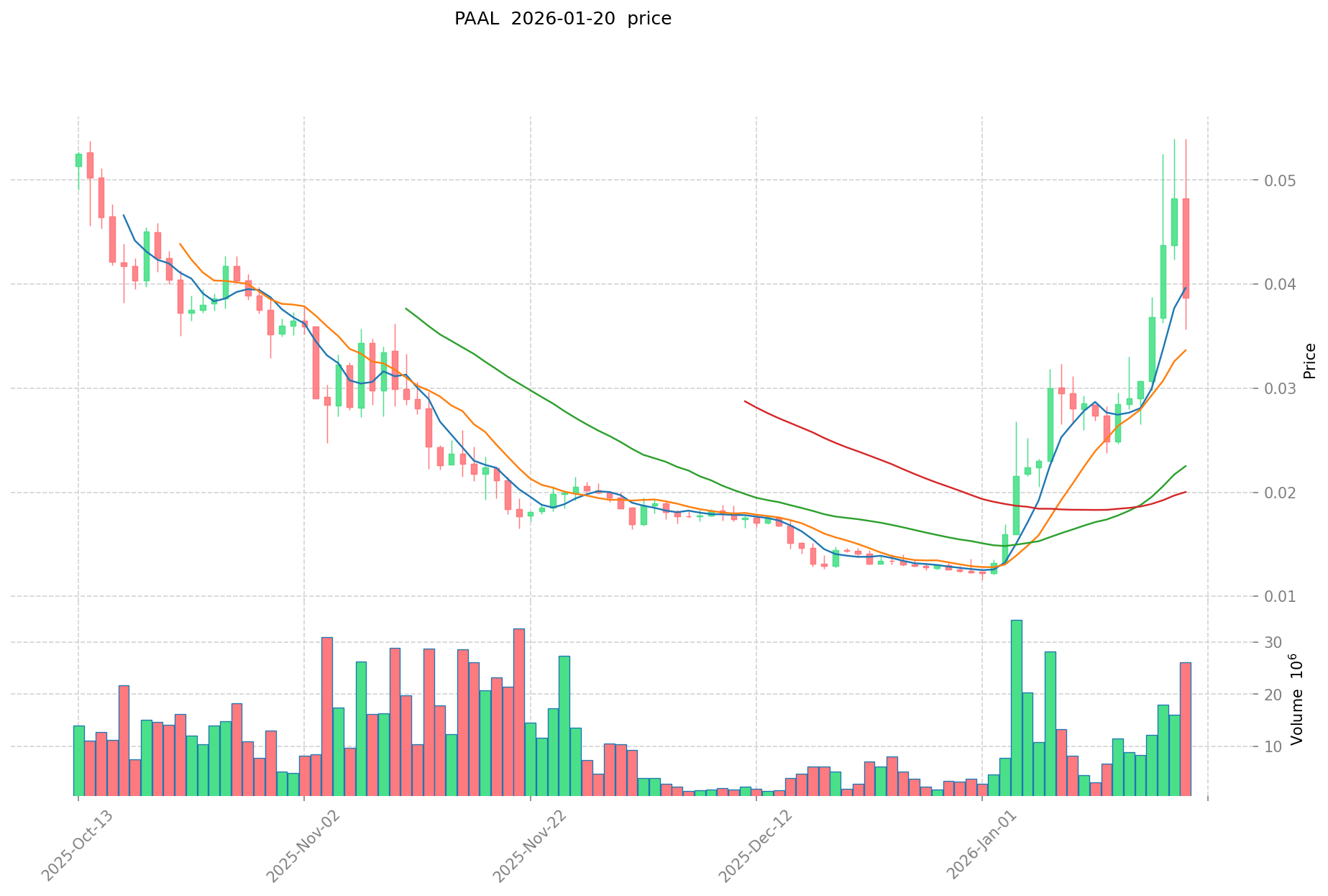
PAAL AI (PAAL) represents an emerging digital asset in the cryptocurrency sector, operating as an advanced ecosystem with chatbots built on artificial intelligence and machine learning technologies. Since its launch in June 2023, the project has focused on streamlining tasks such as natural language understanding, decision-making, and trading. As of January 20, 2026, PAAL maintains a market capitalization of approximately $39.05 million, with a circulating supply of around 998.65 million tokens and a current price near $0.0391. The token has experienced notable price movements over various timeframes, including a 48.85% increase over seven days and a 180.29% rise over thirty days, while showing an 88.39% decline over the one-year period. With a market share of 0.0012% and trading across 12 exchanges, PAAL has attracted attention from approximately 56,925 holders. The token's fully diluted valuation stands at $39.1 million, representing 99.87% of its market cap to FDV ratio. This article examines PAAL's investment characteristics, historical price performance, potential future trajectories, and associated risk factors to provide analytical perspectives for market participants considering exposure to this AI-focused cryptocurrency project.
I. PAAL Token Price History Review and Current Investment Value Status
- 2023: Token launch in June at $0.00008 → Early investors experienced notable returns as price gradually increased from initial levels
- 2023: Price reached low point of $0.0088 in September → Market volatility resulted in significant price fluctuations during initial trading period
- 2024: Market expansion phase → Price climbed from early 2024 levels to $0.88 in March, followed by subsequent market adjustments
- Recent performance: One-year period → Price decreased by 88.39% from previous levels to current trading range
Current PAAL Investment Market Status (January 2026)
- PAAL current price: $0.0391
- 24-hour trading volume: $859,353.40
- Circulating supply: 998,652,231.48 PAAL tokens
- Market capitalization: Approximately $39.05 million
- Market cap to fully diluted valuation ratio: 99.87%
- Total token holders: 56,925
- Recent price movements: +3.50% (1H), -1.01% (24H), +48.85% (7D), +180.29% (30D)
Click to view real-time PAAL market price
II. Core Factors Affecting Whether PAAL AI (PAAL) is a Good Investment
Supply Mechanism and Scarcity (PAAL investment scarcity)
-
Fixed Supply Model → Impact on Price and Investment Value
PAAL AI has a maximum supply of 1,000,000,000 tokens, with a circulating supply of approximately 998,652,231 tokens as of January 20, 2026, representing a circulation ratio of 99.87%. This near-complete circulation indicates limited future supply expansion.
-
Historical Pattern: Supply dynamics have influenced PAAL price movements
The token reached a notable price level of $0.88 in March 2024, compared to a lower range of $0.0088 in September 2023. As of January 20, 2026, the token is trading at approximately $0.0391.
-
Investment Significance: Scarcity as a factor in long-term investment consideration
With nearly all tokens already in circulation and a capped maximum supply, the supply-side pressure from new token releases appears minimal, which may be a relevant factor for investors evaluating long-term holding strategies.
Institutional Investment and Mainstream Adoption (Institutional investment in PAAL)
-
Holder Base Trend: Data indicates 56,925 holders
The token is listed on 12 exchanges, with a 24-hour trading volume of approximately $859,353 as of January 20, 2026.
-
Ecosystem Positioning and Investment Value
PAAL AI is positioned as an advanced ecosystem featuring chatbots built on AI and machine learning technologies, designed to streamline tasks such as natural language understanding, decision-making, and trading. The practical application scope of these AI-driven solutions may influence its adoption trajectory.
Macroeconomic Environment's Impact on PAAL Investment
-
Monetary Policy and Interest Rate Changes → Altering Investment Attractiveness
Shifts in global monetary policy and interest rate environments can affect risk appetite for digital assets. The token's year-over-year performance shows a decline of approximately 88.39% as of January 20, 2026, reflecting broader market volatility and macroeconomic conditions.
-
Geopolitical Uncertainty → Potential Effect on PAAL Investment Demand
Periods of geopolitical instability may drive investors toward or away from digital assets depending on risk tolerance and market sentiment.
Technology and Ecosystem Development (Technology & Ecosystem for PAAL investment)
-
AI and ML Technology Foundation: Enhancing Network Functionality → Investment Attractiveness
PAAL AI's core technology focuses on AI and machine learning applications, which aim to simplify tasks traditionally requiring human intelligence. The development and expansion of these capabilities may serve as a factor in long-term value assessment.
-
Ecosystem Application Expansion → Long-term Value Support
The integration of AI-driven solutions across various use cases, including natural language processing and decision-making support, represents potential areas for ecosystem growth. The extent to which these applications gain traction could influence the token's utility and investment profile.
III. PAAL Future Investment Forecast and Price Outlook (Is PAAL AI(PAAL) worth investing in 2026-2031)
Short-term Investment Forecast (2026, short-term PAAL investment outlook)
- Conservative Forecast: $0.023 - $0.041
- Neutral Forecast: $0.038 - $0.041
- Optimistic Forecast: $0.041 - $0.045
Mid-term Investment Outlook (2027-2028, mid-term PAAL AI(PAAL) investment forecast)
- Market Stage Expectation: The token may experience gradual growth as the AI and ML chatbot ecosystem continues to develop, with potential increases in adoption across decentralized platforms.
- Investment Return Forecast:
- 2027: $0.029 - $0.058
- 2028: $0.026 - $0.053
- Key Catalysts: Expansion of chatbot functionalities, partnerships within the AI sector, and broader integration of natural language processing technologies in blockchain applications.
Long-term Investment Outlook (Is PAAL a good long-term investment?)
- Base Scenario: $0.037 - $0.052 (assuming steady ecosystem development and moderate market conditions)
- Optimistic Scenario: $0.052 - $0.085 (assuming accelerated adoption, favorable regulatory environment, and significant technological advancements)
- Risk Scenario: $0.026 - $0.037 (under adverse market conditions or increased competition in AI-driven blockchain solutions)
View PAAL long-term investment and price forecast: Price Prediction
2026-2031 Long-term Outlook
- Base Scenario: $0.037 - $0.065 (corresponding to steady progress and gradual mainstream application growth)
- Optimistic Scenario: $0.065 - $0.085 (corresponding to large-scale adoption and favorable market environment)
- Transformative Scenario: Above $0.085 (if the ecosystem achieves breakthrough developments and mainstream penetration)
- 2031-12-31 Predicted High: $0.085 (based on optimistic development assumptions)
Disclaimer: The above forecasts are for informational purposes only and do not constitute investment advice. Cryptocurrency markets are highly volatile, and actual performance may differ significantly from predictions.
| Year |
Predicted High Price |
Predicted Average Price |
Predicted Low Price |
Price Change |
| 2026 |
0.0451 |
0.041 |
0.02296 |
4 |
| 2027 |
0.057687 |
0.04305 |
0.0288435 |
10 |
| 2028 |
0.052886925 |
0.0503685 |
0.02619162 |
28 |
| 2029 |
0.053176543875 |
0.0516277125 |
0.036655675875 |
32 |
| 2030 |
0.078079170999375 |
0.0524021281875 |
0.05030604306 |
34 |
| 2031 |
0.085465250967403 |
0.065240649593437 |
0.05219251967475 |
66 |
IV. PAAL AI Investment Strategy and Risk Management (How to invest in AI crypto tokens)
Investment Methodology (PAAL AI investment strategy)
Long-term Holding (HODL PAAL)
For conservative investors, a long-term holding strategy may be considered for PAAL AI tokens. This approach involves acquiring tokens and maintaining positions over extended periods, potentially benefiting from the development of the PAAL AI ecosystem and broader adoption of AI-powered chatbot solutions in the cryptocurrency space.
Active Trading
Active trading strategies for PAAL AI rely on technical analysis and swing trading approaches. Given the token's notable price fluctuations—with a 24-hour range between $0.03564 and $0.04834, and a 7-day increase of approximately 48.85%—traders may identify opportunities through chart patterns and momentum indicators. However, such strategies require continuous market monitoring and experience in technical analysis.
Risk Management (Risk management for PAAL AI investment)
Asset Allocation Ratios
- Conservative Investors: May consider allocating 1-3% of their cryptocurrency portfolio to PAAL AI, given its mid-tier market capitalization ranking of 615 and market dominance of 0.0012%.
- Aggressive Investors: Could allocate 5-10% of their crypto holdings, accepting higher volatility in exchange for potential growth opportunities in the AI chatbot sector.
- Professional Investors: May implement dynamic allocation strategies based on market conditions, technical indicators, and fundamental developments within the PAAL AI ecosystem.
Risk Hedging Solutions
A diversified portfolio approach is recommended, combining PAAL AI with established cryptocurrencies and potentially other AI-focused tokens. Portfolio diversification across different blockchain sectors can help mitigate concentration risk.
Secure Storage
- Hot Wallets: Suitable for active trading portions, enabling quick access to tokens on exchanges like Gate.com where PAAL has trading pairs.
- Cold Wallets: Recommended for long-term holdings to minimize exposure to online security threats.
- Hardware Wallets: Provide enhanced security for significant holdings, offering offline storage solutions compatible with ERC-20 tokens (PAAL AI contract address: 0x14feE680690900BA0ccCfC76AD70Fd1b95D10e16 on Ethereum).
V. PAAL AI Investment Risks and Challenges (Risks of investing in AI crypto tokens)
Market Risk
PAAL AI exhibits substantial price volatility. The token has experienced an 88.39% decline over the past year, while simultaneously showing a 180.29% increase over 30 days. The historical price range spans from $0.0088 (reached on September 15, 2023) to $0.88 (reached on March 10, 2024), demonstrating significant price swings. Such volatility presents both opportunities and risks for investors.
Regulatory Risk
The regulatory landscape for AI-powered cryptocurrency projects varies across jurisdictions. Uncertainty regarding how different countries may classify and regulate AI chatbot tokens could impact PAAL AI's operational capacity and market accessibility. Changes in cryptocurrency regulations, particularly those affecting AI applications in financial services, could affect token value and utility.
Technical Risk
As an ecosystem built on AI and machine learning technologies, PAAL AI faces technical challenges including:
- Network Security: Potential vulnerabilities in smart contracts or chatbot systems that could be exploited.
- Upgrade Risks: Technical upgrades to the AI algorithms or blockchain infrastructure may not perform as expected or could introduce unforeseen issues.
- Dependency on Ethereum Network: As an ERC-20 token, PAAL AI's performance is partially dependent on the Ethereum network's stability, congestion levels, and gas fee fluctuations.
VI. Conclusion: Is AI Crypto Token a Good Investment?
Investment Value Summary
PAAL AI presents a unique proposition in the intersection of artificial intelligence and blockchain technology. With a circulating supply of approximately 998.65 million tokens (99.87% of max supply) and a fully diluted market cap closely aligned with its current market capitalization, the token structure shows near-complete circulation. The project serves over 56,925 holders and maintains listings on 12 exchanges, indicating some level of market adoption.
However, the token demonstrates considerable price volatility, with significant fluctuations across different timeframes. The substantial decline from its all-time high of $0.88 to the current price of approximately $0.0391 reflects the challenges inherent in AI-focused cryptocurrency projects.
Investor Recommendations
✅ Beginners: Consider dollar-cost averaging (DCA) approach with small, regular purchases combined with secure wallet storage. Limit exposure to a small percentage of overall portfolio and focus on understanding the PAAL AI ecosystem before increasing position size.
✅ Experienced Investors: May employ swing trading strategies to capitalize on PAAL AI's volatility patterns while maintaining a core long-term position. Implement portfolio diversification across multiple AI and non-AI crypto assets to balance risk.
✅ Institutional Investors: Could consider strategic long-term allocation as part of a broader AI-focused blockchain portfolio, conducting thorough due diligence on the project's technological capabilities, development roadmap, and competitive positioning.
⚠️ Disclaimer: Cryptocurrency investment carries substantial risk. Price volatility in digital assets can result in significant losses. This content is for informational purposes only and does not constitute investment advice. Investors should conduct independent research and consider their financial situation and risk tolerance before making investment decisions.
VII. FAQ
Q1: Is PAAL AI a good investment for beginners in 2026?
PAAL AI may be suitable for beginners as a small portfolio allocation (1-3%), but it carries significant volatility risks. The token has demonstrated extreme price swings, declining 88.39% over the past year while simultaneously rising 180.29% in the last 30 days. For newcomers to cryptocurrency investing, a dollar-cost averaging (DCA) strategy combined with secure storage in cold wallets is recommended. Beginners should limit exposure to PAAL AI and prioritize understanding the project's AI chatbot ecosystem, technical fundamentals, and market dynamics before increasing their position. The token's near-complete circulation (99.87% of max supply) and presence on 12 exchanges provide some liquidity, but the substantial historical volatility requires careful risk assessment.
Q2: What is the realistic price target for PAAL AI by 2031?
Based on analytical models, PAAL AI's predicted price range for 2031 spans from $0.052 (low scenario) to $0.085 (high scenario), with an average forecast of approximately $0.065. The base scenario ($0.037-$0.065) assumes steady ecosystem development and gradual adoption of AI chatbot functionalities. The optimistic scenario ($0.065-$0.085) depends on breakthrough technological advancements, favorable regulatory environments, and mainstream penetration of PAAL's AI solutions. However, these forecasts carry substantial uncertainty given the token's current price of $0.0391 and historical volatility. Market participants should note that cryptocurrency price predictions are highly speculative, and actual performance may differ significantly from projections due to technological developments, competitive dynamics, and macroeconomic conditions.
Q3: How does PAAL AI compare to other AI cryptocurrency tokens?
PAAL AI occupies a niche position in the AI cryptocurrency sector, ranking 615th by market capitalization with a market dominance of 0.0012%. Unlike broader AI infrastructure tokens, PAAL specifically focuses on AI and machine learning-powered chatbots designed for natural language understanding, decision-making, and trading applications. The token's market cap of approximately $39.05 million is substantially smaller than leading AI crypto projects, which may offer higher growth potential but also greater risk. PAAL's differentiation lies in its specialized chatbot ecosystem rather than general-purpose AI infrastructure. With 56,925 holders and trading availability on 12 exchanges, the project has achieved modest adoption. Investors comparing AI crypto tokens should evaluate PAAL's specific use case, technological capabilities, and competitive positioning within the growing AI-blockchain intersection.
Q4: What are the main risks of investing in PAAL AI tokens?
The primary risks include extreme price volatility, regulatory uncertainty, and technical challenges. PAAL has demonstrated significant price swings, ranging from $0.0088 to $0.88 historically, with an 88.39% decline over the past year. Regulatory risk stems from uncertain classification of AI-powered cryptocurrency projects across different jurisdictions, which could affect operational capacity and market access. Technical risks include potential smart contract vulnerabilities, dependency on Ethereum network stability (as an ERC-20 token), and challenges in upgrading AI algorithms without disruption. Additionally, the token faces competition from other AI chatbot solutions and blockchain projects. The relatively small market cap ($39.05 million) and limited trading volume ($859,353 in 24 hours) create liquidity risks. Investors should implement proper risk management through portfolio diversification, position sizing, and secure storage solutions.
Q5: What is the best investment strategy for PAAL AI in 2026?
The optimal strategy depends on investor risk tolerance and experience level. Conservative investors should consider a dollar-cost averaging (DCA) approach with 1-3% portfolio allocation, purchasing small amounts regularly to average out volatility. Active traders may capitalize on PAAL's substantial price movements (48.85% gain in 7 days, 180.29% in 30 days) through technical analysis and swing trading, though this requires continuous monitoring and experience. Long-term holders (HODL strategy) should focus on the development of PAAL's AI ecosystem and broader adoption trends, storing tokens in cold wallets for security. A balanced approach combines a core long-term position (60-70% of PAAL allocation) with an active trading portion (30-40%) to benefit from both ecosystem growth and short-term volatility. All strategies should incorporate proper risk management, including stop-loss orders for trading positions and portfolio diversification across multiple cryptocurrency sectors.
Q6: How secure is storing PAAL AI tokens, and what are the best practices?
PAAL AI token security depends on storage methods and adherence to best practices. As an ERC-20 token (contract address: 0x14feE680690900BA0ccCfC76AD70Fd1b95D10e16 on Ethereum), PAAL can be stored in various wallet types. For active trading, hot wallets on exchanges like Gate.com provide convenient access but carry online security risks. For long-term holdings, cold storage solutions significantly reduce exposure to hacking threats. Hardware wallets offer the highest security level for substantial positions, providing offline storage compatible with ERC-20 tokens. Best practices include: (1) never sharing private keys or seed phrases; (2) using multi-factor authentication on exchange accounts; (3) verifying contract addresses before transactions; (4) maintaining regular backups of wallet information; (5) diversifying storage across multiple wallet types based on investment horizon. Given PAAL's volatility and the irreversible nature of blockchain transactions, implementing robust security measures is essential for protecting investment value.
Q7: What factors could drive PAAL AI's price growth in the next 5 years?
Several catalysts could influence PAAL AI's price trajectory through 2031. Technological advancement in AI and machine learning capabilities, particularly improvements in natural language processing and decision-making algorithms, could enhance the chatbot ecosystem's utility and attract broader adoption. Strategic partnerships within the AI sector and integration with major blockchain platforms may expand the token's use cases. The growth of decentralized AI applications and increasing demand for automated trading solutions could drive demand for PAAL's services. Favorable regulatory clarity regarding AI-powered cryptocurrency projects would reduce uncertainty and potentially attract institutional investment. The token's near-complete circulation (99.87% of max supply) limits future supply pressure, which may support price appreciation if demand increases. However, these growth factors face counterbalancing risks including intense competition from other AI crypto projects, technological challenges, macroeconomic headwinds affecting risk assets, and potential regulatory restrictions. The realization of growth scenarios depends on successful execution of the development roadmap and favorable market conditions.
Q8: Should I invest in PAAL AI or other established cryptocurrencies?
The decision between PAAL AI and established cryptocurrencies depends on investment objectives, risk tolerance, and portfolio composition. Established cryptocurrencies like Bitcoin and Ethereum offer greater liquidity, lower volatility, and proven track records, making them suitable as core portfolio holdings. PAAL AI, with its $39.05 million market cap and specialized AI chatbot focus, represents a higher-risk, potentially higher-reward opportunity within a diversified crypto portfolio. A balanced approach allocates the majority (60-80%) to established assets and reserves a smaller portion (5-20%) for emerging projects like PAAL AI. The token's 88.39% decline over one year versus 180.29% gain in 30 days illustrates both the risk and opportunity in smaller-cap AI tokens. Investors seeking exposure to AI-blockchain convergence might consider PAAL as a satellite position rather than a core holding. Risk management principles suggest avoiding over-concentration in any single asset, particularly in volatile, emerging projects. The optimal allocation depends on individual financial situations, investment timelines, and capacity to withstand potential losses.
* The information is not intended to be and does not constitute financial advice or any other recommendation of any sort offered or endorsed by Gate.