This comprehensive guide analyzes whether PAAL AI (PAAL) represents a viable investment opportunity in 2024-2031. The article examines PAAL's investment characteristics, including its market capitalization of $38.42 million, 99.87% token circulation, and historical price volatility ranging from $0.0088 to $0.88. Core analysis covers tokenomics scarcity mechanisms, institutional adoption patterns across 12 exchanges including Gate, and technological fundamentals built on Ethereum's AI-powered ecosystem. The guide presents multi-scenario price forecasts through 2031, ranging from conservative ($0.0426-$0.0688) to optimistic ($0.0520-$0.0976) scenarios. Investment strategies address long-term HODL approaches versus active trading, with risk management protocols recommending 1-3% portfolio allocation for conservative investors. Critical considerations include market volatility risks, regulatory uncertainty affecting AI crypto projects, technical security vulnerabilities, and liquidity constraints. This analysis s
Introduction: PAAL AI (PAAL)'s Investment Position and Market Outlook
PAAL AI is a notable asset in the cryptocurrency sector, having launched in 2023 and establishing its presence in the artificial intelligence and machine learning application domain. As of January 20, 2026, PAAL maintains a market capitalization of approximately $38.42 million, with a circulating supply of around 998.65 million tokens and a current price hovering near $0.03847. Positioned as an advanced ecosystem featuring AI-powered chatbots designed to streamline tasks requiring natural language understanding, decision-making, and trading automation, PAAL AI has gradually emerged as a focal point when investors consider "Is PAAL AI (PAAL) a good investment?" The token has experienced notable price volatility, with a 165.15% increase over the past 30 days, though showing an 88.6% decline over the past year from previous price levels. With over 56,925 holders and listings on 12 exchanges, PAAL AI represents a case study in the intersection of artificial intelligence technology and blockchain infrastructure. This article provides a comprehensive analysis of PAAL's investment characteristics, historical price movements, future price projections, and associated investment risks to serve as a reference for market participants.
I. PAAL Token Price History Review and Investment Value Status
- 2023: Token launch in June 2023 at $0.00008 → Early investors experienced significant appreciation as the token traded above initial offering price
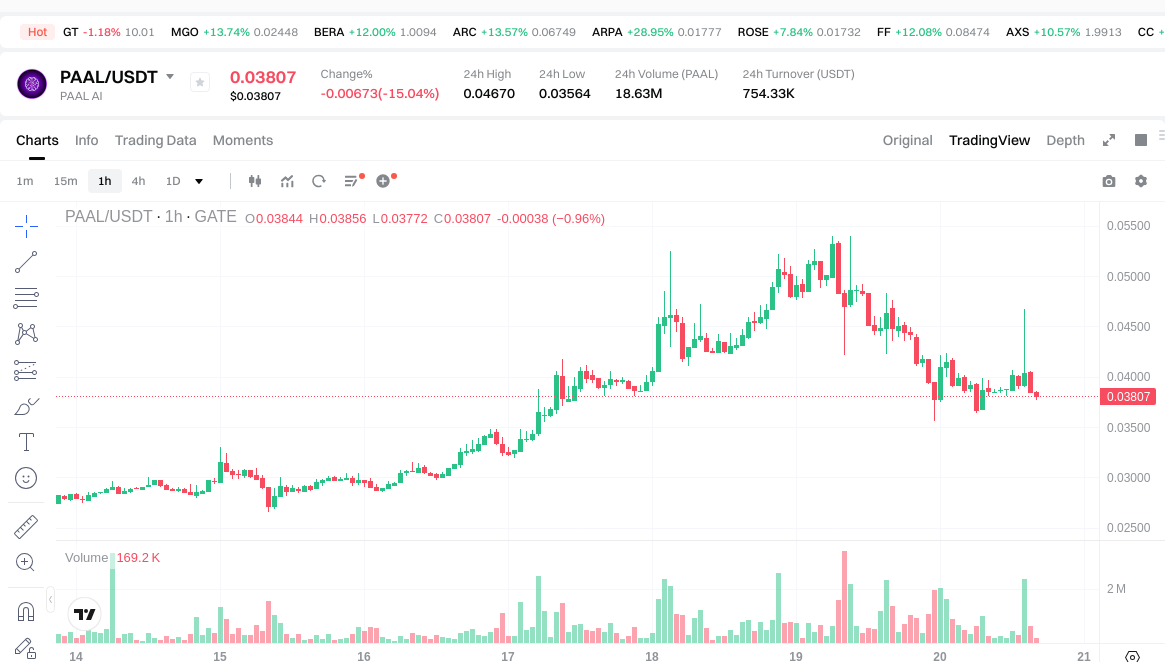
- 2024: Market expansion phase → PAAL price showed volatility with fluctuations between $0.03564 and $0.0467 in recent trading periods
- Recent period: Price adjustment cycle → Trading around $0.03847 with notable short-term movements
Current PAAL Investment Market Status (January 2026)
- PAAL current price: $0.03847
- Market sentiment (Fear & Greed Index): Data not available in provided materials
- 24-hour trading volume: $757,061.73
- Institutional investor holdings: Data not available in provided materials
Click to view real-time PAAL market price
II. Core Factors Influencing Whether PAAL AI (PAAL) is a Good Investment
Supply Mechanism and Scarcity (PAAL investment scarcity)
- Supply Structure: PAAL AI has a maximum supply of 1,000,000,000 tokens, with approximately 998,652,231 tokens (99.87%) already in circulation. This high circulation ratio indicates limited additional supply pressure, which may support price stability.
- Historical Price Movement: PAAL has experienced significant price volatility, with the token recording a peak price of $0.88 on March 10, 2024, and a low of $0.0088 on September 15, 2023. Such price fluctuations reflect both market sentiment and supply-demand dynamics.
- Investment Significance: The near-complete circulation of the total supply suggests that scarcity-driven price appreciation potential may be limited compared to assets with lower circulation ratios. However, the fixed maximum supply eliminates future inflation risks, which remains a foundational characteristic for long-term holders.
Institutional Investment and Mainstream Adoption (Institutional investment in PAAL)
- Holder Distribution: As of the latest data, PAAL AI has approximately 56,925 token holders, indicating a relatively broad retail participation base. The distribution of holdings among different wallet sizes could provide insights into institutional versus retail dominance, though specific large-holder data is not detailed in available materials.
- Exchange Presence: PAAL is listed on 12 exchanges, including Gate.com, which facilitates accessibility for both retail and institutional participants. The presence on multiple platforms may contribute to liquidity and broader adoption.
- Policy and Regulatory Considerations: The investment outlook for PAAL AI, like many AI and blockchain-related tokens, may be influenced by evolving regulatory frameworks concerning digital assets and artificial intelligence technologies. However, specific policy impacts or national-level adoption trends are not documented in the provided materials.
Macroeconomic Environment's Impact on PAAL Investment
- Monetary Policy and Interest Rates: Changes in global monetary policy and interest rate environments can influence risk appetite for speculative digital assets like PAAL. Tightening monetary conditions may reduce capital inflows into higher-risk tokens, while accommodative policies could support demand.
- Inflation Hedge Characteristics: While some digital assets are positioned as inflation hedges, PAAL AI's primary value proposition centers on AI-driven utilities such as chatbots and automation tools, rather than serving as a store of value. Its inflation-hedging potential may be limited compared to assets like Bitcoin.
- Geopolitical Uncertainty: Periods of geopolitical instability can drive investors toward alternative assets. However, PAAL's correlation with such macroeconomic factors would depend on broader market sentiment toward AI and blockchain sectors rather than direct safe-haven demand.
Technology and Ecosystem Development (Technology & Ecosystem for PAAL investment)
- Core Technology: PAAL AI is built on an ecosystem leveraging artificial intelligence and machine learning technologies, designed to automate tasks such as natural language understanding, decision-making, and trading. The token operates on the Ethereum blockchain (contract address: 0x14feE680690900BA0ccCfC76AD70Fd1b95D10e16), which provides a mature infrastructure for decentralized applications.
- Ecosystem Applications: The utility of PAAL AI revolves around its AI-powered chatbot solutions, which aim to streamline processes typically requiring human intelligence. Expansion of use cases within the AI and automation sectors could enhance the token's long-term value proposition.
- Broader Ecosystem Integration: The integration of PAAL AI within decentralized finance (DeFi), non-fungible tokens (NFTs), or payment applications is not explicitly documented in the available materials. Future ecosystem collaborations or partnerships could be a key driver for sustained investment interest, though such developments remain speculative without confirmed announcements.
III. PAAL Future Investment Forecast and Price Outlook (Is PAAL AI(PAAL) worth investing in 2026-2031)
Short-term Investment Forecast (2026, short-term PAAL investment outlook)
- Conservative forecast: $0.0233 - $0.0382
- Neutral forecast: $0.0382 - $0.0467
- Optimistic forecast: $0.0467 - $0.0508
Mid-term Investment Outlook (2027-2029, mid-term PAAL AI(PAAL) investment forecast)
- Market stage expectation: During this period, PAAL AI may experience gradual ecosystem development, with potential growth driven by AI and ML technology adoption trends and expansion of chatbot utility.
- Investment return forecast:
- 2027: $0.0428 - $0.0468
- 2028: $0.0365 - $0.0639
- 2029: $0.0493 - $0.0570
- Key catalysts: Advancement in AI technology integration, expansion of natural language processing capabilities, potential partnerships in the AI sector, and broader adoption of automated decision-making solutions.
Long-term Investment Outlook (Is PAAL a good long-term investment?)
- Base scenario: $0.0426 - $0.0688 (Assumes steady ecosystem growth and gradual mainstream AI adoption)
- Optimistic scenario: $0.0520 - $0.0816 (Assumes accelerated AI technology integration and favorable market conditions)
- Risk scenario: $0.0233 - $0.0365 (Reflects potential market headwinds or slower adoption rates)
Click to view PAAL long-term investment and price forecast: Price Prediction
2026-01-20 - 2031 Long-term Outlook
- Base scenario: $0.0426 - $0.0688 (Corresponds to steady progress and gradual mainstream application growth)
- Optimistic scenario: $0.0520 - $0.0976 (Corresponds to large-scale adoption and favorable market environment)
- Transformative scenario: Above $0.0976 (If ecosystem achieves breakthrough progress and mainstream popularization)
- 2031-12-31 projected high: $0.0976 (Based on optimistic development assumptions)
Disclaimer: Price predictions are based on historical data and market analysis. Cryptocurrency markets are highly volatile and unpredictable. This information should not be considered as investment advice. Please conduct your own research and consult with financial professionals before making any investment decisions.
| Year |
Predicted High Price |
Predicted Average Price |
Predicted Low Price |
Price Change |
| 2026 |
0.0508459 |
0.03823 |
0.0233203 |
0 |
| 2027 |
0.0467648475 |
0.04453795 |
0.042756432 |
15 |
| 2028 |
0.06391195825 |
0.04565139875 |
0.036521119 |
18 |
| 2029 |
0.05697294564 |
0.0547816785 |
0.04930351065 |
42 |
| 2030 |
0.0815808756222 |
0.05587731207 |
0.0519659002251 |
45 |
| 2031 |
0.097595313261462 |
0.0687290938461 |
0.042612038184582 |
78 |
IV. PAAL AI Investment Strategy and Risk Management (How to invest in AI-powered crypto assets)
Investment Methodology (PAAL AI investment strategy)
Risk Management (Risk management for PAAL AI investment)
-
Asset Allocation Ratios: Conservative / Aggressive / Professional investors
- Conservative approach: Allocate no more than 1-3% of total portfolio to PAAL AI, given its relatively lower market capitalization ($38.42 million) and market dominance (0.0011%).
- Aggressive approach: May allocate 5-10% for investors with higher risk tolerance and understanding of AI crypto projects.
- Professional approach: Institutional or experienced investors might consider larger positions while implementing hedging strategies.
-
Risk Hedging Solutions: Multi-asset portfolio + hedging instruments
- Diversify across different crypto categories beyond AI tokens
- Consider stablecoin allocations to manage volatility exposure
- Monitor correlation with broader crypto market movements
-
Secure Storage: Hot/cold wallets + hardware wallet recommendations
- Given PAAL's deployment on the Ethereum network (contract address: 0x14feE680690900BA0ccCfC76AD70Fd1b95D10e16), investors should utilize ERC-20 compatible storage solutions
- Hardware wallets provide enhanced security for long-term holdings
- Hot wallets may be appropriate for active trading positions with smaller amounts
V. PAAL AI Investment Risks and Challenges (Risks of investing in AI crypto assets)
-
Market Risk: High volatility and potential price manipulation
- PAAL has experienced significant price fluctuations, with 1-year performance showing an 88.6% decline from previous levels
- The relatively modest 24-hour trading volume and market capitalization may contribute to higher volatility compared to larger cap assets
- With approximately 56,925 holders and trading on 12 exchanges, liquidity conditions vary across platforms
-
Regulatory Risk: Policy uncertainty across different jurisdictions
- AI-focused crypto projects face evolving regulatory frameworks as authorities develop policies for both artificial intelligence and digital assets
- Compliance requirements may vary significantly across regions, potentially affecting project development and token utility
-
Technical Risk: Network security vulnerabilities and upgrade failures
- As an AI and ML-based ecosystem, PAAL faces technical challenges related to both blockchain infrastructure and artificial intelligence implementation
- Smart contract vulnerabilities on the Ethereum network require ongoing security audits
- Integration complexity between AI systems and blockchain protocols presents unique technical considerations
VI. Conclusion: Is AI-powered crypto a Good Investment?
-
Investment Value Summary: PAAL AI operates in an emerging sector combining artificial intelligence with blockchain technology. The project demonstrates notable price volatility, with recent performance showing mixed signals across different timeframes. The circulating supply represents 99.87% of total supply, indicating minimal future dilution concerns.
-
Investor Recommendations:
- ✅ Beginners: Consider dollar-cost averaging strategies combined with secure wallet storage. Start with minimal allocations to understand market dynamics before increasing exposure.
- ✅ Experienced Investors: May employ swing trading approaches while maintaining diversified portfolio composition. Monitor technical indicators and sector developments in AI crypto projects.
- ✅ Institutional Investors: Could evaluate strategic long-term positioning within broader AI and technology-focused crypto portfolios, with appropriate risk management frameworks.
⚠️ Disclaimer: Cryptocurrency investments carry substantial risk due to market volatility, regulatory uncertainty, and technical challenges. This content is provided for informational purposes only and does not constitute investment advice. Investors should conduct thorough research and consult with qualified financial advisors before making investment decisions.
VII. FAQ
Q1: What makes PAAL AI different from other cryptocurrency investments?
PAAL AI distinguishes itself through its focus on artificial intelligence and machine learning applications within the blockchain ecosystem, specifically offering AI-powered chatbot solutions for natural language understanding, decision-making, and trading automation. Unlike traditional cryptocurrencies that primarily serve as stores of value or payment mechanisms, PAAL operates as a utility token within an AI-driven ecosystem deployed on the Ethereum blockchain. With a market capitalization of approximately $38.42 million and nearly complete circulation (99.87% of total supply), PAAL represents a specialized sector combining emerging AI technology with decentralized infrastructure, though this positioning also subjects it to unique technical and adoption risks compared to established digital assets.
Q2: How volatile has PAAL AI's price been historically?
PAAL AI has demonstrated extremely high volatility since its launch in June 2023. The token recorded its all-time high of $0.88 on March 10, 2024, and its all-time low of $0.0088 on September 15, 2023, representing a price range exceeding 9,900%. Recent performance shows continued volatility, with a 165.15% increase over the past 30 days contrasted against an 88.6% decline over the past year. This substantial price fluctuation pattern reflects both the speculative nature of AI-focused crypto assets and the relatively modest liquidity profile indicated by the $757,061 daily trading volume. Investors should expect significant price swings and prepare for potential drawdowns exceeding 80% during market corrections.
Q3: What is the minimum recommended allocation for PAAL AI in a portfolio?
For conservative investors, financial prudence suggests allocating no more than 1-3% of total portfolio value to PAAL AI, given its relatively small market capitalization of $38.42 million and market dominance of only 0.0011%. This limited allocation helps manage exposure to the significant volatility inherent in smaller-cap AI crypto projects. Aggressive investors with higher risk tolerance and specialized knowledge in AI blockchain projects might consider allocations of 5-10%, while maintaining diversification across other asset categories. The allocation should be sized such that a potential total loss would not materially impact the investor's financial position, reflecting the speculative nature of this investment category.
Q4: Which exchanges support PAAL AI trading and how does this affect liquidity?
PAAL AI is listed on 12 cryptocurrency exchanges, including Gate.com, which provides reasonable accessibility for both retail and institutional participants. However, the 24-hour trading volume of $757,061 suggests relatively modest liquidity compared to major cryptocurrencies. This liquidity profile has several implications: wider bid-ask spreads may increase transaction costs, larger orders could experience significant price slippage, and market manipulation risks may be elevated due to lower trading volumes. Investors should carefully consider order sizing and utilize limit orders rather than market orders when trading PAAL to minimize adverse price impacts, particularly during periods of lower market activity.
Q5: What are realistic price expectations for PAAL AI through 2031?
Based on historical data and market analysis, PAAL AI price projections show a range of scenarios. For 2026, conservative forecasts suggest $0.0233-$0.0382, neutral forecasts indicate $0.0382-$0.0467, and optimistic scenarios project $0.0467-$0.0508. Long-term projections through 2031 estimate a base scenario range of $0.0426-$0.0688, an optimistic scenario of $0.0520-$0.0976, and a potential high of $0.0976 under transformative conditions involving mainstream AI adoption and favorable market environments. However, these projections carry substantial uncertainty due to cryptocurrency market volatility, evolving AI technology landscapes, regulatory developments, and competition within the AI crypto sector. Investors should view these forecasts as speculative reference points rather than guaranteed outcomes.
Q6: What technical risks should investors consider with PAAL AI?
PAAL AI faces multiple technical risk vectors that warrant careful consideration. As an Ethereum-based token (contract address: 0x14feE680690900BA0ccCfC76AD70Fd1b95D10e16), it inherits potential vulnerabilities associated with smart contract security, requiring ongoing audits to identify and remediate code weaknesses. The integration of artificial intelligence systems with blockchain protocols introduces additional complexity, as both technologies present distinct technical challenges that must be addressed simultaneously. Network congestion on Ethereum can impact transaction speeds and costs, affecting user experience. Furthermore, the project's reliance on AI and machine learning technologies means that algorithm performance, data quality, and model reliability directly influence the platform's utility and value proposition, creating dependencies beyond traditional blockchain considerations.
Q7: How does PAAL AI compare to established cryptocurrencies as a long-term investment?
PAAL AI occupies a fundamentally different investment profile compared to established cryptocurrencies like Bitcoin or Ethereum. While major cryptocurrencies benefit from extensive network effects, institutional adoption, regulatory clarity, and proven resilience through multiple market cycles, PAAL represents an early-stage project in the specialized AI crypto niche with a market capitalization of only $38.42 million versus Bitcoin's trillion-dollar scale. The token's 88.6% decline over the past year contrasts with established assets' relatively greater stability. However, PAAL's positioning in the AI sector offers potential upside through technology adoption trends that may not apply to pure store-of-value assets. Long-term investment viability depends on the project's ability to demonstrate sustained utility, expand its user base beyond the current 56,925 holders, and execute its AI integration roadmap amid intense competition in both blockchain and artificial intelligence markets.
Q8: What role does regulatory uncertainty play in PAAL AI investment decisions?
Regulatory uncertainty constitutes a significant risk factor for PAAL AI investments across multiple dimensions. The project operates at the intersection of two rapidly evolving regulatory domains: cryptocurrency markets and artificial intelligence technologies. Authorities worldwide are developing frameworks for both sectors simultaneously, creating compounded uncertainty. Potential regulatory scenarios include restrictions on AI-powered trading automation, data privacy requirements affecting AI chatbot operations, securities classification challenges for utility tokens, and varying compliance standards across jurisdictions. The current regulatory ambiguity means that sudden policy announcements could materially impact PAAL's operational capabilities, exchange listings, and market valuation. Investors should monitor regulatory developments in their respective jurisdictions and recognize that future compliance costs or operational restrictions could significantly alter the project's economics and investment thesis.
* The information is not intended to be and does not constitute financial advice or any other recommendation of any sort offered or endorsed by Gate.