This comprehensive analysis evaluates PAIN, a memecoin launched in February 2025 based on the internet meme 'Hide the Pain Harold,' as an investment opportunity. With a current market cap of approximately $2.06 million and trading price of $0.5897, PAIN exhibits high volatility and significant risk factors alongside speculative opportunities. The article examines PAIN's historical price movements, supply mechanisms, holder distribution, and Solana blockchain infrastructure while analyzing short-term, mid-term, and long-term price outlooks through 2031. It provides detailed investment strategies for conservative, aggressive, and professional investors, emphasizing strict risk management and secure storage practices via cold wallets. Key risk factors include extreme price volatility, regulatory uncertainty, and limited liquidity across only four exchanges. The analysis concludes that PAIN is unsuitable for most beginners and institutional investors, recommending minimal portfolio allocation of 1-2% for conserva
Introduction: Pain (PAIN) Investment Position and Market Outlook
PAIN is a memecoin asset in the cryptocurrency space, officially launched in February 2025 as the token representation of the internet meme legend "Hide the Pain Harold." As of February 1, 2026, PAIN holds a market capitalization of approximately $2.06 million with a circulating supply of around 3.5 million tokens out of a maximum supply of 10 million. The current trading price is approximately $0.5897, with the token held by over 32,632 addresses. Positioned as an expression of emotion on the blockchain through meme culture, PAIN has attracted attention from investors exploring memecoin opportunities. This article provides a comprehensive analysis of PAIN's investment characteristics, historical price movements, future price considerations, and associated investment risks to serve as a reference for investors evaluating this asset.
I. Pain (PAIN) Historical Price Review and Current Investment Value
- 2025: PAIN token launched in February 2025, experiencing notable price movements in its early trading period → Initial market participants observed significant volatility patterns
- 2025: Within weeks of launch, PAIN price movements reflected typical memecoin trading characteristics → Price fluctuations demonstrated high volatility common in newly launched meme-based tokens
- 2025-2026: Market adjustments led to price corrections → Trading range shifted from higher valuations in early 2025 to lower levels by early 2026
Current PAIN Investment Market Status (February 2026)
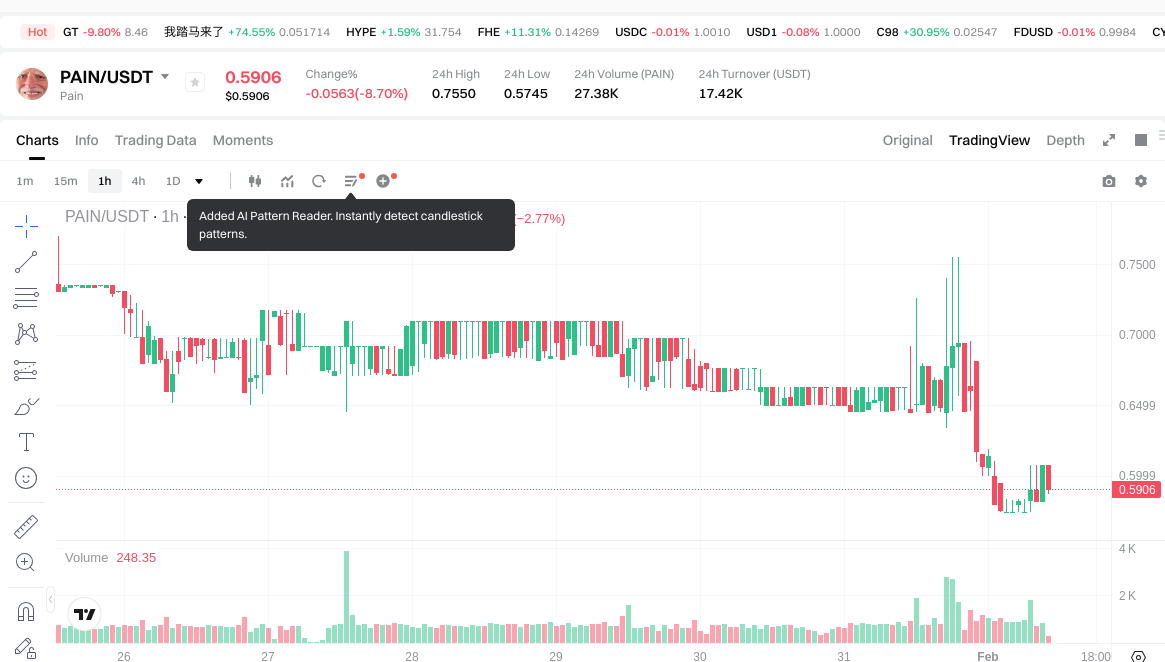
- PAIN current price: $0.5897
- Market sentiment: Price showing negative momentum with -8.39% change over 24 hours
- 24-hour trading volume: $17,438.99
- Circulating supply: 3,499,999.45 PAIN tokens (35% of total supply)
- Current market capitalization: $2,063,949.68
- Token holders: 32,632 addresses
Click to view real-time PAIN market price
II. Core Factors Influencing Whether PAIN is a Good Investment
Supply Mechanism and Scarcity (PAIN Investment Scarcity)
- Maximum supply capped at 10,000,000 tokens with 35% currently circulating → influences price dynamics and investment valuation
- Limited supply structure may support price appreciation as demand increases, following typical tokenomics patterns observed in meme token markets
- Investment significance: the fixed supply cap of 10 million tokens positions scarcity as a fundamental consideration for long-term investment evaluation
Holder Distribution and Market Adoption (Institutional Investment in PAIN)
- Holder base has expanded to 32,632 addresses as of February 2026, indicating growing retail participation
- Trading availability across 4 exchanges provides accessibility for investors seeking exposure to the token
- Market capitalization of approximately $2.06 million reflects early-stage positioning within the memecoin sector
- Price volatility remains substantial, with 24-hour fluctuations ranging from $0.5745 to $0.755, representing approximately 31% intraday variance
- Recent performance shows declines of 3.38% (1H), 8.39% (24H), and 16.89% (7D), illustrating characteristic memecoin volatility patterns
- Historical price range spans from $0.5745 to $22.5, demonstrating significant price discovery dynamics since project launch in February 2025
Technology and Ecosystem Foundation (Technology & Ecosystem for PAIN Investment)
- Built on Solana blockchain using SPL token standard, leveraging the network's high-throughput infrastructure for transaction processing
- Contract address: 1Qf8gESP4i6CFNWerUSDdLKJ9U1LpqTYvjJ2MM4pain, verifiable on Solana Explorer for transparency considerations
- Project positioning as an expression mechanism on blockchain, tied to the "Hide the Pain Harold" meme cultural reference, represents a community-driven value proposition rather than utility-based technical functionality
III. PAIN Future Investment Prediction and Price Outlook (Is Pain(PAIN) worth investing in 2026-2031)
Short-term Investment Outlook (2026, short-term PAIN investment outlook)
- Conservative prediction: $0.51 - $0.59
- Neutral prediction: $0.59 - $0.67
- Optimistic prediction: $0.67 - $0.71
Mid-term Investment Outlook (2027-2028, mid-term Pain(PAIN) investment forecast)
- Market stage expectation: PAIN may enter a gradual growth phase with increasing memecoin adoption and community engagement.
- Investment return prediction:
- 2027: $0.52 - $0.82
- 2028: $0.50 - $0.98
- Key catalysts: Community-driven initiatives, social media virality, broader memecoin market sentiment, and potential partnerships.
Long-term Investment Outlook (Is PAIN a good long-term investment?)
- Base scenario: $0.59 - $0.88 (assuming steady growth in memecoin adoption and stable community support)
- Optimistic scenario: $0.88 - $1.27 (assuming increased mainstream recognition and favorable market conditions)
- Risk scenario: $0.51 - $0.59 (under adverse market conditions or declining community activity)
Click to view PAIN long-term investment and price prediction: Price Prediction
2026-02-01 - 2031 Long-term Outlook
- Base scenario: $0.83 - $1.07 USD (corresponding to steady progress and stable growth in mainstream application)
- Optimistic scenario: $1.07 - $1.28 USD (corresponding to large-scale adoption and favorable market environment)
- Transformative scenario: Above $1.28 USD (if the ecosystem achieves breakthrough progress and mainstream adoption)
- 2031-12-31 predicted high: $1.28 USD (based on optimistic development assumptions)
Disclaimer: The above predictions are for informational purposes only and do not constitute investment advice. Cryptocurrency markets are highly volatile, and actual prices may differ significantly from predictions. Investors should conduct their own research and assess risks before making any investment decisions.
| Year |
Predicted High Price |
Predicted Average Price |
Predicted Low Price |
Price Change |
| 2026 |
0.673284 |
0.5906 |
0.513822 |
0 |
| 2027 |
0.81520518 |
0.631942 |
0.52451186 |
7 |
| 2028 |
0.9768243465 |
0.72357359 |
0.4992657771 |
22 |
| 2029 |
0.901210906345 |
0.85019896825 |
0.5866372880925 |
44 |
| 2030 |
1.269772159081375 |
0.8757049372975 |
0.779377394194775 |
48 |
| 2031 |
1.27655887234543 |
1.072738548189437 |
0.826008682105866 |
81 |
IV. Pain Investment Strategy and Risk Management (How to invest in Pain)
Investment Methodology (Pain investment strategy)
Long-term Holding (HODL Pain): Suitable for conservative investors
For investors with a long-term perspective, holding Pain may be considered as part of a diversified memecoin portfolio. This approach requires patience and tolerance for significant price fluctuations, as memecoin values typically experience substantial volatility.
Active Trading: Relying on technical analysis and swing trading
Active traders may attempt to capitalize on Pain's price movements through technical analysis. Given the token's 24-hour volatility of -8.39% and 7-day change of -16.89%, swing trading opportunities may emerge. However, this strategy demands constant market monitoring and quick decision-making capabilities.
Risk Management (Risk management for Pain investment)
Asset Allocation Ratio: Conservative / Aggressive / Professional investors
- Conservative investors: Given Pain's high volatility and memecoin nature, allocation should not exceed 1-2% of total portfolio
- Aggressive investors: May allocate 5-10% depending on risk tolerance, but should maintain strict stop-loss disciplines
- Professional investors: Could consider higher allocations with sophisticated hedging strategies, but must acknowledge the speculative nature of memecoin investments
Risk Hedging Solutions: Multi-asset portfolio + risk mitigation tools
Investors should consider diversifying across different asset classes rather than concentrating solely in memecoins. Establishing clear exit strategies and position sizing rules is essential. Given Pain's current market cap of approximately $2.06 million and relatively limited exchange availability (4 exchanges), liquidity constraints should be factored into risk management plans.
Secure Storage: Hot and cold wallets + hardware wallet recommendations
Pain tokens are based on the Solana blockchain (SPL standard). Investors should consider:
- Hot wallets: Phantom or Solflare for active trading
- Cold storage: Hardware wallets like Ledger or Trezor for long-term holdings
- Security practices: Enable two-factor authentication, verify contract addresses (1Qf8gESP4i6CFNWerUSDdLKJ9U1LpqTYvjJ2MM4pain), and never share private keys
V. Pain Investment Risks and Challenges (Risks of investing in Pain)
Market Risk: High volatility and potential price manipulation
Pain has demonstrated considerable price volatility, with a 24-hour high of $0.755 and low of $0.5745. The token reached an all-time high of $22.5 on February 20, 2025, but declined to an all-time low of $0.5745 by January 31, 2026, representing a decline of over 97%. With a relatively small market cap of approximately $2.06 million and 32,632 holders, the token may be susceptible to significant price swings and potential manipulation by large holders.
Regulatory Risk: Policy uncertainty across different jurisdictions
As a memecoin with no apparent utility beyond cultural expression, Pain may face heightened regulatory scrutiny in jurisdictions implementing stricter cryptocurrency regulations. The classification and treatment of memecoins remains unclear in many regulatory frameworks, potentially impacting trading availability and investor access.
Technical Risk: Network security vulnerabilities and upgrade failures
While Pain operates on the Solana blockchain, which provides the underlying technical infrastructure, the token itself presents specific risks:
- Smart contract vulnerabilities that could be exploited
- Dependence on Solana network performance and potential outages
- Limited technical development activity typical of memecoin projects
- Lack of formal audits or security assessments (based on available information)
VI. Conclusion: Is Pain a Good Investment?
Investment Value Summary: Pain presents significant risks alongside speculative opportunities, with extreme price volatility characterizing its short trading history.
As a memecoin inspired by the "Hide the Pain Harold" internet meme, Pain primarily functions as a cultural expression token rather than a utility-focused cryptocurrency. The token's dramatic price decline from $22.5 to below $0.60 within less than a year illustrates the highly speculative and volatile nature of memecoin investments. With only 35% of maximum supply in circulation and a modest market cap, Pain exhibits characteristics common to emerging memecoins: high risk, high volatility, and uncertain long-term viability.
Investor Recommendations:
✅ Beginners: If considering exposure to memecoins, implement strict dollar-cost averaging with minimal position sizes and store tokens in secure wallets. Thoroughly research the cultural phenomenon behind the token and understand that investments may result in total loss.
✅ Experienced investors: May explore swing trading opportunities given high volatility, but maintain rigorous risk management with stop-losses and position limits. Consider Pain as a highly speculative allocation within a broader memecoin strategy rather than a core holding.
✅ Institutional investors: Pain's limited liquidity, small market cap, and memecoin classification make it unsuitable for most institutional investment mandates. Only specialized funds focused on high-risk, speculative digital assets might consider minimal exposure.
⚠️ Disclaimer: Cryptocurrency investments carry substantial risk, and memecoin investments carry particularly elevated risk levels. This article is for informational purposes only and does not constitute investment advice. Investors should conduct thorough due diligence and only invest capital they can afford to lose entirely.
VII. FAQ
Q1: Is Pain (PAIN) a good investment for beginners in 2026?
Pain is generally not recommended as a suitable investment for beginners due to its extremely high volatility and speculative nature. As a memecoin with a market cap of only $2.06 million and a 97% decline from its all-time high of $22.5 to below $0.60 within less than a year, Pain carries substantial risk of total capital loss. Beginners should prioritize more established cryptocurrencies with utility-driven value propositions. If choosing to invest despite these risks, beginners should limit allocation to no more than 1-2% of their total portfolio, implement strict dollar-cost averaging strategies, and use secure cold storage wallets. Understanding that memecoins like Pain derive value primarily from community sentiment and cultural relevance rather than technical functionality is crucial before considering any investment.
Q2: What are the main risks of investing in Pain (PAIN)?
The primary risks include extreme price volatility, regulatory uncertainty, and limited liquidity. Pain has demonstrated dramatic price swings, with a 24-hour volatility range of approximately 31% and an overall decline of over 97% from its February 2025 peak. With only 4 exchanges listing the token and a relatively small holder base of 32,632 addresses, Pain faces liquidity constraints that could make exiting positions difficult during market downturns. Regulatory risk is heightened as memecoins may face stricter scrutiny in various jurisdictions. Technical risks include potential smart contract vulnerabilities and dependence on Solana network performance. The lack of utility beyond cultural expression means the token's value relies entirely on sustained community interest, which can dissipate rapidly in the volatile memecoin sector.
Q3: How does Pain's supply mechanism affect its investment potential?
Pain's supply mechanism features a maximum cap of 10 million tokens with only 35% (approximately 3.5 million tokens) currently in circulation. This limited supply structure could theoretically support price appreciation as demand increases, following traditional supply-scarcity economics. However, the impact of this mechanism is tempered by several factors: the remaining 65% of tokens could enter circulation at any time, potentially diluting existing holder value; the small absolute supply numbers mean individual large transactions can significantly impact price; and memecoin valuations typically depend more on community sentiment and social media virality than supply dynamics. While the fixed cap provides some scarcity foundation, investors should not rely solely on supply limitations as a basis for investment decisions, given the token's primary positioning as a cultural expression rather than a utility asset.
Q4: What is the realistic long-term price outlook for Pain through 2031?
Long-term price predictions for Pain range from conservative estimates of $0.59-$0.88 to optimistic scenarios reaching $1.28 by 2031. The base scenario assumes steady growth in memecoin adoption with continued community support, projecting gradual appreciation from the current $0.5897 level. The optimistic scenario of $1.07-$1.28 depends on increased mainstream recognition, favorable market conditions, and sustained community engagement. However, these predictions carry significant uncertainty given Pain's short trading history, extreme past volatility, and dependence on unpredictable social media trends. A risk scenario projecting prices remaining in the $0.51-$0.59 range reflects the possibility of declining community interest or adverse market conditions. Investors should treat these predictions as highly speculative reference points rather than reliable forecasts, as memecoin valuations are notoriously difficult to predict and can deviate dramatically from any projection.
Q5: How should investors manage risk when trading Pain (PAIN)?
Risk management for Pain requires strict position sizing, diversification, and secure storage practices. Conservative investors should limit Pain allocation to 1-2% of total portfolio value, while even aggressive investors should cap exposure at 5-10% with rigorous stop-loss disciplines. Never concentrate capital solely in memecoins; maintain diversification across different asset classes and cryptocurrency categories. For storage, use hot wallets like Phantom or Solflare only for active trading amounts, while keeping long-term holdings in cold storage hardware wallets such as Ledger or Trezor. Always verify the correct contract address (1Qf8gESP4i6CFNWerUSDdLKJ9U1LpqTYvjJ2MM4pain) before transactions and enable two-factor authentication on all accounts. Establish clear exit strategies and predetermined price points for taking profits or cutting losses. Given Pain's limited liquidity across only 4 exchanges, factor in potential execution difficulties during volatile market conditions.
Q6: What factors could drive Pain's price higher in 2026-2027?
Several catalysts could potentially drive Pain appreciation in the near to mid-term, though all carry substantial uncertainty. Increased social media virality and renewed interest in the "Hide the Pain Harold" meme could attract new community members and trading volume. Broader memecoin market sentiment improvements or a general cryptocurrency bull market could lift Pain alongside similar assets. Additional exchange listings beyond the current 4 platforms would improve liquidity and accessibility, potentially attracting larger investor pools. Community-driven initiatives, marketing campaigns, or partnerships with other meme-related projects could generate attention and demand. However, investors should recognize that these potential catalysts are highly unpredictable and may not materialize. Memecoin valuations depend heavily on maintaining cultural relevance and community engagement, both of which can dissipate rapidly. Price appreciation is not guaranteed regardless of these potential factors.
Q7: Should institutional investors consider Pain for their portfolios?
Pain is generally unsuitable for most institutional investment mandates due to its characteristics as a small-cap memecoin. With a market capitalization of only $2.06 million, limited exchange availability on just 4 platforms, and no utility-driven value proposition, Pain fails to meet basic institutional requirements for liquidity, stability, and investability. The token's 97% decline from all-time highs and extreme volatility patterns make it incompatible with typical institutional risk management frameworks and fiduciary responsibilities. Only specialized funds with explicit mandates for high-risk, speculative digital assets or dedicated memecoin strategies might consider minimal exposure as part of a highly diversified alternative cryptocurrency allocation. Even in such cases, Pain would represent an extremely small position relative to total assets under management. Institutions seeking cryptocurrency exposure should focus on established assets with demonstrable utility, institutional-grade custody solutions, and regulatory clarity.
Q8: How does Pain compare to other memecoins as an investment?
Pain shares common characteristics with other memecoins including high volatility, community-driven valuation, and dependence on cultural relevance rather than technical utility. With a market cap of $2.06 million, Pain operates in the micro-cap memecoin segment, distinguishing it from larger memecoins like Dogecoin or Shiba Inu which have multi-billion dollar valuations and broader exchange availability. Pain's connection to the "Hide the Pain Harold" internet meme provides a specific cultural reference point, whereas other memecoins may have different thematic foundations. The token's 35% circulating supply ratio and Solana blockchain infrastructure differ from memecoins built on Ethereum or other networks. However, like all memecoins, Pain's investment viability depends primarily on sustained community engagement and social media momentum rather than technological innovation or real-world applications. Investors comparing memecoins should assess relative liquidity, holder distribution, exchange availability, and community activity levels rather than focusing solely on price or market cap metrics.
* The information is not intended to be and does not constitute financial advice or any other recommendation of any sort offered or endorsed by Gate.