This comprehensive analysis evaluates Particle Network (PARTI) as an investment opportunity, examining its chain abstraction technology, market position, and risk factors. Currently trading at $0.09115 with a market capitalization of $21.24 million, PARTI addresses multi-chain fragmentation through Universal Accounts technology that provides unified Web3 access. The article presents short-term forecasts of $0.0611-$0.1222, mid-term expectations of 17-32% potential gains through 2027-2028, and long-term scenarios reaching $0.1674 by 2031 under optimistic conditions. PARTI demonstrates significant volatility with a 77.91% decline from launch price, substantial technical and regulatory risks, and supply dilution concerns as only 23.3% of tokens circulate. Investment recommendations emphasize diversified allocation strategies, risk management practices, and secure storage solutions across Gate and other exchanges, catering to beginners, experienced investors, and institutions with varying risk tolerances.
Introduction: Particle Network (PARTI)'s Investment Position and Market Outlook
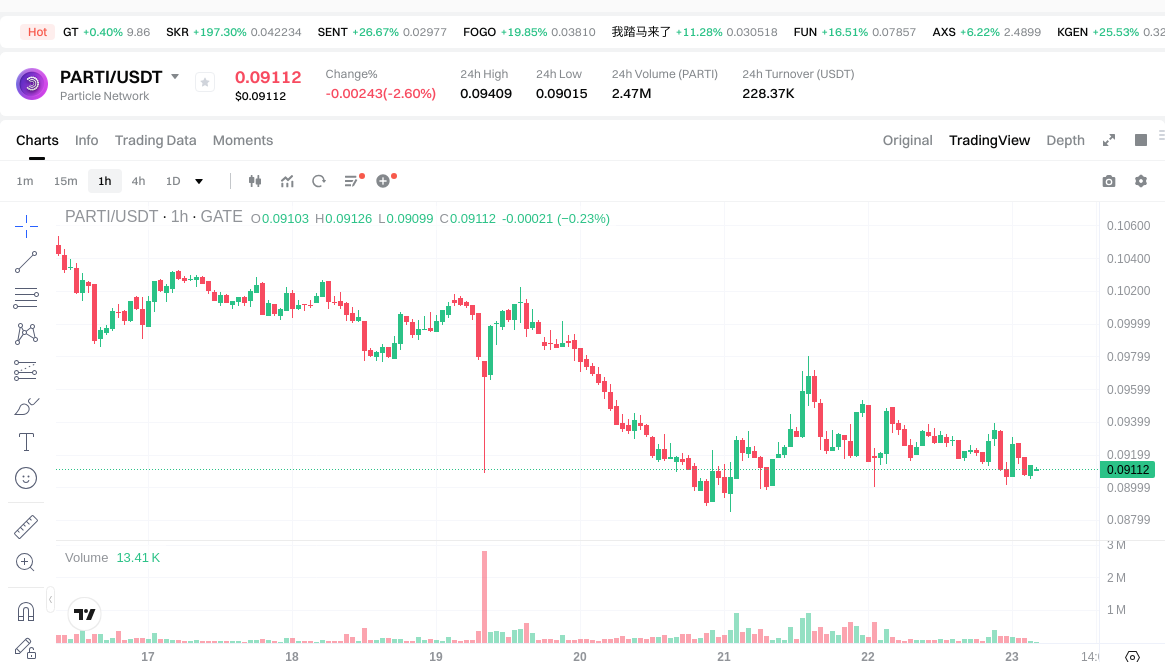
PARTI is a significant asset in the cryptocurrency field. As of January 23, 2026, Particle Network holds a market capitalization of approximately $21.24 million, with a circulating supply of 233 million tokens and a current price around $0.09115. Positioned as a leading chain abstraction infrastructure in Web3, Particle Network addresses multi-chain fragmentation through its Universal Accounts technology, which provides users with a unified account and balance across the entire Web3 ecosystem. With its ranking at #847 and presence on 37 exchanges, PARTI has gradually become a focal point when investors discuss "Is Particle Network (PARTI) a good investment?" The project maintains a holder base of over 171,000 addresses. This article will comprehensively analyze PARTI's investment value, historical trends, future price predictions, and investment risks to provide reference for investors.
I. Historical Price Review and Current Investment Status of PARTI Token
PARTI Historical Price Movement and Investment Performance (Particle Network(PARTI) investment performance)
Based on available data, PARTI experienced notable price fluctuations since its launch. The token reached a peak price of $0.44305 on March 25, 2025, representing a significant appreciation from its launch price of $0.15 in March 2025. Subsequently, the token entered a correction phase, declining to $0.03239 on October 10, 2025. Throughout 2025, PARTI demonstrated considerable volatility characteristic of emerging crypto assets, with price movements reflecting broader market dynamics and project-specific developments.
Current PARTI Investment Market Status (January 2026)
- PARTI current price: $0.09115
- 24-hour trading volume: $231,436.21
- Market capitalization: $21,237,950
- Circulating supply: 233,000,000 PARTI (23.3% of total supply)
- Fully diluted market cap: $91,150,000
- Number of holders: 171,024
- Listed on 37 exchanges
Click to view real-time PARTI market price
II. Core Factors Influencing Whether PARTI is a Good Investment (Is Particle Network(PARTI) a Good Investment)
Supply Mechanism and Scarcity (PARTI investment scarcity)
- Fixed Supply Cap → Influences price and investment value
- PARTI has a maximum supply of 1,000,000,000 tokens with a current circulating supply of 233,000,000 tokens, representing a 23.3% circulation ratio. The predetermined supply limit introduces scarcity dynamics that may influence long-term value considerations.
- Investment Significance: The controlled token release schedule and finite supply structure represent foundational elements for assessing scarcity-based investment characteristics.
Institutional Investment and Mainstream Adoption (Institutional investment in PARTI)
- Holder Base: As of January 2026, PARTI has attracted 171,024 token holders across multiple blockchain networks.
- Multi-Chain Presence: Token deployment on both BSC and Base EVM networks indicates infrastructure support across major blockchain ecosystems.
- Exchange Availability: Listed on 37 exchanges, providing accessibility for institutional and retail participants.
Macroeconomic Environment's Impact on PARTI Investment
- Market Performance Context: PARTI has experienced price fluctuations reflecting broader market conditions, with varying performance across different timeframes.
- Volatility Characteristics: Historical price range between $0.03239 and $0.44305 demonstrates significant price movement potential that investors should consider within their risk assessment frameworks.
- Market Capitalization Position: With a market cap of approximately $21.24 million and market dominance of 0.0028%, PARTI occupies a smaller market segment subject to different dynamics than larger-cap digital assets.
Technology and Ecosystem Development (Technology & Ecosystem for PARTI investment)
- Chain Abstraction Infrastructure: Particle Network's Universal Accounts technology addresses multi-chain fragmentation by enabling unified account and balance management across different blockchain networks.
- Web3 Integration: The platform's focus on solving user experience challenges in multi-chain environments positions it within the broader Web3 infrastructure development narrative.
- Ecosystem Applications: The chain abstraction approach aims to support various decentralized applications by simplifying cross-chain interactions for users and developers.
III. PARTI Future Investment Forecast and Price Outlook (Is Particle Network (PARTI) worth investing in 2026-2031)
Short-term Investment Forecast (2026, short-term PARTI investment outlook)
- Conservative forecast: $0.0611 - $0.0912
- Neutral forecast: $0.0912 - $0.1222
- Optimistic forecast: $0.1222 and above
Based on the current market data, PARTI is trading at $0.09115 with a 24-hour decline of 3.59%. The token has experienced an 11.23% decline over the past 7 days and a 30-day decrease of 7.31%. The short-term outlook reflects moderate volatility as the project continues to establish its chain abstraction infrastructure presence in the Web3 ecosystem.
Mid-term Investment Outlook (2027-2028, mid-term Particle Network (PARTI) investment forecast)
-
Market stage expectations: The mid-term period may witness gradual ecosystem expansion as Particle Network's Universal Accounts technology gains traction in addressing multi-chain fragmentation challenges. Market adoption patterns and technological integration progress will likely influence price movements.
-
Investment return forecast:
- 2027: $0.0790 - $0.1355 (potential change of approximately 17%)
- 2028: $0.1029 - $0.1259 (potential change of approximately 32%)
-
Key catalysts: Adoption of Universal Accounts technology, expansion of partnerships within the Web3 infrastructure sector, developments in chain abstraction solutions, and overall market conditions for blockchain infrastructure projects.
Long-term Investment Outlook (Is PARTI a good long-term investment?)
- Base scenario: $0.0793 - $0.1674 (assuming steady technological development and moderate market conditions)
- Optimistic scenario: $0.1210 - $0.1630 (assuming accelerated adoption of chain abstraction solutions and favorable regulatory environment)
- Risk scenario: Below $0.0610 (under adverse market conditions or significant competitive pressure)
Check PARTI long-term investment and price forecast: Price Prediction
2026-2031 Long-term Outlook
- Base scenario: $0.0793 - $0.1469 (corresponding to steady progress and gradual mainstream application growth)
- Optimistic scenario: $0.1210 - $0.1674 (corresponding to large-scale adoption and favorable market environment)
- Transformative scenario: Above $0.1630 (in case of breakthrough ecosystem developments and mainstream proliferation)
- 2031-12-31 forecast high: $0.1674 (based on optimistic development assumptions)
Disclaimer: The above forecasts are based on historical data and market analysis, and do not constitute investment advice. Cryptocurrency investments carry significant risks, and past performance does not guarantee future results. The circulating supply represents 23.3% of the total supply, with a maximum supply of 1 billion tokens. Investors should conduct thorough research and consider their risk tolerance before making investment decisions.
| Year |
Predicted High Price |
Predicted Average Price |
Predicted Low Price |
Price Change |
| 2026 |
0.1221946 |
0.09119 |
0.0610973 |
0 |
| 2027 |
0.135499221 |
0.1066923 |
0.078952302 |
17 |
| 2028 |
0.12593959092 |
0.1210957605 |
0.102931396425 |
32 |
| 2029 |
0.1630433319372 |
0.12351767571 |
0.0914030800254 |
35 |
| 2030 |
0.15044452901478 |
0.1432805038236 |
0.108893182905936 |
57 |
| 2031 |
0.167423268717876 |
0.14686251641919 |
0.079305758866362 |
61 |
IV. PARTI Investment Strategy and Risk Management (How to invest in Particle Network)
Investment Strategy (PARTI investment strategy)
Long-term Holding (HODL PARTI)
Long-term holding represents a conservative approach for investors who believe in Particle Network's chain abstraction technology. This strategy involves purchasing PARTI tokens and maintaining positions through market cycles, focusing on the project's fundamental development rather than short-term price movements. Given the token's significant decline from its all-time high, investors considering this approach should carefully evaluate the project's roadmap and adoption metrics.
Active Trading
Active trading of PARTI requires technical analysis skills and understanding of market dynamics. The token has demonstrated notable volatility, with 24-hour price fluctuations ranging between $0.09015 and $0.09445. Traders can utilize support and resistance levels, volume analysis, and momentum indicators to identify entry and exit points. The token's trading availability across 37 exchanges provides adequate liquidity for executing trading strategies.
Risk Management (Risk management for PARTI investment)
Asset Allocation Ratios
- Conservative Investors: Allocate 1-3% of crypto portfolio to PARTI, maintaining larger positions in established digital assets
- Aggressive Investors: May consider 5-10% allocation, accepting higher volatility for potential growth opportunities
- Professional Investors: Can structure customized allocations based on comprehensive risk assessment and portfolio objectives
Risk Hedging Strategies
Implement diversification across multiple blockchain infrastructure projects to reduce concentration risk. Consider maintaining positions in established cryptocurrencies alongside PARTI exposure. Monitor correlation patterns with broader market movements to adjust portfolio composition accordingly.
Secure Storage Solutions
- Hot Wallets: Suitable for active trading portions, ensuring quick access for transactions
- Cold Wallets: Recommended for long-term holdings, providing enhanced security through offline storage
- Hardware Wallets: Industry-standard devices offer robust protection for significant PARTI holdings
V. PARTI Investment Risks and Challenges (Risks of investing in Particle Network)
Market Risks
PARTI exhibits substantial price volatility, with a 77.91% decline over the past year from its launch price of $0.15. The token reached an all-time high of $0.44305 on March 25, 2025, before declining to an all-time low of $0.03239 on October 10, 2025. Current price movements show a 3.59% decrease over 24 hours and an 11.23% decline over seven days. With a relatively small market capitalization of approximately $21.24 million and a market cap to fully diluted valuation ratio of 23.3%, the token remains susceptible to significant price swings.
Regulatory Risks
The regulatory landscape for blockchain infrastructure projects varies significantly across jurisdictions. Changes in regulatory frameworks regarding chain abstraction technology, cross-chain transactions, or decentralized infrastructure could impact Particle Network's operations and PARTI token utility. Investors should monitor regulatory developments in key markets where the project operates.
Technical Risks
As a chain abstraction infrastructure project, Particle Network faces technical challenges inherent to cross-chain functionality. Potential vulnerabilities in smart contracts deployed on BSC and BASE chains could pose security concerns. The complexity of Universal Accounts technology requires continuous development and security audits. Network upgrades or protocol changes may introduce unforeseen technical issues that could affect token value and ecosystem stability.
Liquidity and Market Depth
With a circulating supply of 233 million tokens representing 23.3% of the maximum supply of 1 billion tokens, future token releases could create selling pressure. The 24-hour trading volume of approximately $231,436 indicates moderate liquidity levels, which may result in slippage during larger transactions.
VI. Conclusion: Is Particle Network a Good Investment?
Investment Value Assessment
PARTI presents a mixed investment profile characterized by innovative chain abstraction technology offset by substantial price volatility and market challenges. The token has experienced considerable depreciation from its launch price, reflecting either market correction or fundamental concerns. The project's positioning in the chain abstraction sector addresses genuine infrastructure needs in the multi-chain ecosystem, potentially offering long-term utility. However, the current circulating supply represents only 23.3% of total supply, suggesting potential dilution risks.
Investor Recommendations
✅ Beginners: Consider dollar-cost averaging approach with small allocations, utilizing secure wallet storage solutions. Focus on understanding the project's technology and market position before increasing exposure.
✅ Experienced Investors: May employ tactical trading strategies based on technical analysis while maintaining core positions. Diversify across multiple blockchain infrastructure projects to manage concentration risk.
✅ Institutional Investors: Conduct comprehensive due diligence on technology fundamentals, team credentials, and competitive landscape before considering strategic allocations.
⚠️ Disclaimer: Cryptocurrency investments carry substantial risk and volatility. This content is provided for informational purposes only and does not constitute investment advice. Conduct thorough research and consider your financial situation before making investment decisions.
VII. FAQ
Q1: Is Particle Network (PARTI) a good investment for beginners in 2026?
PARTI may be suitable for beginners who accept high volatility, but only with proper risk management. As a blockchain infrastructure token with a market cap of approximately $21.24 million and ranking #847, PARTI represents a higher-risk investment opportunity. The token has experienced significant price fluctuations, declining 77.91% from its launch price of $0.15 and trading at $0.09115 as of January 2026. For beginners, it is recommended to allocate only 1-3% of their crypto portfolio to PARTI and employ a dollar-cost averaging strategy rather than lump-sum investments. The project's chain abstraction technology addresses genuine Web3 infrastructure needs, but investors should thoroughly understand the technology and market dynamics before investing. Secure storage solutions and diversification across established cryptocurrencies are essential risk management practices for new investors.
Q2: What is the price prediction for PARTI token in 2027-2028?
Based on market analysis, PARTI's mid-term price outlook suggests gradual growth potential. For 2027, the predicted price range is $0.0790 - $0.1355, representing an approximate 17% potential change from current levels. In 2028, the forecast extends to $0.1029 - $0.1259, indicating a potential 32% increase. These projections assume steady technological development of Particle Network's Universal Accounts system and moderate market conditions. Key catalysts influencing these forecasts include adoption rates of chain abstraction solutions, expansion of partnerships within the Web3 ecosystem, and overall blockchain infrastructure market growth. However, investors should note that only 23.3% of the total supply currently circulates, and future token releases could create selling pressure. These predictions do not constitute investment advice, and actual results may vary significantly based on market conditions and project execution.
Q3: How does PARTI's Universal Accounts technology differentiate it from competitors?
PARTI's Universal Accounts technology addresses multi-chain fragmentation by providing unified account and balance management across different blockchain networks. Unlike traditional cross-chain solutions that require users to manage separate wallets and balances on each blockchain, Particle Network's chain abstraction infrastructure enables seamless interaction across the entire Web3 ecosystem from a single account. This technology simplifies user experience by eliminating the complexity of switching between networks, managing multiple wallet addresses, and bridging assets. The platform's deployment on both BSC and BASE EVM networks demonstrates its multi-chain infrastructure support. For investors, this technological differentiation represents the project's core value proposition in solving real Web3 usability challenges. However, the success of this technology depends on ecosystem adoption, developer integration, and competitive dynamics in the chain abstraction sector.
Q4: What are the primary risks associated with investing in PARTI?
PARTI investment carries several significant risks that investors must carefully consider. First, market risk is substantial, with the token experiencing a 77.91% decline over the past year and showing high volatility between its all-time high of $0.44305 and all-time low of $0.03239. Second, liquidity risk exists with a relatively modest 24-hour trading volume of approximately $231,436, which may result in slippage during larger transactions. Third, supply dilution risk is present, as only 23.3% of the 1 billion total token supply currently circulates, meaning future releases could create selling pressure. Fourth, technical risks include potential vulnerabilities in smart contracts and the complexity of maintaining chain abstraction infrastructure across multiple networks. Fifth, regulatory uncertainty surrounding blockchain infrastructure projects could impact operations and token utility. Sixth, competitive pressure from other chain abstraction and cross-chain solutions may affect market position and adoption rates. Investors should implement proper risk management through diversification, appropriate position sizing, and secure storage solutions.
Q5: Which exchanges support PARTI trading and what is the recommended storage solution?
PARTI is currently listed on 37 exchanges, providing broad accessibility for both retail and institutional investors. The token is deployed on both BSC (Binance Smart Chain) and BASE EVM networks, supporting diverse trading infrastructure. For storage solutions, the recommended approach depends on investment strategy: active traders should utilize hot wallets for quick transaction access and trading flexibility, while long-term holders should employ cold storage solutions for enhanced security. Hardware wallets represent the industry-standard security practice for significant PARTI holdings, offering robust protection through offline storage mechanisms. Given the token's availability across multiple exchanges and networks, investors should verify contract addresses and exercise caution against fraudulent tokens. For optimal security, it is recommended to withdraw holdings from exchanges to self-custody wallets, particularly for amounts intended for long-term holding rather than active trading.
Q6: How does PARTI's current market position compare to its historical performance?
PARTI's current market position reflects significant contraction from its historical peak performance. The token launched at $0.15 in March 2025 and reached an all-time high of $0.44305 on March 25, 2025, representing a 195% increase from launch price. However, the token subsequently entered a prolonged correction phase, declining to an all-time low of $0.03239 on October 10, 2025. As of January 2026, PARTI trades at $0.09115, which is 79.43% below its all-time high but 181% above its all-time low. The current market capitalization stands at approximately $21.24 million with a fully diluted valuation of $91.15 million. Short-term performance shows a 3.59% decline over 24 hours, 11.23% decrease over seven days, and 7.31% reduction over 30 days. This historical volatility pattern is typical for emerging blockchain infrastructure tokens and reflects both market-wide conditions and project-specific developments. Investors evaluating PARTI should consider this performance context within their risk assessment framework and investment timeframe.
Q7: What factors could drive PARTI's price appreciation in the long term?
Several fundamental factors could potentially drive PARTI's long-term price appreciation, though outcomes remain uncertain. First, widespread adoption of Particle Network's Universal Accounts technology by developers and users could increase token utility and demand. Second, successful partnerships with major Web3 applications and blockchain ecosystems could expand the platform's user base and transaction volume. Third, continued development and enhancement of chain abstraction infrastructure addressing multi-chain fragmentation challenges could strengthen competitive positioning. Fourth, favorable regulatory developments for blockchain infrastructure projects could reduce operational uncertainty and attract institutional participation. Fifth, general growth in the Web3 and multi-chain ecosystem could increase demand for seamless cross-chain solutions. Sixth, reduction in circulating supply velocity through staking mechanisms or ecosystem incentives could create positive supply-demand dynamics. However, investors should note that these potential catalysts face significant execution risks, competitive pressure, and market uncertainties. Long-term price projections suggest a range of $0.0793 - $0.1674 by 2031 under various scenarios, but actual results may differ substantially based on project execution and market conditions.
Q8: Should investors consider PARTI as part of a diversified crypto portfolio?
PARTI can serve as a specialized allocation within a diversified cryptocurrency portfolio for investors with appropriate risk tolerance and understanding of blockchain infrastructure projects. As a chain abstraction infrastructure token with a market capitalization of approximately $21.24 million, PARTI occupies a smaller market segment with different risk-return characteristics compared to established digital assets. For conservative investors, a 1-3% allocation to PARTI alongside larger positions in established cryptocurrencies may provide exposure to Web3 infrastructure development while maintaining overall portfolio stability. Aggressive investors with higher risk tolerance might consider 5-10% allocations, accepting greater volatility for potential growth opportunities. The key consideration is correlation with other portfolio holdings and alignment with investment objectives. PARTI's focus on solving multi-chain fragmentation distinguishes it from pure payment tokens or DeFi protocols, potentially offering diversification benefits within the infrastructure sector. However, investors should balance this exposure with holdings across multiple blockchain categories, including established cryptocurrencies, DeFi protocols, and other infrastructure projects to mitigate concentration risk and project-specific uncertainties.
* The information is not intended to be and does not constitute financial advice or any other recommendation of any sort offered or endorsed by Gate.