This comprehensive analysis examines whether Paxos (USDP) represents a viable investment by evaluating the stablecoin's unique characteristics and market dynamics. USDP, a regulated stablecoin maintained at $1.00 peg through full USD collateralization and New York Financial Services Department oversight, serves primarily as a capital preservation tool rather than a growth investment. The article assesses USDP's institutional adoption potential, technical infrastructure built on Ethereum ERC-20 standards, and regulatory compliance advantages, while also examining counterparty risks, limited liquidity (24-hour volume of $1.49 million), and competitive pressures from larger stablecoins. Strategic recommendations differentiate between investor types: beginners gain entry exposure to digital assets, experienced traders utilize USDP as liquidity buffers, and institutional investors benefit from transparent custody arrangements. Long-term price forecasts remain stable around $0.99-$1.10 through 2031, reflecting USDP
Introduction: Pax Dollar (USDP) Investment Position and Market Outlook
USDP is a significant asset in the cryptocurrency space, originally launched as Paxos Standard (PAX) in September 2018 before being rebranded to Pax Dollar (USDP) in August 2021. As a regulated stablecoin issued by blockchain company Paxos and supervised by the New York Department of Financial Services, USDP has established itself in the digital payment and trading settlement sectors. As of January 19, 2026, USDP maintains a market capitalization of approximately $47.55 million, with a circulating supply of about 47.57 million tokens, and a current price around $0.9996. Positioned as a compliant stablecoin with 1:1 USD backing and 100% collateralization, USDP has become a subject of interest when investors discuss "Is Paxos (USDP) a good investment?" This article comprehensively analyzes USDP's investment characteristics, historical performance, future price considerations, and associated risks to provide reference for market participants.
I. Paxos (USDP) Price History Review and Current Investment Value
- 2018: USDP (originally PAX) launched as one of the first regulated stablecoins with New York State Department of Financial Services approval → Early investors experienced stability anchored to $1 USD
- 2021: Rebranding from PAX to USDP (Pax Dollar) → Price maintained consistent $1 peg throughout transition period
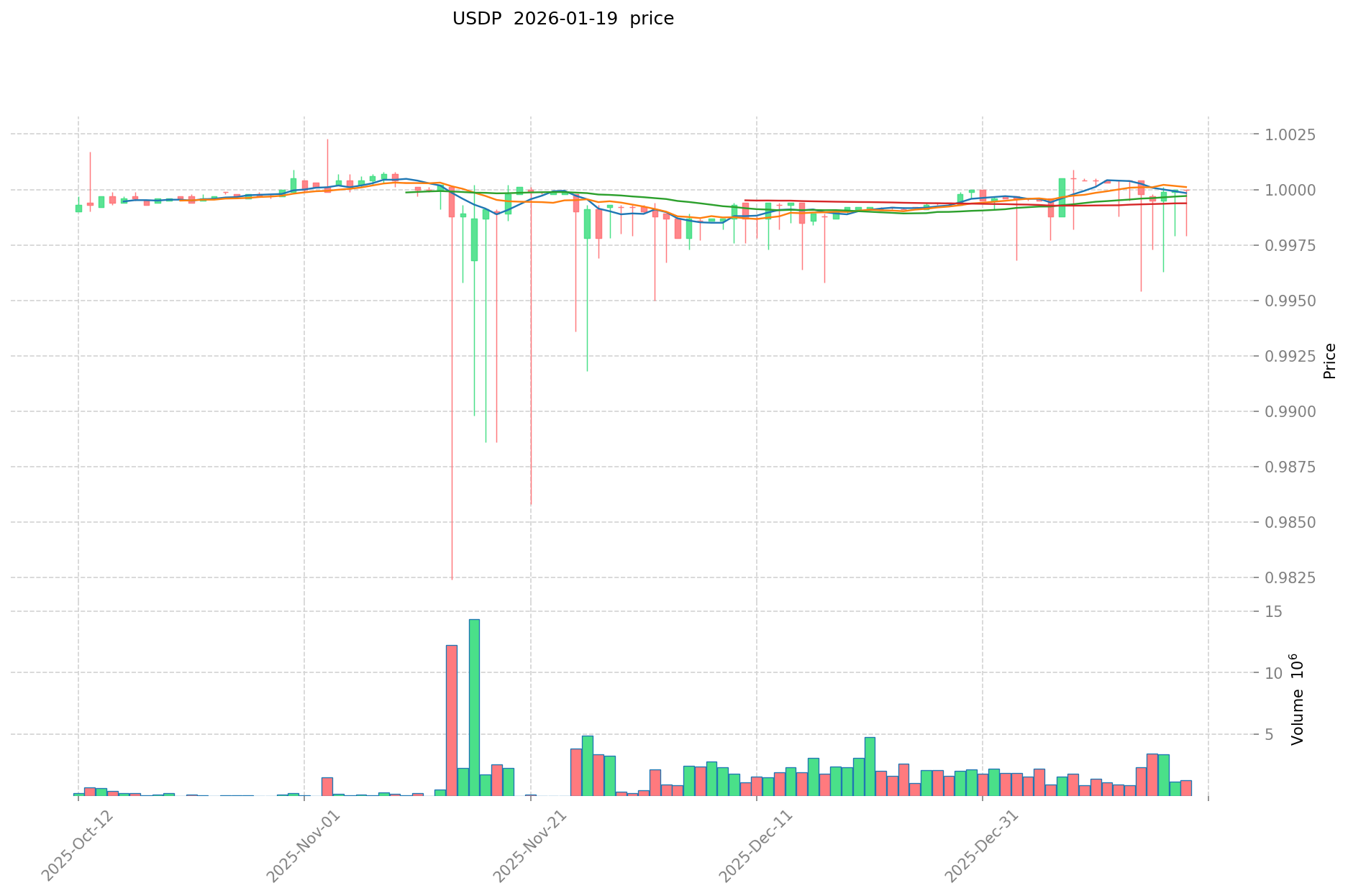
- 2022-2024: Market volatility periods → USDP demonstrated stability, fluctuating between $0.9824 and $1.502 during extreme market conditions
Current USDP Investment Market Status (January 2026)
- USDP current price: $0.9996
- Market sentiment (Fear & Greed Index): Data not available from provided materials
- 24-hour trading volume: $1,487,139.93
- Institutional investor holdings: USDP benefits from regulatory compliance and institutional adoption as a transparent, fully-reserved stablecoin
Click to view real-time USDP market price
II. Core Factors Influencing Whether USDP is a Good Investment (Is Paxos(USDP) a Good Investment)
Supply Mechanism and Scarcity (USDP investment scarcity)
- USDP operates as a fiat-backed stablecoin with a 1:1 USD peg, where supply is controlled through minting and burning mechanisms managed by a supply controller address
- As a stablecoin pegged to the US dollar, USDP's design does not follow traditional scarcity-driven price appreciation models seen in other digital assets
- The investment significance lies in stability rather than scarcity, as USDP aims to maintain consistent value rather than increase in price over time
- As of December 2025, USDP maintains a market capitalization of approximately $51.5 million with a circulating supply of 51.57 million tokens, reflecting a fully collateralized supply model
Institutional Investment and Mainstream Adoption (Institutional investment in USDP)
- USDP received a stability assessment rating of 2 (strong) from S&P Global Ratings regarding its ability to maintain a stable price vis-à-vis the US dollar
- Regulatory developments significantly impacted USDP's market position, with the token being delisted on major EU exchanges in March 2025 under MiCA rules
- In response to regulatory changes, Paxos pivoted to USDG, a MiCA-compliant stablecoin, indicating the company's adaptation to evolving regulatory frameworks
- The issuer Paxos operates as a trust company regulated by the New York Financial Services Department, providing institutional-grade custody and fiduciary protections for client assets
Macroeconomic Environment's Impact on USDP Investment
- As a USD-backed stablecoin, USDP's investment characteristics differ from volatile crypto assets, serving more as a liquidity tool and medium of exchange rather than a speculative investment
- During periods of market uncertainty, stablecoins like USDP can provide a stable store of value within the cryptocurrency ecosystem
- Monetary policy changes and interest rate fluctuations primarily affect the underlying USD reserves rather than USDP's token value directly
- USDP reserves are held in separate accounts at multiple FDIC-insured US registered banks, providing additional security during financial instability
Technology and Ecosystem Building (Technology & Ecosystem for USDP investment)
- USDP is built on Ethereum's ERC-20 standard, enabling compatibility with the Ethereum network and decentralized applications
- The token can be sent between any two wallets on the Ethereum network, facilitating instant global transfers and integration with blockchain-based services
- USDP's open-source code is available on GitHub, allowing for transparency and community verification of the smart contracts
- Technical analysis indicators as of November 2025 showed bullish signals, though stablecoin investments are typically evaluated based on stability rather than price movement
- The broader Paxos ecosystem includes tokenized assets such as Paxos Gold (PAXG), demonstrating the company's focus on tokenization of traditional assets beyond just USD
III. USDP Future Investment Predictions and Price Outlook (Is Paxos(USDP) worth investing in 2026-2031)
Short-term Investment Outlook (2026, short-term USDP investment outlook)
- Conservative Forecast: $0.9996 - $1.00
- Neutral Forecast: $1.00 - $1.001
- Optimistic Forecast: $1.001 - $1.01
Mid-term Investment Outlook (2027-2028, mid-term Paxos(USDP) investment forecast)
- Market Stage Expectation: As a regulated stablecoin with 1:1 USD backing and NYDFS oversight, USDP is expected to maintain its peg stability while potentially experiencing modest variations in market adoption and trading volume.
- Investment Return Forecast:
- 2027: $0.99 - $1.10
- 2028: $0.99 - $1.10
- Key Catalysts: Regulatory compliance framework, institutional adoption in settlement processes, integration with traditional financial infrastructure, and competitive positioning within the stablecoin ecosystem.
Long-term Investment Outlook (Is Paxos a good long-term investment?)
- Base Scenario: $0.99 - $1.01 (assuming maintained regulatory compliance and stable reserve backing)
- Optimistic Scenario: $1.00 - $1.10 (assuming expanded institutional adoption and enhanced utility in cross-border settlements)
- Risk Scenario: $0.98 - $1.00 (under conditions of increased regulatory scrutiny or heightened stablecoin market competition)
Click to view USDP long-term investment and price predictions: Price Prediction
2026-01-19 - 2031 Long-term Outlook
- Base Scenario: $0.99 - $1.01 (corresponding to steady progress in mainstream application adoption)
- Optimistic Scenario: $1.00 - $1.10 (corresponding to large-scale adoption and favorable market conditions)
- Transformative Scenario: Above $1.10 (contingent on breakthrough ecosystem developments and mainstream adoption)
- 2031-12-31 Predicted High: $1.10 (based on optimistic development assumptions)
Disclaimer: Price predictions are subject to market volatility and regulatory changes. Historical performance does not guarantee future results. This analysis does not constitute investment advice.
| Year |
Predicted High Price |
Predicted Average Price |
Predicted Low Price |
Price Change |
| 2026 |
1 |
1 |
1 |
0 |
| 2027 |
1 |
1 |
1 |
0 |
| 2028 |
1 |
1 |
1 |
0 |
| 2029 |
1 |
1 |
1 |
0 |
| 2030 |
1 |
1 |
1 |
0 |
| 2031 |
1 |
1 |
1 |
0 |
IV. USDP Investment Strategy and Risk Management (How to invest in Stablecoins)
Investment Methodology (USDP investment strategy)
-
Long-term Holding (HODL USDP): USDP is designed as a dollar-pegged stablecoin, making it suitable for investors seeking capital preservation and liquidity rather than price appreciation. The token maintains a 1:1 peg with USD through full collateralization with U.S. dollar reserves.
-
Active Trading: Due to its stable nature, USDP is typically used as a trading pair or temporary store of value rather than a speculative trading asset. Price movements generally remain within a narrow range around $1.00, with recent data showing a 24-hour range between $0.9972 and $1.00.
Risk Management (Risk management for USDP investment)
-
Asset Allocation Ratio: USDP functions primarily as a stable value anchor within crypto portfolios. Conservative investors may allocate higher percentages to USDP for capital preservation, while active traders might use it as a liquidity buffer between positions.
-
Risk Hedging Approach: USDP can serve as part of a diversified digital asset portfolio, providing stability during market volatility. Its regulatory compliance under New York Financial Services Department oversight adds a layer of institutional credibility.
-
Secure Storage: USDP is an ERC-20 token on the Ethereum network. Storage options include:
- Hot wallets for active trading and quick access
- Cold storage solutions for long-term holdings
- Hardware wallets compatible with Ethereum-based tokens
V. USDP Investment Risks and Challenges (Risks of investing in Stablecoins)
-
Market Risk: While designed for stability, USDP has shown price fluctuations, trading between $0.9824 and $1.502 during its history. Current trading volume of approximately $1.49 million (24-hour) indicates relatively limited liquidity compared to major stablecoins.
-
Regulatory Risk: As a regulated stablecoin under New York Financial Services Department supervision, USDP faces ongoing regulatory scrutiny. Changes in stablecoin regulations across different jurisdictions could impact its operations and adoption.
-
Technical Risk: Being an ERC-20 token, USDP is subject to Ethereum network vulnerabilities and potential smart contract risks. The token's open-source code is available on GitHub for community review, though this doesn't eliminate technical uncertainties.
-
Counterparty Risk: USDP's value depends on Paxos maintaining full USD reserves in FDIC-insured U.S. bank accounts. While Paxos operates as a trust company with fiduciary responsibilities, users rely on the company's ongoing solvency and operational integrity.
VI. Conclusion: Is Stablecoin a Good Investment?
-
Investment Value Summary: USDP serves a specific utility function as a dollar-denominated digital asset rather than a growth investment. With a market cap of approximately $47.55 million and complete circulation of its supply, it occupies a niche position in the stablecoin market.
-
Investor Recommendations:
✅ Beginners: USDP can provide an entry point into digital assets while maintaining dollar-denominated value, though larger stablecoins may offer greater liquidity
✅ Experienced Investors: May use USDP for specific trading pairs or as temporary capital parking between positions
✅ Institutional Investors: Regulatory compliance and trust company structure may appeal to institutions requiring transparent custody arrangements
⚠️ Notice: Cryptocurrency investments carry inherent risks. This content is for informational purposes only and does not constitute investment advice.
VII. FAQ
Q1: Is USDP (Pax Dollar) a good investment for capital appreciation?
No, USDP is not designed for capital appreciation. As a stablecoin pegged 1:1 to the US dollar, USDP is engineered to maintain stable value rather than increase in price over time. The token's primary investment value lies in capital preservation, liquidity provision, and serving as a stable medium of exchange within the cryptocurrency ecosystem. Investors seeking price growth should consider other digital assets, as USDP's historical price range of $0.9824 to $1.502 reflects stability rather than growth potential.
Q2: How does USDP's regulatory compliance affect its investment characteristics?
USDP's regulatory status provides institutional-grade security but may limit flexibility. As a stablecoin regulated by the New York Department of Financial Services, USDP operates as a trust company with full USD collateralization in FDIC-insured bank accounts. This regulatory oversight enhances counterparty protection and transparency. However, regulatory changes can significantly impact operations—as evidenced by USDP's delisting from major EU exchanges in March 2025 under MiCA rules, leading Paxos to pivot toward USDG for European markets.
Q3: What are the primary risks associated with investing in USDP?
The main risks include limited liquidity, regulatory uncertainty, technical vulnerabilities, and counterparty exposure. With a 24-hour trading volume of approximately $1.49 million and market cap of $47.55 million, USDP has significantly lower liquidity compared to major stablecoins like USDT or USDC. Additionally, as an ERC-20 token, USDP faces Ethereum network risks and smart contract vulnerabilities. The token's value also depends entirely on Paxos maintaining full USD reserves and operational integrity.
Q4: How should investors allocate USDP within a cryptocurrency portfolio?
USDP functions best as a stability anchor rather than a primary holding. Conservative investors might allocate higher percentages to USDP for capital preservation during volatile market conditions, while active traders typically use it as a temporary liquidity buffer between positions. Given its stable nature and regulatory compliance, USDP serves as a dollar-denominated safe haven within digital asset portfolios, though its smaller market size suggests limiting exposure compared to larger, more liquid stablecoins.
Q5: What is USDP's long-term investment outlook through 2031?
USDP is projected to maintain its $1.00 peg through 2031 under normal market conditions. Price predictions range from $0.99 to $1.10 across various scenarios, with the base case expecting $0.99-$1.01 stability. The optimistic scenario ($1.00-$1.10) assumes expanded institutional adoption and enhanced utility in cross-border settlements, while the risk scenario ($0.98-$1.00) accounts for increased regulatory scrutiny or heightened competition. These narrow ranges reflect USDP's fundamental design as a stable value token rather than a speculative investment.
Q6: How does USDP compare to other stablecoins for institutional investors?
USDP offers regulatory compliance and transparency advantages but limited market presence. Its operation as a New York-regulated trust company with S&P Global Ratings assessment (rating: 2/strong) provides institutional credibility. The token's open-source code and full reserve backing in separate FDIC-insured accounts enhance transparency. However, USDP's significantly smaller market capitalization ($47.55 million) and trading volume compared to industry leaders may restrict its utility for large-scale institutional operations requiring deep liquidity.
Q7: What technical infrastructure supports USDP's investment security?
USDP is built on Ethereum's ERC-20 standard, enabling broad compatibility with decentralized applications and wallet infrastructure. The token's open-source smart contracts are available on GitHub for community verification and audit. For secure storage, investors can utilize hot wallets for active trading, cold storage solutions for long-term holdings, or hardware wallets compatible with Ethereum-based tokens. The underlying Ethereum network provides decentralized settlement, though investors should remain aware of potential smart contract vulnerabilities and network congestion risks.
Q8: Should beginners consider USDP as their first cryptocurrency investment?
USDP can serve as an educational entry point but may not be optimal for beginners. While its dollar-pegged stability provides familiarity and capital preservation, larger stablecoins like USDC or USDT offer significantly greater liquidity, wider exchange support, and more robust ecosystems. Beginners seeking stable exposure to digital assets should compare USDP's regulatory advantages against the practical benefits of higher-liquidity alternatives. USDP works best for users specifically requiring New York-regulated stablecoin infrastructure or those prioritizing regulatory compliance over market depth.
* The information is not intended to be and does not constitute financial advice or any other recommendation of any sort offered or endorsed by Gate.