PayPal USD (PYUSD) is a stablecoin backed 100% by U.S. dollar deposits and short-term U.S. Treasuries, designed for digital payments rather than price appreciation. With a market capitalization of $3.62 billion and availability on 16 exchanges including Gate, PYUSD maintains a stable $1 peg, making it suitable for capital preservation and yield generation (4% annual interest available). The analysis examines PYUSD's price history showing minimal volatility, core investment factors including institutional adoption and technological infrastructure on Solana blockchain, and long-term outlook suggesting growth potential to $1.77-$2.21 by 2031 under favorable conditions. Investment strategies vary by risk profile: beginners start with small allocations, experienced investors utilize arbitrage opportunities across exchanges, while institutions leverage it for treasury management. Key risks include regulatory uncertainty, counterparty dependence on Paxos Trust Company, and potential peg deviations. PYUSD serves as a
Introduction: PayPal USD (PYUSD) Investment Status and Market Prospects
PayPal USD (PYUSD) represents a significant stablecoin asset in the cryptocurrency sector. Issued by Paxos Trust Company, PYUSD is designed to contribute to payment opportunities within the digital asset ecosystem. The stablecoin is backed by U.S. dollar deposits, short-term U.S. Treasuries, and similar cash equivalents, maintaining a 1:1 redemption ratio with the U.S. dollar. As of January 13, 2026, PYUSD holds a market ranking of 35 with a market capitalization of approximately $3.62 billion and a circulating supply of about 3.62 billion tokens. The current price remains around $1.00, reflecting its stablecoin design. With a market share of 0.029% and availability on 16 exchanges, PYUSD has garnered attention from approximately 47,574 holders. As investors evaluate whether PayPal USD (PYUSD) represents a suitable investment opportunity, this article provides a comprehensive analysis of PYUSD's investment characteristics, historical performance patterns, future price outlook, and associated risk factors to serve as a reference for potential investors.
I. PayPal USD (PYUSD) Price History Review and Current Investment Value
- 2023: PYUSD launched in August 2023 by PayPal in partnership with Paxos Trust Company → Initial price volatility observed with the token reaching $1.2 shortly after launch
- 2023: Price discovery phase completed → PYUSD demonstrated relative stability, fluctuating between $0.833 and $1.2
- 2024-2025: Maturation period → Price maintained near the $1.00 peg with minimal deviation, reflecting the stablecoin's design effectiveness
Current PYUSD Investment Market Status (January 2026)
- PYUSD current price: $1.00
- 24-hour trading volume: $12,822.35
- Market capitalization: $3.62 billion
- Circulating supply: 3.62 billion PYUSD
- Total supply: 967.61 million PYUSD
- Holder addresses: 47,574
Click to view real-time PYUSD market price
- Historical high: $1.2 (September 12, 2023)
- Historical low: $0.833 (August 22, 2023)
- Past year price change: +0.09%
- 30-day price change: +0.08%
- 7-day price change: +0.06%
PYUSD has demonstrated consistent price stability since its launch, maintaining close proximity to its $1.00 peg. The token is fully backed by U.S. dollar deposits, short-term U.S. Treasuries, and similar cash equivalents, providing fundamental support for its value proposition. As a regulated stablecoin issued by Paxos Trust Company and integrated into PayPal's payment ecosystem, PYUSD offers a combination of traditional financial backing and digital currency functionality for payment and settlement applications.
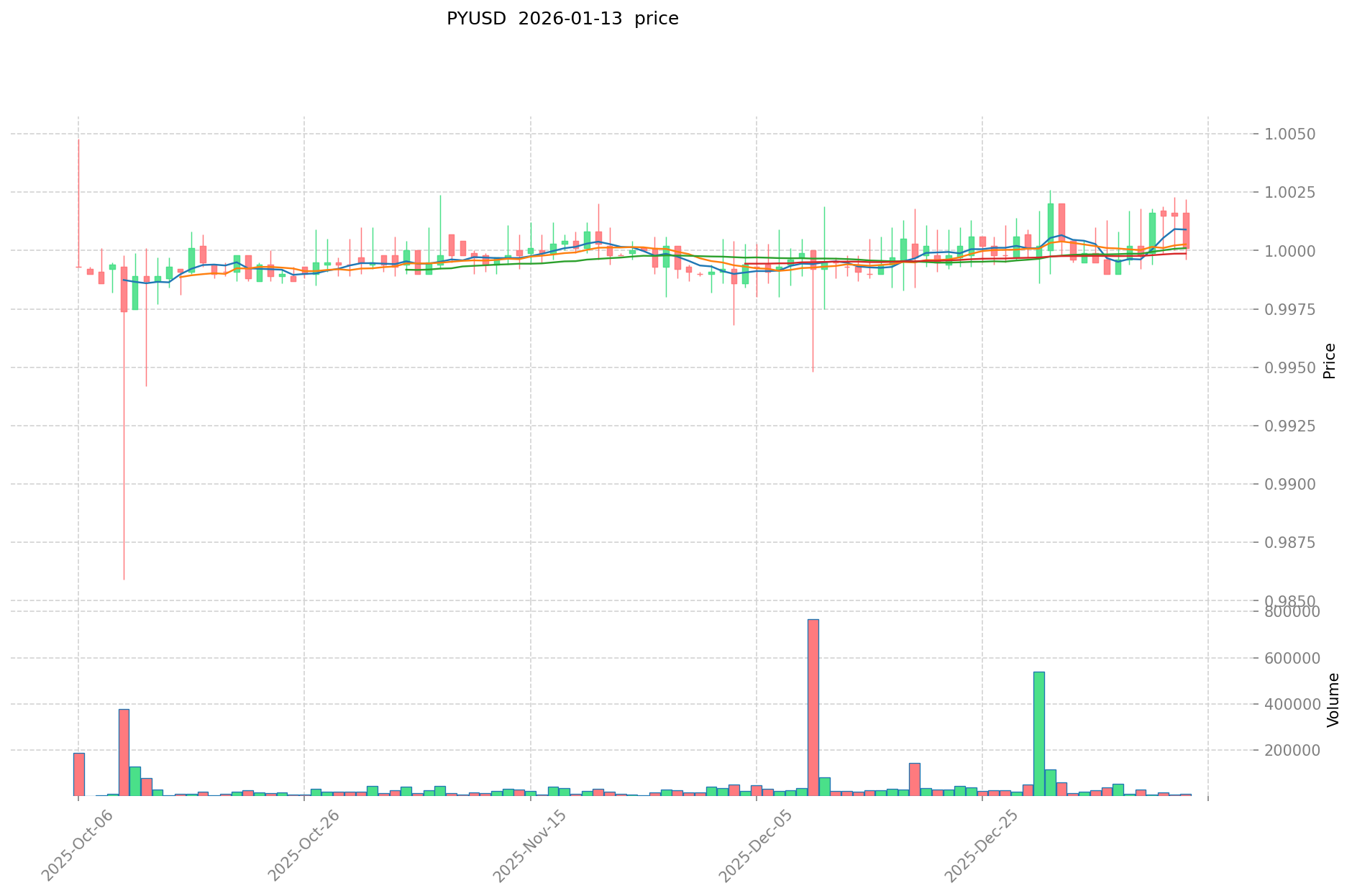
II. Core Factors Influencing Whether PYUSD is a Good Investment
Supply Mechanism and Scarcity (PYUSD Investment Scarcity)
- PYUSD operates as a stablecoin with a supply mechanism tied to 1:1 backing by U.S. dollar deposits, short-term U.S. Treasuries, and similar cash equivalents, issued by Paxos Trust Company. The circulating supply stands at approximately 3.62 billion tokens, while the total supply is around 967.6 million tokens, with maximum supply marked as unlimited.
- The supply mechanism differs from traditional scarcity-driven cryptocurrencies, as PYUSD's value is designed to maintain parity with the U.S. dollar rather than appreciate through supply constraints. Historical price data shows PYUSD trading within a relatively stable range, with recorded high and low prices of $1.2 and $0.833 respectively, reflecting its stablecoin nature rather than scarcity-driven price movements.
- For investment consideration, PYUSD's design prioritizes stability over scarcity-based value appreciation. The unlimited maximum supply indicates that investment value derives from utility and yield opportunities rather than supply limitations.
Institutional Investment and Mainstream Adoption (Institutional Investment in PYUSD)
- PYUSD has gained attention through its association with PayPal's payment infrastructure and recent developments including USD.AI's decision to denominate loans to AI companies in PYUSD, connecting the stablecoin to AI economy financing mechanisms.
- The stablecoin ranks among notable stablecoins by market capitalization, with a market cap of approximately $3.62 billion and a market dominance of 0.029%. PYUSD is available across 16 exchanges and has approximately 47,574 holders.
- Adoption considerations include PYUSD's integration within PayPal's ecosystem and its potential role in digital payment infrastructure, though specific institutional holding data was not provided in the reference materials.
Macroeconomic Environment's Impact on PYUSD Investment
- As a dollar-pegged stablecoin backed by U.S. dollar deposits and short-term U.S. Treasuries, PYUSD's value mechanism is directly influenced by U.S. monetary policy and interest rate environments. Changes in these factors affect the underlying backing assets and potential yield opportunities.
- PYUSD offers a reported 4% annual interest when held in PayPal accounts, positioning it as a yield-generating option within the stablecoin category during certain interest rate conditions.
- The stablecoin's design as a dollar-equivalent asset means its investment profile differs from assets positioned as inflation hedges, instead serving functions related to payment stability and yield generation within specific economic conditions.
Technology and Ecosystem Development (Technology & Ecosystem for PYUSD Investment)
- PYUSD utilizes the SPL (Solana Program Library) algorithm and is deployed on the Solana blockchain, with the contract address 2b1kV6DkPAnxd5ixfnxCpjxmKwqjjaYmCZfHsFu24GXo. This technical infrastructure supports transaction efficiency and ecosystem integration.
- The stablecoin's integration within PayPal's payment platform provides access to existing payment infrastructure and user base, potentially supporting utility-driven adoption.
- PYUSD's ecosystem positioning relates to payment applications and stablecoin utility rather than DeFi or NFT-specific features mentioned in reference materials. Its investment value consideration connects to its role in payment facilitation and yield opportunities within the PayPal ecosystem.
III. PYUSD Future Investment Prediction and Price Outlook (Is PayPal USD(PYUSD) worth investing in 2026-2031)
Short-term Investment Prediction (2026, short-term PYUSD investment outlook)
- Conservative Prediction: $0.74 - $1.00
- Neutral Prediction: $1.00 - $1.20
- Optimistic Prediction: $1.20 - $1.45
Mid-term Investment Outlook (2027-2029, mid-term PayPal USD(PYUSD) investment forecast)
-
Market Stage Expectation: PYUSD may experience gradual growth as a stablecoin backed by U.S. dollar deposits, short-term U.S. Treasuries, and similar cash equivalents. The mid-term outlook suggests potential price stability with moderate upward momentum, influenced by broader stablecoin adoption trends and regulatory developments.
-
Investment Return Prediction:
- 2027: $0.94 - $1.60
- 2028: $1.09 - $1.58
- 2029: $0.85 - $1.89
-
Key Catalysts: Expansion of stablecoin use cases in digital payments, regulatory clarity surrounding stablecoins, integration with PayPal's existing payment infrastructure, and broader institutional adoption of digital assets.
Long-term Investment Outlook (Is PYUSD a good long-term investment?)
- Base Scenario: $1.00 - $1.77 (assuming steady stablecoin market growth and continued regulatory support)
- Optimistic Scenario: $1.50 - $2.21 (assuming accelerated mainstream adoption and favorable market conditions)
- Risk Scenario: $0.74 - $1.00 (under challenging regulatory environments or reduced market confidence)
Click to view PYUSD long-term investment and price prediction: Price Prediction
2026-01-13 - 2031 Long-term Outlook
- Base Scenario: $1.00 - $1.77 (corresponding to steady progress and gradual mainstream application improvement)
- Optimistic Scenario: $1.50 - $2.21 (corresponding to large-scale adoption and favorable market environment)
- Transformative Scenario: Above $2.21 (if the ecosystem achieves breakthrough progress and mainstream popularization)
- 2031-12-31 Predicted High: $2.21 (based on optimistic development assumptions)
Disclaimer: The above predictions are based on historical data analysis and market trend modeling. Cryptocurrency markets are highly volatile and influenced by numerous unpredictable factors including regulatory changes, technological developments, macroeconomic conditions, and market sentiment. Past performance does not guarantee future results. These predictions should not be construed as financial advice or investment recommendations. Investors should conduct their own research and consider their risk tolerance before making any investment decisions.
| Year |
Predicted High Price |
Predicted Average Price |
Predicted Low Price |
Price Change |
| 2026 |
1.45 |
1 |
0.74 |
0 |
| 2027 |
1.60475 |
1.225 |
0.94325 |
22 |
| 2028 |
1.58466 |
1.414875 |
1.08945375 |
41 |
| 2029 |
1.88970705 |
1.4997675 |
0.854867475 |
49 |
| 2030 |
1.84726362975 |
1.694737275 |
1.1863160925 |
69 |
| 2031 |
2.21375056546875 |
1.771000452375 |
0.97405024880625 |
77 |
IV. PYUSD Investment Strategy and Risk Management (How to invest in Stablecoins)
Investment Strategy (PYUSD investment strategy)
Long-term Holding (HODL PYUSD)
For PayPal USD, the traditional "HODL" strategy differs from volatile cryptocurrencies due to its stablecoin nature. PYUSD is designed to maintain a 1:1 peg with the U.S. dollar, backed 100% by U.S. dollar deposits, short-term U.S. Treasuries, and similar cash equivalents. This makes it suitable for:
- Capital Preservation: Conservative investors seeking to maintain dollar-denominated value within the crypto ecosystem
- Payment Infrastructure: Users requiring stable digital currency for transactions and remittances
- Yield Generation: Holding PYUSD in platforms offering interest or rewards on stablecoin deposits
Given PYUSD's historical price range between $0.833 and $1.2, investors should note that while designed for stability, minor deviations from the $1 peg can occur during market stress.
Active Trading
Active trading strategies for PYUSD are limited compared to volatile assets, but opportunities exist:
- Arbitrage Opportunities: Exploiting minor price deviations from the $1 peg across different exchanges
- Liquidity Provision: Participating in DeFi protocols as a liquidity provider for PYUSD trading pairs
- Cross-platform Transfers: Utilizing PYUSD for efficient value transfer between platforms with lower fees
Technical analysis for PYUSD focuses primarily on monitoring peg stability rather than traditional price action patterns.
Risk Management (Risk management for PYUSD investment)
Asset Allocation Ratios
Conservative Investors:
- May allocate a portion of their crypto portfolio to PYUSD as a stable anchor
- Suitable for risk-averse participants seeking dollar exposure without leaving the crypto ecosystem
Aggressive Investors:
- Use PYUSD as temporary parking for capital between high-volatility trades
- Maintain smaller allocations as stablecoins offer limited appreciation potential
Professional Investors:
- Strategic allocation for liquidity management and operational efficiency
- Integration into diversified crypto portfolios for rebalancing purposes
Risk Hedging Solutions
Multi-asset Portfolio Construction:
- Combine PYUSD with other cryptocurrencies to reduce overall portfolio volatility
- Use as a safe haven during market downturns to preserve capital
Hedging Instruments:
- Maintain PYUSD positions to quickly enter or exit volatile positions
- Utilize in conjunction with derivatives for risk management strategies
Secure Storage
Hot Wallet Solutions:
- Suitable for active trading and frequent transactions
- Use reputable exchanges supporting PYUSD with strong security measures
Cold Wallet Solutions:
- For long-term holdings, consider hardware wallets compatible with Solana (SPL tokens)
- PYUSD operates on the Solana blockchain, requiring compatible storage solutions
Hardware Wallet Recommendations:
- Select hardware wallets with verified Solana SPL token support
- Implement multi-signature solutions for institutional holdings
- Regular security audits and backup procedures for recovery phrases
V. PYUSD Investment Risks and Challenges (Risks of investing in Stablecoins)
Market Risks
Volatility Considerations:
While PYUSD aims for price stability, the token has experienced price fluctuations, with historical data showing a low of $0.833 and a high of $1.2. Current 24-hour price movement shows a minor change of -0.04%, with trading between $0.9996 and $1.0017, demonstrating generally stable behavior but not absolute peg maintenance.
Price Deviation Risks:
- Temporary loss of peg during extreme market conditions
- Liquidity constraints during high redemption demand
- Market confidence shifts affecting stablecoin valuations
Regulatory Risks
Jurisdiction-specific Uncertainties:
- Stablecoin regulations vary significantly across different countries
- Potential changes in U.S. regulatory framework affecting PYUSD operations
- Issuer requirements and reserve audit standards subject to evolving regulations
Compliance Considerations:
- PYUSD is issued by Paxos Trust Company, subject to U.S. financial regulations
- Regulatory actions against stablecoin issuers could impact PYUSD accessibility
- Cross-border transaction restrictions may affect utility
Technical Risks
Network Security Concerns:
- PYUSD operates on the Solana blockchain, inheriting network-level risks
- Smart contract vulnerabilities could affect token functionality
- Network congestion or outages may impact transaction processing
Counterparty Risks:
- Dependence on Paxos Trust Company's operational integrity
- Reserve management and audit transparency
- Redemption mechanism reliability during stress periods
Upgrade and Integration Risks:
- Blockchain protocol changes may affect PYUSD functionality
- Exchange delisting or reduced support could impact liquidity
- Integration challenges with evolving DeFi protocols
VI. Conclusion: Is Stablecoin a Good Investment?
Investment Value Summary
PYUSD represents a specialized investment vehicle within the cryptocurrency ecosystem. As a stablecoin backed by U.S. dollar reserves and issued by Paxos Trust Company, it serves primarily as a stable store of value rather than an appreciation asset. With a current market cap of approximately $3.62 billion and presence on 16 exchanges, PYUSD demonstrates substantial adoption within the digital payments infrastructure.
The token's performance shows minimal volatility, with 1-year changes around 0.09%, confirming its function as a stability-focused asset. Its integration with PayPal's ecosystem provides unique utility for digital transactions, though investment returns remain limited compared to volatile cryptocurrencies.
Investor Recommendations
✅ Beginners:
- Use PYUSD for initial crypto exposure with minimal price risk
- Implement secure wallet storage compatible with Solana blockchain
- Start with small allocations to understand stablecoin mechanics and redemption processes
✅ Experienced Investors:
- Utilize PYUSD for portfolio rebalancing and liquidity management
- Explore arbitrage opportunities around minor peg deviations
- Integrate into broader crypto trading strategies for efficient capital deployment
✅ Institutional Investors:
- Consider PYUSD for treasury management within crypto operations
- Evaluate as part of stablecoin diversification strategy
- Assess integration benefits with PayPal's payment infrastructure
⚠️ Disclaimer: Cryptocurrency investments carry substantial risks. Stablecoins, while designed for stability, are not risk-free and may experience loss of peg, regulatory challenges, or operational issues. This content is for informational purposes only and does not constitute investment advice. Investors should conduct thorough due diligence and consider their risk tolerance before making investment decisions.
VII. FAQ
Q1: Is PayPal USD (PYUSD) a safe investment for long-term holding?
PYUSD is designed primarily for stability rather than long-term appreciation, making it suitable for capital preservation rather than growth-oriented investments. As a stablecoin backed 100% by U.S. dollar deposits, short-term U.S. Treasuries, and similar cash equivalents issued by Paxos Trust Company, PYUSD maintains a 1:1 peg with the U.S. dollar. While historical data shows price stability with minor fluctuations between $0.833 and $1.2, investors should understand that PYUSD serves best as a stable store of value within the crypto ecosystem rather than an appreciation asset. The token's investment value derives from utility, yield opportunities (such as the reported 4% annual interest when held in PayPal accounts), and payment functionality rather than price growth potential.
Q2: What are the main risks associated with investing in PYUSD?
The primary risks include regulatory uncertainty, counterparty risk, and temporary loss of peg during market stress. PYUSD faces potential regulatory changes affecting stablecoin operations, dependence on Paxos Trust Company's operational integrity, and reserve management reliability. Technical risks include vulnerabilities related to the Solana blockchain infrastructure, smart contract security concerns, and potential liquidity constraints during high redemption demand. Additionally, while PYUSD aims for price stability, historical data shows it has experienced deviations from the $1 peg, ranging from $0.833 to $1.2. Investors should also consider exchange delisting risks, cross-border transaction restrictions, and the evolving regulatory landscape for stablecoins across different jurisdictions.
Q3: How does PYUSD compare to other stablecoins like USDT or USDC?
PYUSD distinguishes itself through its integration with PayPal's payment infrastructure and backing by Paxos Trust Company, a regulated financial institution. With a market capitalization of approximately $3.62 billion and availability on 16 exchanges, PYUSD holds a smaller market share (0.029%) compared to larger stablecoins. Its unique advantage lies in seamless integration with PayPal's existing user base and payment systems, potentially offering advantages for users already within the PayPal ecosystem. PYUSD operates on the Solana blockchain, which may provide faster transaction speeds and lower fees compared to Ethereum-based stablecoins, though this also introduces network-specific risks. The reported 4% annual interest rate on holdings provides yield generation opportunities, though investors should compare this with other stablecoin yield options and consider associated platform risks.
Q4: What is the best strategy for investing in PYUSD?
The optimal strategy for PYUSD focuses on capital preservation, liquidity management, and yield generation rather than price appreciation. Conservative investors may allocate a portion of their crypto portfolio to PYUSD as a stable anchor for dollar exposure within the digital asset ecosystem. Active traders can utilize PYUSD for efficient capital deployment between volatile positions, exploiting minor arbitrage opportunities around peg deviations across exchanges, or participating as liquidity providers in DeFi protocols. For portfolio management, PYUSD serves effectively as a rebalancing tool and safe haven during market downturns. Investors should implement secure storage solutions compatible with Solana blockchain, consider multi-signature wallets for larger holdings, and maintain diversification across multiple stablecoins to mitigate issuer-specific risks.
Q5: Will PYUSD maintain its $1 peg in the future?
While PYUSD is designed to maintain a 1:1 peg with the U.S. dollar through full backing by reserves, absolute peg maintenance cannot be guaranteed under all market conditions. Historical data shows PYUSD has experienced price fluctuations between $0.833 and $1.2, though recent performance demonstrates stability with minimal deviation (24-hour range of $0.9996-$1.0017). The peg's stability depends on several factors: Paxos Trust Company's operational integrity, reserve management transparency, redemption mechanism efficiency during stress periods, regulatory environment stability, and overall market confidence in stablecoins. Extreme market conditions, liquidity constraints during high redemption demand, or significant regulatory actions could temporarily affect the peg. Investors should monitor reserve audit reports, regulatory developments, and maintain awareness that even well-designed stablecoins may experience temporary deviations from their intended peg during crisis periods.
Q6: How can beginners start investing in PYUSD?
Beginners should start with small allocations to understand PYUSD's mechanics before scaling investments. First, select a reputable cryptocurrency exchange supporting PYUSD (currently available on 16 exchanges) and complete necessary verification procedures. Acquire PYUSD through direct purchase with fiat currency or by converting other cryptocurrencies. Implement secure storage solutions compatible with Solana blockchain, choosing between hot wallets for active use or hardware wallets for long-term holdings. Understand the redemption process and how to convert PYUSD back to fiat currency when needed. Beginners should use PYUSD initially for minimal-risk crypto exposure, learning digital asset management without significant volatility concerns. Monitor the token's peg stability, stay informed about regulatory developments affecting stablecoins, and gradually explore yield-generating opportunities such as interest-bearing accounts or liquidity provision as experience grows.
Q7: What factors could cause PYUSD's price to deviate from $1?
Several factors may cause temporary deviations from PYUSD's $1 peg. Market stress events creating high redemption demand can strain liquidity, causing temporary price drops as seen in the historical low of $0.833. Conversely, increased demand during market volatility may push prices temporarily above peg, as reflected in the historical high of $1.2. Regulatory announcements affecting Paxos Trust Company or stablecoins generally can impact market confidence and trading behavior. Technical issues on the Solana blockchain, exchange-specific liquidity constraints, or delays in redemption processing may create arbitrage opportunities and price discrepancies across platforms. Changes in U.S. monetary policy affecting the underlying reserve assets, particularly short-term U.S. Treasuries, could indirectly influence confidence. Additionally, concerns about reserve transparency, audit results, or operational challenges at Paxos could trigger selling pressure. While these deviations are typically temporary due to arbitrage mechanisms and reserve backing, investors should maintain awareness of these risk factors.
Q8: Is PYUSD suitable for institutional investment portfolios?
PYUSD presents specific advantages for institutional investors requiring stable digital asset exposure and integration with traditional payment infrastructure. With a market capitalization of approximately $3.62 billion and regulatory oversight through Paxos Trust Company, PYUSD offers institutional-grade stability compared to volatile cryptocurrencies. The integration with PayPal's ecosystem provides unique operational benefits for institutions already utilizing PayPal's payment services. Institutions may utilize PYUSD for treasury management within crypto operations, cross-border settlement efficiency, and as part of a diversified stablecoin strategy to mitigate issuer-specific risks. However, institutional investors should conduct thorough due diligence on reserve management practices, regulatory compliance frameworks, and redemption mechanism reliability. The relatively smaller market share (0.029%) compared to dominant stablecoins requires assessment of liquidity depth for large transactions. Institutions should implement robust custody solutions, consider multi-signature arrangements, and maintain diversification across multiple stablecoin issuers to manage counterparty risk effectively.
* The information is not intended to be and does not constitute financial advice or any other recommendation of any sort offered or endorsed by Gate.