This comprehensive guide examines whether Pendle (PENDLE) is a viable investment opportunity in 2024-2025 and beyond. The article analyzes PENDLE's current market position (ranked #165 with $375.11M market cap at $2.22), evaluates its innovative yield tokenization mechanism through Principal Tokens and Yield Tokens, and explores the vePENDLE governance system that rewards long-term holders with swap fees and yield distributions. Key sections assess tokenomics dynamics, including the emission reduction schedule through April 2026 transitioning to 2% annual inflation, institutional adoption trends, and technology differentiation including the Pendle v2 AMM and 2025 Boros platform expansion into funding-rate derivatives. The analysis presents multi-scenario price forecasts through 2031 alongside detailed investment strategies for beginners through institutional investors, comprehensive risk assessment covering market volatility, regulatory uncertainty, and technical vulnerabilities, and actionable management fra
Introduction: Pendle (PENDLE)'s Investment Position and Market Prospects
PENDLE is a notable asset in the cryptocurrency field. As a permissionless yield trading protocol, it enables users to execute various yield management strategies through tokenizing future yield on its AMM system. As of January 15, 2026, Pendle holds a market ranking of 165, with a market capitalization reaching approximately $375.11 million and a circulating supply of about 168.97 million tokens. The current price stands at around $2.22. With its positioning as a protocol that separates yield-bearing assets into Principal Tokens (PT) and Yield Tokens (YT), PENDLE has gradually become a focal point when investors discuss "Is Pendle (PENDLE) a good investment?" The protocol features a capital-efficient Pendle v2 AMM design model and a governance mechanism through vePENDLE, where locked token holders can participate in emission reward direction voting and accumulate fees from swap operations and YT-generated yields. This article will comprehensively analyze Pendle's investment value, historical trends, future price predictions, and investment risks to provide reference for investors.
I. Pendle (PENDLE) Price History Review and Current Investment Value
- 2021: PENDLE raised $3.7 million in seed funding in April 2021, with a Fully Diluted Valuation (FDV) of $35 million. The token launched at a publish price of $1.6957.
- 2024: PENDLE experienced notable growth during the year, with its price approaching $6 in August and showing over 30% monthly gains. The protocol's Total Value Locked (TVL) reached a peak of approximately $9 billion in mid-August.
- 2024: In April, PENDLE recorded a price of $7.5. By late June, significant market volatility occurred when certain liquidity restaking pools matured on June 27, causing Pendle's TVL to decline from approximately $6.2 billion to $3.7 billion.
- 2024-2025: From late 2024 into early 2025, PENDLE's price showed downward movement, with trading activity reflecting broader market corrections.
Current PENDLE Investment Market Status (January 2026)
- PENDLE current price: $2.22
- 24-hour trading volume: $629,190.45
- Market capitalization: $375.11 million
- Circulating supply: 168.97 million PENDLE (60.02% of total supply)
- Total supply: 281.53 million PENDLE
- Price changes: -1.89% (24h), +1.09% (7d), +12.06% (30d), -42.02% (1y)
- Holder count: 71,219 addresses
- Exchange listings: 52 exchanges
Click to view real-time PENDLE market price
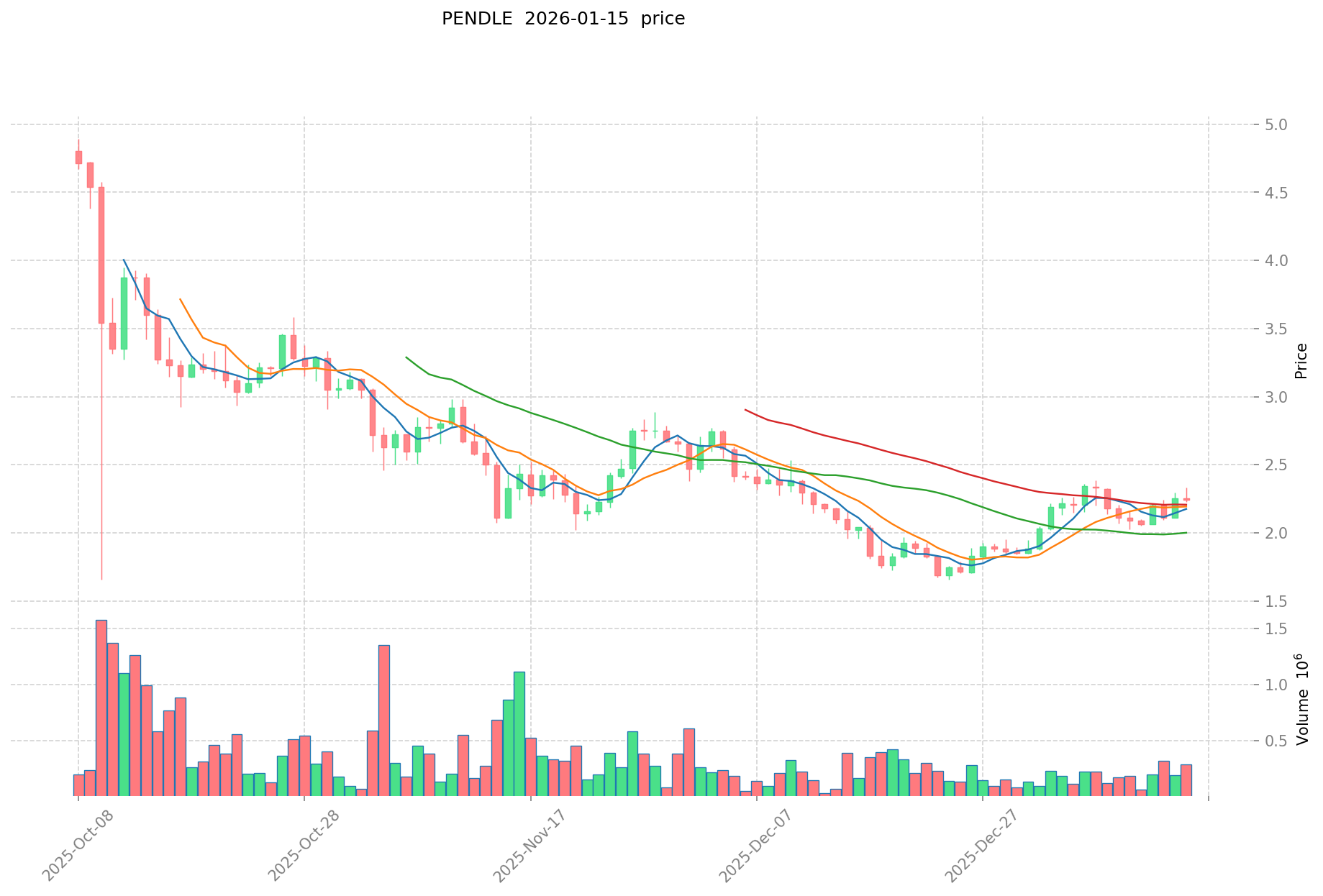
II. Core Factors Influencing Whether PENDLE is a Good Investment (Is Pendle(PENDLE) a Good Investment)
Supply Mechanism and Scarcity (PENDLE investment scarcity)
- Token emission structure → influences price and investment value
- Historical pattern: According to the reference materials, as of June 2023, weekly emissions stood at 460,000 tokens with a 1.10% weekly reduction until April 2026, transitioning to a 2.00% annual inflation rate thereafter, which may impact long-term supply dynamics
- Investment significance: The emission reduction mechanism and transition to lower inflation could support long-term investment considerations
Institutional Investment and Mainstream Adoption (Institutional investment in PENDLE)
- Early funding: The protocol raised $3.7 million in a seed round in April 2021 at an FDV of $35 million, representing 14.9% of total supply
- Protocol growth: Reference materials indicate record growth in 2025 with $40 million annualized revenue and strategic expansion through the launch of Boros, a funding-rate derivatives platform
- Ecosystem expansion: Pendle's position as a yield trading protocol for tokenized yield and interest-rate products may contribute to its adoption within DeFi markets
Macroeconomic Environment Impact on PENDLE Investment
- Market volatility: According to reference materials, 2025 showed increased stability with average price at $3.71 and volatility falling to 94%, which may reflect broader market conditions
- Interest rate markets: Pendle's focus on yield and interest-rate products positions it within the context of changing rate environments
- DeFi market dynamics: The protocol's expansion into funding-rate derivatives targets structural volatility in crypto markets, which may be influenced by macroeconomic factors
Technology and Ecosystem Development (Technology & Ecosystem for PENDLE investment)
- Pendle v2 AMM: A capital-efficient design model enabling PT and YT swaps through a single liquidity pool via flash swaps, enhancing protocol efficiency
- Boros platform launch: The 2025 introduction of Boros enables trading of tokenized perpetual funding-rate exposure, expanding the protocol's product suite into institutional-grade rate markets
- Yield tokenization mechanism: The protocol wraps base yield tokens into SY (Standardized Yield tokens), then splits them into Principal Tokens (PT) and Yield Tokens (YT), allowing users to execute various yield management strategies
- vePENDLE governance: Token holders can lock PENDLE for up to 2 years as vePENDLE to vote on emission reward directions and accumulate fees from swap operations and YT-generated yields (3% fee with 100% redistribution to vePENDLE holders)
III. PENDLE Future Investment Forecast and Price Outlook (Is Pendle (PENDLE) worth investing in 2026-2031)
Short-term PENDLE Investment Outlook (2026)
- Conservative Forecast: $2.05 - $2.35
- Neutral Forecast: $2.23 - $2.59
- Optimistic Forecast: $2.59 - $2.94
Mid-term Pendle (PENDLE) Investment Forecast (2027-2029)
- Market Stage Expectations: The mid-term outlook suggests a period of gradual expansion, with potential for moderate upward movement driven by DeFi sector developments and protocol adoption trends.
- Investment Return Forecast:
- 2027: $2.35 - $2.97
- 2028: $2.28 - $3.23
- 2029: $1.98 - $4.38
- Key Catalysts: Continued evolution of yield trading mechanisms, broader DeFi ecosystem integration, and potential expansion of protocol features.
Long-term Investment Outlook (Is PENDLE a good long-term investment?)
- Base Scenario: $2.33 - $4.03 (assuming steady protocol development and maintained market position)
- Optimistic Scenario: $3.69 - $4.47 (assuming enhanced protocol adoption and favorable DeFi market conditions)
- Risk Scenario: $1.98 - $2.35 (under conditions of reduced DeFi activity or heightened market volatility)
Click to view PENDLE long-term investment and price forecast: Price Prediction
2026-2031 Long-term Outlook
- Base Scenario: $2.05 - $4.03 (corresponding to steady progress and gradual mainstream application growth)
- Optimistic Scenario: $3.69 - $4.47 (corresponding to large-scale adoption and favorable market environment)
- Transformative Scenario: Above $4.47 (if ecosystem achieves breakthrough developments and mainstream adoption)
- December 31, 2031 Forecast High: $4.47 (based on optimistic development assumptions)
Disclaimer: The forecasts presented are derived from historical data patterns and market analysis models. Cryptocurrency markets remain highly volatile and unpredictable. These projections should not be interpreted as financial advice or guarantees of future performance. Market participants should conduct independent research and consider their risk tolerance before making investment decisions.
| Year |
Predicted High Price |
Predicted Average Price |
Predicted Low Price |
Price Change |
| 2026 |
2.9436 |
2.23 |
2.0516 |
0 |
| 2027 |
2.97482 |
2.5868 |
2.353988 |
16 |
| 2028 |
3.2257396 |
2.78081 |
2.2802642 |
25 |
| 2029 |
4.384781208 |
3.0032748 |
1.982161368 |
35 |
| 2030 |
4.35895304472 |
3.694028004 |
2.32723764252 |
66 |
| 2031 |
4.4694044820396 |
4.02649052436 |
2.3353645041288 |
81 |
IV. Pendle Investment Strategy and Risk Management (How to invest in Yield Trading Protocols)
Investment Methodology (Pendle investment strategy)
Risk Management (Risk management for Pendle investment)
-
Asset Allocation Ratio: Conservative / Aggressive / Professional investors
- Conservative investors: Allocate 1-3% of crypto portfolio to PENDLE as part of DeFi exposure.
- Aggressive investors: May increase allocation to 5-10%, considering higher risk tolerance.
- Professional investors: Strategic allocation based on DeFi market conditions and yield trading trends.
-
Risk Hedging Solutions: Multi-asset portfolio + hedging instruments
- Diversify across different crypto categories (Layer 1, DeFi, stablecoins) to reduce concentrated risk.
- Consider stablecoin holdings or derivatives for downside protection during market downturns.
-
Secure Storage: Cold and hot wallets + hardware wallet recommendations
- Hardware wallets (Ledger, Trezor) recommended for long-term PENDLE storage.
- Use reputable hot wallets for active trading, ensuring proper security measures (2FA, whitelisting).
- Verify contract address (0x808507121b80c02388fad14726482e061b8da827 on Ethereum) before transactions.
V. Pendle Investment Risks and Challenges (Risks of investing in Yield Trading Protocols)
-
Market Risk: High volatility, potential price manipulation
- PENDLE has experienced substantial volatility, with a 1-year decline of -42.02% from previous levels.
- The gap between all-time high ($7.5 on April 11, 2024) and current price ($2.22) indicates significant downside risk.
- Market capitalization to fully diluted valuation ratio of 60.02% suggests potential dilution risk as more tokens enter circulation.
-
Regulatory Risk: Policy uncertainty across different jurisdictions
- DeFi protocols face evolving regulatory frameworks in major markets, which may impact PENDLE's operational model.
- Yield trading mechanisms and tokenization of future yields may attract regulatory scrutiny in certain jurisdictions.
-
Technical Risk: Network security vulnerabilities, upgrade failures
- Smart contract vulnerabilities could affect the Pendle v2 AMM and yield tokenization mechanisms.
- The protocol's reliance on wrapped yield tokens (SY) and complex PT/YT mechanisms introduces technical complexity.
- Ethereum network congestion or high gas fees may impact user experience and protocol adoption.
VI. Conclusion: Is Yield Trading Protocol a Good Investment?
-
Investment Value Summary: PENDLE demonstrates potential for long-term value through its yield trading protocol, but faces notable short-term price fluctuations.
- The protocol's innovative approach to yield tokenization and the vePENDLE rewards system provide fundamental value propositions.
- Market capitalization ranking (#165) and 24-hour trading volume ($629,190.46) indicate moderate liquidity.
- Circulating supply represents 60.02% of total supply, with emission schedule extending through April 2026.
-
Investor Recommendations:
-
✅ Beginners: Consider dollar-cost averaging (DCA) + secure wallet storage
- Start with small allocations to understand protocol mechanics and market dynamics.
- Prioritize learning about yield tokenization and DeFi fundamentals before investing.
-
✅ Experienced Investors: Swing trading + portfolio allocation
- Monitor technical levels and market sentiment for tactical trading opportunities.
- Integrate PENDLE as part of a diversified DeFi portfolio strategy.
-
✅ Institutional Investors: Strategic long-term allocation
- Evaluate protocol fundamentals, TVL trends, and competitive positioning in yield trading sector.
- Consider participation in governance through vePENDLE staking for protocol influence.
⚠️ Disclaimer: Cryptocurrency investment carries high risk. This content is for informational purposes only and does not constitute investment advice.
VII. FAQ
Q1: Is Pendle (PENDLE) a good investment for beginners in 2026?
PENDLE may be suitable for beginners who understand DeFi fundamentals and can tolerate high volatility, but requires careful risk management. As a yield trading protocol with innovative tokenization mechanisms, PENDLE offers exposure to the growing DeFi sector. However, beginners should note the token's significant price volatility, evidenced by its 42.02% decline over the past year and the gap between its all-time high of $7.5 (April 2024) and current price of $2.22. For those new to crypto investing, a conservative approach is recommended: allocate only 1-3% of your crypto portfolio to PENDLE, use dollar-cost averaging (DCA) to reduce timing risk, and store tokens in secure hardware wallets. Understanding the protocol's PT/YT tokenization mechanism and vePENDLE governance system is essential before investing.
Q2: What are the main risks of investing in Pendle (PENDLE)?
The primary risks include high market volatility, regulatory uncertainty, and technical vulnerabilities. Market risk is substantial, with PENDLE experiencing significant price fluctuations and a 42.02% decline over the past year, while its market cap to fully diluted valuation ratio of 60.02% indicates potential dilution as more tokens enter circulation. Regulatory risk stems from evolving DeFi frameworks across jurisdictions, which may impact yield trading mechanisms and tokenization of future yields. Technical risk involves smart contract vulnerabilities in the Pendle v2 AMM system, the complexity of wrapped yield tokens (SY) and PT/YT mechanisms, and potential issues from Ethereum network congestion or high gas fees. Additionally, the protocol's TVL decline from $6.2 billion to $3.7 billion in late June 2024 demonstrates liquidity risk during pool maturities.
Q3: How does Pendle's vePENDLE mechanism benefit long-term investors?
The vePENDLE mechanism provides significant incentives for long-term holders through fee distribution and governance participation. Token holders can lock PENDLE for up to 2 years to receive vePENDLE, which grants voting rights on emission reward directions and accumulates 100% of swap operation fees plus 3% of yield token (YT) generated yields. This creates a direct revenue-sharing model where long-term investors benefit from protocol activity without selling their holdings. The governance aspect allows vePENDLE holders to influence which liquidity pools receive emission rewards, potentially directing incentives toward pools they participate in. This mechanism aligns long-term holder interests with protocol growth, as increased trading volume and yield generation directly translate to higher fee accumulation for vePENDLE participants.
Q4: What price forecasts exist for PENDLE through 2031?
Price forecasts suggest moderate growth potential with significant uncertainty. For 2026, conservative estimates range from $2.05-$2.35, neutral forecasts suggest $2.23-$2.59, and optimistic scenarios project $2.59-$2.94. Mid-term forecasts show gradual expansion: 2027 ($2.35-$2.97), 2028 ($2.28-$3.23), and 2029 ($1.98-$4.38). Long-term projections through 2031 present three scenarios: base case ($2.33-$4.03 assuming steady development), optimistic scenario ($3.69-$4.47 with enhanced adoption), and risk scenario ($1.98-$2.35 under reduced DeFi activity). The December 31, 2031 forecast high reaches $4.47 under optimistic assumptions. However, these projections are based on historical patterns and market models, and cryptocurrency markets remain highly volatile and unpredictable, so forecasts should not be interpreted as guarantees of future performance.
Q5: How does Pendle's technology differentiate it from other DeFi protocols?
Pendle's core innovation lies in its yield tokenization mechanism and capital-efficient AMM design. The protocol wraps base yield tokens into Standardized Yield tokens (SY), then splits them into Principal Tokens (PT) representing the underlying asset and Yield Tokens (YT) representing future yield. This separation allows users to execute sophisticated yield management strategies, such as fixed-rate lending (buying PT) or leveraged yield exposure (buying YT). The Pendle v2 AMM enables PT and YT swaps through a single liquidity pool via flash swaps, improving capital efficiency compared to traditional AMM designs. The 2025 launch of Boros further expanded the protocol's capabilities by enabling trading of tokenized perpetual funding-rate exposure, targeting institutional-grade rate markets. This combination of yield tokenization, efficient AMM design, and expansion into funding-rate derivatives positions Pendle uniquely within the DeFi ecosystem.
Q6: What factors should investors monitor when considering PENDLE investment?
Key monitoring factors include Total Value Locked (TVL) trends, protocol revenue metrics, token emission schedules, and broader DeFi market conditions. TVL serves as an indicator of protocol usage and trust, with historical fluctuations from $9 billion peak (August 2024) to $3.7 billion (late June 2024) demonstrating the importance of tracking liquidity flows, particularly around pool maturity dates. Protocol revenue reached $40 million annualized in 2025, providing insight into sustainable growth. The token emission schedule, currently at a 1.10% weekly reduction until April 2026 before transitioning to 2.00% annual inflation, affects supply dynamics and potential selling pressure. Additionally, investors should track technical indicators such as support/resistance levels, monitor Ethereum network conditions that impact gas fees, watch for regulatory developments affecting DeFi protocols, and observe competitive positioning within the yield trading sector.
Q7: What investment strategy works best for PENDLE?
The optimal strategy depends on investor experience level and risk tolerance. Conservative long-term holders should consider the HODL approach with vePENDLE staking to benefit from fee distribution (100% of swap fees and 3% of YT fees) and reduced selling pressure from the decreasing emission schedule. This strategy suits investors allocating 1-3% of their crypto portfolio to PENDLE with a 2-3 year time horizon. Active traders may capitalize on short-term volatility using technical analysis around support ($2.214) and resistance ($2.332) levels, with recent price changes showing tradable fluctuations (24H: -1.89%, 7D: +1.09%, 30D: +12.06%). Aggressive investors might allocate 5-10% with swing trading combined with strategic vePENDLE participation. Regardless of strategy, risk management through diversification across crypto categories, secure storage in hardware wallets, and avoiding over-concentration in single assets remains essential.
Q8: How does Pendle's token supply mechanism affect long-term investment value?
The token supply mechanism suggests potential long-term value support through emission reduction and controlled inflation. As of January 2026, circulating supply represents 60.02% of the 281.53 million total supply, with a structured emission schedule decreasing by 1.10% weekly until April 2026, after which it transitions to a 2.00% annual inflation rate. This progressive reduction in new token supply may decrease selling pressure over time, particularly as vePENDLE staking locks tokens for up to 2 years, effectively reducing circulating supply further. The historical emission data shows weekly emissions of 460,000 tokens in June 2023, which has been declining systematically. For long-term investors, this deflationary trajectory combined with fee accumulation from protocol activity creates a value proposition where token scarcity increases while revenue generation provides fundamental support, though market conditions and protocol adoption remain critical variables affecting actual price performance.
* The information is not intended to be and does not constitute financial advice or any other recommendation of any sort offered or endorsed by Gate.