This comprehensive guide analyzes whether PepeCoin (PEPECOIN) represents a viable investment opportunity in 2024-2026. Currently trading at $0.0947 with a $10.14 million market cap, PEPECOIN evolved from a 2016 memecoin to an asset with utility features including PepeOS, PepePaint, and Kek Bot. The article examines critical investment factors: price history showing volatility from $7.019 peak to current levels, supply mechanics with 80.03% circulation, ecosystem development, and macroeconomic influences. Price predictions range from $0.0886-$0.2779 by 2031 depending on adoption scenarios. The analysis covers investment strategies for different investor profiles, essential risk management approaches, and detailed risk categories including market volatility, regulatory uncertainty, and technical vulnerabilities. Suitable for investors exploring Gate.com PEPECOIN trading, this guide provides actionable insights on position sizing, portfolio allocation, and long-term versus active trading strategies in the memecoi
Introduction: PepeCoin (PEPECOIN)'s Investment Position and Market Prospects
PepeCoin (PEPECOIN) represents a distinctive asset in the cryptocurrency landscape, having been launched in 2016 as the original memecoin associated with the Pepe the Frog meme. As of January 26, 2026, PEPECOIN maintains a market capitalization of approximately $10.14 million, with a circulating supply of around 107.06 million tokens and a current trading price of $0.0947. With its positioning as a meme-based digital asset that has evolved to incorporate utility features through products like PepeOS, PepePaint, and Kek Bot, PEPECOIN has become a subject of discussion among participants exploring "Is PepeCoin (PEPECOIN) a good investment?" This article provides a comprehensive analysis of PEPECOIN's investment characteristics, historical price movements, future price considerations, and associated risks to serve as a reference for market participants.
I. PepeCoin (PEPECOIN) Price History Review and Current Investment Value Status
- 2016: PepeCoin launched as the original memecoin associated with the Pepe the Frog meme → Establishing its cultural presence in the cryptocurrency space with initial pricing at $0.03817
- 2024: Significant price movement occurred → PEPECOIN reached a notable price level of $7.019 on November 10, 2024
- 2025-2026: Market adjustment phase → Price declined from higher levels to $0.089 on January 25, 2026, followed by a recovery to current trading levels
Current PEPECOIN Investment Market Status (January 2026)
- PEPECOIN current price: $0.0947
- 24-hour trading volume: $14,836.13
- Total market capitalization: $10,138,318.65
- Circulating supply: 107,057,219.16 PEPECOIN (representing 80.03% of total supply)
- Holder count: 18,674 addresses
- Available on 5 exchanges with Gate.com trading support
Click to view real-time PEPECOIN market price
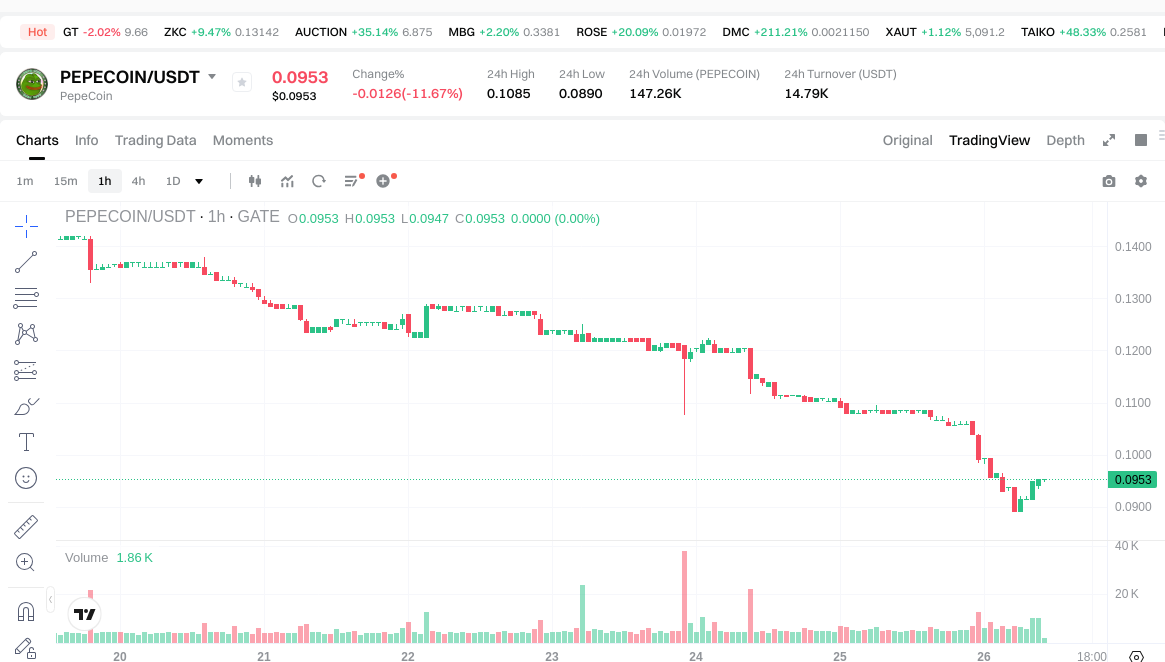
II. Core Factors Affecting Whether PEPECOIN is a Good Investment (Is PepeCoin(PEPECOIN) a Good Investment)
Supply Mechanism and Scarcity (PEPECOIN investment scarcity)
-
Supply Mechanism Impact on Investment Value: PepeCoin has a maximum supply of 133,769,420 tokens, with approximately 107,057,219 tokens currently in circulation, representing a circulation ratio of about 80.03%. The controlled supply structure may contribute to potential scarcity dynamics that could influence price behavior over time.
-
Supply Dynamics and Price Considerations: Historical data shows that PepeCoin experienced significant price fluctuations, with a recorded high of $7.019 in November 2024 and a low of $0.089 in January 2026. These variations occurred within the context of its fixed maximum supply framework, though multiple factors beyond supply mechanics contributed to these price movements.
-
Investment Significance of Scarcity: The capped supply model, combined with the relatively high circulation ratio, suggests that the majority of tokens are already in the market. This supply distribution characteristic represents one element investors may consider when evaluating long-term holding strategies.
Institutional Investment and Mainstream Adoption (Institutional investment in PepeCoin)
-
Market Position and Exchange Presence: PepeCoin is currently listed on 5 exchanges and holds a market capitalization of approximately $10.14 million, ranking 1,192 in the cryptocurrency market. The token has approximately 18,674 holders, indicating a community of users and investors.
-
Ecosystem Development: PepeCoin has evolved beyond its memecoin origins to develop utility-focused products including PepeOS, PepePaint, and Kek Bot. These ecosystem components represent efforts to establish practical use cases beyond speculative trading activity.
-
Historical Context: Launched in 2016 as one of the earlier memecoin projects associated with the Pepe the Frog cultural phenomenon, PepeCoin has maintained presence in the market for multiple years, transitioning through various phases of development and market cycles.
Macroeconomic Environment's Impact on PepeCoin Investment
-
Market Volatility Considerations: Recent performance data shows PepeCoin experienced a 12.71% decline over 24 hours, a 32.84% decrease over 7 days, and a 92.85% decline over one year as of January 26, 2026. These fluctuations occur within broader cryptocurrency market conditions influenced by various macroeconomic factors including monetary policy shifts and risk appetite changes.
-
24-Hour Trading Range: The token traded between a low of $0.089 and a high of $0.1085 within the 24-hour period, with a trading volume of approximately $14,836, reflecting ongoing market activity and liquidity availability at current price levels.
-
Market Share and Positioning: PepeCoin holds a 0.00032% share of the total cryptocurrency market, positioning it as a smaller-cap digital asset that may experience different volatility patterns compared to larger capitalization cryptocurrencies during varying macroeconomic conditions.
Technology and Ecosystem Development (Technology & Ecosystem for PepeCoin investment)
-
Technical Infrastructure: PepeCoin operates as an ERC-20 token on the Ethereum blockchain, utilizing the established infrastructure and security features of the Ethereum network. The contract address (0xa9e8acf069c58aec8825542845fd754e41a9489a) is verifiable through Etherscan.
-
Ecosystem Products: The project has developed several applications including PepeOS, PepePaint, and Kek Bot, which aim to provide utility beyond the token itself. These products represent efforts to build a functional ecosystem around the PepeCoin brand and community.
-
Evolution from Memecoin: PepeCoin's transition from its 2016 origins as a meme-based cryptocurrency to a project with utility-focused products reflects an adaptation strategy within the evolving cryptocurrency landscape. This development trajectory distinguishes it from purely speculative memecoin projects without functional applications.
III. PEPECOIN Future Investment Prediction and Price Outlook (Is PepeCoin(PEPECOIN) worth investing in 2026-2031)
Short-term Investment Prediction (2026, short-term PEPECOIN investment outlook)
- Conservative Prediction: $0.0886 - $0.0953
- Neutral Prediction: $0.0953 - $0.1048
- Optimistic Prediction: $0.1048 and above
Mid-term Investment Outlook (2027-2028, mid-term PepeCoin(PEPECOIN) investment forecast)
- Market Stage Expectation: The mid-term period may witness gradual ecosystem development and potential market recovery phases, with price movements reflecting broader memecoin sector sentiment and adoption trends
- Investment Return Prediction:
- 2027: $0.0931 - $0.1281
- 2028: $0.0673 - $0.1665
- Key Catalysts: Ecosystem expansion including products like PepeOS, PepePaint, and Kek Bot; broader memecoin market sentiment shifts; potential exchange listings; community growth dynamics
Long-term Investment Outlook (Is PepeCoin a good long-term investment?)
- Base Scenario: $0.0673 - $0.1665 (assuming moderate ecosystem development and sustained community engagement)
- Optimistic Scenario: $0.1665 - $0.2779 (assuming successful utility expansion and favorable market conditions)
- Risk Scenario: Below $0.0673 (under prolonged bearish conditions or reduced market interest)
View PEPECOIN long-term investment and price prediction: Price Prediction
2026-2031 Long-term Outlook
- Base Scenario: $0.0886 - $0.1665 (corresponding to steady progress and gradual mainstream application growth)
- Optimistic Scenario: $0.1665 - $0.2779 (corresponding to large-scale adoption and favorable market environment)
- Transformative Scenario: Above $0.2779 (if ecosystem achieves breakthrough development and mainstream popularity)
- 2031-12-31 Predicted High: $0.2779 (based on optimistic development assumptions)
Disclaimer: Price predictions are speculative and based on historical data analysis and model projections. Cryptocurrency markets are highly volatile and subject to numerous unpredictable factors. Past performance does not guarantee future results. This content does not constitute investment advice, and investors should conduct independent research and consider their risk tolerance before making any investment decisions.
| Year |
Predicted High Price |
Predicted Average Price |
Predicted Low Price |
Price Change |
| 2026 |
0.10483 |
0.0953 |
0.088629 |
0 |
| 2027 |
0.1280832 |
0.100065 |
0.09306045 |
5 |
| 2028 |
0.166548186 |
0.1140741 |
0.067303719 |
20 |
| 2029 |
0.20064493449 |
0.140311143 |
0.07576801722 |
48 |
| 2030 |
0.21991666998105 |
0.170478038745 |
0.1193346271215 |
80 |
| 2031 |
0.277180243195495 |
0.195197354363025 |
0.171773671839462 |
106 |
IV. PepeCoin Investment Strategy and Risk Management (How to invest in memecoin)
Investment Methodology (PepeCoin investment strategy)
-
Long-term Holding (HODL PepeCoin): Suitable for conservative investors who believe in the long-term cultural significance and ecosystem development of PepeCoin. This approach involves accumulating tokens during market corrections and holding through volatility cycles.
-
Active Trading: Relies on technical analysis and swing trading strategies. Traders may capitalize on PepeCoin's price volatility by identifying support and resistance levels, monitoring trading volume patterns, and utilizing momentum indicators to time entry and exit points.
Risk Management (Risk management for PepeCoin investment)
V. PepeCoin Investment Risks and Challenges (Risks of investing in memecoin)
-
Market Risk: PepeCoin exhibits significant price volatility, with recent data showing fluctuations including a 24-hour change of -12.71% and a 7-day change of -32.84%. The memecoin category is susceptible to sentiment-driven price movements and potential market manipulation due to relatively lower market capitalization and trading volumes.
-
Regulatory Risk: Cryptocurrency regulations vary significantly across jurisdictions and continue to evolve. Policy uncertainties regarding digital assets, particularly memecoins, may impact trading availability, taxation, and overall market accessibility in different countries.
-
Technical Risk: Network security vulnerabilities related to the Ethereum blockchain infrastructure and smart contract implementation. Potential risks include exploitation of contract weaknesses, failed protocol upgrades, or unforeseen technical issues that could affect token functionality and user funds.
VI. Conclusion: Is Memecoin a Good Investment?
-
Investment Value Summary: PepeCoin demonstrates potential for long-term value preservation as one of the original memecoins with historical significance dating back to 2016. However, investors should be aware of substantial short-term price fluctuations, as evidenced by recent performance metrics.
-
Investor Recommendations:
✅ Beginners: Consider dollar-cost averaging approach combined with secure wallet storage solutions. Start with minimal allocation to understand market dynamics and token behavior.
✅ Experienced Investors: Implement swing trading strategies alongside diversified portfolio configuration. Monitor technical indicators and ecosystem developments for informed decision-making.
✅ Institutional Investors: Evaluate strategic long-term allocation opportunities while maintaining comprehensive risk assessment frameworks and adherence to internal governance protocols.
⚠️ Disclaimer: Cryptocurrency investment carries substantial risk. This content is provided for informational purposes only and does not constitute investment advice. Investors should conduct thorough research and consider their financial circumstances before making investment decisions.
VII. FAQ
Q1: What is PepeCoin (PEPECOIN) and what makes it different from other memecoins?
PepeCoin (PEPECOIN) is the original memecoin launched in 2016 associated with the Pepe the Frog meme, distinguished by its historical significance and ecosystem development. Unlike purely speculative memecoins, PEPECOIN has evolved to incorporate utility-focused products including PepeOS, PepePaint, and Kek Bot, operating as an ERC-20 token on the Ethereum blockchain with a verifiable contract address (0xa9e8acf069c58aec8825542845fd754e41a9489a). With approximately 18,674 holders and a maximum supply of 133,769,420 tokens, it represents one of the earlier memecoin projects that has maintained market presence through multiple cryptocurrency cycles.
Q2: What has been PepeCoin's price performance and current market position?
PepeCoin currently trades at $0.0947 with a market capitalization of approximately $10.14 million, ranking 1,192 in the cryptocurrency market. The token experienced significant volatility, reaching a notable high of $7.019 on November 10, 2024, before declining to $0.089 in January 2026. Recent performance shows a 24-hour change of -12.71%, a 7-day decline of -32.84%, and a one-year decrease of -92.85%. The token is available on 5 exchanges with a 24-hour trading volume of $14,836.13, and approximately 107.06 million tokens are in circulation, representing 80.03% of the total supply.
Q3: What are the price predictions for PepeCoin from 2026 to 2031?
Short-term predictions for 2026 range from $0.0886 (conservative) to above $0.1048 (optimistic), with a neutral outlook of $0.0953-$0.1048. Mid-term forecasts suggest 2027 prices of $0.0931-$0.1281 and 2028 prices of $0.0673-$0.1665. Long-term projections indicate a base scenario of $0.0886-$0.1665 by 2031, an optimistic scenario of $0.1665-$0.2779, and a transformative scenario above $0.2779, with the predicted high for December 31, 2031, at $0.2779. These predictions depend on factors including ecosystem development, market sentiment, exchange listings, and community growth, though cryptocurrency markets remain highly volatile and unpredictable.
Q4: What investment strategies are suitable for PepeCoin?
Two primary strategies exist for PepeCoin investment: long-term holding (HODL) suitable for conservative investors believing in the token's cultural significance and ecosystem development, involving accumulation during market corrections; and active trading utilizing technical analysis and swing trading strategies to capitalize on price volatility. Conservative investors should allocate 1-3% of their crypto portfolio to PEPECOIN, while aggressive investors may consider 5-10% allocation with active monitoring. Risk management includes diversified asset portfolios, stablecoin reserves for liquidity, and secure storage solutions combining hot wallets for active trading with cold wallets and hardware devices for long-term holdings.
Q5: What are the main risks associated with investing in PepeCoin?
PepeCoin carries three primary risk categories: market risk, characterized by significant price volatility with recent declines and susceptibility to sentiment-driven movements due to lower market capitalization; regulatory risk, stemming from evolving cryptocurrency regulations across jurisdictions that may impact trading availability, taxation, and market accessibility; and technical risk, including potential Ethereum blockchain vulnerabilities, smart contract exploitation, protocol upgrade failures, or unforeseen technical issues affecting token functionality. The memecoin category faces particular challenges from market manipulation potential, liquidity concerns given the $14,836 24-hour trading volume, and the inherent speculative nature of meme-based digital assets.
Q6: Is PepeCoin suitable for different types of investors?
PepeCoin suitability varies by investor profile and risk tolerance. Beginners should consider dollar-cost averaging with minimal allocation to understand market dynamics, combined with secure wallet storage solutions. Experienced investors may implement swing trading strategies alongside diversified portfolio configurations, monitoring technical indicators and ecosystem developments for informed decisions. Institutional investors should evaluate strategic long-term allocation opportunities while maintaining comprehensive risk assessment frameworks and adhering to internal governance protocols. All investors must recognize that cryptocurrency investment carries substantial risk, and thorough independent research considering individual financial circumstances is essential before making investment decisions.
Q7: What factors could influence PepeCoin's future performance?
Several key factors may impact PepeCoin's future trajectory: ecosystem expansion success of products like PepeOS, PepePaint, and Kek Bot; broader memecoin sector sentiment shifts and adoption trends; potential additional exchange listings beyond the current 5 platforms; community growth dynamics and holder engagement; macroeconomic conditions affecting cryptocurrency markets including monetary policy and risk appetite; supply dynamics with 80.03% circulation ratio; competitive landscape developments in the memecoin category; and regulatory developments affecting digital assets. The capped supply of 133,769,420 tokens combined with ecosystem utility development represents a differentiation factor from purely speculative memecoins, though market volatility remains a significant consideration.
Q8: How does PepeCoin's technology and ecosystem support its investment value?
PepeCoin operates as an ERC-20 token on the Ethereum blockchain, utilizing established infrastructure and security features with a verifiable smart contract. The project has evolved from its 2016 memecoin origins to develop utility-focused applications including PepeOS, PepePaint, and Kek Bot, representing efforts to build functional ecosystem value beyond speculative trading. This transition strategy distinguishes PEPECOIN from memecoins without practical applications, though the effectiveness of these products in driving sustainable value and user adoption remains dependent on continued development, market acceptance, and competition within the broader cryptocurrency ecosystem. The Ethereum foundation provides technical reliability, while ecosystem products aim to establish long-term utility beyond cultural significance.
* The information is not intended to be and does not constitute financial advice or any other recommendation of any sort offered or endorsed by Gate.