PepeCoin (PEPECOIN) is an ERC-20 token launched in 2016 that has evolved from a memecoin phenomenon into a utility-focused digital asset with ecosystem products including PepeOS, PepePaint, and Kek Bot. This comprehensive analysis examines whether PepeCoin represents a viable investment by evaluating its market fundamentals, historical performance, and future potential through 2031. Currently trading at $0.0946 with a $10.13 million market capitalization across 5 exchanges via Gate and others, PepeCoin presents substantial volatility—experiencing a 92.9% annual decline and 98.7% decrease from its $7.019 all-time high. The guide provides targeted investment strategies for beginners, experienced traders, and institutional investors, emphasizing risk management through portfolio allocation (1-3% for conservative investors), secure storage solutions, and diversification approaches. While ecosystem development and cultural significance offer growth potential, extreme volatility and regulatory uncertainties demand
Introduction: PepeCoin (PEPECOIN) Investment Position and Market Outlook
PEPECOIN represents a notable asset in the cryptocurrency landscape, having been launched in 2016 as one of the early memecoin projects associated with the Pepe the Frog cultural phenomenon. As of January 26, 2026, PepeCoin holds a market capitalization of approximately $10.13 million, with a circulating supply of around 107.06 million tokens and a current trading price near $0.0946. The project has evolved from its memecoin origins into a digital asset supported by ecosystem products including PepeOS, PepePaint, and Kek Bot. With approximately 18,674 token holders and deployment on the Ethereum network as an ERC-20 token, PepeCoin has established its presence across 5 exchanges. Currently ranked 1192 in market capitalization, the asset maintains a market dominance of 0.00032%. This analysis examines PepeCoin's investment characteristics, historical price movements, future outlook considerations, and associated risk factors to provide informational context for market participants evaluating "Is PepeCoin (PEPECOIN) a good investment?" within their research processes.
I. Historical Price Review and Current Investment Value Status of PEPECOIN
- 2016: Launched as the original memecoin associated with the iconic Pepe the Frog meme → Established as a cultural phenomenon in the cryptocurrency space
- 2024: Reached a notable price level of 7.019 on November 10 → Market participants observed significant price movement
- 2026: Experienced price fluctuation from previous levels to 0.089 on January 25
Current PEPECOIN Investment Market Status (January 2026)
- PEPECOIN current price: $0.0946
- Market sentiment (Fear & Greed Index): Data not available in provided materials
- 24-hour trading volume: $14,869.69
- Institutional investor holdings: Data not available in provided materials
Click to view real-time PEPECOIN market price
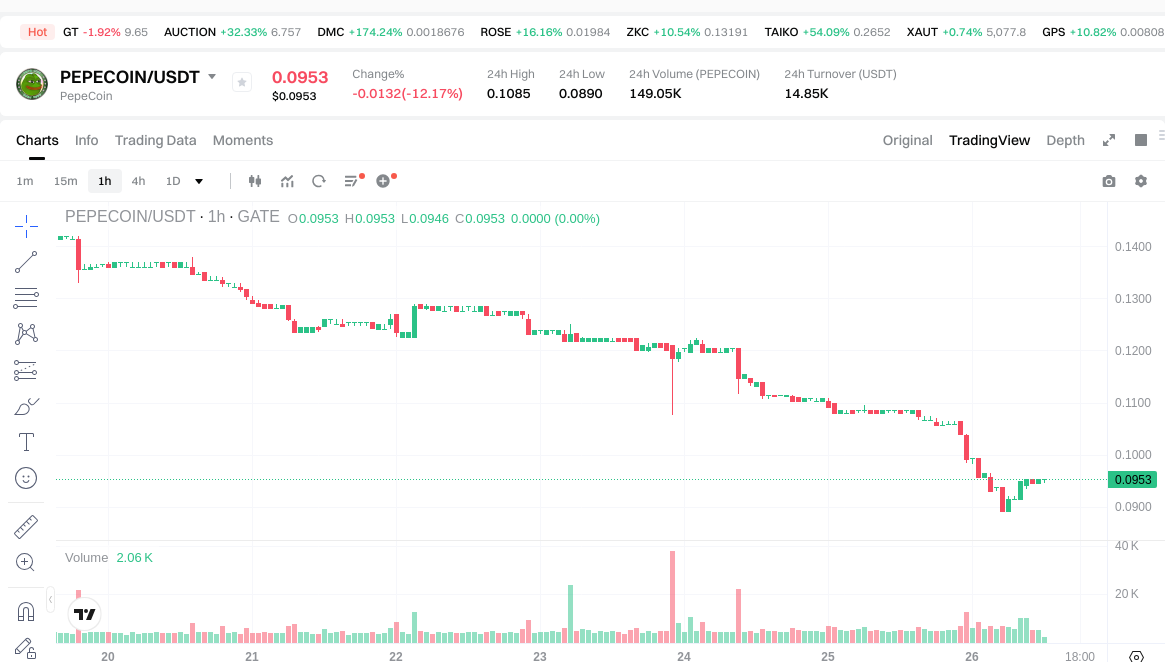
II. Core Factors Affecting Whether PEPECOIN is a Good Investment (Is PepeCoin(PEPECOIN) a Good Investment)
Supply Mechanism and Scarcity (PEPECOIN investment scarcity)
- Total supply stands at 107,630,586 tokens with a maximum supply cap of 133,769,420 tokens → influences price dynamics and investment valuation
- Circulating supply represents approximately 80.03% of total supply, with 107,057,219 tokens currently in circulation
- Investment significance: The defined supply cap and circulation ratio serve as fundamental factors in assessing potential scarcity-driven value
Institutional Investment and Mainstream Adoption (Institutional investment in PepeCoin)
- The token maintains listings across 5 exchanges, indicating a degree of market accessibility
- Community engagement is reflected through 18,674 token holders
- Market positioning: PepeCoin holds a market dominance of 0.00032%, with a market capitalization to fully diluted valuation ratio of 80.03%
Macroeconomic Environment's Impact on PEPECOIN Investment
- Monetary policy adjustments and interest rate fluctuations may influence investor allocation preferences across digital asset classes
- Market sentiment indicators suggest neutral positioning, reflecting broader macroeconomic considerations
- Trading volume of $14,869.69 within the 24-hour period provides liquidity metrics for investment assessment
Technology and Ecosystem Development (Technology & Ecosystem for PepeCoin investment)
- PepeCoin operates on the ERC-20 standard, utilizing Ethereum's infrastructure for transaction processing and security
- Ecosystem products include PepeOS, PepePaint, and Kek Bot, expanding utility beyond memecoin origins
- Long-term value support: The evolution from a cultural phenomenon to a utility-bearing digital asset represents ongoing ecosystem maturation since its 2016 launch
III. PEPECOIN Future Investment Prediction and Price Outlook (Is PepeCoin(PEPECOIN) worth investing in 2026-2031)
Short-term Investment Prediction (2026, short-term PEPECOIN investment outlook)
- Conservative Prediction: $0.058 - $0.095
- Neutral Prediction: $0.095 - $0.127
- Optimistic Prediction: $0.095 - $0.127
Mid-term Investment Outlook (2027-2029, mid-term PepeCoin(PEPECOIN) investment forecast)
- Market Stage Expectation: PepeCoin may experience gradual development during the mid-term period, with potential ecosystem expansion and community engagement driving incremental growth.
- Investment Return Prediction:
- 2027: $0.077 - $0.114
- 2028: $0.076 - $0.162
- 2029: $0.111 - $0.184
- Key Catalysts: Expansion of ecosystem products such as PepeOS, PepePaint, and Kek Bot, along with broader market sentiment towards meme-based digital assets.
Long-term Investment Outlook (Is PepeCoin a good long-term investment?)
- Base Scenario: $0.087 - $0.238 (assuming steady ecosystem development and moderate market conditions)
- Optimistic Scenario: $0.181 - $0.275 (assuming enhanced adoption and favorable market environment)
- Risk Scenario: Below $0.087 (under adverse market conditions or reduced community engagement)
Click to view PEPECOIN long-term investment and price prediction: Price Prediction
2026-01-26 - 2031 Long-term Outlook
- Base Scenario: $0.087 - $0.238 (corresponding to steady progress and gradual mainstream application improvement)
- Optimistic Scenario: $0.181 - $0.275 (corresponding to large-scale adoption and favorable market environment)
- Transformative Scenario: Above $0.275 (in case of breakthrough ecosystem progress and mainstream popularization)
- 2031-12-31 Predicted High: $0.275 (based on optimistic development assumptions)
Disclaimer: This analysis is for informational purposes only and does not constitute investment advice. Cryptocurrency markets are highly volatile and unpredictable. Past performance does not guarantee future results. Investors should conduct their own research and consult with financial professionals before making investment decisions.
| Year |
Predicted High Price |
Predicted Average Price |
Predicted Low Price |
Price Change |
| 2026 |
0.126749 |
0.0953 |
0.058133 |
0 |
| 2027 |
0.114355235 |
0.1110245 |
0.076606905 |
17 |
| 2028 |
0.1622734092 |
0.1126898675 |
0.075502211225 |
19 |
| 2029 |
0.184225395389 |
0.13748163835 |
0.1113601270635 |
45 |
| 2030 |
0.23806320496686 |
0.1608535168695 |
0.08686089910953 |
70 |
| 2031 |
0.275252538067088 |
0.19945836091818 |
0.181507108435543 |
110 |
IV. PepeCoin Investment Strategy and Risk Management (How to invest in memecoins)
Investment Methodology (PepeCoin investment strategy)
Long-term Holding (HODL PepeCoin): Suitable for Conservative Investors
Long-term holding represents a passive investment approach where investors acquire PepeCoin and maintain their positions over extended periods, regardless of short-term price fluctuations. This strategy is particularly suitable for conservative investors who believe in the project's long-term cultural significance and ecosystem development. Given PepeCoin's evolution from its 2016 launch as a memecoin to a digital asset with utility products including PepeOS, PepePaint, and Kek Bot, long-term holders may benefit from potential ecosystem expansion. However, investors should note that PepeCoin experienced a 92.9% decline over the past year, highlighting the importance of thorough due diligence and risk tolerance assessment before adopting this strategy.
Active Trading: Technical Analysis and Swing Operations
Active trading involves capitalizing on PepeCoin's price movements through technical analysis and swing trading techniques. With a 24-hour trading volume of approximately $14,869.69 and recent price volatility showing a 12.81% decline in 24 hours and 33.05% decline over 7 days, PepeCoin presents opportunities for traders who can navigate short-term price movements. The asset's 24-hour price range of $0.089 to $0.1085 demonstrates intraday volatility that active traders may exploit. This approach requires continuous market monitoring, technical analysis skills, and the ability to execute timely entries and exits based on chart patterns, volume indicators, and market sentiment.
Risk Management (Risk management for PepeCoin investment)
Asset Allocation Ratio: Conservative / Aggressive / Professional Investors
Conservative Investors: Given PepeCoin's high volatility characteristics and 92.9% annual decline, conservative investors should limit exposure to 1-3% of their total investment portfolio. This allocation minimizes potential losses while maintaining exposure to potential upside.
Aggressive Investors: Those with higher risk tolerance and belief in memecoin sector recovery may allocate 5-10% of their portfolio to PepeCoin. This allocation should be paired with strict stop-loss mechanisms and regular portfolio rebalancing.
Professional Investors: Institutional or experienced investors with advanced risk management systems may consider higher allocations within a diversified cryptocurrency portfolio, combined with hedging strategies and active monitoring of market conditions and ecosystem developments.
Risk Hedging Solutions: Multi-asset Portfolio + Hedging Instruments
Effective risk management for PepeCoin investment requires diversification across multiple asset classes. Investors should consider:
- Diversifying across different cryptocurrency sectors (DeFi, Layer 1 protocols, stablecoins) to reduce concentration risk
- Incorporating traditional assets (stocks, bonds) to balance overall portfolio volatility
- Utilizing stablecoins for partial profit-taking during price rallies
- Implementing stop-loss orders to limit downside exposure
- Considering options or futures contracts (where available) for hedging purposes
Secure Storage: Hot/Cold Wallets + Hardware Wallet Recommendations
Secure storage is critical for PepeCoin holders, as the asset operates on the Ethereum blockchain (contract address: 0xa9e8acf069c58aec8825542845fd754e41a9489a). Storage options include:
Cold Wallets (Hardware Wallets): Recommended for long-term holders storing significant amounts. Hardware wallets like Ledger or Trezor provide offline storage, protecting assets from online threats.
Hot Wallets: Suitable for active traders requiring frequent access. MetaMask and other Ethereum-compatible wallets enable convenient trading but require strong security practices including two-factor authentication and regular software updates.
Best Practices: Never store large amounts on exchanges, maintain backup recovery phrases in secure physical locations, and regularly verify contract addresses before transactions to avoid phishing attempts.
V. PepeCoin Investment Risks and Challenges (Risks of investing in memecoins)
Market Risk: High Volatility and Price Manipulation
PepeCoin demonstrates significant market risk characteristics inherent to memecoin assets. The token's price declined 12.81% within 24 hours and 33.05% over 7 days, reflecting substantial volatility. The historical price range between an all-time high of $7.019 (November 10, 2024) and an all-time low of $0.089 (January 25, 2026) represents a 98.7% decline from peak levels, illustrating extreme price swings. With a relatively modest market capitalization of approximately $10.13 million and daily trading volume of $14,869.69, PepeCoin may be susceptible to price manipulation by large holders. The token's 24-hour price range ($0.089-$0.1085) indicates continued intraday volatility. Additionally, with only 5 exchanges listing PepeCoin, liquidity constraints may amplify price movements during periods of buying or selling pressure.
Regulatory Risk: Policy Uncertainty Across Different Countries
As a memecoin-categorized digital asset, PepeCoin faces regulatory uncertainty across various jurisdictions. Different countries maintain evolving stances toward cryptocurrency classification, taxation, and trading restrictions. Regulatory developments may impact:
- Exchange listings and delisting decisions
- Tax treatment of memecoin transactions
- Classification as securities or commodities in certain jurisdictions
- Cross-border transaction limitations
- Marketing and promotional restrictions related to meme-based assets
Investors should monitor regulatory developments in their respective jurisdictions and consider potential compliance requirements that may affect PepeCoin's accessibility and value proposition.
Technical Risk: Network Security Vulnerabilities and Upgrade Failures
PepeCoin operates as an ERC-20 token on the Ethereum blockchain, inheriting both the benefits and risks of this infrastructure. Technical risks include:
Smart Contract Vulnerabilities: Potential coding flaws in PepeCoin's contract (0xa9e8acf069c58aec8825542845fd754e41a9489a) could expose holders to security breaches or exploits.
Ethereum Network Dependencies: PepeCoin's functionality depends on Ethereum network stability, congestion levels, and transaction fees, which may impact trading efficiency and cost-effectiveness.
Ecosystem Product Risks: The project's ecosystem products (PepeOS, PepePaint, Kek Bot) represent technical development initiatives that may face implementation challenges, bugs, or adoption barriers.
Upgrade Compatibility: Future Ethereum network upgrades or changes in token standards may require PepeCoin contract updates, presenting potential technical challenges.
Investors should conduct thorough smart contract audits, monitor development activity, and assess the team's technical capabilities before committing capital.
VI. Conclusion: Is Memecoin a Good Investment?
Investment Value Summary
PepeCoin presents a complex investment proposition characterized by historical significance as a 2016-launched memecoin and ongoing ecosystem development, balanced against substantial volatility and market risks. While the project has evolved beyond its meme origins to incorporate utility products including PepeOS, PepePaint, and Kek Bot, recent performance indicators show significant challenges. The token's 92.9% annual decline, 33.05% weekly decline, and current price of $0.0946 (representing a 98.7% decrease from its all-time high) reflect the intense volatility inherent in memecoin investments. The project maintains a holder base of 18,674 addresses and a market capitalization ratio to fully diluted valuation of 80.03%, indicating moderate token circulation. However, with a market dominance of only 0.00032% and limited exchange availability, PepeCoin remains a speculative asset suitable primarily for investors with high risk tolerance and understanding of memecoin market dynamics.
Investor Recommendations
✅ Beginners: Dollar-Cost Averaging + Secure Wallet Storage
New investors considering PepeCoin exposure should:
- Implement dollar-cost averaging strategies to mitigate timing risk in volatile markets
- Limit initial exposure to 1-2% of total investment portfolio
- Prioritize secure storage using hardware wallets or verified Ethereum-compatible wallets
- Thoroughly research the project's ecosystem developments and community engagement
- Avoid investing capital that cannot be lost entirely
- Verify contract addresses through official channels (0xa9e8acf069c58aec8825542845fd754e41a9489a) before any transactions
✅ Experienced Investors: Swing Trading + Portfolio Diversification
Investors with cryptocurrency market experience may consider:
- Employing technical analysis to identify entry and exit points based on PepeCoin's price patterns
- Allocating 3-5% of cryptocurrency portfolio to memecoin sector exposure, with PepeCoin as one component
- Setting strict stop-loss orders given recent volatility (12.81% daily decline)
- Monitoring ecosystem product development and community metrics as fundamental indicators
- Balancing PepeCoin holdings with less volatile cryptocurrency assets
- Tracking holder count (currently 18,674) and exchange listing developments
✅ Institutional Investors: Strategic Long-term Allocation
Institutional participants evaluating memecoin sector exposure should:
- Conduct comprehensive due diligence on smart contract security and team credentials
- Consider PepeCoin within a broader thematic allocation to culturally significant digital assets
- Implement sophisticated risk management frameworks including hedging mechanisms
- Monitor regulatory developments affecting memecoin classifications
- Assess ecosystem utility adoption rates for PepeOS, PepePaint, and Kek Bot
- Maintain diversified exposure across multiple memecoin projects to reduce concentration risk
⚠️ Disclaimer
Cryptocurrency investments carry substantial risk, and investors may lose their entire capital. This article provides informational content only and does not constitute investment advice, financial guidance, or recommendations to buy, sell, or hold any digital asset. PepeCoin's historical performance, including a 92.9% annual decline and extreme volatility, demonstrates the high-risk nature of memecoin investments. Investors should conduct independent research, consult qualified financial advisors, and carefully assess their risk tolerance and financial circumstances before making any investment decisions. Past performance does not guarantee future results, and cryptocurrency markets remain subject to significant regulatory, technical, and market uncertainties.
VII. FAQ
Q1: What is PepeCoin (PEPECOIN) and how does it differ from other memecoins?
PepeCoin is an ERC-20 token launched in 2016, representing one of the earliest memecoin projects associated with the Pepe the Frog cultural phenomenon. Unlike many memecoins that remain purely speculative, PepeCoin has evolved to include ecosystem products such as PepeOS, PepePaint, and Kek Bot, providing utility beyond its meme origins. Operating on the Ethereum blockchain with a contract address of 0xa9e8acf069c58aec8825542845fd754e41a9489a, the project maintains 18,674 token holders and a capped supply of 133,769,420 tokens. This combination of historical significance, established community, and utility-focused development distinguishes PepeCoin within the broader memecoin landscape.
Q2: What are the primary risks associated with investing in PepeCoin?
PepeCoin carries substantial investment risks including extreme price volatility, limited liquidity, and regulatory uncertainty. The token experienced a 92.9% annual decline and a 98.7% decrease from its all-time high of $7.019, demonstrating significant downside potential. With a modest market capitalization of approximately $10.13 million and daily trading volume of only $14,869.69, PepeCoin is susceptible to price manipulation and liquidity constraints. As a memecoin listed on only 5 exchanges, it faces delisting risks and limited trading accessibility. Technical vulnerabilities related to smart contract security and dependencies on Ethereum network performance present additional concerns. Investors should also consider evolving regulatory frameworks across jurisdictions that may impact memecoin trading and taxation.
Q3: Is PepeCoin suitable for long-term investment or short-term trading?
Both strategies carry distinct risk-return profiles. Long-term holding suits investors with strong conviction in PepeCoin's ecosystem development and cultural relevance, though the 92.9% annual decline suggests significant patience and risk tolerance are required. Conservative long-term investors should limit exposure to 1-3% of their portfolio and focus on secure storage using hardware wallets. Short-term trading may capitalize on PepeCoin's volatility, with recent 24-hour price ranges of $0.089-$0.1085 presenting swing trading opportunities. However, this approach demands technical analysis expertise, continuous market monitoring, and strict risk management including stop-loss orders. Given the project's volatile history and modest trading volume, neither strategy guarantees returns, and investors should align their approach with their risk tolerance and investment objectives.
Q4: How should investors securely store PepeCoin tokens?
Secure storage requires understanding PepeCoin's ERC-20 token structure on the Ethereum blockchain. Long-term holders storing significant amounts should utilize hardware wallets such as Ledger or Trezor, which provide offline cold storage protection against online threats. Active traders requiring frequent access may use hot wallets like MetaMask or other Ethereum-compatible wallets, though these necessitate robust security practices including two-factor authentication and regular software updates. Critical security measures include: never storing large amounts on exchanges, maintaining backup recovery phrases in secure physical locations, verifying the correct contract address (0xa9e8acf069c58aec8825542845fd754e41a9489a) before transactions, and implementing multiple security layers. Investors should prioritize security infrastructure proportional to their holding size and trading frequency.
Q5: What factors should investors monitor to assess PepeCoin's future potential?
Key monitoring factors include ecosystem product adoption rates for PepeOS, PepePaint, and Kek Bot, which represent the project's evolution beyond memecoin status. Investors should track holder count changes from the current 18,674 addresses, exchange listing developments beyond the current 5 platforms, and trading volume trends from the present $14,869.69 daily level. Technical developments including smart contract upgrades, Ethereum network compatibility, and security audit results provide insight into project sustainability. Market positioning metrics such as the market dominance rate (currently 0.00032%) and the circulating supply ratio (80.03% of maximum supply) influence scarcity dynamics. Broader market conditions, regulatory developments affecting memecoin classification, and community engagement metrics also significantly impact PepeCoin's investment outlook.
Q6: How does PepeCoin's supply mechanism affect its investment characteristics?
PepeCoin's supply structure features a maximum cap of 133,769,420 tokens, with 107,630,586 currently in total supply and 107,057,219 in circulation, representing an 80.03% circulation ratio. This defined supply cap creates scarcity-driven value potential, distinguishing PepeCoin from inflationary token models. The relatively high circulation percentage suggests limited supply overhang, though approximately 20% remaining uncirculated tokens could impact future supply dynamics. Investors should consider that with the current circulating supply, each percentage point of increased demand may exert proportional upward price pressure given fixed supply constraints. However, the modest holder base of 18,674 addresses indicates concentration risk, where large holders may significantly influence supply available for trading. Supply scarcity alone does not guarantee value appreciation and should be evaluated alongside utility adoption, market demand, and competitive positioning.
Q7: What price predictions exist for PepeCoin through 2031, and what assumptions underlie them?
Price forecasts suggest varied scenarios: short-term 2026 predictions range from $0.058-$0.127, with mid-term 2027-2029 projections between $0.076-$0.184, and long-term 2031 estimates reaching $0.181-$0.275 under optimistic conditions. These predictions assume steady ecosystem development, gradual mainstream adoption, and favorable market conditions. Conservative base scenarios ($0.087-$0.238 by 2031) presume moderate progress without breakthrough adoption, while optimistic scenarios ($0.181-$0.275) assume enhanced utility adoption and positive market sentiment. However, these forecasts carry significant uncertainty given PepeCoin's historical volatility, including a 98.7% decline from all-time highs. Investors should recognize that cryptocurrency price predictions rely on assumptions about ecosystem development, market conditions, and adoption rates that may not materialize. Past performance, including the substantial recent declines, does not guarantee future results.
Q8: What allocation strategy should different investor types employ for PepeCoin exposure?
Allocation strategies should align with investor experience and risk tolerance. Conservative investors should limit PepeCoin exposure to 1-3% of total portfolio value, implementing dollar-cost averaging to mitigate timing risk and prioritizing secure hardware wallet storage. Aggressive investors with higher risk tolerance may allocate 5-10% within their cryptocurrency portfolio, paired with strict stop-loss mechanisms and regular rebalancing based on market conditions and ecosystem developments. Professional or institutional investors may consider higher allocations within diversified cryptocurrency portfolios, employing sophisticated risk management frameworks including hedging instruments and multi-asset diversification strategies. All investor types should diversify across different cryptocurrency sectors (DeFi, Layer 1 protocols, stablecoins) rather than concentrating solely in memecoins. Given PepeCoin's 92.9% annual decline and modest $10.13 million market capitalization, position sizing should reflect the asset's speculative nature and potential for complete capital loss.
* The information is not intended to be and does not constitute financial advice or any other recommendation of any sort offered or endorsed by Gate.