The article examines Perpetual Protocol (PERP) as an investment, focusing on its market performance, risk factors, and potential within decentralized derivatives trading. It discusses the viability of PERP, considering its price history, governance mechanisms, and staking rewards, while highlighting risks like market volatility and regulatory challenges. The analysis targets investors seeking insight into PERP's utility in the DeFi ecosystem. Structured in sections, the article covers price trends, project overview, market position, and investment strategy. Keywords emphasize DeFi, trading, investment, and PERP. Gate is mentioned as a primary trading platform.
Introduction: Perpetual Protocol (PERP) Investment Position and Market Prospects
PERP is an important asset in the cryptocurrency domain. Launched in 2020, it has achieved significant accomplishments in the decentralized perpetual futures sector. As of December 2025, PERP's market capitalization stands at approximately $13.86 million USD, with a circulating supply of around 72.61 million tokens and a current price hovering near $0.0924. Positioned as a "decentralized perpetual contract protocol supporting any asset," PERP has gradually become a focal point when investors discuss "Is Perpetual Protocol (PERP) a good investment?"
Perpetual Protocol operates through a virtual automated market maker (vAMM) mechanism, enabling traders to execute transactions directly without requiring counterparties. The platform integrates price data from reputable oracle sources such as Chainlink and Uniswap, allowing the creation of perpetual contracts for any asset with on-chain price feeds. The native PERP token serves dual functions: governance rights that enable token holders to vote on new asset listings and protocol development direction, as well as staking capabilities that provide rewards and a share of trading fees.
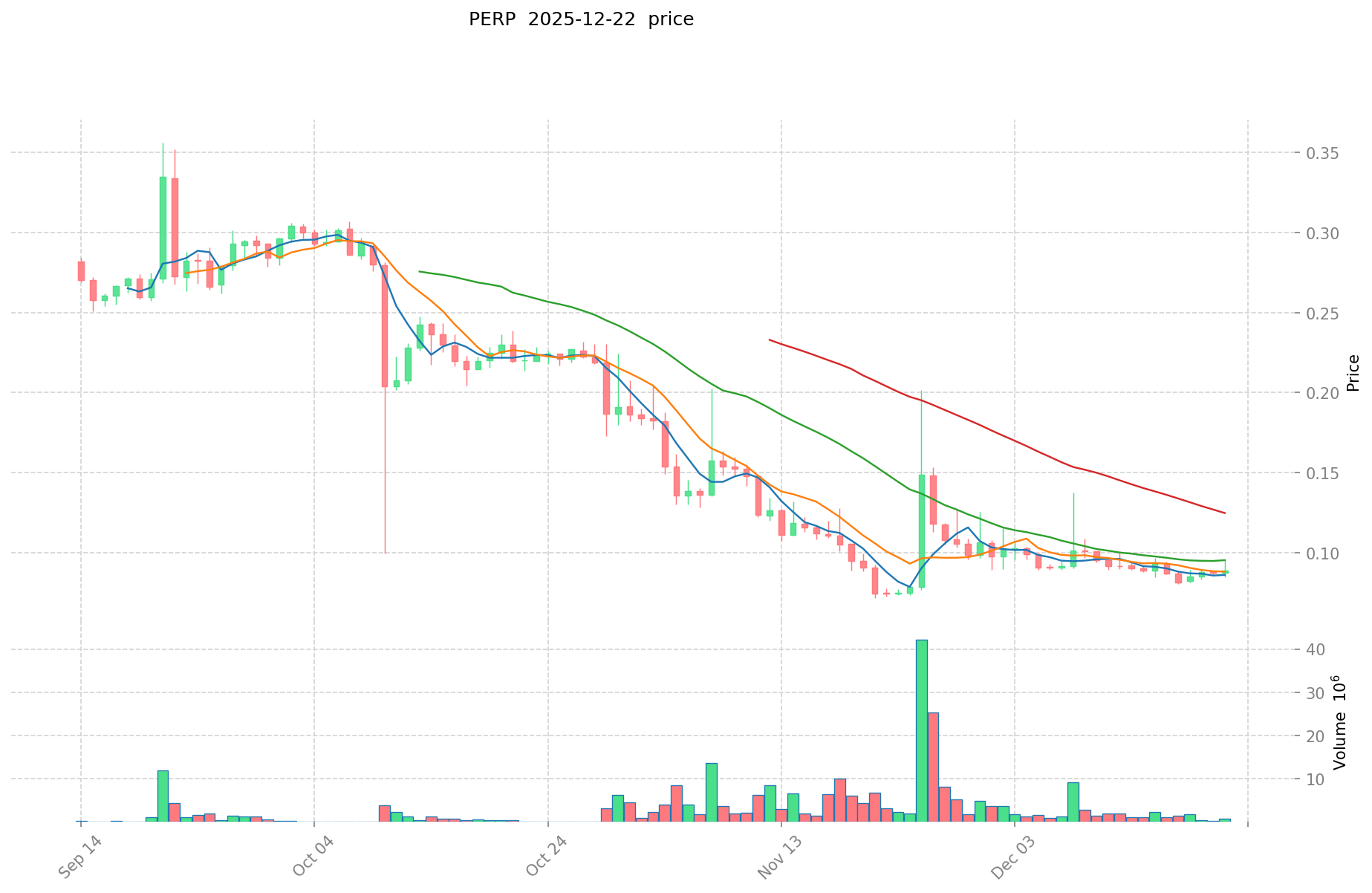
The token has experienced substantial price volatility since its inception, reaching an all-time high of $24.40 on August 30, 2021, and trading at lows around $0.073. Over the past year, PERP has declined approximately 88.29 percent, yet recent performance shows signs of recovery, with a 26.32 percent gain over the last 30 days and 6.32 percent appreciation over the past week.
This article provides a comprehensive analysis of PERP's investment value proposition, historical price dynamics, future price forecasting, and associated investment risks to serve as a reference for investors.
Perpetual Protocol (PERP) Investment Analysis Report
I. Price History Review and Current Investment Status
All-Time High and Low:
- All-Time High (ATH): $24.40 (August 30, 2021)
- All-Time Low (ATL): $0.072752 (November 22, 2025)
- Price Decline from ATH: Approximately 99.70%
Current Price Status (December 23, 2025):
- Current Price: $0.0924 USD
- 24-Hour Price Change: +3.13%
- 7-Day Price Change: +6.32%
- 30-Day Price Change: +26.32%
- 1-Year Price Change: -88.29%
Price Range (24 Hours):
- High: $0.10616
- Low: $0.0879
Current PERP Market Status (December 23, 2025)
Market Metrics:
- Current Price: $0.0924 USD
- Market Capitalization (FDV): $13,860,000.00
- Circulating Market Cap: $6,709,151.46
- Circulating Supply: 72,609,864.24 PERP tokens
- Total Supply: 150,000,000 PERP tokens
- Circulation Ratio: 48.41%
- 24-Hour Trading Volume: $302,194.08
- Market Dominance: 0.00043%
Holder Distribution:
- Total Token Holders: 13,196
Reference: Real-time PERP market data available on Gate
II. Project Overview and Tokenomics
Protocol Architecture
Perpetual Protocol is a decentralized perpetual contract protocol that supports any asset through a virtual automated market maker (vAMM) mechanism. Key operational features include:
Core Infrastructure:
- Traders execute transactions directly through the vAMM without requiring a counterparty
- Price data sourced from oracle providers including Chainlink, Uniswap, and other decentralized oracles
- Any asset with verified on-chain price data can be integrated to create perpetual contracts
Future Development Roadmap:
- Community marketplace creation allowing users to establish new contract markets
- Decentralized fee-sharing model where market creators receive portions of trading fees (similar to Uniswap liquidity provider mechanisms)
PERP Token Utility and Governance
Primary Token Functions:
I. Governance Rights
- Token holders exercise voting power on protocol development decisions
- Community voting determines which assets are listed on the platform
- Token holders influence the protocol's evolution direction
II. Staking and Rewards
- Token holders can stake PERP on the platform to earn:
- Staking rewards
- Portion of platform trading fees
- Market protection benefits through collateralized positions
III. Market Positioning and Competitive Landscape
Sector Classification
Perpetual Protocol is categorized across multiple crypto asset segments:
- Exchange-based Tokens
- Decentralized Finance (DeFi)
- Decentralized Exchange (DEX)
- Derivatives Trading Infrastructure
Market Position
Ranking: 1,375 by market capitalization
Token Distribution:
- Maximum Supply: 150,000,000 PERP
- Circulating Supply: 72,609,864.24 PERP (48.41% of total supply)
- Genesis Price (September 12, 2020): $1.20 USD
Industry Context
The perpetual derivatives DEX sector has experienced significant evolution and intensifying competition. Competing platforms demonstrate varying technical architectures, liquidity models, and fee structures, indicating a maturing market with established standards (CLOB models) and ongoing technical innovation.
IV. Financial and Technical Indicators
Valuation Metrics
| Metric |
Value |
| Fully Diluted Valuation (FDV) |
$13,860,000.00 |
| Circulating Market Cap |
$6,709,151.46 |
| FDV vs. Market Cap Ratio |
48.41% |
| 24-Hour Trading Volume |
$302,194.08 |
Price Volatility Analysis
| Timeframe |
Price Change |
| 1 Hour |
-0.24% |
| 24 Hours |
+3.13% |
| 7 Days |
+6.32% |
| 30 Days |
+26.32% |
| 1 Year |
-88.29% |
V. Token Acquisition and Network Accessibility
Official Channels:
Blockchain Integration:
- Smart Contract Address (Ethereum): 0xbc396689893d065f41bc2c6ecbee5e0085233447
- Network: Ethereum (ETH)
- Verification: Etherscan
Community Channels:
Disclaimer
This report is prepared for informational purposes only and does not constitute investment advice, a recommendation to buy or sell, or an offer of any kind. Cryptocurrency markets are highly volatile and carry substantial risk. Past performance does not guarantee future results. Readers should conduct thorough independent research and consult with qualified financial advisors before making any investment decisions.
Perpetual Protocol (PERP) Investment Analysis Report
Report Date: December 23, 2025
I. Executive Summary
Perpetual Protocol (PERP) is a decentralized perpetual futures protocol operating on the Ethereum blockchain. As of the report date, PERP trades at $0.0924 with a fully diluted market capitalization of $13.86 million, ranking 1,375 among digital assets. The token exhibits significant volatility, having declined 88.29% over the past year while showing modest 24-hour gains of 3.13%.
II. Core Factors Influencing Perpetual Protocol (PERP) Investment Viability
Supply Mechanism and Scarcity
The PERP token maintains a fixed maximum supply of 150 million tokens, with 72.61 million currently in circulation (48.41% circulating ratio). This predetermined supply structure creates a defined scarcity framework that theoretically constrains long-term inflationary pressure. The circulating supply represents less than half of total supply, indicating ongoing token release mechanisms that may impact price discovery in medium-term periods.
Institutional Investment and Mainstream Adoption
The protocol maintains 13,196 token holders and is traded on Gate exchange. Market activity reflects modest liquidity with 24-hour trading volumes of approximately $302,194. The low holder concentration and exchange availability suggest limited institutional accumulation patterns currently evident in on-chain data.
Protocol Functionality and Ecosystem Value
Perpetual Protocol functions as a decentralized perpetual futures exchange utilizing a virtual automated market maker (vAMM) architecture. Key operational features include:
- Asset Support: The protocol supports any asset with accessible price feed data from Chainlink, Uniswap, or alternative oracle providers
- Counterparty Elimination: Direct vAMM trading removes centralized counterparty requirements
- Market Creation: Future roadmap includes permissionless market creation with fee participation mechanisms, modeled after Uniswap liquidity provider structures
Token Utility and Governance Model
PERP serves dual functional purposes:
- Governance: Token holders participate in protocol development decisions, including asset listing prioritization
- Staking Rewards: Pledge mechanisms generate staking rewards and partial fee distribution, with staked tokens contributing to market protection functions
Price Dynamics and Historical Context
| Timeframe |
Price Change |
Amount Change |
| 1 Hour |
-0.24% |
-$0.000222 |
| 24 Hours |
+3.13% |
+$0.002804 |
| 7 Days |
+6.32% |
+$0.005493 |
| 30 Days |
+26.32% |
+$0.019252 |
| 1 Year |
-88.29% |
-$0.696669 |
Historical Extremes:
- All-Time High: $24.40 (August 30, 2021)
- All-Time Low: $0.072752 (November 22, 2025)
- Current Price Range: $0.0879 (24h low) to $0.10616 (24h high)
IV. Market Sentiment and Broader Considerations
Current technical indicators reflect bearish sentiment regarding PERP performance in 2025. Market analysis across multiple sources indicates:
- Weak liquidity conditions and persistent selling pressure
- Technical analysis suggesting downward price trajectory
- Limited institutional interest relative to broader market participants
V. Key Risks and Limitations
- Volatility: Extreme price fluctuations ($24.40 to $0.072752) demonstrate substantial risk exposure
- Liquidity Constraints: Modest trading volumes may challenge position entry/exit execution
- Market Competition: Established derivatives protocols operate with greater liquidity and adoption
- Token Concentration: Incomplete circulation creates ongoing supply pressure from token releases
VI. Conclusion
Perpetual Protocol operates as a functional DeFi derivatives infrastructure with defined tokenomics and governance mechanisms. However, significant year-over-year depreciation, limited institutional adoption, and technical bearish indicators present material investment considerations. Market sentiment indicates caution regarding short-to-medium term price performance, while long-term viability remains contingent upon protocol adoption acceleration and ecosystem expansion.
III. PERP Future Investment Predictions and Price Outlook
Short-term Investment Prediction (2025, short-term PERP investment outlook)
- Conservative forecast: $0.0850 - $0.0924
- Neutral forecast: $0.0924 - $0.1135
- Optimistic forecast: $0.1135 - $0.1349
Mid-term Investment Outlook (2026-2028, mid-term Perpetual Protocol (PERP) investment forecast)
- Market phase expectations: PERP is transitioning through a recovery phase following significant historical drawdowns. The token demonstrates modest growth trajectories with increasing market participation in perpetual DEX trading activities.
- Investment return predictions:
- 2026: $0.0989 - $0.1580
- 2027: $0.1250 - $0.1698
- 2028: $0.1467 - $0.1742
- Key catalysts: Expansion of decentralized derivatives infrastructure, increased institutional adoption of perpetual contracts, platform's vAMM efficiency improvements, and integration with emerging blockchain ecosystems.
Long-term Investment Outlook (Is PERP a good long-term investment?)
- Base case scenario: $0.1166 - $0.1766 by 2030 (Assuming steady ecosystem development and mainstream integration of perpetual trading protocols)
- Optimistic scenario: $0.1800 - $0.2366 by 2030 (Assuming accelerated DeFi adoption and significant expansion of tradable asset pairs on the protocol)
- Risk scenario: $0.0800 - $0.1200 by 2030 (Assuming increased competition, regulatory headwinds, or market contraction in derivatives trading)
Click to view PERP long-term investment and price predictions: Price Prediction
2025-12-23 to 2030 Long-term Outlook
- Base case: $0.1166 - $0.1766 USD (Corresponding to steady ecosystem development and mainstream adoption of perpetual trading solutions)
- Optimistic scenario: $0.1800 - $0.2366 USD (Corresponding to large-scale institutional adoption and favorable market environment)
- Transformative scenario: $0.2500 USD and above (If the protocol achieves breakthrough ecosystem progress and mainstream proliferation)
- 2030-12-31 predicted high point: $0.2366 USD (Based on optimistic development assumptions)
Disclaimer Statement: The foregoing analysis is derived from available market data and historical trends. Price predictions involve substantial uncertainty and should not be construed as investment advice. Cryptocurrency markets are inherently volatile and subject to rapid, unpredictable changes. Investors should conduct independent research and consult qualified financial advisors before making investment decisions.
| 年份 |
预测最高价 |
预测平均价格 |
预测最低价 |
涨跌幅 |
| 2025 |
0.1349332 |
0.09242 |
0.0850264 |
0 |
| 2026 |
0.158010474 |
0.1136766 |
0.098898642 |
23 |
| 2027 |
0.16980442125 |
0.135843537 |
0.12497605404 |
47 |
| 2028 |
0.1742193362025 |
0.152823979125 |
0.14671101996 |
65 |
| 2029 |
0.18968512288995 |
0.16352165766375 |
0.114465160364625 |
76 |
| 2030 |
0.236648542970979 |
0.17660339027685 |
0.116558237582721 |
91 |
Perpetual Protocol (PERP) Investment Analysis Report
I. Project Overview
Perpetual Protocol is a decentralized perpetual futures protocol that enables trading of any asset through a virtual automated market maker (vAMM) mechanism. The protocol allows traders to execute trades directly through the vAMM without requiring a counterparty.
Core Technology
The protocol leverages vAMM technology to facilitate perpetual contract creation for any asset with available on-chain price data sourced from oracle providers such as Chainlink and Uniswap. This architecture enables the platform to support an expanding range of tradable assets.
Token Utility (PERP)
PERP serves as the platform's native functional token with two primary purposes:
- Governance: Token holders can vote on new assets to be listed and influence protocol development direction
- Staking: Token holders can stake PERP to earn staking rewards, receive a portion of trading fees, and help protect market integrity
Current Market Data (As of December 23, 2025)
| Metric |
Value |
| Current Price |
$0.0924 |
| Market Capitalization |
$6,709,151.46 |
| Fully Diluted Valuation |
$13,860,000 |
| 24-Hour Trading Volume |
$302,194.08 |
| Market Ranking |
1,375 |
| Circulating Supply |
72,609,864 PERP |
| Total Supply |
150,000,000 PERP |
| Circulation Ratio |
48.41% |
| Time Period |
Change |
Price Movement |
| 1 Hour |
-0.24% |
-$0.000222 |
| 24 Hours |
+3.13% |
+$0.0028 |
| 7 Days |
+6.32% |
+$0.0055 |
| 30 Days |
+26.32% |
+$0.0193 |
| 1 Year |
-88.29% |
-$0.6967 |
Historical Price Range
- All-Time High: $24.40 (August 30, 2021)
- All-Time Low: $0.072752 (November 22, 2025)
- 24-Hour High: $0.10616
- 24-Hour Low: $0.0879
- Initial Offering Price: $1.20
III. Investment Strategy and Risk Management
Investment Methodology
Long-Term Holding (HODL PERP)
- Suitable for conservative investors who believe in the protocol's long-term fundamentals
- Applicable for investors with high risk tolerance willing to hold through market cycles
- Requires conviction in the vAMM technology and decentralized perpetual futures market adoption
Active Trading
- Dependent on technical analysis given high price volatility
- Suitable for experienced traders who can execute swing trading strategies
- Recent 30-day gains of 26.32% indicate potential trading opportunities
Risk Management
Asset Allocation Recommendations
- Conservative Investors: 1-3% portfolio allocation to PERP
- Aggressive Investors: 5-10% portfolio allocation to PERP
- Professional Investors: Consider PERP as part of broader DeFi derivatives exposure, typically 2-5% of high-risk allocation
Risk Mitigation Strategies
- Diversified Portfolio Approach: Combine PERP holdings with other DeFi protocols, stablecoins, and broader cryptocurrency assets
- Hedging Tools: Utilize opposing perpetual positions or derivatives to hedge directional risk
- Position Sizing: Implement stop-loss orders at 15-20% below entry prices
Secure Storage Solutions
- Hot Wallets: For active trading amounts only, use reputable DEX interfaces or trusted custodians
- Cold Wallets: For long-term holdings, utilize hardware wallets such as Ledger or Trezor
- Contract Address: The token operates on Ethereum (0xbc396689893d065f41bc2c6ecbee5e0085233447)
IV. Investment Risks and Challenges
Market Risk
- High Volatility: PERP has experienced significant price fluctuations, declining 88.29% over the past year despite recent 30-day gains of 26.32%
- Price Recovery Uncertainty: Current price ($0.0924) remains 99.62% below all-time high, indicating substantial recovery risk
- Liquidity Concerns: 24-hour trading volume of $302,194 is relatively modest for the market cap size
Regulatory Risk
- Jurisdictional Uncertainty: Decentralized derivatives protocols face evolving regulatory scrutiny globally
- Policy Changes: Potential restrictions on perpetual futures trading in major markets could impact protocol adoption
- Compliance Evolution: Regulatory frameworks for decentralized finance continue to develop unpredictably
Technology Risk
- Smart Contract Vulnerability: vAMM mechanism and protocol architecture may contain undiscovered security vulnerabilities
- Oracle Dependency: Reliance on external price feeds (Chainlink, Uniswap) introduces potential manipulation or failure points
- Upgrade Risk: Protocol upgrades could introduce unintended consequences or bugs affecting token holders
Market Adoption Risk
- Competitive Landscape: Multiple established perpetual futures protocols compete for liquidity and user base
- Network Effects: Success depends on achieving critical mass of traders and market makers
- Developer Activity: Uncertainty regarding ongoing platform development and feature expansion
V. Conclusion: Is Perpetual Protocol (PERP) a Good Investment?
Investment Value Summary
Perpetual Protocol operates in the growing decentralized derivatives sector with proven technology (vAMM) and clear tokenomics (governance and staking). However, the token has experienced severe drawdowns, trading at 99.62% below its all-time high with uncertain recovery trajectory. The protocol's long-term potential depends on market adoption of decentralized perpetual futures and regulatory environment stability.
Investor Recommendations
✅ Beginner Investors
- Implement dollar-cost averaging (DCA) strategy with small, consistent PERP purchases over time
- Utilize hardware wallets for secure long-term storage
- Limit allocation to 1-2% of portfolio
✅ Experienced Traders
- Execute swing trading strategies leveraging 30-day uptrend (+26.32%)
- Employ technical analysis to identify support ($0.0879) and resistance ($0.10616) levels
- Maintain disciplined risk management with stop-loss orders
- Consider 5-10% portfolio allocation
✅ Institutional Investors
- Conduct thorough due diligence on smart contract security and audit history
- Evaluate protocol governance participation ROI versus alternative DeFi investments
- Consider strategic allocation (2-5% of high-risk allocation) for exposure to decentralized derivatives market
- Monitor regulatory developments affecting perpetual futures trading
Risk Disclaimer
⚠️ Important Notice: Cryptocurrency investments carry substantial risk including potential total loss of capital. PERP has demonstrated extreme volatility with an 88.29% one-year decline. This report is provided for informational purposes only and does not constitute investment advice, financial recommendation, or solicitation to buy or sell PERP tokens. Conduct independent research and consult qualified financial advisors before making investment decisions. Past performance does not guarantee future results.
Report Generated: December 23, 2025
Data Source: Market data current as of 2025-12-23 03:23:39 UTC
Perpetual Protocol (PERP) Investment Analysis Report - FAQ
VII. Frequently Asked Questions
Q1: What is Perpetual Protocol (PERP) and how does it function?
A: Perpetual Protocol is a decentralized perpetual futures trading protocol operating on the Ethereum blockchain. It utilizes a virtual automated market maker (vAMM) mechanism that enables traders to execute perpetual contract trades directly without requiring a centralized counterparty. The protocol sources price data from oracle providers such as Chainlink and Uniswap, allowing the creation of perpetual contracts for any asset with accessible on-chain price feeds. The native PERP token serves dual functions: governance rights enabling token holders to vote on asset listings and protocol development, plus staking capabilities that generate rewards and fee participation.
Q2: What is the current price and market status of PERP as of December 23, 2025?
A: As of December 23, 2025, PERP trades at $0.0924 USD with a fully diluted market capitalization of $13.86 million and a circulating market cap of $6.71 million. The token demonstrates modest short-term gains with a 24-hour increase of 3.13%, 7-day appreciation of 6.32%, and 30-day gains of 26.32%. However, PERP has declined 88.29% over the past year and trades 99.62% below its all-time high of $24.40 (August 30, 2021). The protocol ranks 1,375 among digital assets by market capitalization with 13,196 total token holders.
Q3: Is Perpetual Protocol (PERP) a good investment for long-term holders?
A: Long-term investment viability depends on individual risk tolerance and investment objectives. The protocol operates in the growing decentralized derivatives sector with proven technology and clear tokenomics. However, significant considerations include: (1) severe historical price volatility and 88.29% one-year decline, (2) modest liquidity conditions with $302,194 24-hour trading volume, (3) competitive landscape with established perpetual futures protocols, and (4) regulatory uncertainty affecting derivatives trading. Conservative long-term investors should limit allocations to 1-3% of portfolio, while optimistic investors may consider 5-10% allocation coupled with disciplined risk management strategies. Long-term price forecasts suggest potential range of $0.1166-$0.1766 by 2030 under base-case assumptions, though predictions involve substantial uncertainty.
Q4: What are the primary risks associated with investing in PERP?
A: Key investment risks include: (1) Market Risk - PERP exhibits extreme volatility with potential for rapid, significant price declines; (2) Liquidity Risk - modest trading volumes may challenge execution of large position entries or exits; (3) Regulatory Risk - decentralized derivatives protocols face evolving regulatory scrutiny that could restrict trading in major jurisdictions; (4) Technology Risk - smart contract vulnerabilities, oracle manipulation concerns, and upgrade-related risks could negatively impact token value; (5) Competition Risk - established perpetual futures protocols compete for liquidity and user adoption; (6) Supply Risk - only 48.41% of total PERP supply currently circulates, creating ongoing inflationary pressure from token releases.
Q5: How should investors approach PERP acquisition and storage?
A: For token acquisition, PERP trades on Gate exchange and integrates with decentralized protocols. The Ethereum smart contract address is 0xbc396689893d065f41bc2c6ecbee5e0085233447. For storage, recommended approaches include: (1) Hot Wallets - utilize decentralized exchange interfaces or trusted custodians for active trading allocations only; (2) Cold Wallets - employ hardware wallets (Ledger, Trezor) for long-term holdings to enhance security; (3) Dollar-Cost Averaging (DCA) - implement consistent periodic PERP purchases to reduce timing risk; (4) Position Sizing - establish stop-loss orders at 15-20% below entry prices for downside protection. Conservative investors should verify smart contract authenticity on Etherscan before token transfers.
Q6: What utility and governance functions does the PERP token provide?
A: The PERP token serves two primary functions: (1) Governance Rights - token holders exercise voting authority over protocol development decisions, including prioritization of new asset listings and determination of platform evolution direction; (2) Staking Mechanisms - holders can stake PERP tokens to earn staking rewards, receive distributions of platform trading fees, and contribute collateralized positions that help protect market integrity. This dual-function design incentivizes long-term token holding among stakeholders committed to protocol development. Staking participation creates earning opportunities beyond speculative price appreciation, potentially improving risk-adjusted returns for patient investors.
Q7: What are the realistic price forecasts for PERP in different investment timeframes?
A: Price predictions involve substantial uncertainty and should not constitute investment decision factors. However, analysts project: (1) Short-Term (2025) - conservative range $0.0850-$0.0924, neutral range $0.0924-$0.1135, optimistic range $0.1135-$0.1349; (2) Mid-Term (2026-2028) - 2026 projection $0.0989-$0.1580, 2027 projection $0.1250-$0.1698, 2028 projection $0.1467-$0.1742; (3) Long-Term (2030) - base-case scenario $0.1166-$0.1766, optimistic scenario $0.1800-$0.2366, transformative scenario exceeding $0.2500. Price forecasts assume steady ecosystem development, increased institutional adoption of perpetual trading, and favorable regulatory environment. Conservative investors should prepare for scenarios where actual prices underperform predictions significantly.
Q8: What investment strategy should different investor profiles employ for PERP allocation?
A: Recommended strategies vary by investor profile: (1) Conservative Investors - implement dollar-cost averaging with 1-3% portfolio allocation, utilize hardware wallets, avoid leveraged trading, focus on long-term staking rewards; (2) Experienced Traders - execute swing trading leveraging recent 30-day uptrend (+26.32%), employ technical analysis using support level $0.0879 and resistance level $0.10616, maintain 5-10% portfolio allocation with disciplined stop-loss orders at 15-20% below entry; (3) Institutional Investors - conduct thorough smart contract security audits, evaluate governance participation ROI versus alternative DeFi investments, allocate 2-5% of high-risk portfolio segment, monitor regulatory developments. All investor profiles should diversify PERP holdings across broader cryptocurrency and DeFi asset categories to mitigate concentration risk. Leverage should be avoided given extreme historical volatility.
Disclaimer: This FAQ analysis is provided for informational purposes only and does not constitute investment advice, financial recommendations, or solicitation to purchase or sell PERP tokens. Cryptocurrency markets are inherently volatile and carry substantial risk including potential total loss of capital. Past performance does not guarantee future results. Investors should conduct independent research and consult qualified financial advisors before making investment decisions.
* The information is not intended to be and does not constitute financial advice or any other recommendation of any sort offered or endorsed by Gate.