Perpetual Protocol (PERP) is a governance and staking token for a decentralized perpetual contract platform utilizing virtual automated market makers (vAMM). This comprehensive analysis examines whether PERP represents a good investment by evaluating its market position, price history, and future potential through 2031. The article covers PERP's historical performance from its $24.4 peak in 2021 to current price levels, analyzes core investment factors including supply mechanisms, ecosystem adoption, and technological infrastructure, and presents price forecasts across conservative, neutral, and optimistic scenarios. It details investment strategies suitable for different investor profiles—from dollar-cost averaging for beginners to swing trading for experienced traders—while emphasizing critical risk management practices including asset allocation, hedging solutions, and secure storage methods on Gate. The analysis identifies significant risks encompassing market volatility, regulatory uncertainties, and tec
Introduction: Perpetual Protocol (PERP) Investment Position and Market Outlook
PERP is a functional token in the cryptocurrency field. Since its launch in September 2020, it has been operating as the native governance and staking token of Perpetual Protocol, a decentralized perpetual contract platform utilizing virtual automated market makers (vAMM). As of February 2026, PERP has a market capitalization of approximately $1.98 million, with a circulating supply of around 72.61 million tokens out of a maximum supply of 150 million tokens. The current price stands at approximately $0.027. With its positioning in the decentralized derivatives trading sector, PERP has become a subject of discussion among investors exploring "Is Perpetual Protocol (PERP) a good investment?" This article will comprehensively analyze PERP's investment characteristics, historical price movements, future price considerations, and associated investment risks to provide reference information for market participants.
I. Perpetual Protocol (PERP) Price History Review and Investment Value Status
- 2021: August 30 reached a price level of $24.4 → early-stage investors experienced significant returns
- 2025: PerpDEX market share expanded from approximately 5% to 20-26%, with Q3 quarterly trading volume reaching $1.8 trillion → the sector demonstrated substantial growth momentum
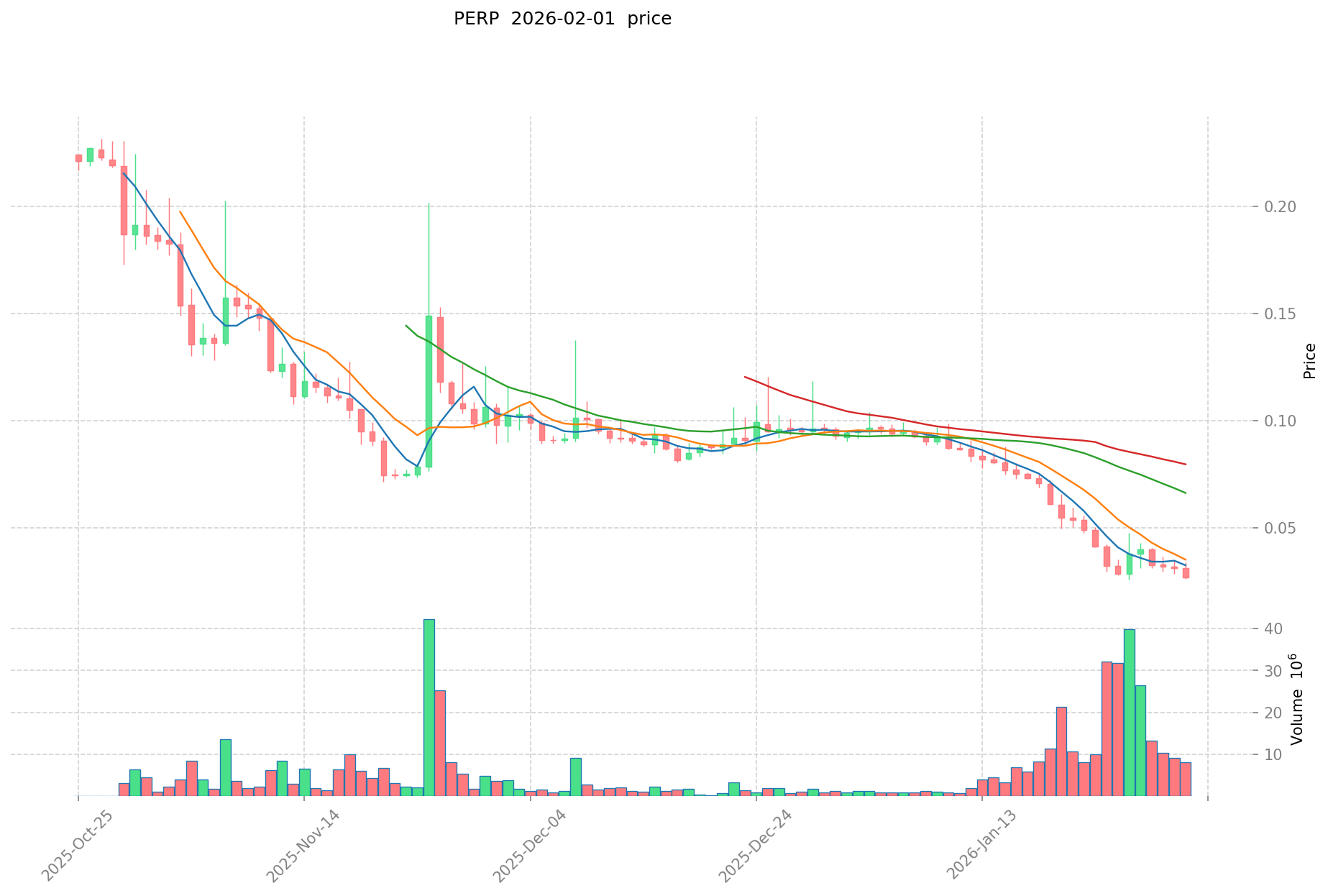
- 2026: As of January 26, the price declined to $0.02583463, representing a notable adjustment from previous levels
Current PERP Investment Market Status (February 2026)
- PERP current price: $0.02721
- 24-hour trading volume: $249,246.16
- Market capitalization: $1,975,714.41
- Circulating supply: 72,609,864.24 PERP (48.41% of maximum supply)
- Number of holders: 13,353
Click to view real-time PERP market price
II. Core Factors Affecting Whether PERP is a Good Investment (Is Perpetual Protocol (PERP) a Good Investment)
Supply Mechanism and Scarcity (PERP Investment Scarcity)
- Token supply structure influences price dynamics and investment valuation
- PERP operates with a maximum supply of 150,000,000 tokens, with approximately 72,609,864 tokens currently in circulation, representing a circulating ratio of 48.41%
- The fixed maximum supply creates a defined scarcity model that may support valuation considerations over extended timeframes
- Investment consideration: Supply constraints represent one element among multiple factors affecting long-term investment assessments
Institutional Investment and Mainstream Adoption (Institutional Investment in PERP)
- Current holder count stands at 13,353 addresses
- PERP maintains trading availability across 16 exchanges, indicating established market presence
- Governance mechanism enables token holders to participate in protocol decision-making and asset listing determinations
- Staking functionality allows participants to earn rewards and receive portions of transaction fees
Macroeconomic Environment Impact on PERP Investment
- Broader cryptocurrency market conditions influence decentralized perpetual contract protocol valuations
- Market volatility factors affect trading volume and liquidity considerations
- Regulatory developments in decentralized finance sectors may impact protocol operations and adoption trajectories
Technology and Ecosystem Construction (Technology & Ecosystem for PERP Investment)
- Virtual Automated Market Maker (vAMM) architecture enables perpetual contract trading without direct counterparties
- Protocol design supports creation of perpetual contracts for assets with on-chain price data from oracle sources including Chainlink and Uniswap
- Platform structure allows community members to create new contract markets and participate in fee distribution mechanisms
- Integration with oracle infrastructure provides price feed functionality supporting diverse asset coverage
III. PERP Future Investment Forecast and Price Outlook (Is Perpetual Protocol(PERP) worth investing in 2026-2031)
Short-term Investment Forecast (2026, short-term PERP investment outlook)
- Conservative forecast: $0.0167 - $0.0274
- Neutral forecast: $0.0274 - $0.0338
- Optimistic forecast: $0.0338 - $0.0381
Mid-term Investment Outlook (2027-2029, mid-term Perpetual Protocol(PERP) investment forecast)
- Market stage expectation: During the mid-term period, PERP may experience moderate fluctuations influenced by market sentiment, technical developments, and user adoption rates.
- Investment return forecast:
- 2027: $0.0258 - $0.0340
- 2028: $0.0280 - $0.0410
- 2029: $0.0339 - $0.0391
- Key catalysts: Factors affecting PERP price movements may include technological advancements in the protocol, changes in user adoption, and broader market trends.
Long-term Investment Outlook (Is PERP a good long-term investment?)
- Base scenario: $0.0286 - $0.0435 (assuming steady development and moderate market conditions)
- Optimistic scenario: $0.0390 - $0.0514 (assuming favorable market environment and increased adoption)
- Risk scenario: Below $0.0286 (under adverse market conditions or project setbacks)
Click to view PERP long-term investment and price forecast: Price Prediction
2026-02-01 - 2031 Long-term Outlook
- Base scenario: $0.0286 - $0.0435 (corresponding to steady progress and gradual mainstream application improvement)
- Optimistic scenario: $0.0390 - $0.0514 (corresponding to large-scale adoption and favorable market environment)
- Transformative scenario: Above $0.0514 (if the ecosystem achieves breakthrough progress and mainstream adoption)
- 2031-12-31 predicted high: $0.0514 (based on optimistic development assumptions)
Disclaimer: The information provided is for reference purposes only and does not constitute investment advice. Cryptocurrency markets are highly volatile, and price predictions are subject to various uncertainties. Investors should conduct their own research and consider their risk tolerance before making investment decisions.
| Year |
Predicted High Price |
Predicted Average Price |
Predicted Low Price |
Price Change |
| 2026 |
0.0380582 |
0.02738 |
0.0167018 |
1 |
| 2027 |
0.034027864 |
0.0327191 |
0.025848089 |
21 |
| 2028 |
0.04104938286 |
0.033373482 |
0.02803372488 |
24 |
| 2029 |
0.0390720040515 |
0.03721143243 |
0.0338624035113 |
38 |
| 2030 |
0.043481558794455 |
0.03814171824075 |
0.028606288680562 |
41 |
| 2031 |
0.051422664532179 |
0.040811638517602 |
0.031833078043729 |
51 |
IV. PERP Investment Strategy and Risk Management (How to invest in Perpetual Protocol)
Investment Strategy (PERP investment strategy)
Long-term Holding (HODL PERP)
For conservative investors considering long-term holding of PERP, the approach involves accumulating tokens during periods of market weakness and maintaining positions through market cycles. This strategy suits those who believe in the long-term potential of decentralized perpetual contract protocols and are willing to weather short-term price fluctuations. Given PERP's role as both a governance and staking token within the Perpetual Protocol ecosystem, long-term holders may benefit from staking rewards and trading fee distributions while participating in protocol governance decisions.
Active Trading
Active traders focusing on PERP typically employ technical analysis and swing trading strategies to capitalize on price movements. The token has demonstrated significant volatility, with 24-hour price changes reaching double-digit percentages. Traders may utilize support and resistance levels, volume analysis, and momentum indicators to identify entry and exit points. The availability of PERP on 16 exchanges provides sufficient liquidity for active trading strategies, though traders should be mindful of the relatively modest 24-hour trading volume of approximately $249,246.
Risk Management (Risk management for PERP investment)
Asset Allocation Ratio
- Conservative Investors: Allocate no more than 1-3% of crypto portfolio to PERP, prioritizing established cryptocurrencies for core holdings
- Aggressive Investors: May consider 5-10% allocation as part of a diversified DeFi-focused portfolio
- Professional Investors: Can utilize dynamic allocation strategies based on protocol metrics, market conditions, and technical developments
Risk Hedging Solutions
- Multi-asset Portfolio: Diversify across different cryptocurrency categories (large-cap, DeFi, layer-1 protocols) to reduce concentration risk
- Hedging Tools: Consider using stablecoins for partial position hedging, or utilizing derivatives on platforms that support PERP trading pairs
- Position Sizing: Implement disciplined position sizing to limit exposure to any single asset's volatility
Secure Storage
- Cold Wallet Storage: For long-term holdings, transfer PERP tokens to hardware wallets such as Ledger or Trezor to minimize security risks
- Hot Wallet Management: Keep only necessary amounts for active trading or staking in exchange wallets or software wallets
- Hardware Wallet Recommendations: Leading hardware wallet providers support ERC-20 tokens including PERP (contract address: 0xbc396689893d065f41bc2c6ecbee5e0085233447 on Ethereum)
- Security Best Practices: Enable two-factor authentication, maintain backup seed phrases in secure locations, and verify contract addresses before transactions
V. PERP Investment Risks and Challenges (Risks of investing in Perpetual Protocol)
Market Risk
High Volatility: PERP has exhibited substantial price volatility, with recent data showing a 30-day decline of 70.58% and a 1-year decline of 95.8%. The token's price range within 24 hours has varied between $0.02545 and $0.03163, representing significant intraday fluctuations. This volatility level requires investors to maintain strong risk tolerance and appropriate position sizing.
Price Manipulation Potential: With a relatively modest market capitalization of approximately $1.98 million and 24-hour trading volume of $249,246, PERP may be susceptible to price manipulation by large holders or coordinated trading activity. The token's ranking at position 2065 and market share of 0.00014% indicates limited liquidity compared to major cryptocurrencies.
Regulatory Risk
Decentralized perpetual contract protocols operate in a regulatory environment characterized by evolving policies across different jurisdictions. Changes in regulations regarding derivatives trading, DeFi protocols, or cryptocurrency trading platforms could impact the protocol's operations and token utility. The uncertainty surrounding regulatory frameworks in major markets creates ongoing compliance challenges and potential operational restrictions.
Technical Risk
Network Security Vulnerabilities: As a protocol built on Ethereum (contract address verified on Etherscan), PERP is subject to smart contract risks and potential vulnerabilities in the vAMM mechanism. Historical precedents in DeFi have demonstrated that complex protocols can face unexpected exploits or bugs.
Protocol Upgrade Challenges: Future protocol upgrades or migrations could encounter technical difficulties, potentially affecting token holders. The implementation of new features or changes to the vAMM system requires careful execution to maintain platform stability and user confidence.
Oracle Dependencies: The protocol relies on price data from oracles such as Chainlink and other sources. Oracle failures, manipulation, or inaccuracies could impact the functioning of perpetual contracts and potentially affect the entire ecosystem.
VI. Conclusion: Is Perpetual Protocol a Good Investment?
Investment Value Summary
Perpetual Protocol presents an innovative approach to decentralized perpetual contracts through its vAMM mechanism, offering traders the ability to trade without traditional counterparties. However, the token has experienced substantial price declines, with the current price of $0.02721 representing a significant decrease from its all-time high of $24.4 recorded on August 30, 2021. The circulating supply represents 48.41% of the maximum supply of 150 million tokens, with 13,353 holders. While the protocol's governance and staking utility provides fundamental value propositions, investors should carefully weigh the high volatility and market risks against the potential long-term benefits of participating in a decentralized derivatives ecosystem.
Investor Recommendations
✅ Beginners: Consider dollar-cost averaging (DCA) strategy to mitigate timing risk, combined with secure storage in hardware wallets. Start with small allocation amounts while gaining familiarity with the protocol and broader cryptocurrency market dynamics.
✅ Experienced Investors: Implement swing trading strategies based on technical analysis, maintain diversified portfolio allocation across multiple DeFi protocols, and actively monitor protocol developments and governance proposals that may impact token value.
✅ Institutional Investors: Evaluate strategic long-term allocation as part of a broader DeFi protocol exposure strategy, considering the protocol's position within the decentralized derivatives landscape and potential for ecosystem growth.
⚠️ Disclaimer: Cryptocurrency investments carry substantial risk. PERP has demonstrated extreme volatility and significant price declines over various timeframes. This content is provided for informational purposes only and does not constitute investment advice. Investors should conduct thorough due diligence, assess their risk tolerance, and consider consulting with financial advisors before making investment decisions.
VII. FAQ
Q1: What makes Perpetual Protocol (PERP) different from traditional perpetual contract platforms?
Perpetual Protocol utilizes a Virtual Automated Market Maker (vAMM) mechanism that enables perpetual contract trading without requiring direct counterparties. Unlike traditional perpetual contract platforms that rely on order books and matching buyers with sellers, PERP's vAMM creates a mathematical model for pricing and liquidity. This design allows the protocol to support perpetual contracts for any asset with reliable on-chain price data from oracles such as Chainlink and Uniswap. Additionally, the protocol's governance structure enables community members to create new contract markets and participate in fee distribution, offering a more decentralized approach compared to centralized derivatives exchanges.
Q2: How can PERP token holders generate returns beyond price appreciation?
PERP token holders can generate additional returns through two primary mechanisms: staking and governance participation. By staking PERP tokens, holders receive portions of the transaction fees generated by trading activity on the Perpetual Protocol platform. This creates a passive income stream that is directly tied to the protocol's trading volume and adoption. Additionally, token holders participate in governance decisions, including asset listing determinations and protocol parameter adjustments, which may influence the long-term development trajectory and value of their holdings. However, investors should note that staking returns depend on protocol usage and overall market conditions.
Q3: Why has PERP experienced such significant price declines from its all-time high?
PERP's price declined approximately 99.9% from its all-time high of $24.4 in August 2021 to the current level of $0.027 in February 2026. This substantial correction reflects several factors: the broader cryptocurrency market downturn following the 2021 bull market peak, increased competition within the decentralized derivatives sector, and general market volatility affecting smaller-cap DeFi tokens. The token's relatively modest market capitalization of $1.98 million and position at rank 2065 indicate limited liquidity compared to major cryptocurrencies, making it more susceptible to significant price swings. Despite protocol improvements and market share expansion in the PerpDEX sector (growing from 5% to 20-26% in 2025), price recovery has remained limited due to broader market conditions.
Q4: What is the appropriate allocation percentage for PERP in a cryptocurrency portfolio?
The appropriate allocation depends on investor risk profile and investment objectives. Conservative investors should limit PERP exposure to 1-3% of their cryptocurrency portfolio, maintaining larger positions in established cryptocurrencies with proven track records. Aggressive investors comfortable with higher volatility may consider allocations of 5-10% as part of a diversified DeFi-focused strategy. Professional investors can utilize dynamic allocation strategies based on protocol metrics, trading volume trends, and technical developments. Given PERP's high volatility—evidenced by a 30-day decline of 70.58% and 1-year decline of 95.8%—position sizing should reflect individual risk tolerance and the understanding that the token may experience significant value fluctuations.
Q5: What are the primary risks associated with investing in PERP?
PERP investments face multiple risk categories. Market risks include extreme volatility and potential price manipulation due to the token's relatively small market capitalization and limited trading volume of approximately $249,246 in 24 hours. Technical risks encompass smart contract vulnerabilities in the vAMM mechanism, oracle dependencies that could affect protocol functioning, and challenges associated with future protocol upgrades. Regulatory risks stem from the evolving legal framework surrounding decentralized derivatives and DeFi protocols across different jurisdictions. Additionally, the circulating supply currently represents 48.41% of maximum supply, meaning future token releases could create additional selling pressure. Investors should carefully evaluate these risks against potential returns.
Q6: How does PERP's market share growth in the PerpDEX sector affect investment potential?
The expansion of PerpDEX market share from approximately 5% to 20-26% during 2025, with Q3 quarterly trading volume reaching $1.8 trillion, demonstrates significant sector growth momentum. This increasing market share indicates growing adoption of decentralized perpetual contract protocols and suggests improved competitive positioning for Perpetual Protocol within the derivatives trading landscape. However, this market share growth has not yet translated into sustained price appreciation for the PERP token, as evidenced by the continued low price levels in 2026. While market share expansion represents a positive fundamental development, investors should recognize that token price performance depends on multiple factors including overall cryptocurrency market conditions, tokenomics, and investor sentiment, not solely on protocol trading volumes.
Q7: What security measures should investors implement when holding PERP tokens?
Investors should implement multi-layered security measures appropriate to their holding timeframe and trading activity. For long-term holdings, transfer PERP tokens to hardware wallets such as Ledger or Trezor to minimize exposure to exchange hacks or security breaches. Since PERP is an ERC-20 token (contract address: 0xbc396689893d065f41bc2c6ecbee5e0085233447 on Ethereum), major hardware wallet providers offer native support. For active traders requiring frequent access, maintain only necessary amounts in exchange or software wallets while keeping the majority in cold storage. Essential security practices include enabling two-factor authentication on all accounts, maintaining secure offline backups of seed phrases, verifying contract addresses before transactions, and avoiding sharing private keys or sensitive information.
Q8: What factors should investors monitor to assess PERP's future investment potential?
Investors should track multiple key metrics to evaluate PERP's investment trajectory. Protocol metrics include trading volume trends on the Perpetual Protocol platform, total value locked (TVL), number of active users, and growth in supported perpetual contract markets. Market metrics encompass PERP's trading volume across exchanges, holder count growth, exchange listings, and market capitalization ranking. Technical developments such as protocol upgrades, new feature implementations, security audits, and oracle integration improvements provide insight into long-term sustainability. Additionally, broader market indicators including DeFi sector growth, regulatory developments affecting decentralized derivatives, and overall cryptocurrency market conditions significantly influence PERP's investment outlook.
* The information is not intended to be and does not constitute financial advice or any other recommendation of any sort offered or endorsed by Gate.