Persistence (XPRT) is a multi-asset protocol focusing on liquid staking (pSTAKE), NFTs (Asset Mantle), and commodities (Comdex) tokenization. As of January 2026, XPRT trades at $0.014805 with a $3.61 million market cap and 50,932 holders, showing a 119.98% 30-day gain despite an 89.7% annual decline. This article analyzes XPRT's investment viability through multiple dimensions: historical price trends ranging from $0.00588 to $16.59, technological infrastructure powered by Tendermint BFT consensus supporting Cosmos and Ethereum networks, and price forecasts suggesting potential range of $0.0157-$0.0255 by 2031 under base-to-optimistic scenarios. The analysis addresses core investment considerations including supply dynamics (60.42% circulation rate), market adoption metrics, and ecosystem development catalysts. Detailed risk assessment covers market volatility, regulatory uncertainty, and technical vulnerabilities alongside recommended investment strategies for diverse investor profiles through Gate trading p
Introduction: Persistence (XPRT)'s Investment Position and Market Prospects
XPRT is an important asset in the cryptocurrency sector, launched in 2021 as the native token of the Persistence protocol. As of January 30, 2026, XPRT maintains a market capitalization of approximately $3.61 million with a circulating supply of around 243.67 million tokens, trading at approximately $0.0148. Positioned as a multi-asset protocol focused on liquid staking (pSTAKE), NFTs (Asset Mantle), and commodities (Comdex), Persistence has developed its ecosystem around bridging traditional finance and decentralized finance through real-world asset tokenization. The protocol operates on a Proof-of-Stake chain powered by Tendermint BFT consensus engine, supporting multi-chain infrastructure including Cosmos and Ethereum-based networks. With approximately 50,932 holders and a market dominance of 0.00012%, XPRT has experienced notable price volatility, ranging from an all-time low of $0.00588 in January 2026 to an all-time high of $16.59 in May 2021. Recent market performance shows a 119.98% increase over the past 30 days, though the token has experienced a decline of 89.7% over the past year. This article provides a comprehensive analysis of XPRT's investment value, historical trends, future price considerations, and associated risks to serve as a reference for market participants examining whether Persistence (XPRT) aligns with their portfolio considerations.
I. Persistence (XPRT) Price History Review and Current Investment Value
- April 2021: XPRT token launch at $0.45 → Early investors experienced initial price discovery phase
- May 2021: Market expansion period → XPRT price reached elevated levels around $16.59
- 2021-2026: Market cycle volatility → Price declined from previous peaks to current level of $0.014805
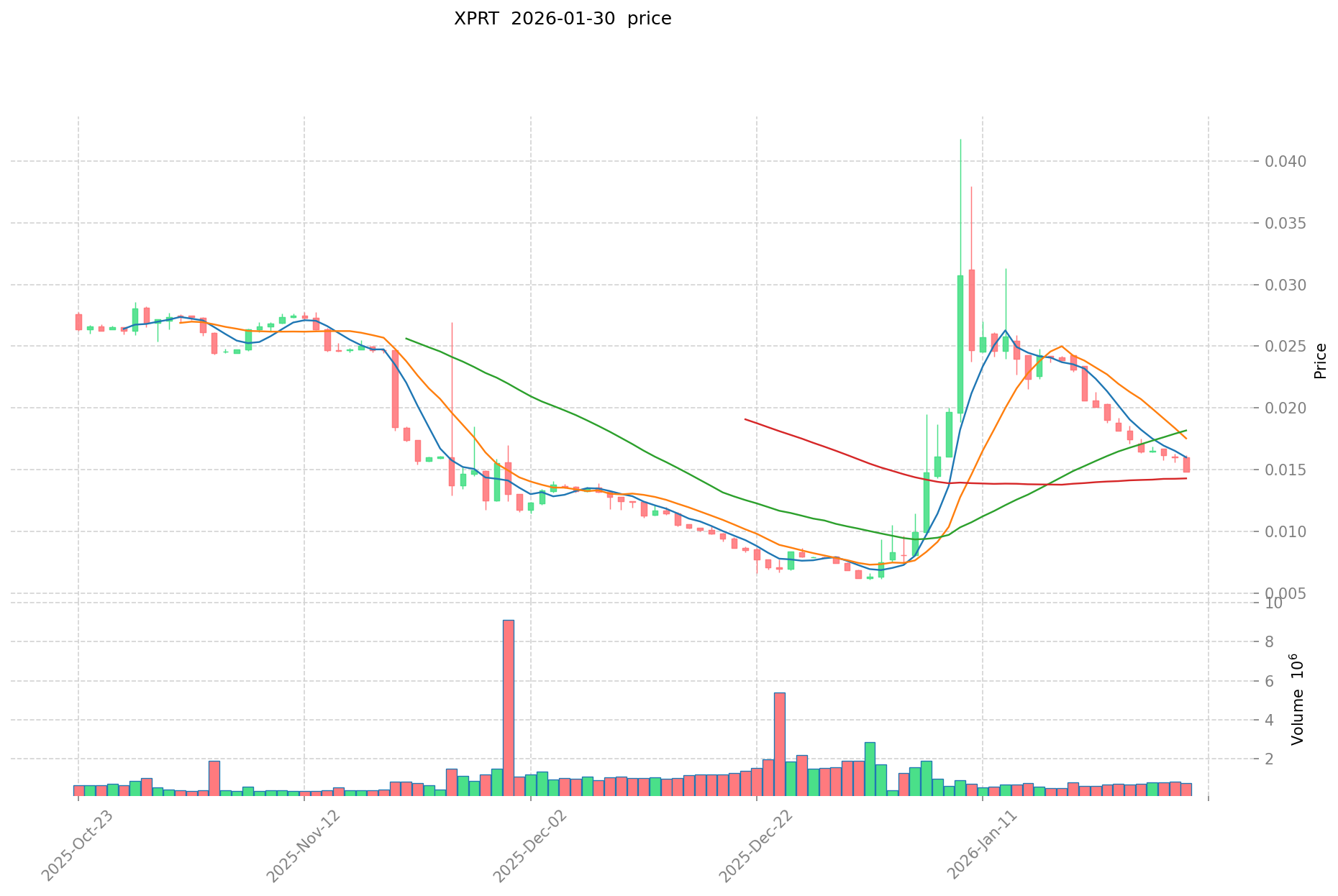
- January 2026: Recent price movement → XPRT trading at $0.014805 with 24-hour decline of 6.06%
- 30-day performance: Price recovery phase → XPRT demonstrated 119.98% increase over the past month
- Annual trend: Extended decline → XPRT price decreased 89.7% over the one-year period
Current XPRT Investment Market Status (January 2026)
- XPRT current price: $0.014805
- 24-hour price range: High $0.016025 / Low $0.014575
- 24-hour trading volume: $11,590.996865
- Market capitalization: $3,607,604.43
- Circulating supply: 243,674,733.813895 XPRT
- Market share: 0.00012%
- Circulation ratio: 60.42% of total supply
- Holder distribution: 50,932 addresses
Click to view real-time XPRT market price
II. Core Factors Influencing Whether XPRT is a Good Investment
Supply Mechanism and Scarcity (XPRT Investment Scarcity)
- XPRT has a maximum supply of 403,308,352 tokens, with a current circulating supply of 243,674,733.813895 tokens, representing approximately 60.42% of the total supply. This supply structure creates a defined scarcity framework that may influence long-term valuation dynamics.
- The token has experienced notable price movements, with its historical price ranging from $0.00587964 to $16.59, demonstrating significant volatility patterns that reflect supply-demand interactions over time.
- Investment consideration: The limited maximum supply combined with the current circulation rate suggests a supply mechanism that could support future valuation, though market dynamics remain subject to multiple variables.
Institutional Investment and Mainstream Adoption (Institutional Investment in XPRT)
- As of January 30, 2026, XPRT is held by 50,932 addresses, indicating a distributed holder base across the network.
- The token is currently listed on 2 exchanges, suggesting a developing market presence that reflects ongoing ecosystem expansion efforts.
- Market share stands at 0.00012%, positioning XPRT within the broader digital asset landscape with room for potential growth in adoption metrics.
Macroeconomic Environment Impact on XPRT Investment
- The broader cryptocurrency market environment continues to influence XPRT's performance, with recent 30-day trends showing a 119.98% price change, while the 1-year trend reflects an -89.7% change, indicating sensitivity to market cycles.
- Digital asset investment dynamics are affected by global monetary policy trends, regulatory developments, and institutional capital flows, which collectively shape the investment environment for assets like XPRT.
- Market volatility patterns, as evidenced by XPRT's 24-hour price range between $0.014575 and $0.016025, reflect ongoing price discovery processes influenced by macroeconomic conditions.
Technology and Ecosystem Development (Technology & Ecosystem for XPRT Investment)
- Persistence operates as a multi-asset protocol focusing on liquid staking (pSTAKE), NFTs (Asset Mantle), and commodities (Comdex), aiming to facilitate global liquidity and seamless value exchange.
- The core mainnet is a Proof-of-Stake chain powered by Tendermint BFT consensus engine, with a multi-chain technology stack currently supporting Cosmos, Ethereum, and other Tendermint-based chains, enabling developers to build DEXs, marketplaces, and lending platforms.
- Key technological features include: (1) Asset tokenization using NFTs to bring real-world assets on-chain into the DeFi ecosystem; (2) Cross-chain exchange capabilities for both crypto and real-world assets; (3) Liquidity aggregation through stablecoin pools backed by various real-world assets, providing diverse investment and lending opportunities.
- Persistence is developing interchain NFT/Metadata standards in collaboration with leading PoS networks and foundations, while supporting PoS ecosystem growth through its validator AUDIT.one, contributing to broader blockchain infrastructure development.
III. XPRT Future Investment Forecast and Price Outlook (Is Persistence(XPRT) worth investing in 2026-2031)
Short-term Investment Forecast (2026, short-term XPRT investment outlook)
- Conservative forecast: $0.0089 - $0.0120
- Neutral forecast: $0.0130 - $0.0148
- Optimistic forecast: $0.0155 - $0.0161
Mid-term Investment Outlook (2027-2029, mid-term Persistence(XPRT) investment forecast)
-
Market stage expectation: XPRT may experience gradual growth driven by ecosystem development and broader DeFi adoption trends. The protocol's focus on liquid staking solutions could position it for steady expansion during this period.
-
Investment return forecast:
- 2027: $0.0102 - $0.0173
- 2028: $0.0112 - $0.0187
- 2029: $0.0121 - $0.0239
-
Key catalysts: Expansion of liquid staking services, integration with additional blockchain networks, development of DeFi applications within the Persistence ecosystem, and potential partnerships with proof-of-stake networks.
Long-term Investment Outlook (Is XPRT a good long-term investment?)
- Base scenario: $0.0157 - $0.0210 (assuming continued ecosystem development and moderate market conditions)
- Optimistic scenario: $0.0220 - $0.0255 (assuming accelerated adoption of liquid staking solutions and favorable regulatory environment)
- Risk scenario: Below $0.0100 (under adverse market conditions or technical setbacks)
Click to view XPRT long-term investment and price forecast: Price Prediction
2026-01-30 to 2031 Long-term Outlook
- Base scenario: $0.0157 - $0.0221 USD (corresponding to steady progress and gradual mainstream application improvement)
- Optimistic scenario: $0.0221 - $0.0255 USD (corresponding to large-scale adoption and favorable market environment)
- Transformative scenario: Above $0.0255 USD (if ecosystem achieves breakthrough progress and mainstream popularization)
- 2031-12-31 forecast high: $0.0255 USD (based on optimistic development assumptions)
Disclaimer: Price predictions are based on historical data analysis and market trends, but cryptocurrency markets remain highly volatile and unpredictable. These forecasts should not be considered financial advice, and investors should conduct their own research and consider their risk tolerance before making investment decisions.
| Year |
Predicted High Price |
Predicted Average Price |
Predicted Low Price |
Price Change |
| 2026 |
0.01614072 |
0.014808 |
0.0088848 |
0 |
| 2027 |
0.0173312832 |
0.01547436 |
0.0102130776 |
4 |
| 2028 |
0.018699216624 |
0.0164028216 |
0.011153918688 |
10 |
| 2029 |
0.02386938599232 |
0.017551019112 |
0.01211020318728 |
18 |
| 2030 |
0.023609630909462 |
0.02071020255216 |
0.015739753939641 |
39 |
| 2031 |
0.025483904240432 |
0.022159916730811 |
0.019057528388497 |
49 |
IV. XPRT Investment Strategy and Risk Management (How to invest in Persistence)
Investment Strategy (XPRT investment strategy)
Long-term Holding (HODL XPRT)
Long-term holding may be suitable for conservative investors who believe in the fundamental value of Persistence's multi-asset protocol approach. This strategy involves:
- Accumulating XPRT tokens during market corrections
- Holding through market cycles to potentially benefit from ecosystem development
- Monitoring progress in liquid staking (pSTAKE), NFTs (Asset Mantle), and commodities (Comdex) sectors
Given the 30-day price change of 119.98% as of January 30, 2026, timing entry points becomes relevant for managing average acquisition costs.
Active Trading
Active trading strategies rely on technical analysis and swing trading opportunities:
- Technical Analysis: Monitor support levels (24-hour low: $0.014575) and resistance levels (24-hour high: $0.016025)
- Volatility Management: The 24-hour price change of -6.06% and 7-day change of -21.36% indicate significant short-term volatility
- Volume Analysis: Daily trading volume of $11,590.996865 should be considered when evaluating liquidity for entry and exit positions
Risk Management (Risk management for XPRT investment)
Asset Allocation Ratios
Conservative Investors:
- Allocate 1-3% of crypto portfolio to XPRT
- Focus on dollar-cost averaging to mitigate volatility
- Maintain longer holding periods
Aggressive Investors:
- May allocate 5-10% of crypto portfolio to XPRT
- More active position management based on market conditions
- Willing to accept higher volatility for potential returns
Professional Investors:
- Strategic allocation based on comprehensive portfolio analysis
- Advanced risk metrics and correlation analysis with other assets
- Access to institutional-grade tools and market data
Risk Hedging Solutions
- Multi-Asset Portfolio: Diversify across different crypto categories to reduce concentration risk
- Hedging Tools: Consider using derivatives or correlated assets for downside protection
- Position Sizing: Based on the current market cap of $3,607,604.43 and market share of 0.00012%, XPRT represents a smaller market cap asset requiring appropriate position sizing
Secure Storage
Cold and Hot Wallet Solutions:
- Hot Wallets: For active trading portions, use reputable exchanges or software wallets
- Cold Storage: For long-term holdings, transfer to hardware wallets
- Hardware Wallet Recommendations: Ledger, Trezor, or other certified hardware security devices
- Security Practices: Enable two-factor authentication, maintain backup seed phrases in secure locations
With 50,932 holders as of the latest data, understanding proper custody solutions becomes important for asset security.
V. XPRT Investment Risks and Challenges (Risks of investing in Persistence)
Market Risk
High Volatility:
- The 1-year performance shows a -89.7% decline, demonstrating substantial price fluctuation potential
- Recent 7-day decline of -21.36% contrasts with 30-day gain of 119.98%, indicating rapid sentiment shifts
- Current price of $0.014805 represents significant distance from the historical high of $16.59 (May 15, 2021)
Price Manipulation Concerns:
- Lower market capitalization assets may be more susceptible to large order impacts
- Trading volume of $11,590.996865 should be evaluated relative to position sizes
- Listed on 2 exchanges, potentially limiting liquidity depth
Regulatory Risk
Policy Uncertainty Across Jurisdictions:
- Crypto asset regulations continue evolving globally
- Multi-chain technology stack (supporting Cosmos, Ethereum, and Tendermint-based chains) may face varying regulatory treatment across different networks
- Real-world asset tokenization features may attract additional regulatory scrutiny in certain jurisdictions
- Investors should monitor regulatory developments in their respective countries
Technical Risk
Network Security Vulnerabilities:
- As a Proof-of-Stake chain powered by Tendermint BFT consensus, potential consensus mechanism vulnerabilities
- Cross-chain functionality introduces additional attack surface considerations
- Smart contract risks associated with liquid staking and NFT protocols
Upgrade Failures:
- Protocol upgrades and network migrations carry execution risks
- Multi-chain infrastructure complexity may increase technical coordination challenges
- Development dependencies across ecosystem products (pSTAKE, Asset Mantle, Comdex)
Ecosystem Dependencies:
- Success depends on adoption of liquid staking, NFT, and commodity tokenization features
- Competition from other DeFi protocols and NFT platforms
- Validator operations through AUDIT.one introduce additional operational considerations
VI. Conclusion: Is Persistence a Good Investment?
Investment Value Summary
Persistence presents a multi-faceted protocol focusing on liquid staking, NFTs, and commodities tokenization. The long-term investment potential depends on successful ecosystem development and adoption of its core products. However, price performance shows considerable volatility, with the current price at $0.014805 substantially below the historical high of $16.59.
Investor Recommendations
✅ Beginners:
- Consider dollar-cost averaging to manage volatility exposure
- Use secure wallet storage solutions, preferably hardware wallets for significant holdings
- Start with small allocation percentages (1-3% of crypto portfolio)
- Focus on understanding the Persistence ecosystem and its development progress
✅ Experienced Investors:
- Implement swing trading strategies around support and resistance levels
- Diversify across multiple assets to manage concentration risk
- Monitor 24-hour trading ranges and volume patterns for entry/exit timing
- Evaluate allocation as part of broader DeFi and multi-chain exposure
✅ Institutional Investors:
- Consider strategic long-term allocation based on comprehensive due diligence
- Assess Persistence's role within broader liquid staking and tokenization trends
- Implement advanced risk management frameworks
- Evaluate correlation with other portfolio holdings
⚠️ Disclaimer: Cryptocurrency investment carries substantial risk. XPRT has demonstrated significant price volatility, including a -89.7% decline over one year. This content is for informational purposes only and does not constitute investment advice. Investors should conduct independent research and consider their risk tolerance before making investment decisions.
VII. FAQ
Q1: What is the current market position of XPRT and is it worth investing in 2026?
As of January 30, 2026, XPRT trades at $0.014805 with a market capitalization of approximately $3.61 million and 50,932 holders. The token has shown significant volatility, with a 119.98% increase over the past 30 days but an 89.7% decline over the past year. Whether XPRT is worth investing depends on individual risk tolerance and portfolio strategy. Conservative investors might allocate 1-3% of their crypto portfolio, while those with higher risk appetite could consider 5-10%. The investment case centers on Persistence's multi-asset protocol focusing on liquid staking (pSTAKE), NFTs (Asset Mantle), and commodities (Comdex), though market conditions remain uncertain.
Q2: What are the main technological features that differentiate Persistence from other blockchain projects?
Persistence operates as a Proof-of-Stake chain powered by Tendermint BFT consensus engine with multi-chain infrastructure supporting Cosmos, Ethereum, and other Tendermint-based networks. The protocol distinguishes itself through three core features: (1) Asset tokenization using NFTs to bring real-world assets on-chain into the DeFi ecosystem, (2) Cross-chain exchange capabilities for both crypto and real-world assets, and (3) Liquidity aggregation through stablecoin pools backed by various real-world assets. Additionally, Persistence is developing interchain NFT/Metadata standards in collaboration with leading PoS networks and operates its own validator service AUDIT.one, contributing to broader blockchain infrastructure development.
Q3: What is the price forecast for XPRT from 2026 to 2031?
Based on historical data analysis and market trends, XPRT price forecasts vary across different scenarios. For 2026, the conservative forecast ranges from $0.0089 to $0.0120, while the optimistic forecast suggests $0.0155 to $0.0161. Mid-term forecasts show gradual growth potential: 2027 ($0.0102-$0.0173), 2028 ($0.0112-$0.0187), and 2029 ($0.0121-$0.0239). Long-term projections for 2031 indicate a base scenario of $0.0157-$0.0210 and an optimistic scenario of $0.0220-$0.0255, with a predicted high of $0.0255. However, these projections carry significant uncertainty, as cryptocurrency markets remain highly volatile and unpredictable. Investors should note that XPRT's historical price ranged from $0.00588 to $16.59, demonstrating substantial volatility patterns.
Q4: What are the primary risks associated with investing in XPRT?
XPRT investment carries multiple risk categories. Market risks include high volatility, evidenced by the -89.7% one-year decline and rapid sentiment shifts between the 7-day (-21.36%) and 30-day (119.98%) performance. The lower market capitalization ($3.61 million) and limited exchange listings (2 exchanges) may increase susceptibility to price manipulation and liquidity constraints. Regulatory risks stem from evolving crypto asset regulations globally and the protocol's focus on real-world asset tokenization, which may attract additional scrutiny. Technical risks involve potential network security vulnerabilities in the Proof-of-Stake consensus mechanism, cross-chain functionality complexities, smart contract risks, and dependencies on successful adoption of liquid staking and NFT protocols. Competition from other DeFi and NFT platforms also presents ecosystem challenges.
Q5: What investment strategies are recommended for different types of XPRT investors?
Investment strategies should align with risk profiles and experience levels. Beginners should consider dollar-cost averaging to manage volatility exposure, starting with small allocations (1-3% of crypto portfolio), and using secure hardware wallets for storage while focusing on understanding Persistence's ecosystem development. Experienced investors can implement active trading strategies around support ($0.014575) and resistance ($0.016025) levels, diversify across multiple assets, and monitor trading volume patterns for optimal entry/exit timing. Institutional investors may pursue strategic long-term allocation based on comprehensive due diligence, assess Persistence's role within broader liquid staking and tokenization trends, implement advanced risk management frameworks, and evaluate correlation with other portfolio holdings. All investors should maintain appropriate position sizing relative to XPRT's market capitalization and liquidity characteristics.
Q6: How does XPRT's token supply mechanism affect its investment potential?
XPRT has a maximum supply of 403,308,352 tokens, with a current circulating supply of 243,674,733 tokens, representing approximately 60.42% of the total supply. This defined scarcity framework creates a supply mechanism that may influence long-term valuation dynamics, with approximately 39.58% of tokens yet to enter circulation. The limited maximum supply combined with the current circulation rate suggests a supply structure that could support future valuation, though market dynamics remain subject to multiple variables including release schedules and token utility demand. The distribution across 50,932 holder addresses indicates a relatively distributed ownership base, which may contribute to price stability compared to highly concentrated token distributions.
Q7: What are the key catalysts that could drive XPRT's future price performance?
Several key catalysts may influence XPRT's future performance through 2031. Primary drivers include the expansion of liquid staking services as PoS networks gain adoption, integration with additional blockchain networks beyond the current Cosmos and Ethereum support, and development of DeFi applications within the Persistence ecosystem. Strategic partnerships with proof-of-stake networks and mainstream adoption of the pSTAKE liquid staking solution could significantly impact token utility and demand. The success of Asset Mantle (NFT platform) and Comdex (commodities tokenization) in attracting users and liquidity represents additional growth potential. Broader market factors such as favorable regulatory developments for real-world asset tokenization, institutional capital flows into DeFi protocols, and overall cryptocurrency market conditions will also play crucial roles in determining XPRT's price trajectory.
Q8: What wallet security measures should XPRT investors implement?
XPRT investors should implement a multi-layered security approach based on their holding strategy. For long-term holdings, hardware wallets (such as Ledger or Trezor) provide the highest security level by keeping private keys offline and protected from online threats. Active traders may use hot wallets on reputable exchanges or software wallets for the trading portion while transferring long-term holdings to cold storage. Essential security practices include enabling two-factor authentication on all accounts, maintaining backup seed phrases in secure physical locations (preferably multiple geographically separated locations), never sharing private keys or seed phrases, and verifying wallet addresses before transactions. Given XPRT's presence on 2 exchanges, investors should research exchange security track records and consider withdrawal limits when determining hot wallet exposure. Regular security audits of personal practices and staying informed about potential vulnerabilities in the Persistence ecosystem are also recommended.
* The information is not intended to be and does not constitute financial advice or any other recommendation of any sort offered or endorsed by Gate.