This comprehensive guide evaluates Phantasma (SOUL) as an investment opportunity in 2024-2031. SOUL is a blockchain protocol focused on decentralized content delivery and privacy-focused messaging infrastructure, currently trading at $0.0166 with a market cap of $2.19 million. The article analyzes SOUL's price history, technology fundamentals, and market position, revealing an 83.87% decline over one year but ongoing development activity. It provides detailed price forecasts across conservative, neutral, and optimistic scenarios through 2031, while addressing critical investment risks including market volatility, regulatory uncertainty, and limited exchange liquidity (available on Gate exchange). The guide offers tailored investment strategies for beginners, experienced traders, and institutional investors, emphasizing strict risk management and portfolio allocation limits of 1-10% depending on risk tolerance. Suitable for investors seeking exposure to blockchain infrastructure innovation with appropriate ris
Introduction: Phantasma (SOUL) Investment Position and Market Outlook
SOUL is a digital asset in the cryptocurrency sector, launched in May 2018, focusing on decentralized content delivery and messaging protocol infrastructure. As of February 2026, Phantasma holds a market capitalization of approximately $2.19 million, with a circulating supply of around 132.12 million tokens, and the current price stands at approximately $0.0166. Positioned as a next-generation messaging protocol emphasizing privacy and security, SOUL has attracted attention among investors exploring "Is Phantasma (SOUL) a good investment?" This article provides a comprehensive analysis of SOUL's investment characteristics, historical performance, future price outlook, and associated risks to serve as a reference for market participants.
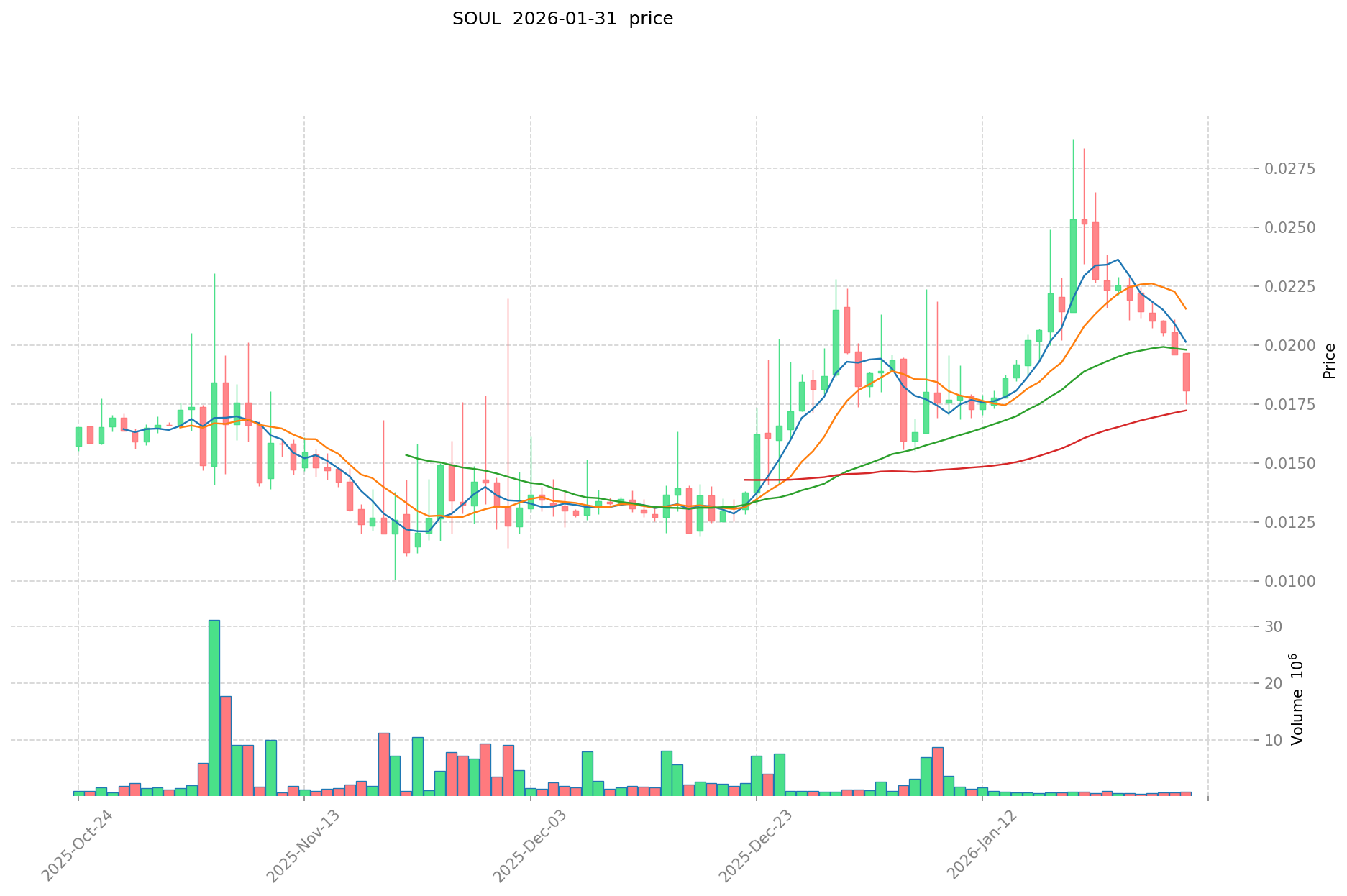
Phantasma operates as a decentralized content delivery system that enables users to maintain control over their data, including emails, photos, invoices, and multimedia content. The protocol incorporates encryption mechanisms during data distribution to enhance privacy protection. With a market ranking of 1986 and a market share of 0.000074%, SOUL represents a smaller-cap asset within the broader cryptocurrency ecosystem. The token has experienced notable price fluctuations, with recorded performance showing a decline of 8.59% over 24 hours, 25.56% over 7 days, and 83.87% over one year as of the observation date. The asset reached a price level of $3.96 in December 2021, while its lower price point of approximately $0.0096 was recorded in March 2020.
The circulating supply ratio stands at approximately 106.44%, indicating that circulating tokens exceed the initially stated total supply, with both total and maximum supply figures listed at 124.13 million tokens. The 24-hour trading volume amounts to approximately $14,588.53, reflecting relatively limited liquidity conditions. Phantasma maintains presence across multiple development repositories and community channels, with ongoing technical development visible through GitHub repositories covering chain infrastructure, SDKs, mail applications, and wallet solutions. The token holder count of 1,319 suggests a relatively concentrated distribution pattern within its user base.
I. SOUL Price History Review and Current Investment Value
- 2018: Project launched in May with initial focus on blockchain-based messaging protocol → Early adopters witnessed significant price volatility as the project established its market presence
- 2021: December saw price movement toward upper ranges → SOUL reached 3.96 USD during this period, reflecting heightened market interest in blockchain infrastructure projects
- 2020-2026: Market cycles brought substantial fluctuations → Price experienced movements from 0.00960482 USD in March 2020 to current levels around 0.0166 USD
Current SOUL Investment Market Status (February 2026)
- SOUL current price: 0.0166 USD
- Recent price changes: -3.42% (1H), -8.59% (24H), -25.56% (7D), -10.51% (30D), -83.87% (1Y)
- 24-hour trading volume: 14,588.53 USD
- Market capitalization: Approximately 2.19 million USD
- Circulating supply: 132,119,034 SOUL tokens
- Total supply: 124,129,197 SOUL tokens
- Token holders: 1,319 addresses
- Exchange availability: Listed on Gate.com
Click to view real-time SOUL market price
II. Core Factors Affecting Whether SOUL is a Good Investment (Is Phantasma(SOUL) a Good Investment)
Supply Mechanism and Scarcity (SOUL investment scarcity)
- Fixed supply model → influences price and investment value
- The max supply is capped at 124,129,197 SOUL tokens, with a circulating supply of 132,119,034.34 SOUL as of February 1, 2026
- The market cap to fully diluted valuation ratio stands at 100%, indicating that all tokens are effectively in circulation
- Investment significance: the limited supply mechanism may provide potential long-term value support
Institutional Investment and Mainstream Adoption (Institutional investment in SOUL)
- Current holder base: approximately 1,319 holders as of the latest data
- The token is listed on 1 exchange, indicating limited mainstream trading venue adoption
- No specific institutional holding trends or major enterprise adoption data available in the reference materials
Macroeconomic Environment Impact on SOUL Investment
- Market share stands at 0.000074% of the total crypto market, reflecting its position as a smaller-cap asset
- The token's performance may be influenced by broader crypto market sentiment and risk appetite
- Current market ranking at 1986 suggests it operates in a highly competitive environment
Technology and Ecosystem Development (Technology & Ecosystem for SOUL investment)
- Phantasma operates as a next-generation messaging protocol built on blockchain technology
- Core features: decentralized content delivery system with focus on privacy and security through encryption
- Use cases include sharing emails, photos, invoices, and media content in a decentralized manner
- The project offers infrastructure with potential alternative use cases at the DApp level
- Development activity visible through multiple GitHub repositories covering PhantasmaChain, SDK, Mail, Spook, and Wallet implementations
III. SOUL Future Investment Forecast and Price Outlook (Is Phantasma(SOUL) worth investing in 2026-2031)
Short-term Investment Forecast (2026, short-term SOUL investment outlook)
- Conservative Forecast: $0.0159 - $0.0167
- Neutral Forecast: $0.0167 - $0.0175
- Optimistic Forecast: $0.0175 - $0.0179
Mid-term Investment Outlook (2027-2029, mid-term Phantasma(SOUL) investment forecast)
- Market Phase Expectation: SOUL may experience gradual growth across mid-term horizons, with price trajectories potentially influenced by broader market sentiment and protocol developments.
- Investment Return Forecast:
- 2027: $0.0140 - $0.0213
- 2028: $0.0166 - $0.0257
- 2029: $0.0203 - $0.0311
- Key Catalysts: Market dynamics, ecosystem expansion potential, and evolving demand for decentralized content delivery infrastructure.
Long-term Investment Outlook (Is SOUL a good long-term investment?)
- Baseline Scenario: $0.0254 - $0.0287 (assuming steady adoption and moderate ecosystem growth through 2030-2031)
- Optimistic Scenario: $0.0286 - $0.0311 (assuming enhanced adoption, favorable market conditions, and successful protocol enhancements)
- Risk Scenario: $0.0141 - $0.0159 (under adverse market conditions or slower-than-expected ecosystem development)
View SOUL long-term investment and price forecast: Price Prediction
2026-02-01 - 2031 Long-term Outlook
- Baseline Scenario: $0.0254 - $0.0287 (corresponding to steady progress and gradual mainstream application improvement)
- Optimistic Scenario: $0.0286 - $0.0311 (corresponding to large-scale adoption and favorable market environment)
- Transformative Scenario: Above $0.0311 (if the ecosystem achieves breakthrough progress and mainstream adoption)
- 2031-12-31 Forecast High: $0.0286 (based on optimistic development assumptions)
Disclaimer: The forecasts presented are based on historical data patterns and predictive modeling. Cryptocurrency markets involve substantial risk and volatility. Past performance does not guarantee future results. Investors should conduct independent research and consider their risk tolerance before making investment decisions.
| Year |
Predicted High Price |
Predicted Average Price |
Predicted Low Price |
Price Change |
| 2026 |
0.0179225 |
0.01675 |
0.0159125 |
0 |
| 2027 |
0.0213235875 |
0.01733625 |
0.0140423625 |
4 |
| 2028 |
0.0257087919375 |
0.01932991875 |
0.016623730125 |
16 |
| 2029 |
0.031076710374375 |
0.02251935534375 |
0.020267419809375 |
35 |
| 2030 |
0.028673895159196 |
0.026798032859062 |
0.025458131216109 |
61 |
| 2031 |
0.028568042929403 |
0.027735964009129 |
0.014145341644656 |
67 |
IV. Phantasma Investment Strategy and Risk Management (How to invest in SOUL)
Investment Methodology (SOUL investment strategy)
Long-term Holding (HODL SOUL)
For conservative investors seeking stability, a long-term holding strategy may be considered. This approach involves acquiring SOUL tokens and maintaining positions over extended periods, potentially weathering short-term volatility. Given Phantasma's focus on decentralized content delivery and privacy features, investors following this strategy would be betting on the protocol's long-term adoption and ecosystem development.
Active Trading
More experienced investors may opt for active trading strategies based on technical analysis and swing trading opportunities. With SOUL demonstrating price fluctuations (24-hour change of -8.59%, 7-day change of -25.56%), technical traders could identify entry and exit points through chart patterns, volume analysis, and momentum indicators. However, this approach requires constant market monitoring and carries higher risk exposure.
Risk Management (Risk management for SOUL investment)
Asset Allocation Ratio
- Conservative Investors: Consider allocating no more than 1-3% of total crypto portfolio to SOUL, given its ranking (#1986) and relatively lower market capitalization
- Aggressive Investors: May allocate 5-10% for higher risk tolerance, understanding potential volatility
- Professional Investors: Could incorporate SOUL as part of diversified blockchain infrastructure exposure, typically 3-7% depending on overall portfolio strategy
Risk Hedging Solutions
Implementing a multi-asset portfolio approach can help mitigate concentration risk. Investors might consider:
- Diversifying across different blockchain protocols and use cases
- Balancing SOUL holdings with more established cryptocurrencies
- Utilizing stablecoin positions to preserve capital during market downturns
- Considering hedging instruments when available on supporting platforms
Secure Storage
Given that SOUL operates on the KCALP chain (Phantasma's native blockchain), investors should prioritize security:
- Cold Wallets: For long-term holdings, offline storage solutions provide maximum security against online threats
- Hot Wallets: For active trading, use reputable wallet solutions compatible with Phantasma blockchain, maintaining only necessary amounts for transactions
- Hardware Wallets: Consider hardware wallet options that support Phantasma network for enhanced security with convenient access
- Private Key Management: Never share private keys and maintain secure backup procedures
V. Phantasma Investment Risks and Challenges (Risks of investing in SOUL)
Market Risk
Phantasma exhibits significant price volatility, with recent performance showing considerable fluctuations. The 24-hour price range between $0.0166 and $0.01819 demonstrates short-term volatility, while the 1-year decline of -83.87% reflects substantial downward price movement. With a relatively small 24-hour trading volume of approximately $14,589 and market capitalization of around $2.19 million, SOUL may be susceptible to larger price swings from relatively modest trading activity. The limited exchange availability (1 exchange) could potentially contribute to liquidity constraints and price impact from larger transactions.
Regulatory Risk
As a blockchain protocol focusing on decentralized messaging and content delivery, Phantasma operates in an evolving regulatory landscape. Different jurisdictions maintain varying approaches to blockchain technology, privacy-focused protocols, and cryptocurrency classification. Changes in regulatory frameworks across major markets could affect:
- Protocol operations and compliance requirements
- Token classification and legal status
- Cross-border transactions and data privacy regulations
- Platform accessibility in certain jurisdictions
Investors should monitor regulatory developments in their respective countries and assess how policy changes might impact their holdings.
Technical Risk
Phantasma's infrastructure presents several technical considerations:
- Network Security: As with any blockchain protocol, vulnerabilities in smart contracts or consensus mechanisms could pose risks to the ecosystem
- Protocol Upgrades: Implementation of network upgrades or feature additions carries execution risk
- Adoption Challenges: The protocol's success depends on attracting developers and users to its decentralized content delivery system
- Competition: Alternative blockchain-based messaging and content delivery solutions may compete for market share
- Infrastructure Dependencies: Technical issues affecting the underlying blockchain infrastructure could impact token functionality
VI. Conclusion: Is SOUL a Good Investment?
Investment Value Summary
Phantasma (SOUL) presents as a specialized blockchain protocol targeting decentralized content delivery, messaging, and privacy-focused applications. While the project addresses relevant use cases in blockchain infrastructure, potential investors should carefully weigh several factors. The token has experienced significant price decline over the past year (-83.87%) and maintains a relatively modest market presence with limited exchange availability. The circulating supply exceeds maximum supply by approximately 6.44%, suggesting completed token distribution.
For long-term investment consideration, SOUL's viability depends on the protocol's ability to attract sustained developer activity, achieve meaningful adoption of its content delivery system, and differentiate itself in a competitive blockchain infrastructure landscape. Short-term price movements have demonstrated considerable volatility, which characterizes both risk and potential opportunity depending on market conditions and investor strategy.
Investor Recommendations
✅ Beginners: If considering SOUL exposure, implement a dollar-cost averaging approach with very small position sizes (under 2% of crypto portfolio). Prioritize secure wallet storage compatible with Phantasma blockchain and focus on understanding the protocol's technology before committing capital.
✅ Experienced Investors: May explore swing trading opportunities based on technical analysis, given observed price volatility. Consider SOUL as a minor component of a broader blockchain infrastructure portfolio rather than a core holding. Monitor project development, partnership announcements, and ecosystem growth metrics.
✅ Institutional Investors: Approach SOUL as a highly speculative, small-cap blockchain infrastructure play. Conduct thorough due diligence on protocol development, team credentials, and competitive positioning. Position sizing should reflect the elevated risk profile associated with lower market cap projects.
⚠️ Disclaimer: Cryptocurrency investments carry substantial risk, including the possibility of complete capital loss. This content is provided for informational purposes only and does not constitute investment advice, financial guidance, or a recommendation to buy, sell, or hold any cryptocurrency. Investors should conduct independent research, assess their risk tolerance, and consult qualified financial advisors before making investment decisions.
VII. FAQ
Q1: What is Phantasma (SOUL) and what problem does it solve?
Phantasma (SOUL) is a next-generation blockchain protocol focused on decentralized content delivery and messaging infrastructure with enhanced privacy features. The protocol enables users to maintain control over their data—including emails, photos, invoices, and multimedia content—through a decentralized system that incorporates encryption mechanisms during data distribution. Unlike centralized platforms where user data is stored on corporate servers, Phantasma allows individuals to share and store content in a decentralized manner while preserving privacy and security. The project addresses growing concerns about data ownership, privacy, and centralized control in digital communications.
Q2: How has SOUL performed as an investment historically?
SOUL has experienced significant price volatility since its launch in May 2018. The token reached its peak price of approximately $3.96 in December 2021 during the broader cryptocurrency market rally. However, as of February 2026, the price stands at approximately $0.0166, representing a decline of 83.87% over the past year. Short-term performance shows negative trends with -8.59% over 24 hours and -25.56% over 7 days. The lowest recorded price was approximately $0.0096 in March 2020. These fluctuations reflect both broader market sentiment and the token's position as a smaller-cap asset with limited liquidity.
Q3: What are the main risks of investing in SOUL?
Investing in SOUL carries several significant risks: (1) Market Risk—the token exhibits high volatility with limited liquidity, as evidenced by a 24-hour trading volume of only $14,589 and availability on just one exchange, which can lead to substantial price swings; (2) Regulatory Risk—as a privacy-focused messaging protocol, Phantasma may face evolving regulatory scrutiny across different jurisdictions regarding data privacy and cryptocurrency classification; (3) Technical Risk—potential vulnerabilities in smart contracts, adoption challenges in attracting developers and users, and competition from alternative blockchain-based messaging solutions. The token's small market capitalization of approximately $2.19 million and market ranking of 1986 indicate elevated risk compared to more established cryptocurrencies.
Q4: What is the price forecast for SOUL through 2031?
Price forecasts for SOUL vary across different scenarios and timeframes. For 2026, conservative estimates range from $0.0159 to $0.0167, neutral forecasts suggest $0.0167 to $0.0175, and optimistic projections indicate $0.0175 to $0.0179. Mid-term forecasts show potential ranges of $0.0140-$0.0213 for 2027, $0.0166-$0.0257 for 2028, and $0.0203-$0.0311 for 2029. Long-term projections for 2030-2031 present a baseline scenario of $0.0254-$0.0287, an optimistic scenario of $0.0286-$0.0311, and a risk scenario of $0.0141-$0.0159. These forecasts depend heavily on ecosystem adoption, market conditions, and protocol development success.
Q5: How should investors allocate SOUL in their portfolio?
Portfolio allocation for SOUL should reflect the token's risk profile and investor experience level. Conservative investors should consider limiting SOUL exposure to 1-3% of their total cryptocurrency portfolio, given its lower market capitalization and ranking. Aggressive investors with higher risk tolerance might allocate 5-10%, while professional investors could incorporate SOUL as part of a diversified blockchain infrastructure exposure, typically between 3-7%. Regardless of allocation, investors should implement proper risk management through diversification across different blockchain protocols, maintaining stablecoin positions for market downturns, and never investing more than they can afford to lose completely.
Q6: Where can investors buy and store SOUL tokens?
As of February 2026, SOUL is listed on Gate.com, providing the primary trading venue for the token. The limited exchange availability (1 exchange) may impact liquidity and trading options compared to more widely listed cryptocurrencies. For storage, investors should prioritize security based on their investment strategy: cold wallets provide maximum security for long-term holdings by keeping assets offline; hot wallets offer convenience for active trading but should only hold necessary transaction amounts; hardware wallets compatible with Phantasma's blockchain (KCALP chain) provide a balance of security and accessibility. Regardless of storage method, maintaining secure private key management and backup procedures is essential.
Q7: Is SOUL suitable for beginners or more appropriate for experienced traders?
SOUL presents challenges that make it more suitable for experienced investors rather than beginners. The token's high volatility, limited liquidity, significant historical price decline (-83.87% over one year), and small market presence require sophisticated risk assessment and portfolio management skills. Beginners interested in SOUL should start with very small position sizes (under 2% of crypto portfolio), utilize dollar-cost averaging to mitigate timing risk, and thoroughly understand the protocol's technology before committing capital. Experienced investors may explore swing trading opportunities based on technical analysis, while institutional investors should treat SOUL as a highly speculative, small-cap blockchain infrastructure investment requiring comprehensive due diligence on protocol development, team credentials, and competitive positioning.
Q8: What factors could drive SOUL's future price appreciation?
Several factors could potentially influence SOUL's price trajectory positively: (1) Ecosystem Expansion—successful adoption of Phantasma's decentralized content delivery system by developers and users could increase demand for SOUL tokens; (2) Technical Development—continued progress visible through active GitHub repositories covering chain infrastructure, SDKs, and wallet solutions may enhance protocol capabilities; (3) Market Sentiment—favorable conditions in the broader cryptocurrency market, particularly for privacy-focused and infrastructure projects, could benefit SOUL; (4) Partnership Announcements—strategic collaborations or integrations that expand Phantasma's use cases and reach; (5) Exchange Listings—additional exchange availability could improve liquidity and accessibility. However, these potential catalysts must be weighed against significant competition, regulatory uncertainties, and the protocol's current limited mainstream adoption.
* The information is not intended to be and does not constitute financial advice or any other recommendation of any sort offered or endorsed by Gate.