This comprehensive guide analyzes whether Pi Network (PI) represents a viable cryptocurrency investment in 2024-2026. Currently trading at $0.20787 with a $1.74 billion market capitalization, PI offers distinctive mobile mining accessibility but faces significant volatility (historical range $0.049-$3). The article examines core investment factors including supply mechanics, institutional adoption across 9 Gate exchange listings, and macroeconomic influences. Short-term forecasts range $0.11-$0.30, while mid-to-long-term outlooks suggest $0.22-$0.50 under various scenarios. Key strategies include dollar-cost averaging for beginners and active trading for experienced investors, with recommended portfolio allocation of 1-5% for conservative positions. Critical risks encompass extreme price volatility, regulatory uncertainties, limited liquidity, and technical vulnerabilities. The analysis concludes PI suits risk-tolerant investors seeking emerging digital assets while demanding careful risk management and secur
Introduction: Pi Network (PI)'s Investment Position and Market Outlook
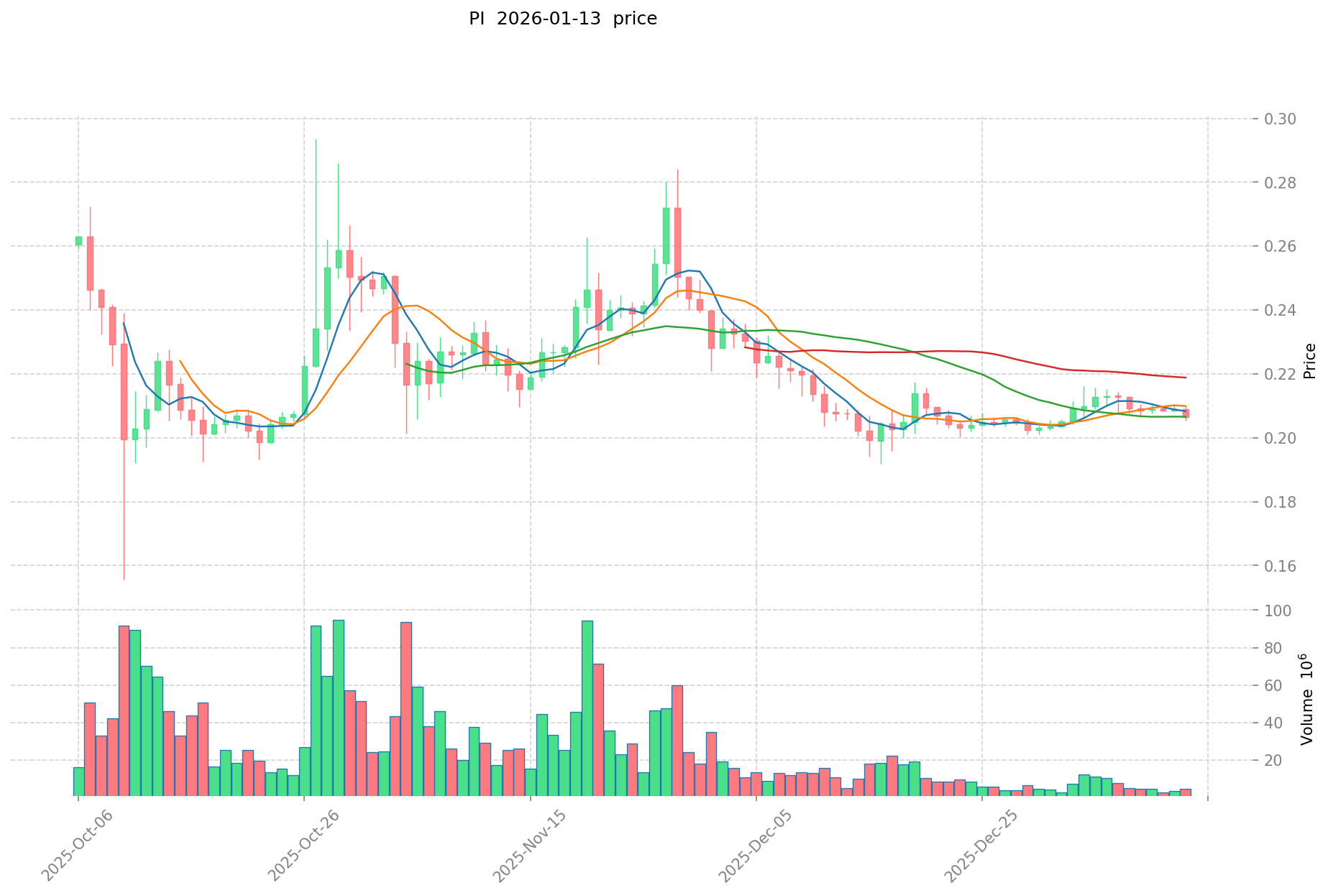
Pi Network (PI) represents a distinctive asset in the cryptocurrency sector, positioning itself as the first digital currency designed for mobile mining. As of January 2026, PI holds a market capitalization of approximately $1.74 billion with a circulating supply of around 8.38 billion tokens, while the current price remains near $0.208. The project operates on its own mainnet and has established presence across 9 exchanges. With a market dominance of 0.079%, PI has attracted attention among investors evaluating cryptocurrency portfolios. The token's trading performance shows fluctuations, recording a 0.93% increase over 24 hours, a -0.89% change over 7 days, and a 2.94% movement across 30 days. This article provides a comprehensive analysis of PI's investment characteristics, historical price movements, future price scenarios, and associated risks for investor reference.
I. PI Token Price History Review and Current Investment Value Status
- 2025-02: Market volatility period → PI price reached $3 on February 26, subsequently experiencing significant fluctuations
- 2025-02: Price correction phase → PI declined to $0.049 on February 20, reflecting market adjustment dynamics
- Recent trends: From February peak levels → Price stabilized around $0.20787 range as of January 2026
Current PI Investment Market Status (January 2026)
- PI current price: $0.20787
- 24-hour trading volume: $870,430.77
- Market capitalization: $1.74 billion
- Circulating supply: 8.38 billion PI tokens
- Market capitalization to fully diluted valuation ratio: 8.38%
Click to view real-time PI market price
II. Core Factors Influencing Whether PI is a Good Investment
Supply Mechanism and Scarcity
- Supply distribution and unlock schedule → Impact on price stability and investment value
- Market dynamics: Pi Network has a maximum supply of 100 billion tokens, with approximately 8.38 billion tokens currently in circulation (8.38% circulating ratio)
- Investment significance: The controlled token release mechanism and gradual unlock schedule represent key considerations for long-term investment evaluation
Institutional Investment and Mainstream Adoption
- Exchange listings: Pi Network is currently listed on 9 exchanges, indicating limited but growing institutional support
- Adoption challenges: The project's controversial KYC requirements and token lock mechanisms may affect institutional participation
- Regulatory considerations: The project faces ongoing scrutiny regarding data privacy and regulatory compliance, which could influence institutional investment decisions
Macroeconomic Environment's Impact on PI Investment
- Market positioning: Pi Network's mobile mining model positions it as an accessible entry point for retail investors during varying economic conditions
- Volatility considerations: The token has demonstrated significant price fluctuations, with historical price ranges from $0.049 to $3.00
- Economic uncertainty: As a relatively new mainnet token, Pi's performance during different macroeconomic cycles remains untested
Technology and Ecosystem Development
- Mainnet infrastructure: Pi Network operates on its proprietary mainnet with node network support
- Ecosystem applications: The project focuses on mobile accessibility and user verification systems through KYC processes
- Development roadmap: Ongoing ecosystem development aims to expand utility and application scenarios, though specific technical upgrades and DeFi integration details are not extensively documented in available materials
III. PI Future Investment Prediction and Price Outlook (Is Pi Network(PI) worth investing in 2026-2030)
Short-term Investment Prediction (2026, short-term PI investment outlook)
- Conservative Forecast: $0.11 - $0.21
- Neutral Forecast: $0.21 - $0.24
- Optimistic Forecast: $0.24 - $0.30
Mid-term Investment Outlook (2027-2028, mid-term Pi Network(PI) investment forecast)
-
Market Stage Expectation: PI is anticipated to experience moderate volatility as the project continues development of its ecosystem and expands exchange listings. Price movements may be influenced by overall cryptocurrency market sentiment and adoption rates.
-
Investment Return Prediction:
- 2027: $0.14 - $0.29
- 2028: $0.15 - $0.27
-
Key Catalysts: Protocol upgrades (such as V23 upgrade), expansion of real-world applications, growth in KYC-verified user base, and increased exchange availability may serve as important factors.
Long-term Investment Outlook (Is PI a good long-term investment?)
- Base Scenario: $0.22 - $0.33 (assuming steady network growth and gradual ecosystem development)
- Optimistic Scenario: $0.30 - $0.50 (assuming broader market acceptance and successful implementation of decentralized applications)
- Risk Scenario: $0.11 - $0.20 (under conditions of limited mainnet functionality or prolonged market downturn)
Click to view PI long-term investment and price prediction: Price Prediction
2026-01-14 - 2031 Long-term Outlook
- Base Scenario: $0.22 - $0.35 (corresponding to steady progress and gradual mainstream application growth)
- Optimistic Scenario: $0.30 - $0.50 (corresponding to large-scale adoption and favorable market conditions)
- Transformative Scenario: Above $0.50 (in case of breakthrough ecosystem developments and mainstream popularization)
- 2031-12-31 Predicted High: $0.35 (based on optimistic development assumptions)
Disclaimer: Price predictions are based on current market data and analytical models. Cryptocurrency markets are highly volatile and subject to multiple risk factors including regulatory changes, technological developments, and market sentiment. These predictions should not be considered as investment advice. Investors should conduct thorough research and consult financial advisors before making investment decisions.
| Year |
Predicted High Price |
Predicted Average Price |
Predicted Low Price |
Price Change |
| 2026 |
0.2369718 |
0.20787 |
0.1143285 |
0 |
| 2027 |
0.293595588 |
0.2224209 |
0.142349376 |
7 |
| 2028 |
0.27348873864 |
0.258008244 |
0.1548049464 |
24 |
| 2029 |
0.3268706443236 |
0.26574849132 |
0.19931136849 |
27 |
| 2030 |
0.32594052460398 |
0.2963095678218 |
0.219269080188132 |
42 |
| 2031 |
0.354682552682694 |
0.31112504621289 |
0.261345038818827 |
49 |
IV. PI Investment Strategy and Risk Management (How to invest in cryptocurrency)
Investment Strategy (PI investment strategy)
Long-term Holding (HODL PI)
For conservative investors, long-term holding may be an approach to consider. This strategy involves acquiring PI tokens and maintaining positions over extended periods, reducing exposure to short-term price fluctuations. Investors adopting this method typically focus on the project's fundamental development rather than daily price movements.
Active Trading
Active trading relies on technical analysis and swing trading operations. Traders using this approach monitor price patterns, trading volumes, and market indicators to identify potential entry and exit points. This method requires continuous market monitoring and understanding of technical analysis tools.
Risk Management (Risk management for PI investment)
Asset Allocation Ratio
- Conservative investors: Consider limiting PI exposure to a small percentage of the overall portfolio, typically 1-5%, maintaining majority holdings in traditional assets.
- Aggressive investors: May allocate 10-20% of their portfolio to PI and similar digital assets, accepting higher volatility for potential returns.
- Professional investors: Conduct comprehensive due diligence and may adjust allocation based on market conditions and risk tolerance, potentially ranging from 5-30% depending on investment thesis.
Risk Hedging Solutions
Diversification across multiple asset classes can help manage concentration risk. This may include:
- Maintaining positions in various cryptocurrencies with different use cases
- Combining digital assets with traditional investments
- Utilizing stablecoins as a temporary safe haven during high volatility periods
Secure Storage
- Cold wallets: Offline storage solutions that keep private keys disconnected from the internet, suitable for long-term holdings
- Hot wallets: Online wallets for active trading and smaller amounts requiring frequent access
- Hardware wallets: Physical devices that store private keys securely, recommended for significant holdings
V. PI Investment Risks and Challenges (Risks of investing in cryptocurrency)
Market Risk
PI has demonstrated significant price volatility, with historical prices ranging from $0.049 to $3. The 24-hour price fluctuation between $0.20564 and $0.20826 reflects ongoing market dynamics. Such volatility can result in substantial gains or losses over short periods. Additionally, with a relatively limited number of exchanges (9) listing PI, liquidity constraints and potential price manipulation remain concerns.
Regulatory Risk
Regulatory frameworks for digital currencies vary significantly across jurisdictions and continue to evolve. Changes in government policies, licensing requirements, or outright restrictions in certain countries could impact PI's accessibility, adoption, and valuation. Investors should monitor regulatory developments in their respective jurisdictions.
Technical Risk
Network security vulnerabilities, potential smart contract bugs, or technical upgrade failures could affect the PI Network's operation. As with any blockchain project, the mainnet's stability and security depend on ongoing development and maintenance. Any technical issues could impact user confidence and token value.
VI. Conclusion: Is Cryptocurrency a Good Investment?
Investment Value Summary
PI presents characteristics common to emerging digital assets: potential for growth alongside substantial volatility. With a current price of $0.20787 and a market capitalization of $1.74 billion, PI has established a presence in the cryptocurrency market. However, the significant decline from its historical high of $3 to current levels reflects the inherent volatility of the sector.
Investor Recommendations
✅ Beginners: Consider dollar-cost averaging (DCA) to mitigate timing risk, combined with secure wallet storage practices. Start with small amounts to understand the market dynamics before increasing exposure.
✅ Experienced Investors: May employ swing trading strategies while maintaining diversified portfolio allocation. Technical analysis and market sentiment monitoring can inform trading decisions.
✅ Institutional Investors: Conduct comprehensive due diligence on the project's fundamentals, team, and technology before considering strategic long-term allocation as part of a broader digital asset strategy.
⚠️ Notice: Cryptocurrency investment carries high risk, including potential loss of principal. This content is for informational purposes only and does not constitute investment advice. Investors should conduct their own research and consult with financial professionals before making investment decisions.
VII. FAQ
Q1: Is Pi Network (PI) worth investing in 2026?
Pi Network presents a mixed investment case with both opportunities and challenges. Currently priced at $0.20787 with a market capitalization of $1.74 billion, PI has demonstrated significant volatility, trading between $0.049 and $3 historically. The project's mobile mining approach and ongoing ecosystem development offer potential growth, but limited exchange listings (9 exchanges) and regulatory uncertainties pose risks. Conservative forecasts suggest a 2026 price range of $0.11-$0.30, while the neutral outlook places it around $0.21-$0.24. Investors should carefully assess their risk tolerance, considering PI's relatively low circulating supply ratio (8.38%) and unproven long-term viability before making investment decisions.
Q2: What makes PI different from other cryptocurrency investments?
PI distinguishes itself primarily through its mobile-first mining model, which aims to democratize cryptocurrency access for everyday users. Unlike traditional proof-of-work cryptocurrencies requiring specialized hardware, PI enables mining through smartphone applications. However, this accessibility comes with tradeoffs: the project implements mandatory KYC verification processes, maintains token lock mechanisms, and operates on a proprietary mainnet with limited exchange availability. The maximum supply of 100 billion tokens with only 8.38 billion currently circulating creates a unique supply dynamic that differs from fully circulating cryptocurrencies. These characteristics position PI as an accessible but controversial option within the broader cryptocurrency landscape.
Q3: What are the main risks when investing in PI?
The primary risks include extreme price volatility (historical range from $0.049 to $3), limited exchange liquidity across only 9 platforms, and ongoing regulatory scrutiny regarding data privacy and compliance. Technical risks involve potential network vulnerabilities and the unproven stability of the proprietary mainnet infrastructure. Market risks stem from the token's relatively small market dominance (0.079%) and susceptibility to broader cryptocurrency market downturns. Additionally, the controversial KYC requirements and token unlock schedule create uncertainty around future supply dynamics. Investors should allocate only 1-5% of conservative portfolios to PI, recognizing the potential for substantial principal loss.
Q4: How should I store PI tokens securely?
For long-term holdings, hardware wallets or cold storage solutions offer the highest security by keeping private keys offline and disconnected from internet-based threats. These physical devices protect against hacking attempts and unauthorized access. For active traders requiring frequent transactions, hot wallets provide convenience but should only hold amounts you're prepared to actively manage. Consider splitting holdings between cold storage (majority of tokens) and hot wallets (trading amounts) to balance security with accessibility. Avoid keeping significant amounts on exchanges, as centralized platforms present additional custody risks. Always enable two-factor authentication and maintain secure backups of recovery phrases in physical locations.
Q5: What price movement can I expect for PI in the next 3-5 years?
Based on analytical models and current market conditions, PI's mid-term outlook (2027-2028) suggests a range of $0.14-$0.29, with 2028 estimates around $0.15-$0.27. Long-term predictions through 2030 indicate a base scenario of $0.22-$0.35, assuming steady network growth and ecosystem development. Optimistic scenarios project $0.30-$0.50 if mainstream adoption accelerates, while risk scenarios suggest $0.11-$0.20 under adverse market conditions. Key factors influencing these projections include protocol upgrades, expansion of real-world applications, growth in KYC-verified users, and increased exchange availability. However, cryptocurrency markets remain highly unpredictable, and these forecasts should not be considered guaranteed outcomes.
Q6: What investment strategy works best for PI tokens?
Conservative investors should consider dollar-cost averaging (DCA) combined with long-term holding, allocating 1-5% of their portfolio to PI and maintaining positions regardless of short-term fluctuations. This approach reduces timing risk and focuses on fundamental project development rather than daily price movements. Aggressive investors might allocate 10-20% and employ active trading strategies using technical analysis to identify entry and exit points based on price patterns and volume indicators. Professional investors conducting comprehensive due diligence may adjust allocations between 5-30% depending on market conditions and risk assessment. Regardless of strategy, maintain proper portfolio diversification across multiple asset classes and never invest more than you can afford to lose.
Q7: How does PI's tokenomics affect its investment potential?
PI's tokenomics present a unique supply structure with a maximum supply of 100 billion tokens, of which only 8.38 billion (8.38%) currently circulate. This low circulating ratio creates potential upward price pressure as more tokens unlock, but also introduces uncertainty regarding future supply releases. The controlled token release mechanism and gradual unlock schedule aim to prevent sudden market flooding, theoretically supporting price stability. However, the eventual release of the remaining 91.62% of tokens represents a significant dilution risk that could pressure prices downward. Market capitalization to fully diluted valuation ratio of 8.38% suggests substantial future supply increases. Investors must weigh this supply dynamic against ecosystem development and adoption rates when evaluating long-term investment potential.
Q8: Should beginners invest in PI Network tokens?
Beginners should approach PI investment with caution, starting with small amounts to understand market dynamics before increasing exposure. The cryptocurrency market's high volatility and complexity require foundational knowledge of blockchain technology, wallet security, and risk management principles. New investors should begin by researching PI's technology, team, and use cases, then practice with minimal capital (1-2% of available investment funds). Implement dollar-cost averaging to mitigate timing risks and avoid emotional decision-making during price swings. Focus on learning secure storage practices using reputable wallets before accumulating significant holdings. Consider PI as a small portion of a diversified portfolio rather than a concentrated bet, and never invest funds needed for essential expenses or emergency reserves.
* The information is not intended to be and does not constitute financial advice or any other recommendation of any sort offered or endorsed by Gate.