Pine Token (PINE) is a specialized NFTfi protocol enabling non-custodial asset-backed lending through NFT collateral, currently trading at $0.001803 with a market cap of $358,516. This comprehensive analysis examines PINE's investment characteristics across multiple dimensions. The article reviews historical price performance—from a February 2023 peak of $0.738236 to the current level, reflecting a 29.52% annual decline—and evaluates core investment factors including supply mechanisms, institutional adoption, and ecosystem development. With limited liquidity ($14,887.53 daily volume) and 515 token holders, PINE presents both opportunities and substantial risks. The guide provides actionable investment strategies for different investor types, risk management frameworks, and price forecasts through 2031, ranging from conservative to optimistic scenarios. Detailed analysis of regulatory, market, and technical risks helps investors make informed decisions about whether Pine Token merits inclusion in their crypto
Introduction: Pine Token (PINE) Investment Position and Market Outlook
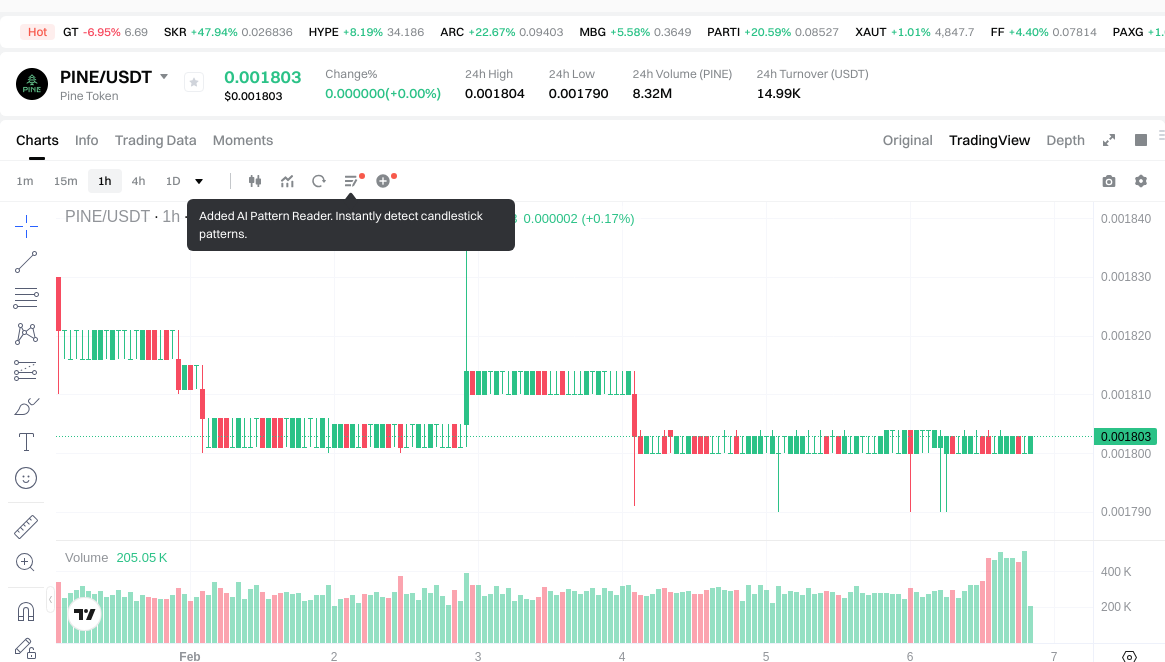
Pine Token (PINE) represents a specialized asset in the cryptocurrency sector, focusing on NFT-backed financing infrastructure. As of February 6, 2026, PINE maintains a market capitalization of approximately $358,516, with a circulating supply of 198,844,407 tokens and a current price of $0.001803. The project positions itself as a gateway for NFTfi revenue, operating as a non-custodial decentralized asset-backed lending protocol that enables borrowers to use non-fungible tokens as collateral for obtaining fungible digital tokens from lenders. With an open and composable architecture designed for seamless integration with NFT and NFTfi platforms, PINE has established a presence in the decentralized finance ecosystem. The token's price performance shows a 1.79% decline over the past 7 days and a 29.52% decrease over the past year, while maintaining a 99.42% ratio between market cap and fully diluted valuation. This article examines PINE's investment characteristics, historical price movements, future price considerations, and associated risks to provide investors with analytical perspectives when evaluating "Is Pine Token (PINE) a good investment?"
I. Pine Token (PINE) Price History Review and Current Investment Value
- 2023: PINE experienced significant price volatility during this period → The token traded within a wide range, with price movements reflecting broader NFTfi market dynamics
- February 2023: PINE reached a notable price level of $0.738236 → This represented a substantial valuation point during the NFT-collateralized lending market expansion phase
- April 2025: Market conditions led to price compression → PINE traded at $0.00116283, reflecting a significant contraction from previous levels
- 2025-2026: Price stabilization phase → PINE has shown relatively stable trading patterns around the $0.001803 level
Current PINE Investment Market Status (February 2026)
- PINE Current Price: $0.001803
- 24-hour Trading Volume: $14,887.53
- Market Capitalization: $358,516.47
- Circulating Supply: 198,844,407 PINE (99.42% of total supply)
- Fully Diluted Valuation: $360,600
- Token Holders: 515 addresses
Click to view real-time PINE market price
II. Core Factors Affecting Whether PINE is a Good Investment
Supply Mechanism and Scarcity (PINE Investment Scarcity)
- Fixed Supply Cap → Influences price dynamics and investment value
- PINE has a maximum supply of 200,000,000 tokens, with 198,844,407 tokens currently in circulation, representing approximately 99.42% of the total supply. The near-complete circulation suggests limited new supply entering the market.
- Historical Performance: PINE experienced significant price volatility, trading at $0.738236 in February 2023 and declining to $0.00116283 in April 2025, reflecting market-driven fluctuations rather than supply changes.
- Investment Implication: The high circulating supply ratio reduces inflationary pressure from new token releases, though scarcity alone does not guarantee value appreciation given the token's historical price trajectory.
Institutional Investment and Mainstream Adoption (Institutional Investment in PINE)
- Limited Market Presence: As of February 2026, PINE holds a market capitalization of approximately $358,516, ranking 3,314th globally with a market dominance of 0.000015%.
- Exchange Availability: The token is listed on one exchange, indicating relatively restricted access for institutional investors compared to more widely traded assets.
- Holder Base: PINE has 515 token holders, suggesting a relatively small community of investors.
- Investment Consideration: The limited institutional participation and modest holder base may constrain liquidity and price discovery mechanisms.
Macroeconomic Environment's Impact on PINE Investment
- Market Correlation: As a lower-cap digital asset within the NFTfi sector, PINE's performance may be influenced by broader cryptocurrency market trends and investor risk appetite.
- Volatility Context: The token has demonstrated substantial price fluctuations, with a 29.52% decline over the past year, indicating sensitivity to market conditions.
- Sector-Specific Factors: PINE operates in the NFT-collateralized lending space, where adoption depends on NFT market activity and decentralized finance (DeFi) participation trends.
Technology and Ecosystem Development (Technology & Ecosystem for PINE Investment)
- Protocol Architecture: Pine operates as a non-custodial, decentralized asset-backed lending protocol, enabling borrowers to use non-fungible tokens as collateral for fungible token loans.
- Interoperability Design: The protocol features an open and composable architecture designed for integration with NFT and NFTfi platforms, potentially expanding its utility within the ecosystem.
- Multi-Chain Deployment: PINE has deployed smart contracts on Ethereum (0x569424c5EE13884A193773fDC5d1c5f79C443a51) and Polygon (0x612D833c0c7A54cdfBe9a4328B6d658020563Ec0), providing access across multiple blockchain networks.
- Ecosystem Positioning: As an NFT-backed lending solution, Pine's long-term investment value depends on the growth and maturation of the NFT finance sector, which remains subject to market adoption rates and technological development.
III. PINE Future Investment Forecast & Price Outlook (Is Pine Token(PINE) worth investing in 2026-2031)
Short-term PINE Investment Outlook (2026)
- Conservative forecast: $0.001136 - $0.001803
- Neutral forecast: $0.001803 - $0.002272
- Optimistic forecast: $0.002272 and above
Mid-term Pine Token(PINE) Investment Forecast (2027-2029)
-
Market phase expectation: Pine Token may experience gradual growth as the NFTfi sector continues to develop, with potential volatility influenced by broader crypto market trends and adoption of decentralized asset-backed lending protocols.
-
Investment return forecast:
- 2027: $0.001365 - $0.002812
- 2028: $0.002352 - $0.003079
- 2029: $0.001624 - $0.002944
-
Key catalysts: Integration with NFT platforms, expansion of the NFTfi ecosystem, protocol upgrades, and increased adoption of non-custodial asset-backed lending services.
Long-term Investment Outlook (Is PINE a good long-term investment?)
- Base scenario: $0.001737 - $0.003588 (assuming steady development of the NFTfi market and continued protocol functionality)
- Optimistic scenario: $0.002864 - $0.004506 (assuming accelerated adoption of asset-backed lending and favorable market conditions for NFT-related projects)
- Risk scenario: Below $0.001624 (under conditions of limited adoption, intense competition, or adverse regulatory developments)
View PINE long-term investment & price forecast: Price Prediction
2026-02-06 - 2031 Long-term Outlook
- Base scenario: $0.001737 - $0.003588 (corresponding to steady progress and gradual mainstream application growth)
- Optimistic scenario: $0.002864 - $0.004506 (corresponding to large-scale adoption and favorable market environment)
- Transformative scenario: Above $0.004506 (if ecosystem achieves breakthrough progress and mainstream adoption)
- 2031-12-31 forecast high: $0.004506 (based on optimistic development assumptions)
Disclaimer: Price forecasts are based on historical data, market analysis, and predictive models. Actual results may vary significantly due to market volatility, regulatory changes, technological developments, and other unforeseen factors. This information is for reference purposes only and does not constitute investment advice. Investors should conduct their own research and consider their risk tolerance before making investment decisions.
| Year |
Predicted High Price |
Predicted Average Price |
Predicted Low Price |
Price Change |
| 2026 |
0.00227178 |
0.001803 |
0.00113589 |
0 |
| 2027 |
0.0028115982 |
0.00203739 |
0.0013650513 |
13 |
| 2028 |
0.003079107507 |
0.0024244941 |
0.002351759277 |
34 |
| 2029 |
0.002944426859745 |
0.0027518008035 |
0.001623562474065 |
52 |
| 2030 |
0.003588623427844 |
0.002848113831622 |
0.001737349437289 |
57 |
| 2031 |
0.004505716081626 |
0.003218368629733 |
0.002864348080462 |
78 |
IV. PINE Investment Strategy and Risk Management (How to invest in NFT-backed lending)
Investment Strategy (PINE investment strategy)
Long-term Holding (HODL PINE)
For investors with a stable risk appetite, long-term holding may be considered as an approach. This strategy involves acquiring PINE tokens and holding them through market cycles, potentially benefiting from the development of the NFTfi ecosystem. However, given the project's positioning in the niche NFT-backed lending sector, investors should carefully assess the long-term growth potential of this market segment.
Active Trading
Active trading strategies rely on technical analysis and market timing. Traders may utilize price trends, volume indicators, and support/resistance levels to execute short-term or medium-term trades. Based on recent data, PINE has shown limited price movement, with a 24-hour change of 0% and a 7-day decline of 1.79%, suggesting relatively low volatility in the short term.
Risk Management (Risk management for PINE investment)
Asset Allocation Ratio
- Conservative Investors: May allocate no more than 1-2% of their crypto portfolio to PINE, given its lower market capitalization and niche market focus
- Aggressive Investors: Could consider a 3-5% allocation while maintaining diversification across different crypto asset categories
- Professional Investors: May adjust allocation based on comprehensive due diligence and market analysis
Risk Hedging Solutions
Implementing a multi-asset portfolio approach can help mitigate concentration risk. Investors may consider combining PINE with other asset classes, including established cryptocurrencies and stablecoins, to balance risk exposure.
Secure Storage
- Cold Wallets: For long-term holdings, hardware wallets such as Ledger or Trezor provide enhanced security by keeping private keys offline
- Hot Wallets: For active trading, reputable software wallets with strong security features may be used, though with limited amounts
- Contract Addresses: PINE is available on Ethereum (0x569424c5EE13884A193773fDC5d1c5f79C443a51) and Polygon (0x612D833c0c7A54cdfBe9a4328B6d658020563Ec0) networks
V. PINE Investment Risks and Challenges (Risks of investing in NFT-backed lending)
Market Risk
PINE demonstrates significant price volatility characteristics. The token has experienced substantial price movements, with a 1-year decline of 29.52%. The 24-hour trading volume of approximately $14,887.53 suggests relatively limited liquidity, which may result in increased price slippage during larger transactions. Market manipulation risks may be elevated in lower-volume assets.
Regulatory Risk
The NFT-backed lending sector operates in an evolving regulatory environment. Different jurisdictions maintain varying approaches to DeFi protocols and NFT-related financial services. Regulatory developments could impact the protocol's operations, token utility, or market access across different regions.
Technical Risk
- Smart Contract Vulnerabilities: As a DeFi protocol facilitating asset-backed lending, PINE's smart contracts are subject to potential security vulnerabilities or exploitation risks
- Network Dependency: The protocol operates across multiple networks, which may introduce cross-chain technical complexities
- Protocol Upgrades: Implementation of protocol improvements or modifications may encounter technical challenges or community governance issues
Additional Considerations
- Market Capitalization: With a market cap of approximately $358,516, PINE represents a relatively small project, which may correlate with higher volatility and liquidity risks
- Circulation Rate: Approximately 99.42% of tokens are in circulation (198,844,407 out of 200,000,000 max supply)
- Holder Distribution: The token has approximately 515 holders, indicating a relatively concentrated ownership structure
VI. Conclusion: Is NFT-backed lending a Good Investment?
Investment Value Summary
PINE presents itself as a specialized protocol in the NFTfi sector, aiming to provide infrastructure for asset-backed financing on-chain. While the project addresses a specific market niche, potential investors should note the token's performance, which has shown a 29.52% decline over the past year. The project's long-term potential may depend on the broader adoption of NFT-backed lending and the growth of the NFTfi ecosystem.
Investor Recommendations
✅ Beginners: Consider dollar-cost averaging (DCA) with minimal allocation + secure storage in hardware wallets. Thoroughly research the NFTfi sector before participating.
✅ Experienced Investors: May explore tactical trading approaches while maintaining diversified portfolio allocation. Monitor protocol development and ecosystem partnerships.
✅ Institutional Investors: Conduct comprehensive due diligence regarding protocol security, market position, and regulatory compliance before considering strategic allocation.
⚠️ Disclaimer: Cryptocurrency investments carry substantial risk, including potential loss of principal. This content is for informational purposes only and does not constitute investment advice. Investors should conduct their own research and consult with financial professionals before making investment decisions.
VII. FAQ
Q1: What is the primary use case of Pine Token (PINE)?
PINE serves as the native token of a non-custodial, decentralized asset-backed lending protocol that enables borrowers to use non-fungible tokens (NFTs) as collateral to obtain fungible digital tokens from lenders. The protocol operates within the NFTfi (NFT Finance) ecosystem, providing infrastructure for NFT-backed financing. With smart contract deployments on both Ethereum (0x569424c5EE13884A193773fDC5d1c5f79C443a51) and Polygon (0x612D833c0c7A54cdfBe9a4328B6d658020563Ec0), Pine's open and composable architecture is designed for seamless integration with NFT and NFTfi platforms, positioning itself as a gateway for NFTfi revenue generation.
Q2: How has PINE's price performed historically?
PINE has experienced substantial price volatility throughout its trading history. The token reached a notable price point of $0.738236 in February 2023 during the NFT-collateralized lending market expansion. However, by April 2025, the price had contracted significantly to $0.00116283. As of February 6, 2026, PINE trades at $0.001803, representing a 29.52% decline over the past year and a 1.79% decrease over the past 7 days. This performance reflects both broader NFTfi market dynamics and evolving investor sentiment toward NFT-backed lending protocols.
Q3: What is PINE's current market capitalization and liquidity status?
PINE maintains a relatively modest market capitalization of approximately $358,516 as of February 2026, ranking 3,314th globally with a market dominance of 0.000015%. The token's 24-hour trading volume stands at $14,887.53, indicating limited liquidity compared to larger cryptocurrency assets. With 198,844,407 tokens in circulation out of a maximum supply of 200,000,000 (99.42% circulation rate) and approximately 515 token holders, PINE's market presence suggests a concentrated ownership structure and relatively restricted trading activity. The token is currently listed on one exchange, which may constrain institutional access and price discovery mechanisms.
Q4: What are the main risks associated with investing in PINE?
Investing in PINE carries several significant risks. Market risk is substantial, as demonstrated by the token's 29.52% annual decline and limited daily trading volume of approximately $14,887.53, which may result in increased price slippage and potential manipulation concerns. Regulatory risk exists due to the evolving legal framework surrounding DeFi protocols and NFT-related financial services across different jurisdictions. Technical risks include potential smart contract vulnerabilities in the asset-backed lending protocol, cross-chain technical complexities from multi-network operations, and challenges related to protocol upgrades or governance. Additionally, the token's relatively small market capitalization and concentrated holder base (515 addresses) may contribute to heightened volatility and liquidity constraints.
Q5: What is the long-term price forecast for PINE through 2031?
Long-term price projections for PINE vary across different scenarios. The base scenario estimates a range of $0.001737 to $0.003588 through 2031, assuming steady development of the NFTfi market and continued protocol functionality. The optimistic scenario projects $0.002864 to $0.004506, contingent upon accelerated adoption of asset-backed lending and favorable market conditions for NFT-related projects. In a transformative scenario with breakthrough ecosystem progress and mainstream adoption, prices could potentially exceed $0.004506. Conversely, the risk scenario suggests prices below $0.001624 under conditions of limited adoption, intense competition, or adverse regulatory developments. By December 31, 2031, the optimistic forecast high reaches $0.004506, representing a potential 78% change from current levels. However, these projections are based on historical data and predictive models, and actual results may vary significantly due to market volatility, technological developments, and unforeseen factors.
Q6: How should different investor types approach PINE investment?
Investment strategies for PINE should align with individual risk profiles and experience levels. Conservative investors may consider allocating no more than 1-2% of their crypto portfolio to PINE, given its lower market capitalization and niche market focus within NFT-backed lending. Aggressive investors could consider a 3-5% allocation while maintaining diversification across different crypto asset categories. Beginners should focus on dollar-cost averaging (DCA) with minimal allocation and secure storage using hardware wallets, while thoroughly researching the NFTfi sector before participating. Experienced investors may explore tactical trading approaches based on technical analysis while maintaining diversified portfolio allocation. Institutional investors should conduct comprehensive due diligence regarding protocol security, market position, and regulatory compliance before considering strategic allocation. All investor types should implement risk hedging through multi-asset portfolio approaches and utilize appropriate storage solutions, including cold wallets (Ledger, Trezor) for long-term holdings and reputable hot wallets for active trading.
Q7: What factors could drive PINE's future adoption and value?
PINE's future value potential depends on several key catalysts within the NFTfi ecosystem. Integration with established NFT platforms and marketplaces could expand the protocol's utility and user base. The overall growth and maturation of the NFT finance sector will significantly influence demand for asset-backed lending services. Protocol upgrades that enhance security, efficiency, or functionality may attract additional users and liquidity. Increased adoption of non-custodial asset-backed lending services as mainstream DeFi participants seek NFT-collateralized financing options could drive organic growth. The project's multi-chain deployment strategy (Ethereum and Polygon) positions it to capture users across different blockchain networks. However, PINE's success remains contingent upon broader market acceptance of NFT-backed lending, competitive differentiation from alternative protocols, and the sustainable development of use cases that generate genuine demand for the token within its ecosystem.
* The information is not intended to be and does not constitute financial advice or any other recommendation of any sort offered or endorsed by Gate.