This comprehensive analysis evaluates PinLink (PIN) as an investment opportunity within the AI computing, real-world assets (RWA), and decentralized physical infrastructure (DePin) sectors. Currently trading at $0.12407 with a $9.93 million market cap, PIN operates as a marketplace for tokenized computing resources including GPUs and cloud storage. The article examines PIN's price history, supply mechanics with 80 million of 100 million tokens circulating, and core technological foundations. Future projections suggest potential appreciation to $0.2553-$0.3294 by 2031, though significant volatility and regulatory uncertainties present substantial risks. Investment strategies range from conservative dollar-cost averaging for beginners to active trading for experienced investors. The analysis emphasizes PIN carries high-risk characteristics typical of early-stage infrastructure tokens, requiring thorough due diligence and appropriate portfolio allocation before investment.
Introduction: PinLink (PIN)'s Investment Position and Market Prospects
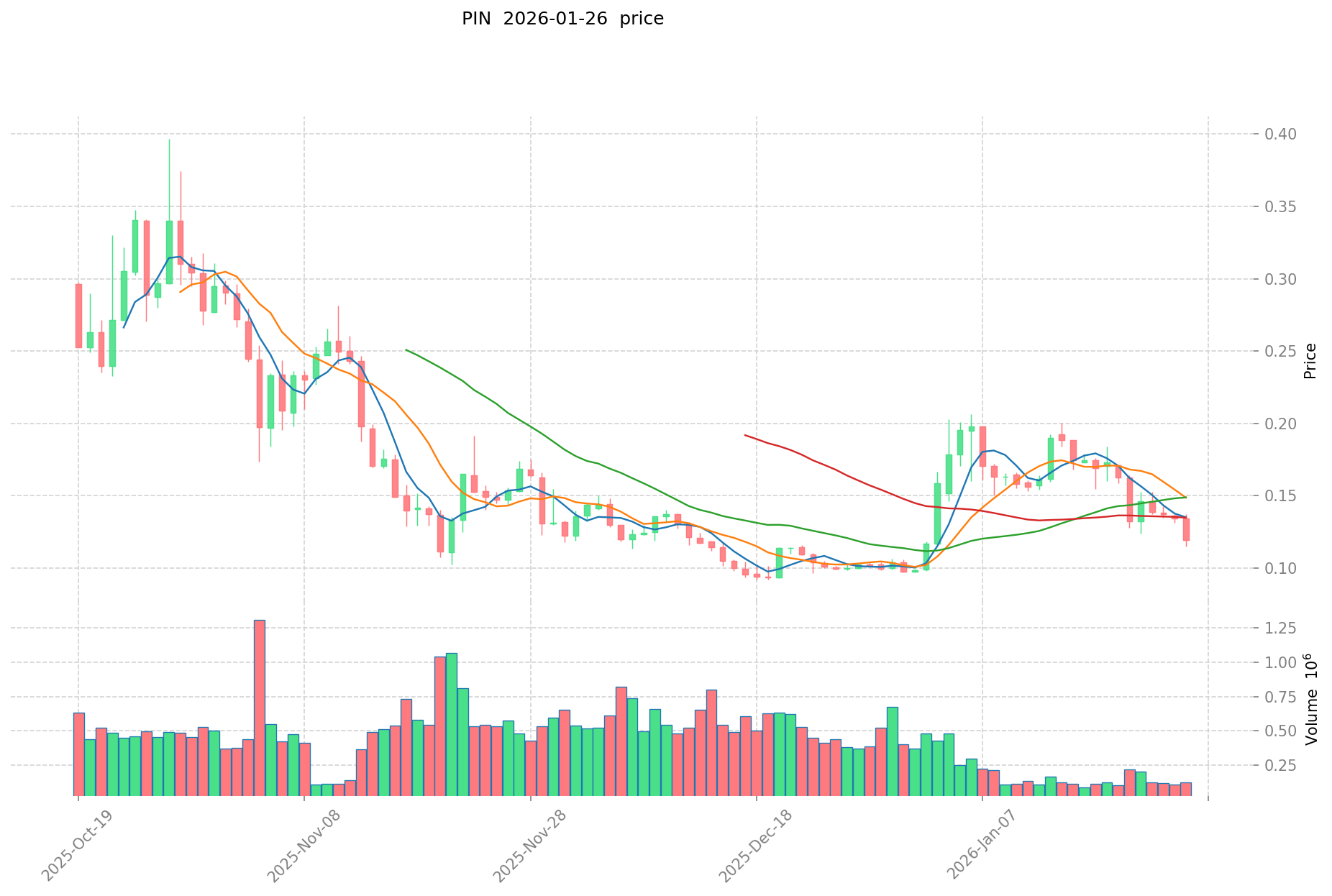
PIN is a notable asset in the cryptocurrency space, launched in November 2024 and gaining recognition in the AI, real-world assets (RWA), and decentralized physical infrastructure networks (DePin) sectors. As of January 26, 2026, PIN maintains a market capitalization of approximately $9.93 million, with a circulating supply of 80 million tokens out of a maximum supply of 100 million. The current price stands at around $0.12407, with a 24-hour trading volume of $18,045.65. The token has demonstrated notable price volatility, experiencing a 24.56% increase over the past 30 days while showing a -21.52% change over the past 7 days. With its market share of 0.00039% and ranking at position 1206, PIN positions itself as a marketplace connecting users with tokenized computing resources including GPUs, miners, and cloud storage for AI and machine learning applications. The token's performance since its listing, including a previous price level of $3.84 in January 2025 compared to its current valuation, has prompted investors to evaluate the question "Is PinLink (PIN) a good investment?" This article provides a comprehensive analysis of PIN's investment characteristics, historical performance, future price considerations, and associated risk factors for reference purposes.
I. Token (PIN) Price History Review and Current Investment Value Status
- 2024: Initial trading commenced → Token launched at $0.058
- 2025: Market volatility observed → PIN experienced significant price movements from January highs to December lows
- 2025-2026: Market correction phase → Price declined from early 2025 levels to current trading range
Current PIN Investment Market Status (January 2026)
- PIN current price: $0.12407
- Market sentiment (Fear & Greed Index): Data not available in provided materials
- 24-hour trading volume: $18,045.65
- Institutional investor holdings: Data not available in provided materials
Click to view real-time PIN market price
II. Core Factors Influencing Whether PIN is a Good Investment (Is PinLink(PIN) a Good Investment)
Supply Mechanism and Scarcity (PIN investment scarcity)
- Fixed supply mechanism → impacts price and investment value
- Maximum supply: 100,000,000 PIN tokens, with 80,000,000 tokens (80%) currently in circulation
- The finite supply model establishes a foundation for potential scarcity-driven value appreciation
- Investment significance: scarcity dynamics serve as a key element supporting long-term investment considerations
Institutional Investment and Mainstream Adoption (Institutional investment in PIN)
- Current holder base: 24,918 addresses, indicating growing community participation
- Trading availability: listed on 5 exchanges, with Gate.com among the platforms supporting PIN trading
- The expanding exchange presence and holder distribution reflect increasing market accessibility for institutional and retail investors
Macroeconomic Environment's Impact on PIN Investment
- Monetary policy and interest rate changes → alter investment attractiveness across crypto assets
- Inflation environment considerations → digital assets as potential diversification tools
- Geopolitical uncertainty → may strengthen demand for decentralized asset investments
Technology and Ecosystem Development (Technology & Ecosystem for PIN investment)
- Real-World Asset (RWA) tokenization model: connects users with tokenized GPUs, miners, and cloud storage resources
- AI and machine learning integration: provides marketplace for developers and enterprises to access computational power and hashrate
- DePIN infrastructure: bridges artificial intelligence, real-world assets, and decentralized physical infrastructure
- ERC-20 standard implementation on Ethereum network ensures compatibility with existing DeFi ecosystems
- Long-term value support: the combination of AI computational resource marketplace and RWA tokenization framework establishes differentiated positioning in the decentralized infrastructure sector
III. PIN Future Investment Forecast and Price Outlook (Is PinLink(PIN) worth investing in 2026-2031)
Short-term Investment Forecast (2026, short-term PIN investment outlook)
- Conservative forecast: $0.0866 - $0.1255
- Neutral forecast: $0.1255
- Optimistic forecast: $0.1255 - $0.1544
Mid-term Investment Outlook (2027-2029, mid-term PinLink(PIN) investment forecast)
-
Market phase expectation: Based on the projected data, PIN is anticipated to experience gradual appreciation during the mid-term period, with predicted average prices rising from $0.1399 in 2027 to $0.1948 in 2029. This growth trajectory suggests potential market maturation and expanding ecosystem adoption.
-
Investment return forecast:
- 2027: $0.0756 - $0.1833
- 2028: $0.0873 - $0.2279
- 2029: $0.1305 - $0.2512
-
Key catalysts: The development of PinLink's RWA tokenization model for AI computing resources, expansion of GPU and cloud storage marketplace adoption, and broader DePin infrastructure integration may serve as potential growth drivers during this period.
Long-term Investment Outlook (Is PIN a good long-term investment?)
- Base scenario: $0.1561 - $0.2559 (assuming steady development of the DePin and RWA sectors with moderate adoption of tokenized computing resources)
- Optimistic scenario: $0.2559 - $0.3294 (assuming accelerated adoption of decentralized AI computing infrastructure and favorable market conditions for RWA tokenization)
- Risk scenario: Below $0.1561 (under adverse market conditions or slower-than-expected ecosystem development)
For detailed PIN long-term investment and price predictions, visit: Price Prediction
2026-2031 Long-term Outlook
- Base scenario: $0.1561 - $0.2559 (corresponding to steady progress and stable mainstream application growth)
- Optimistic scenario: $0.2093 - $0.3294 (corresponding to large-scale adoption and favorable market environment)
- Transformative scenario: Above $0.3294 (if the ecosystem achieves breakthrough developments and mainstream adoption)
- 2031-12-31 predicted high: $0.3294 (based on optimistic development assumptions)
Disclaimer: The above predictions are based on historical data analysis and market trend projections. Cryptocurrency investments carry substantial risks, and actual prices may differ significantly from forecasts due to market volatility, technological developments, regulatory changes, and other unforeseen factors. This content does not constitute investment advice, and investors should conduct thorough research and risk assessment before making any investment decisions.
| Year |
Predicted High Price |
Predicted Average Price |
Predicted Low Price |
Price Change |
| 2026 |
0.154365 |
0.1255 |
0.086595 |
0 |
| 2027 |
0.183311575 |
0.1399325 |
0.07556355 |
11 |
| 2028 |
0.227887072875 |
0.1616220375 |
0.08727590025 |
29 |
| 2029 |
0.251233376191875 |
0.1947545551875 |
0.130485551975625 |
55 |
| 2030 |
0.287662215739696 |
0.222993965689687 |
0.156095775982781 |
78 |
| 2031 |
0.329373237021952 |
0.255328090714692 |
0.209369034386047 |
104 |
IV. PIN Investment Strategy and Risk Management (How to invest in PinLink)
Investment Methodology (PIN investment strategy)
Long-term Holding (HODL PIN): Suitable for Conservative Investors
For investors seeking steady accumulation in the AI-compute and RWA tokenization space, a long-term holding strategy may align with PinLink's vision of bridging decentralized physical infrastructure (DePin) with tokenized GPU and mining resources. This approach typically involves periodic purchases and storage in secure wallets, minimizing exposure to short-term price swings.
Active Trading: Relying on Technical Analysis and Swing Operations
Traders with experience in technical indicators may leverage PIN's price movements across multiple timeframes. Given recent data showing a 24-hour decline of approximately 7.61% and a 7-day drop of around 21.52%, active traders might monitor support and resistance levels, volume trends, and broader market sentiment to identify entry and exit points. However, such strategies require continuous market observation and risk discipline.
Risk Management (Risk management for PIN investment)
Asset Allocation Ratios: Conservative / Aggressive / Professional Investors
- Conservative investors may limit exposure to PIN to a small percentage of their overall portfolio (e.g., 1-5%), balancing it with more established assets.
- Aggressive investors comfortable with higher volatility might allocate a larger share (e.g., 5-15%), accepting the potential for significant gains or losses.
- Professional investors often diversify across multiple AI and DePin projects, using PIN as part of a sector-specific basket to capture thematic growth while mitigating single-asset risk.
Risk Hedging Solutions: Multi-Asset Portfolios and Hedging Instruments
To manage volatility, investors may combine PIN holdings with other digital assets or stablecoins, enabling rebalancing during market shifts. Some advanced participants explore derivatives or options (where available) to hedge against downside moves, though such instruments carry their own complexities.
Secure Storage: Cold and Hot Wallets, Hardware Wallet Recommendations
Given that PIN operates as an ERC-20 token on the Ethereum network, users should prioritize secure custody solutions. Hot wallets (e.g., MetaMask, Trust Wallet) offer convenience for active trading, while cold storage options—such as hardware wallets like Ledger or Trezor—provide enhanced security for long-term holdings. Always verify contract addresses (e.g., 0x2e44f3f609ff5aa4819b323fd74690f07c3607c4) before transactions to avoid phishing risks.
V. PIN Investment Risks and Challenges (Risks of investing in PinLink)
Market Risk: High Volatility and Price Manipulation
PIN has exhibited notable price fluctuations, with a 30-day increase of approximately 24.56% contrasted by a 1-year decline of around 92.31%. Such swings underscore the asset's sensitivity to market sentiment, liquidity conditions, and broader crypto trends. Lower market capitalizations can also expose tokens to sharper moves driven by large trades or speculative activity.
Regulatory Risk: Policy Uncertainty Across Jurisdictions
As governments worldwide continue to develop frameworks for digital assets, AI-related tokens, and real-world asset tokenization, regulatory clarity remains in flux. Changes in tax treatment, securities classification, or cross-border transaction rules could impact PIN's accessibility and valuation in certain markets.
Technical Risk: Network Security Vulnerabilities and Upgrade Failures
Operating on Ethereum, PIN inherits the network's security profile, including exposure to smart contract bugs or layer-1 congestion. Additionally, any planned protocol upgrades or integrations with GPU/mining infrastructure must be executed carefully to avoid disruptions or exploits. Investors should monitor official channels for updates on technical developments and security audits.
VI. Conclusion: Is PinLink a Good Investment?
Investment Value Summary
PIN presents a distinct value proposition within the intersection of AI compute, real-world asset tokenization, and decentralized infrastructure. Its marketplace model for renting and tokenizing GPUs and mining power aligns with emerging trends in machine learning and high-performance computing. However, the token's significant price volatility—including a substantial decline over the past year—reflects both early-stage market dynamics and sector-wide headwinds.
Investor Recommendations
✅ Beginners: Consider a dollar-cost averaging (DCA) approach, acquiring small amounts at regular intervals and storing them in a reputable hardware wallet to mitigate timing risk.
✅ Experienced Investors: Leverage technical analysis for swing trading opportunities while maintaining a diversified portfolio that includes other AI, RWA, or infrastructure tokens to balance exposure.
✅ Institutional Investors: Evaluate PIN as part of a strategic, long-term allocation to the AI-compute and DePin narrative, conducting thorough due diligence on project fundamentals, team credentials, and ecosystem partnerships.
⚠️ Disclaimer: Cryptocurrency investments carry substantial risk due to market volatility, regulatory uncertainty, and technical complexities. This content is for informational purposes only and does not constitute financial, investment, or legal advice. Conduct independent research and consult qualified professionals before making investment decisions.
VII. FAQ
Q1: What is PinLink (PIN) and what makes it different from other cryptocurrency projects?
PinLink (PIN) is an ERC-20 token that operates as a marketplace connecting users with tokenized computing resources, including GPUs, miners, and cloud storage for AI and machine learning applications. What distinguishes PIN from other crypto projects is its unique positioning at the intersection of three emerging sectors: AI computing infrastructure, Real-World Asset (RWA) tokenization, and Decentralized Physical Infrastructure Networks (DePin). Unlike general-purpose cryptocurrencies, PIN specifically addresses the growing demand for decentralized access to computational power and hashrate, enabling developers and enterprises to rent and tokenize high-performance computing resources through a blockchain-based marketplace model.
Q2: Is PinLink a good short-term investment in 2026?
Based on current market analysis, PIN presents a high-risk, high-volatility short-term investment opportunity. The token has demonstrated significant price swings, with a 24.56% increase over the past 30 days but a -21.52% decline over the past 7 days, indicating substantial short-term volatility. Short-term forecasts for 2026 suggest a price range between $0.0866 and $0.1544, with a neutral forecast around $0.1255. Given the current price of approximately $0.12407 and low trading volume of $18,045.65, short-term investors should approach PIN with caution, employing strict risk management strategies and only allocating capital they can afford to lose. Technical analysis and active monitoring of market sentiment are essential for those considering short-term trading positions.
Q3: What is PinLink's long-term investment potential for 2026-2031?
Long-term projections suggest PIN may experience gradual appreciation, with predicted average prices potentially rising from $0.1255 in 2026 to $0.2553 by 2031, representing a potential growth trajectory of approximately 104% over five years. The base scenario forecasts a price range of $0.1561-$0.2559, while optimistic scenarios suggest potential highs reaching $0.3294 by late 2031. However, these projections assume successful development of PinLink's RWA tokenization model, expanded adoption of its GPU and cloud storage marketplace, and favorable market conditions for the DePin sector. Long-term value depends heavily on the project's ability to achieve meaningful ecosystem growth, establish strategic partnerships, and navigate regulatory challenges in the AI computing and tokenization space.
Q4: What are the main risks associated with investing in PIN?
PIN investments carry three primary risk categories. First, market risk: the token has exhibited extreme volatility, with a 92.31% decline over one year despite recent 30-day gains, and its low market capitalization ($9.93 million) makes it susceptible to price manipulation and liquidity issues. Second, regulatory risk: as governments worldwide develop frameworks for AI-related tokens and real-world asset tokenization, policy changes could significantly impact PIN's accessibility and valuation across different jurisdictions. Third, technical risk: operating as an ERC-20 token, PIN inherits Ethereum's security profile, including exposure to smart contract vulnerabilities, network congestion, and potential upgrade failures. Additionally, the integration with GPU/mining infrastructure introduces unique operational risks that require careful monitoring.
Q5: How should beginners approach investing in PinLink?
Beginners should adopt a highly conservative approach when considering PIN investment. A dollar-cost averaging (DCA) strategy is recommended, where small amounts are purchased at regular intervals rather than investing a lump sum, helping to mitigate timing risk in this volatile asset. Allocation should be limited to 1-5% of the overall investment portfolio, ensuring that potential losses remain manageable. Secure storage is critical—beginners should use reputable hardware wallets like Ledger or Trezor for long-term holdings, and always verify the official contract address (0x2e44f3f609ff5aa4819b323fd74690f07c3607c4) before any transactions to avoid phishing scams. Most importantly, beginners should only invest capital they can afford to lose entirely, conduct thorough independent research, and avoid making investment decisions based solely on price predictions or short-term market movements.
Q6: What factors could drive PinLink's price appreciation in the future?
Several catalysts may support PIN's price appreciation: expanding adoption of PinLink's marketplace for tokenized GPU and mining resources as demand for decentralized AI computing infrastructure grows; successful implementation and scaling of its RWA tokenization model; increased integration within the broader DePin ecosystem; listings on additional major exchanges beyond the current five platforms; growing holder base beyond the current 24,918 addresses; and favorable macroeconomic conditions that drive institutional interest in alternative digital assets. Additionally, breakthrough developments in AI and machine learning applications that require decentralized computing resources could significantly boost demand for PIN's marketplace services. However, these positive scenarios are contingent on successful execution of the project roadmap and favorable market conditions.
Q7: How does PinLink's tokenomics affect its investment potential?
PinLink's tokenomics feature a maximum supply cap of 100 million tokens, with 80 million (80%) currently in circulation as of January 2026. This finite supply model establishes a foundation for potential scarcity-driven value appreciation, particularly if demand for the platform's services grows over time. The relatively high circulating supply percentage (80%) suggests limited future token unlocks, reducing the risk of significant supply-side selling pressure. However, with a current market capitalization of only $9.93 million and ranking at position 1206, the token remains in a nascent stage with limited liquidity. The tokenomics structure supports long-term holding strategies for those who believe in the project's fundamentals, but the current low trading volume ($18,045.65 over 24 hours) indicates that large transactions could significantly impact price stability.
Q8: What investment strategy is most suitable for PIN holders?
The optimal strategy depends on investor profile and risk tolerance. Conservative investors should employ a long-term HODL (hold) strategy, limiting PIN to 1-5% of their portfolio, using dollar-cost averaging for entries, and storing tokens in cold storage hardware wallets to minimize exposure to short-term volatility. Aggressive investors comfortable with higher risk might allocate 5-15% of their portfolio, potentially employing active trading strategies that leverage technical analysis to capture swing trading opportunities, though this requires continuous market monitoring and disciplined risk management. Professional investors may treat PIN as part of a sector-specific basket within the AI-compute and DePin narrative, diversifying across multiple related projects while conducting ongoing due diligence on fundamentals, team execution, and ecosystem development. Regardless of strategy, all investors should implement stop-loss mechanisms, regularly reassess their thesis, and avoid over-concentration in this high-volatility asset.
* The information is not intended to be and does not constitute financial advice or any other recommendation of any sort offered or endorsed by Gate.