This comprehensive investment analysis examines Pippin (PIPPIN), a Solana-based meme token created by AI innovator Yohei Nakajima, currently trading at $0.30664 with a market capitalization of $306.62 million as of January 15, 2026. The article evaluates Pippin's investment viability by analyzing price history showing 114.098% annual gains, market position across 20 exchanges with 34,426 holders, and core factors including supply mechanics, ecosystem development, and macroeconomic context. The analysis presents short-term price forecasts ranging $0.24-$0.38, mid-term projections through 2029 reaching $0.73-$1.34, and long-term scenarios through 2031 between $0.10-$1.20 depending on utility development and market conditions. Investment strategies tailored for beginners, experienced traders, and institutional investors address portfolio allocation ratios, risk management protocols, and secure storage solutions. The article thoroughly examines market volatility risks, regulatory uncertainty, liquidity constraint
Introduction: Pippin (PIPPIN)'s Investment Position and Market Prospects
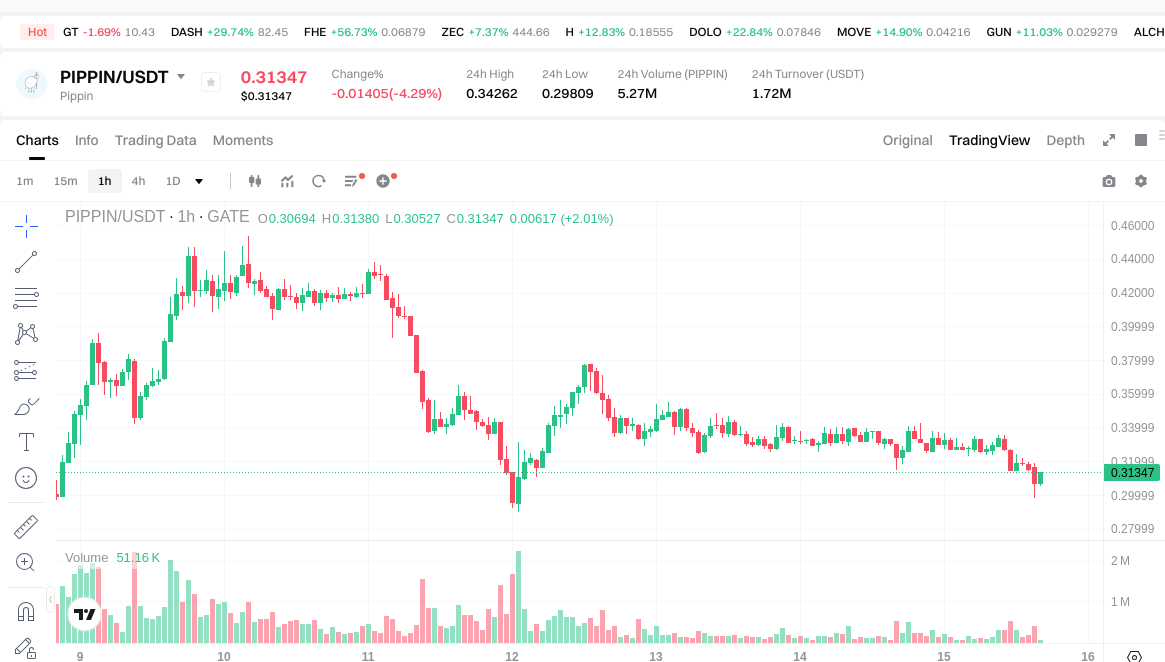
Pippin (PIPPIN) is a meme token operating on the Solana blockchain, launched via Pumpfun platform. As of January 15, 2026, PIPPIN holds a market ranking of 188 with a market capitalization of approximately $306.62 million and a circulating supply of 999.94 million tokens. The current price stands at $0.30664, reflecting recent market fluctuations with a 24-hour change of -5.55% and a 7-day increase of 9.26%. Over the past year, PIPPIN has demonstrated notable price movement with a 114.098% increase from its launch price of $0.144.
Created by Yohei Nakajima, a recognized innovator in the AI venture capital space known for developing BabyAGI and over 100 AI-driven prototypes, PIPPIN represents an SVG unicorn character generated using advanced LLM benchmarks on ChatGPT 4o. The token's contract address on Solana (Dfh5DzRgSvvCFDoYc2ciTkMrbDfRKybA4SoFbPmApump) serves approximately 34,426 holders across 20 exchanges.
With a circulating ratio of 99.99% and a market cap to fully diluted valuation ratio of 99.99%, PIPPIN exhibits characteristics common to meme tokens while attracting attention in discussions around "Is Pippin (PIPPIN) a good investment?" This analysis examines PIPPIN's investment value, historical price trends, future price projections, and associated risks to provide reference points for potential investors navigating the cryptocurrency market.
I. Pippin (PIPPIN) Price History Review and Investment Value Status
Pippin is a meme token launched on the Solana blockchain via Pumpfun. According to available data, the token was created by Yohei Nakajima, a recognized innovator in the AI VC space, known for projects such as BabyAGI. The token features an SVG unicorn character designed using ChatGPT 4o's latest LLM benchmarks.
- 2025 (October): Pippin token launched at a publish price of $0.144, marking the beginning of its trading history on the Solana network.
- 2025 (December): Pippin reached a peak price level of $0.78 on December 24, 2025, representing significant upward momentum from its initial launch.
- 2026 (January): As of January 15, 2026, Pippin is trading at approximately $0.30664, reflecting market adjustments from previous highs.
Based on reference materials, Pippin has demonstrated notable price volatility characteristic of meme tokens in the Solana ecosystem. The token's journey from its launch price to subsequent price levels illustrates the speculative nature of meme-based cryptocurrencies.
Current Pippin Investment Market Status (January 2026)
- Pippin current price: $0.30664 (as of January 15, 2026, 16:20:12 UTC)
- Market capitalization: Approximately $306.62 million
- 24-hour trading volume: $1.73 million
- Circulating supply: 999.94 million PIPPIN tokens (approximately 99.99% of total supply)
- Total supply: 999.94 million PIPPIN
- Maximum supply: 1 billion PIPPIN
- Token holders: 34,426 addresses
- Listed exchanges: Available on 20 trading platforms
- Market share: 0.0089% of total cryptocurrency market
Click to view real-time PIPPIN market price
Recent price performance indicates:
- 1-hour change: -1.97%
- 24-hour change: -5.55%
- 7-day change: +9.26%
- 30-day change: -32.35%
- 1-year change: +114.098%
Pippin operates as a meme token within the Solana ecosystem, with its contract address Dfh5DzRgSvvCFDoYc2ciTkMrbDfRKybA4SoFbPmApump verifiable on the Solana blockchain explorer. The project maintains an official website at pippin.love and active social media presence on Twitter (@pippinlovesyou).
The token's market dynamics reflect typical meme token characteristics, with price movements driven primarily by community engagement and market sentiment rather than fundamental utility or technical infrastructure developments.
II. Core Factors Influencing Whether PIPPIN is a Good Investment
Supply Mechanism and Scarcity (PIPPIN investment scarcity)
- Total Supply: PIPPIN has a maximum supply of 1,000,000,000 tokens, with 999,937,618.509896 tokens currently in circulation, representing approximately 99.99% of the total supply.
- Circulation Rate: With nearly all tokens already circulating, the circulating supply is 999,937,618.509896 PIPPIN, leaving minimal room for significant future dilution.
- Market Cap to FDV Ratio: The market cap to fully diluted valuation ratio stands at 99.99%, indicating that the current market capitalization closely reflects the fully diluted valuation, which may limit expectations for future supply-driven price appreciation.
- Investment Implication: The near-complete circulation of tokens suggests limited scarcity-driven upward pressure, as most tokens are already in the market.
Institutional Investment and Mainstream Adoption (Institutional investment in PIPPIN)
- Exchange Listings: PIPPIN is listed on 20 exchanges, which provides accessibility for trading but does not necessarily indicate significant institutional adoption.
- Holder Distribution: The token has 34,426 holders, reflecting a degree of retail interest, though specific data on institutional involvement is not available in the provided materials.
Macroeconomic Environment Impact on PIPPIN Investment
- Market Sentiment: As of January 15, 2026, the general market sentiment for PIPPIN appears to be positive, with technical indicators showing bullish signals.
- Altcoin Market Context: In 2025, the altcoin market experienced a bear phase with an average market cap decline of 28%. However, PIPPIN demonstrated notable resilience during this period, which may influence investor perceptions in the current macroeconomic environment.
Technology and Ecosystem Development (Technology & Ecosystem for PIPPIN investment)
- Blockchain Platform: PIPPIN is a meme token running on the Solana blockchain, which is known for its high-speed transactions and lower fees compared to some other blockchain platforms.
- Project Origins: The token was created by Yohei Nakajima, recognized for innovation in the AI and venture capital space. Nakajima is known for public building methodologies and has been associated with AI-driven projects, including BabyAGI, an open-source autonomous agent with task planning capabilities.
- Token Characteristics: PIPPIN incorporates SVG unicorn art generated via ChatGPT 4o and is associated with autonomous AI agent capabilities, blending creative and technological elements.
- Launch Platform: The token was launched on Pumpfun, a platform for meme token launches.
- Investment Implication: While the Solana blockchain offers technical advantages, the token's classification as a meme token and its origins in AI-driven art generation may appeal to specific investor segments interested in novelty and cultural trends rather than traditional utility or infrastructure development.
III. PIPPIN Future Investment Forecast and Price Outlook (Is Pippin (PIPPIN) worth investing in 2026-2031)
Short-term Investment Forecast (2026, short-term PIPPIN investment outlook)
Based on available market data as of January 15, 2026, Pippin (PIPPIN) exhibits characteristics typical of meme tokens on the Solana blockchain, with current trading around $0.30664. Short-term forecasts for 2026 suggest the following scenarios:
- Conservative forecast: $0.24 - $0.31 USD
- Neutral forecast: $0.31 - $0.35 USD
- Optimistic forecast: $0.35 - $0.38 USD
The token has experienced notable volatility, with a 24-hour decline of 5.55% and a 7-day gain of 9.26%, reflecting the speculative nature common to meme-based assets. The short-term outlook depends heavily on community engagement, social media momentum, and broader Solana ecosystem sentiment.
Mid-term Investment Outlook (2027-2029, mid-term Pippin (PIPPIN) investment forecast)
-
Market stage expectation: Entry into a maturation phase where the project's AI-inspired narrative and community tools may drive increased adoption, though volatility is expected to remain elevated.
-
Investment return forecast:
- 2027: $0.45 - $0.72 USD (representing potential growth of 47% to 135% from current levels)
- 2028: $0.57 - $0.98 USD (suggesting sustained momentum if utility features gain traction)
- 2029: $0.73 - $1.34 USD (conditional on ecosystem expansion and broader meme coin market cycles)
-
Key catalysts: Development of AI agent experiments, community-driven tools, integration with decentralized applications, potential listings on major centralized exchanges, and overall sentiment toward Solana-based meme tokens.
Long-term Investment Outlook (Is PIPPIN a good long-term investment?)
Long-term forecasts for Pippin extend through 2031, with outcomes dependent on execution of the project's roadmap, sustained community interest, and broader market conditions:
- Base scenario: $0.30 - $0.63 USD (assuming steady community engagement and incremental utility development)
- Optimistic scenario: $0.82 - $1.20 USD (assuming successful implementation of AI-driven features, increased liquidity, and favorable market sentiment)
- Risk scenario: $0.10 - $0.25 USD (in the event of declining community interest, lack of utility development, or adverse regulatory conditions)
Click to view PIPPIN long-term investment and price forecast: Price Prediction
2026-01-15 to 2031 Long-term Outlook
- Base scenario: $0.30 - $0.63 USD (corresponding to steady progress and gradual mainstream application growth)
- Optimistic scenario: $0.82 - $1.20 USD (corresponding to large-scale adoption and favorable market conditions)
- Transformative scenario: Above $1.50 USD (contingent on breakthrough ecosystem developments and mainstream adoption)
- 2031-12-31 predicted high: $0.82 USD (based on optimistic development assumptions)
Disclaimer
The forecasts presented are derived from technical analysis, historical price patterns, and available project information as of January 15, 2026. Cryptocurrency investments, particularly meme tokens, carry substantial risk due to high volatility, speculative dynamics, and the absence of guaranteed utility. Past performance does not indicate future results. Investors should conduct independent research, assess their risk tolerance, and consult financial advisors before making investment decisions. Pippin's value is heavily influenced by community sentiment, social media trends, and broader market cycles, which are inherently unpredictable. No forecast should be construed as financial advice or a guarantee of returns.
| Year |
Predicted High Price |
Predicted Average Price |
Predicted Low Price |
Price Change |
| 2026 |
0.3804326 |
0.31183 |
0.2369908 |
0 |
| 2027 |
0.508813011 |
0.3461313 |
0.224985345 |
11 |
| 2028 |
0.53861491593 |
0.4274721555 |
0.277856901075 |
37 |
| 2029 |
0.5603305014294 |
0.483043535715 |
0.35262178107195 |
55 |
| 2030 |
0.735578696186802 |
0.5216870185722 |
0.297361600586154 |
68 |
| 2031 |
0.817222714593351 |
0.628632857379501 |
0.333175414411135 |
102 |
IV. Pippin Investment Strategy and Risk Management (How to invest in Meme Tokens)
Investment Methodology (Pippin investment strategy)
-
Long-term Holding (HODL Pippin): Suitable for conservative investors who believe in the long-term community development and brand recognition of meme tokens. Given Pippin's connection to AI innovation and its creator's reputation in the venture capital space, patient holders may benefit from potential ecosystem growth and increased adoption over time.
-
Active Trading: Relies on technical analysis and momentum trading. Meme tokens like Pippin typically exhibit high volatility, making them suitable for traders who can monitor market sentiment, social media trends, and short-term price movements. Recent data shows Pippin experienced a -1.97% change in 1 hour and -5.55% in 24 hours, while gaining 9.26% over 7 days, indicating significant short-term price swings.
Risk Management (Risk management for Pippin investment)
-
Asset Allocation Ratio:
- Conservative Investors: Allocate no more than 1-3% of total portfolio to high-risk meme tokens like Pippin
- Aggressive Investors: May allocate 5-10% while maintaining diversification across other asset classes
- Professional Investors: Can consider higher allocations with appropriate hedging strategies and stop-loss mechanisms
-
Risk Hedging Strategies: Employ diversified asset portfolios including established cryptocurrencies, stablecoins, and traditional assets. Consider position sizing based on market conditions and avoid over-concentration in single meme tokens.
-
Secure Storage:
- Hot Wallets: Suitable for active trading portions, with platforms supporting Solana network tokens
- Cold Wallets: Recommended for long-term holdings
- Hardware Wallets: Devices compatible with Solana blockchain provide enhanced security for substantial holdings
V. Pippin Investment Risks and Challenges (Risks of investing in Meme Tokens)
-
Market Risks: Pippin demonstrates substantial volatility, with 30-day performance showing -32.35% decline while 1-year performance indicates 114.098% gain. The token's 24-hour high of $0.34262 and low of $0.29809 reflect rapid price fluctuations. Market manipulation remains a concern in meme token trading due to lower liquidity compared to major cryptocurrencies.
-
Regulatory Risks: Meme tokens face uncertain regulatory treatment across jurisdictions. Different countries maintain varying policies regarding cryptocurrency classification, taxation, and trading restrictions. Investors should stay informed about regulatory developments that may impact meme token markets.
-
Technical Risks: As a Solana-based token launched on Pumpfun, Pippin faces network-related risks including potential blockchain congestion, smart contract vulnerabilities, and dependency on Solana network stability. Security audits and ongoing technical maintenance are important factors to monitor.
-
Liquidity Risks: With a 24-hour trading volume of approximately $1.73 million and market capitalization around $306.6 million, liquidity may vary significantly during different market conditions, potentially impacting execution of large trades.
-
Project-Specific Risks: Meme tokens heavily rely on community sentiment, social media presence, and continued developer engagement. Changes in these factors can rapidly affect token value.
VI. Conclusion: Is Meme Token a Good Investment?
-
Investment Value Summary: Pippin presents opportunities for investors interested in AI-themed meme tokens with recognizable creator background. The token shows substantial price volatility, with recent 30-day decline of -32.35% contrasted against 1-year gain of 114.098%. Its market capitalization of approximately $306.6 million and holder base of 34,426 indicate established community presence. However, short-term price movements remain highly unpredictable.
-
Investor Recommendations:
✅ Beginners: Consider dollar-cost averaging with small amounts, store tokens in secure wallets supporting Solana network, and invest only funds you can afford to lose completely.
✅ Experienced Investors: Employ technical analysis for momentum trading, maintain diversified portfolio allocation, and use appropriate position sizing based on risk tolerance.
✅ Institutional Investors: Conduct thorough due diligence on project fundamentals, community metrics, and liquidity conditions before considering strategic allocation.
⚠️ Disclaimer: Cryptocurrency investments carry substantial risks, including potential total loss of capital. This content is for informational purposes only and does not constitute investment advice. Conduct independent research and consult financial advisors before making investment decisions.
VII. FAQ
Q1: What is Pippin (PIPPIN) and how does it differ from other meme tokens?
Pippin is a meme token operating on the Solana blockchain, created by Yohei Nakajima, an AI venture capital innovator known for developing BabyAGI. Unlike typical meme tokens, Pippin features an SVG unicorn character generated using ChatGPT 4o's advanced LLM benchmarks, blending AI innovation with meme culture. The token was launched via the Pumpfun platform with a total supply of 1 billion tokens, currently trading at approximately $0.30664 as of January 15, 2026. With 34,426 holders across 20 exchanges and a market capitalization around $306.62 million, Pippin distinguishes itself through its creator's reputation in the AI space and integration of autonomous AI agent concepts, positioning it at the intersection of AI-driven creativity and blockchain technology.
Q2: Is Pippin (PIPPIN) a good short-term investment in 2026?
Short-term investment in Pippin carries substantial volatility risk. The token has demonstrated significant price fluctuations, with recent data showing a 24-hour decline of 5.55%, a 7-day gain of 9.26%, and a 30-day decline of 32.35%. Conservative forecasts for 2026 suggest a price range of $0.24-$0.31, while optimistic scenarios project $0.35-$0.38. Short-term outcomes depend heavily on community engagement, social media momentum, and broader Solana ecosystem sentiment. Active traders who can monitor market conditions and employ technical analysis may find opportunities in Pippin's volatility, but beginners should approach with caution, allocating only 1-3% of their portfolio to such high-risk assets and employing dollar-cost averaging strategies.
Q3: What are the main risks associated with investing in Pippin (PIPPIN)?
Investing in Pippin involves multiple risk categories. Market risks include extreme volatility, evidenced by a 1-year gain of 114.098% contrasted with recent 30-day losses of 32.35%, and potential market manipulation due to meme token characteristics. Regulatory risks stem from uncertain legal treatment of cryptocurrencies across jurisdictions, with varying policies on classification and taxation. Technical risks involve dependency on Solana network stability, potential smart contract vulnerabilities, and blockchain congestion. Liquidity risks may impact large trade execution, with 24-hour trading volume around $1.73 million. Project-specific risks center on heavy reliance on community sentiment, social media presence, and continued developer engagement—factors that can rapidly affect token value and potentially lead to total capital loss.
Q4: What is Pippin's long-term investment outlook through 2031?
Long-term forecasts for Pippin through 2031 present three scenarios based on project execution and market conditions. The base scenario projects $0.30-$0.63, assuming steady community engagement and incremental utility development. The optimistic scenario estimates $0.82-$1.20, contingent on successful AI-driven feature implementation, increased liquidity, and favorable market sentiment. The risk scenario suggests $0.10-$0.25 if community interest declines or regulatory conditions become adverse. Predicted high for 2031 reaches $0.82 under optimistic assumptions. Key catalysts include AI agent experiment development, community-driven tools, decentralized application integration, and major exchange listings. However, these forecasts carry substantial uncertainty as they depend on unpredictable factors like social media trends, community dynamics, and broader cryptocurrency market cycles.
Q5: How should different investor types approach Pippin (PIPPIN) investment?
Different investor profiles require tailored approaches to Pippin investment. Beginners should allocate no more than 1-3% of their total portfolio, employ dollar-cost averaging with small amounts, and invest only funds they can afford to lose completely. Experienced investors can allocate 5-10% while maintaining diversification, utilize technical analysis for momentum trading based on Pippin's high volatility (recent data shows -1.97% hourly and 9.26% weekly changes), and implement appropriate stop-loss mechanisms. Institutional investors should conduct thorough due diligence on project fundamentals, community metrics with 34,426 current holders, and liquidity conditions with $1.73 million daily trading volume before considering strategic allocation. All investors should store tokens securely using hardware wallets compatible with Solana blockchain for long-term holdings and hot wallets for active trading portions.
Q6: What factors influence Pippin's investment value and price movements?
Pippin's investment value is influenced by several interconnected factors. Supply mechanism plays a role, with 999.94 million tokens (99.99% of total supply) already circulating, limiting scarcity-driven price appreciation. The market cap to fully diluted valuation ratio of 99.99% indicates minimal future dilution potential. Technology and ecosystem development matter, as Pippin operates on Solana blockchain known for high-speed transactions and lower fees, while its creator's AI innovation background adds narrative appeal. Community engagement and social media momentum significantly impact meme token valuations. Macroeconomic environment affects investor sentiment, with Pippin demonstrating resilience during 2025's altcoin bear phase that saw average 28% market cap declines. Exchange accessibility across 20 platforms provides trading infrastructure, though specific institutional adoption data remains limited.
Q7: What investment strategies work best for Pippin (PIPPIN)?
Two primary strategies suit Pippin investment based on risk tolerance and time horizon. Long-term holding (HODL) appeals to conservative investors who believe in the project's AI-themed narrative and community development potential, given creator Yohei Nakajima's reputation in venture capital and AI innovation. This approach requires patience to weather volatility and benefit from potential ecosystem growth. Active trading suits investors who can monitor market conditions closely, leveraging technical analysis to capitalize on Pippin's substantial price swings—recent data shows daily price ranges between $0.29809 and $0.34262. Effective risk management requires strict asset allocation (1-3% for conservative, 5-10% for aggressive investors), diversified portfolios including established cryptocurrencies and stablecoins, and secure storage solutions using hardware wallets for long-term holdings and hot wallets for trading portions.
Q8: How does Pippin compare to other Solana-based meme tokens?
Pippin distinguishes itself within the Solana meme token ecosystem through several characteristics. Its creation by Yohei Nakajima, recognized for AI innovations including BabyAGI and over 100 AI-driven prototypes, provides credibility distinct from anonymous meme token launches. The integration of SVG unicorn art generated via ChatGPT 4o's LLM benchmarks represents a unique fusion of AI technology and creative expression. With 34,426 holders and listing on 20 exchanges, Pippin demonstrates established market presence. Its market capitalization of approximately $306.62 million ranks it at position 188 globally, indicating competitive positioning within the meme token category. However, like other meme tokens, Pippin's value derives primarily from community sentiment and social media trends rather than fundamental utility or technical infrastructure, making it subject to similar speculative dynamics characteristic of the meme token sector.
* The information is not intended to be and does not constitute financial advice or any other recommendation of any sort offered or endorsed by Gate.