This comprehensive analysis examines whether Pirate Nation (PIRATE) represents a viable investment opportunity within the crypto gaming sector. The article evaluates PIRATE's market fundamentals—including its $2.66 million market capitalization, 14,321 token holders, and cross-chain functionality on Ethereum—alongside critical investment factors such as supply mechanics and ecosystem development. Through detailed price forecasts spanning 2026-2031 and comparative risk assessments, the guide addresses core investor questions about volatility, liquidity constraints, and long-term adoption potential. Tailored recommendations for beginners, experienced traders, and institutional investors provide actionable strategies for portfolio allocation and risk management. This resource equips investors with essential data to evaluate PIRATE's investment merit within a diversified cryptocurrency strategy.
Introduction: Pirate Nation (PIRATE) Investment Position and Market Outlook
PIRATE is a digital asset in the cryptocurrency space that launched in June 2024. As of January 31, 2026, PIRATE has a market capitalization of approximately $2.66 million, with a circulating supply of about 535.21 million tokens. The current price stands at around $0.004967. With a total supply capped at 1 billion tokens and approximately 53.52% currently in circulation, PIRATE serves as a utility token for Pirate Nation, enabling spending on Ethereum and facilitating cross-chain transactions through Proof of Play Apex infrastructure. The token is listed on 11 exchanges and has attracted 14,321 holders. This article will comprehensively analyze PIRATE's investment characteristics, historical performance, future price trends, and associated risks to provide investors with reference information when evaluating the question "Is Pirate Nation (PIRATE) a good investment?"
I. Pirate Nation (PIRATE) Price History Review and Current Investment Value
- 2024: On June 13, PIRATE recorded a notable price level of $0.6, representing a significant milestone in its early trading period
- 2025: Market dynamics shifted considerably, with price movements reflecting broader crypto gaming sector trends
- 2026: As of January 2026, PIRATE experienced price fluctuations, trading in a range between $0.004501 and current levels
Current PIRATE Investment Market Status (January 2026)
- PIRATE current price: $0.004967
- Market sentiment (Fear & Greed Index): Data shows positive short-term momentum with a 24-hour change of 1.34%
- 24-hour trading volume: $16,084.35
- Token holder distribution: Approximately 14,321 addresses hold PIRATE tokens
Click to view real-time PIRATE market price
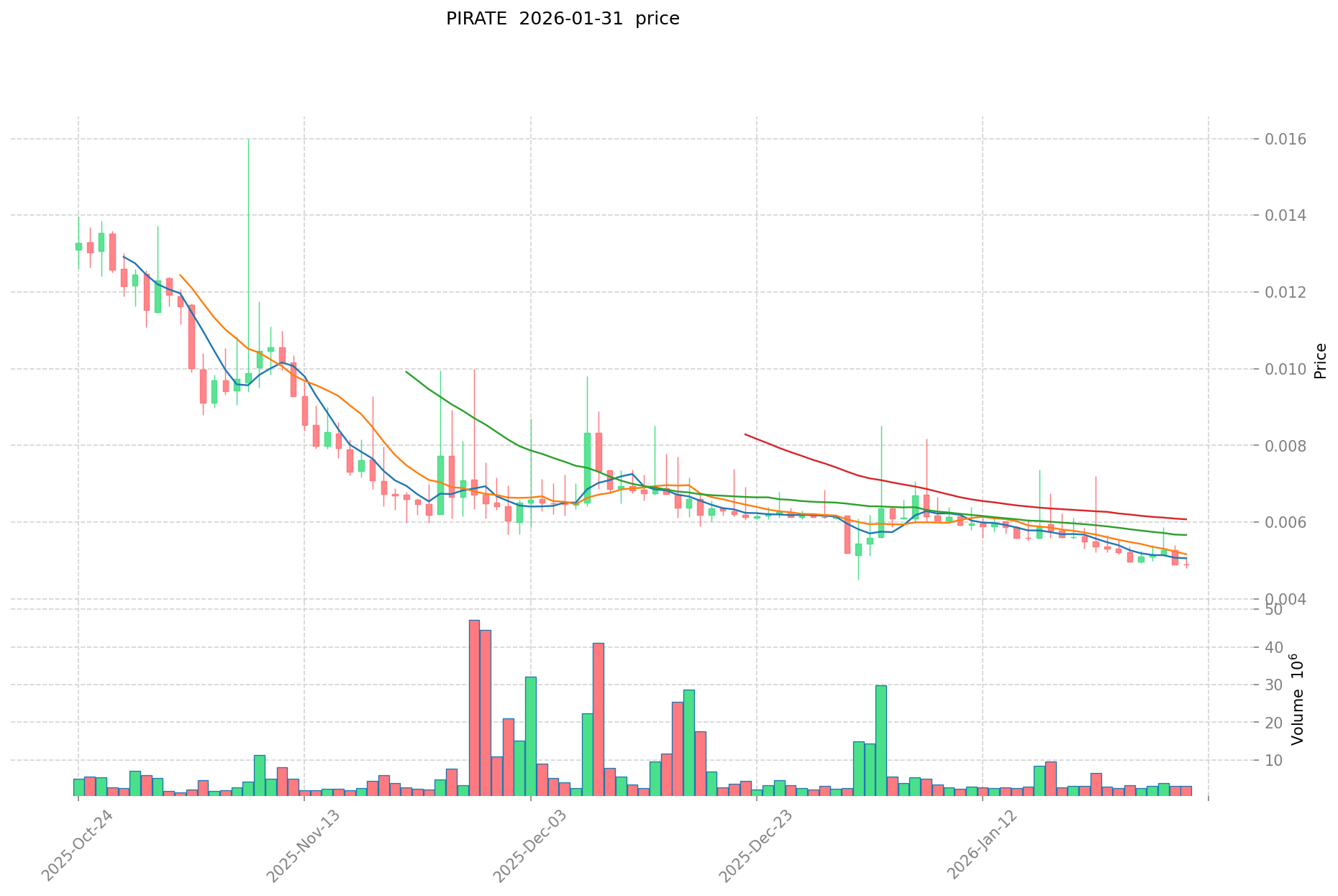
II. Core Factors Affecting Whether PIRATE is a Good Investment
Supply Mechanism and Scarcity (PIRATE Investment Scarcity)
- Fixed Maximum Supply: PIRATE has a maximum supply of 1,000,000,000 tokens, with a current circulating supply of 535,213,932 tokens (53.52% of total supply). This predetermined cap establishes a supply ceiling that may influence long-term value dynamics.
- Supply Distribution: With approximately 535 million tokens currently in circulation and a total supply of 1 billion tokens, the remaining non-circulating tokens represent potential future supply increases that investors should monitor.
- Investment Significance: The fixed supply structure provides a transparent framework for evaluating scarcity, though actual scarcity impact depends on demand dynamics and token utility adoption within the Pirate Nation ecosystem.
Institutional Investment and Mainstream Adoption (Institutional Investment in PIRATE)
- Holder Base: As of current data, PIRATE has 14,321 token holders, indicating a developing community base for the token.
- Exchange Availability: PIRATE is listed on 11 cryptocurrency exchanges, providing multiple access points for investors and contributing to liquidity considerations.
- Ecosystem Utility: The token serves as a utility token for Pirate Nation, with functionality on Ethereum that allows cross-chain execution on Proof of Play Apex, supporting low-gas transactions while maintaining supply on Ethereum mainnet.
Macroeconomic Environment's Impact on PIRATE Investment
- Market Positioning: PIRATE holds a market capitalization ranking of 1902 with a market share of 0.00016%, positioning it as a smaller-cap digital asset subject to broader crypto market conditions.
- Price Volatility: Recent performance shows mixed trends with a 24-hour increase of 1.34%, but declines of 7.9% over 7 days and 12.65% over 30 days, reflecting sensitivity to market sentiment.
- Broader Market Correlation: As a gaming-related utility token, PIRATE's investment appeal may be influenced by trends in blockchain gaming, general cryptocurrency market conditions, and investor appetite for utility-focused tokens.
Technology and Ecosystem Development (Technology & Ecosystem for PIRATE Investment)
- Cross-Chain Functionality: PIRATE implements cross-chain execution capabilities through Proof of Play Apex, enabling transactions across chains while maintaining token supply integrity on Ethereum mainnet, which may enhance operational efficiency.
- Ethereum Integration: The token operates on Ethereum as an ERC20 token (contract address: 0x7613C48E0cd50E42dD9Bf0f6c235063145f6f8DC), leveraging Ethereum's established infrastructure and security model.
- Gaming Ecosystem Application: PIRATE functions as a utility token within Pirate Nation, with its investment value potentially connected to the adoption and growth of the game's ecosystem and user engagement levels.
- Technical Infrastructure: The implementation of low-gas cross-chain purchasing mechanisms aims to reduce transaction friction, which could support broader utility adoption within the gaming platform.
III. PIRATE Future Investment Forecast and Price Outlook (Is Pirate Nation(PIRATE) worth investing in 2026-2031)
Short-term Investment Forecast (2026, short-term PIRATE investment outlook)
- Conservative forecast: $0.00368 - $0.00497
- Neutral forecast: $0.00497 - $0.00559
- Optimistic forecast: $0.00559 - $0.00621
Mid-term Investment Outlook (2027-2029, mid-term Pirate Nation(PIRATE) investment forecast)
- Market stage expectation: The token may experience gradual growth phases with potential fluctuations driven by utility adoption within the Pirate Nation ecosystem and broader market conditions.
- Investment return forecast:
- 2027: $0.00358 - $0.00760
- 2028: $0.00580 - $0.00890
- 2029: $0.00666 - $0.01038
- Key catalysts: Expansion of utility functions within Pirate Nation gaming ecosystem, cross-chain execution developments on Proof of Play Apex, and overall cryptocurrency market sentiment.
Long-term Investment Outlook (Is PIRATE a good long-term investment?)
- Base scenario: $0.00526 - $0.01006 (assuming steady ecosystem development and moderate market conditions through 2030)
- Optimistic scenario: $0.00889 - $0.01272 (assuming enhanced adoption of utility features and favorable market environment through 2031)
- Risk scenario: Below $0.00368 (under adverse market conditions or reduced ecosystem activity)
View PIRATE long-term investment and price forecast: Price Prediction
2026-01-31 - 2031 Long-term Outlook
- Base scenario: $0.00497 - $0.00906 USD (corresponding to steady progress and gradual mainstream application growth)
- Optimistic scenario: $0.00889 - $0.01272 USD (corresponding to large-scale adoption and favorable market environment)
- Transformative scenario: Above $0.01272 USD (if the ecosystem achieves breakthrough developments and mainstream adoption)
- 2031-12-31 predicted high: $0.01272 USD (based on optimistic development assumptions)
Disclaimer: Price forecasts are based on historical data analysis and market indicators. Cryptocurrency markets are highly volatile and subject to numerous unpredictable factors. These projections should not be considered as financial advice or guarantees of future performance. Investors should conduct their own research and assess their risk tolerance before making any investment decisions.
| Year |
Predicted High Price |
Predicted Average Price |
Predicted Low Price |
Price Change |
| 2026 |
0.00620875 |
0.004967 |
0.00367558 |
0 |
| 2027 |
0.00759951 |
0.005587875 |
0.00357624 |
12 |
| 2028 |
0.008901484875 |
0.0065936925 |
0.0058024494 |
32 |
| 2029 |
0.01038176884125 |
0.0077475886875 |
0.00666292627125 |
55 |
| 2030 |
0.010061793428456 |
0.009064678764375 |
0.005257513683337 |
82 |
| 2031 |
0.012719104008232 |
0.009563236096415 |
0.008893809569666 |
92 |
IV. PIRATE Investment Strategy and Risk Management (How to invest in Pirate Nation)
Investment Methodology (PIRATE investment strategy)
Long-term Holding (HODL PIRATE)
For conservative investors seeking steady exposure to blockchain gaming utility tokens, a long-term holding strategy may be considered. This approach involves:
- Acquiring PIRATE tokens during periods of relative price stability
- Storing tokens securely for extended periods while monitoring the development of Pirate Nation's ecosystem
- Evaluating the token's utility expansion within the gaming platform over time
Given PIRATE's role as a utility token within the Pirate Nation gaming ecosystem, long-term holders should focus on the game's user adoption metrics, ecosystem development, and cross-chain functionality improvements on Ethereum mainnet.
Active Trading
For traders with technical analysis capabilities, active trading strategies may involve:
- Monitoring price movements within the observed 24-hour range ($0.004799 - $0.005107)
- Utilizing technical indicators to identify potential entry and exit points
- Tracking trading volume patterns (current 24h volume: approximately $16,084)
- Considering the token's historical volatility, with recorded price movements ranging from $0.004501 to $0.6
Risk Management (Risk management for PIRATE investment)
Asset Allocation Ratios
- Conservative investors: Limit PIRATE exposure to less than 1-2% of total cryptocurrency portfolio
- Moderate investors: May consider 3-5% allocation as part of a diversified gaming token strategy
- Experienced investors: Could allocate up to 5-10% depending on risk tolerance and gaming sector thesis
Risk Hedging Approaches
- Diversify across multiple blockchain gaming tokens to reduce single-project exposure
- Maintain positions in established cryptocurrencies (BTC, ETH) as portfolio stabilizers
- Consider stablecoin reserves for opportunistic rebalancing during market volatility
- Monitor correlation with broader gaming token sector and adjust positions accordingly
Secure Storage Solutions
- Cold wallet storage: Hardware wallets supporting ERC-20 tokens (Ledger, Trezor) for long-term holdings
- Hot wallet storage: MetaMask or similar Ethereum-compatible wallets for active trading
- Multi-signature wallets: For larger holdings requiring enhanced security
- Regular security audits: Verify contract address (0x7613C48E0cd50E42dD9Bf0f6c235063145f6f8DC) before transactions
V. PIRATE Investment Risks and Challenges (Risks of investing in Pirate Nation)
Market Risks
- High volatility: PIRATE has experienced significant price fluctuations, with a decline of approximately 94.71% over one year
- Limited liquidity: With 24-hour trading volume around $16,084 and market capitalization of approximately $2.66 million, liquidity constraints may impact execution during volatile periods
- Price sensitivity: The token's relatively small market cap (ranking #1902) may increase susceptibility to large order impacts
- Market dominance: With only 0.00016% market share, PIRATE remains a minor player in the cryptocurrency ecosystem
Regulatory Risks
- Gaming token classification: Evolving regulatory frameworks for gaming-related tokens across different jurisdictions
- Securities law considerations: Potential regulatory scrutiny regarding token classification and utility claims
- Cross-border compliance: Uncertainty regarding international gaming and cryptocurrency regulations
- Platform regulatory exposure: Regulatory actions affecting blockchain gaming platforms may impact PIRATE utility
Technical Risks
- Smart contract vulnerabilities: ERC-20 token security depends on underlying contract integrity
- Cross-chain execution risks: The token's cross-chain functionality via Proof of Play Apex introduces additional technical complexity
- Network congestion: Ethereum mainnet congestion may affect transaction costs and execution speed
- Platform dependency: PIRATE utility is closely tied to Pirate Nation platform performance and adoption
- Upgrade failures: Technical issues during platform updates could temporarily affect token functionality
VI. Conclusion: Is Pirate Nation a Good Investment?
Investment Value Summary
PIRATE presents as a utility token within the blockchain gaming sector, with specific functionality tied to the Pirate Nation ecosystem. While the token offers cross-chain capabilities on Ethereum mainnet, it has experienced substantial price volatility, including a one-year decline of approximately 94.71%. The token's relatively small market capitalization ($2.66 million) and limited liquidity suggest higher risk compared to established cryptocurrencies. Long-term potential depends heavily on the adoption and success of the underlying Pirate Nation gaming platform.
Investor Recommendations
✅ Beginners:
- Consider starting with minimal exposure through dollar-cost averaging
- Prioritize secure storage using hardware wallets supporting ERC-20 tokens
- Thoroughly research the Pirate Nation gaming platform before investing
- Avoid allocating more than 1-2% of total portfolio to gaming utility tokens
✅ Experienced Investors:
- Employ tactical trading strategies based on technical analysis and gaming sector trends
- Diversify across multiple gaming tokens to mitigate single-project risk
- Monitor platform development updates and ecosystem growth metrics
- Consider position sizing relative to overall blockchain gaming sector allocation
✅ Institutional Investors:
- Evaluate PIRATE within broader blockchain gaming and metaverse investment thesis
- Conduct thorough due diligence on platform team, technology, and competitive positioning
- Consider strategic allocation only as part of diversified alternative asset portfolio
- Implement robust risk management frameworks given the token's volatility profile
⚠️ Disclaimer: Cryptocurrency investments carry substantial risk due to high volatility, regulatory uncertainty, and technological complexities. This content is provided for informational purposes only and does not constitute financial, investment, or legal advice. Conduct thorough independent research and consult qualified financial advisors before making investment decisions.
VII. FAQ
Q1: What is the current circulating supply of PIRATE tokens and how does it affect investment considerations?
PIRATE currently has a circulating supply of approximately 535.21 million tokens out of a maximum supply of 1 billion tokens, representing 53.52% of the total supply. This means nearly half of the total token supply has not yet entered circulation, which presents both opportunities and risks for investors. The remaining non-circulating tokens could create potential selling pressure if released into the market, potentially affecting price stability. Investors should monitor token unlock schedules and distribution plans, as the gradual release of the remaining 46.48% supply could impact the token's scarcity dynamics and valuation over time.
Q2: How does PIRATE's cross-chain functionality work and what benefits does it provide to investors?
PIRATE operates on Ethereum mainnet as an ERC-20 token but features cross-chain execution capabilities through Proof of Play Apex infrastructure. This functionality allows users to spend PIRATE across different blockchain networks while maintaining the token supply on Ethereum, enabling low-gas transactions without fragmenting the token supply across multiple chains. For investors, this technical architecture provides enhanced flexibility in utilizing the token within the gaming ecosystem while potentially reducing transaction costs. However, the cross-chain mechanism also introduces additional technical complexity that investors should understand, including potential smart contract risks and the dependency on the Proof of Play Apex infrastructure's continued operation and security.
Q3: Why has PIRATE experienced a 94.71% price decline over one year, and what does this indicate about investment risk?
PIRATE's significant price decline from its June 2024 high of $0.6 to the current level of approximately $0.004967 reflects several factors including broader cryptocurrency market conditions, gaming token sector sentiment, and the challenges of establishing utility token adoption within a competitive blockchain gaming landscape. This substantial decline indicates high volatility and considerable risk for potential investors. The price movement suggests that market enthusiasm has not yet translated into sustained valuation support, possibly due to slower-than-expected ecosystem adoption, limited liquidity, or unfavorable market conditions. This historical performance underscores the importance of careful risk assessment, appropriate position sizing, and recognition that utility tokens tied to specific gaming platforms carry execution risk related to the underlying platform's success.
Q4: What makes PIRATE different from other gaming utility tokens in terms of investment potential?
PIRATE distinguishes itself through its integration with the Pirate Nation gaming ecosystem and its cross-chain execution capabilities on Ethereum mainnet. Unlike many gaming tokens that exist solely on a single blockchain, PIRATE maintains supply integrity on Ethereum while enabling low-gas cross-chain transactions through Proof of Play Apex. This technical approach aims to balance security with operational efficiency. However, PIRATE's investment potential remains heavily dependent on the success and adoption of the Pirate Nation gaming platform itself. With a relatively small holder base of 14,321 addresses and limited market capitalization of $2.66 million, PIRATE remains an early-stage gaming utility token where investment outcomes are closely tied to platform development, user acquisition, and the broader evolution of blockchain gaming adoption rather than established network effects or widespread mainstream recognition.
Q5: What are the key metrics investors should monitor to evaluate PIRATE's investment prospects?
Investors evaluating PIRATE should focus on several key metrics: (1) Token holder growth beyond the current 14,321 addresses, indicating expanding community adoption; (2) Trading volume trends relative to the current 24-hour volume of approximately $16,084, as increased volume may suggest growing interest and improved liquidity; (3) Pirate Nation platform user engagement metrics and active player counts, which directly influence token utility demand; (4) Token unlock schedules and distribution plans for the remaining 46.48% non-circulating supply; and (5) Development milestones related to cross-chain functionality and ecosystem expansion. Additionally, monitoring the token's correlation with broader gaming token sector performance and general cryptocurrency market sentiment can provide context for price movements. Given PIRATE's current market ranking of #1902 and 0.00016% market share, these metrics are crucial for assessing whether the project is gaining traction or facing persistent adoption challenges.
Q6: Is PIRATE suitable as a long-term investment compared to short-term trading?
PIRATE's suitability as a long-term versus short-term investment depends on individual risk tolerance and investment objectives. For long-term holding, investors must have conviction in the Pirate Nation gaming platform's ability to attract and retain users, expand its ecosystem, and drive sustained token utility demand over multiple years. The fixed supply cap of 1 billion tokens provides transparency, but the token's success ultimately depends on platform adoption rather than scarcity alone. The significant 94.71% one-year price decline suggests considerable long-term risk that requires careful evaluation. For short-term trading, PIRATE exhibits price volatility that may present opportunities for experienced traders using technical analysis, though limited liquidity (24-hour volume around $16,084) can create execution challenges. Conservative investors might find the risk-reward profile more favorable in established cryptocurrencies, while those specifically bullish on blockchain gaming and willing to accept high risk might consider PIRATE as a small speculative allocation, ideally not exceeding 1-5% of a diversified cryptocurrency portfolio depending on experience level.
Q7: What security considerations should investors be aware of when holding PIRATE tokens?
Investors holding PIRATE tokens should prioritize several security considerations. First, verify transactions using the correct ERC-20 contract address (0x7613C48E0cd50E42dD9Bf0f6c235063145f6f8DC) to avoid scam tokens or phishing attempts. For long-term storage, hardware wallets supporting ERC-20 tokens (such as Ledger or Trezor) provide enhanced security compared to exchange-held or software wallets. Investors actively trading should use reputable Ethereum-compatible wallets like MetaMask while implementing strong security practices including two-factor authentication and secure password management. Given PIRATE's cross-chain functionality through Proof of Play Apex, investors should understand the additional smart contract risks associated with cross-chain execution mechanisms. Regularly monitoring the token's official channels for security updates and being cautious of social media scams targeting gaming token communities are also important. For larger holdings, multi-signature wallet configurations can provide additional security layers, requiring multiple approvals for transactions and reducing single-point-of-failure risks.
Q8: How might regulatory developments affect PIRATE as an investment?
Regulatory developments pose significant considerations for PIRATE investment. As a gaming utility token, PIRATE operates in an evolving regulatory environment where classifications of gaming tokens, virtual assets, and their securities status remain subject to interpretation across different jurisdictions. Regulatory actions targeting blockchain gaming platforms or utility token offerings could impact PIRATE's functionality, trading availability, or market access in certain regions. The token's cross-chain capabilities and its use within the Pirate Nation gaming ecosystem may attract regulatory scrutiny regarding consumer protection, gaming laws, and cryptocurrency regulations. Investors should monitor regulatory developments in major markets including the United States, European Union, and Asia-Pacific regions, as regulatory clarity or restrictions could significantly influence PIRATE's adoption potential and investment viability. The relatively small market capitalization and early-stage status mean PIRATE is less likely to be an immediate regulatory focus compared to larger tokens, but broader gaming token sector regulations could still impact its long-term prospects. Diversification across multiple jurisdictions and maintaining awareness of evolving regulatory frameworks can help investors manage this risk dimension.
* The information is not intended to be and does not constitute financial advice or any other recommendation of any sort offered or endorsed by Gate.