This comprehensive analysis examines whether Pitbull (PIT), a community-driven cryptocurrency launched on March 17, 2021, represents a viable investment opportunity. Operating on Binance Smart Chain with over 525,000 holders and a market cap of approximately $8.4 million, PIT features a reflection mechanism providing passive rewards to token holders. The article evaluates historical price performance from its August 2021 peak of $0.000000150393 to the current price of $0.0000000002165, while providing price forecasts through 2031 across conservative, neutral, and optimistic scenarios. For prospective investors, the analysis presents tailored strategies for beginners, experienced traders, and institutions, alongside detailed risk management approaches and security considerations. Available on Gate and select exchanges, PIT demonstrates characteristics typical of small-cap assets with significant volatility and limited liquidity, requiring careful portfolio positioning and thorough due diligence before investme
Introduction: Pitbull (PIT) Investment Position and Market Prospects
PIT is a cryptocurrency asset in the digital currency field. Launched in March 2021, it has developed as a community-driven project with holding reward features. As of January 2026, Pitbull has a market capitalization of approximately 8.4 million USD, with a circulating supply of around 38.8 trillion tokens, and the current price is maintained at approximately 0.0000000002165 USD. Positioned as a community-driven cryptocurrency with holding interest generation characteristics, PIT has attracted attention from investors discussing "Is Pitbull (PIT) a good investment?" This article will comprehensively analyze the investment value, historical trends, future price predictions, and investment risks of Pitbull, providing reference for investors.
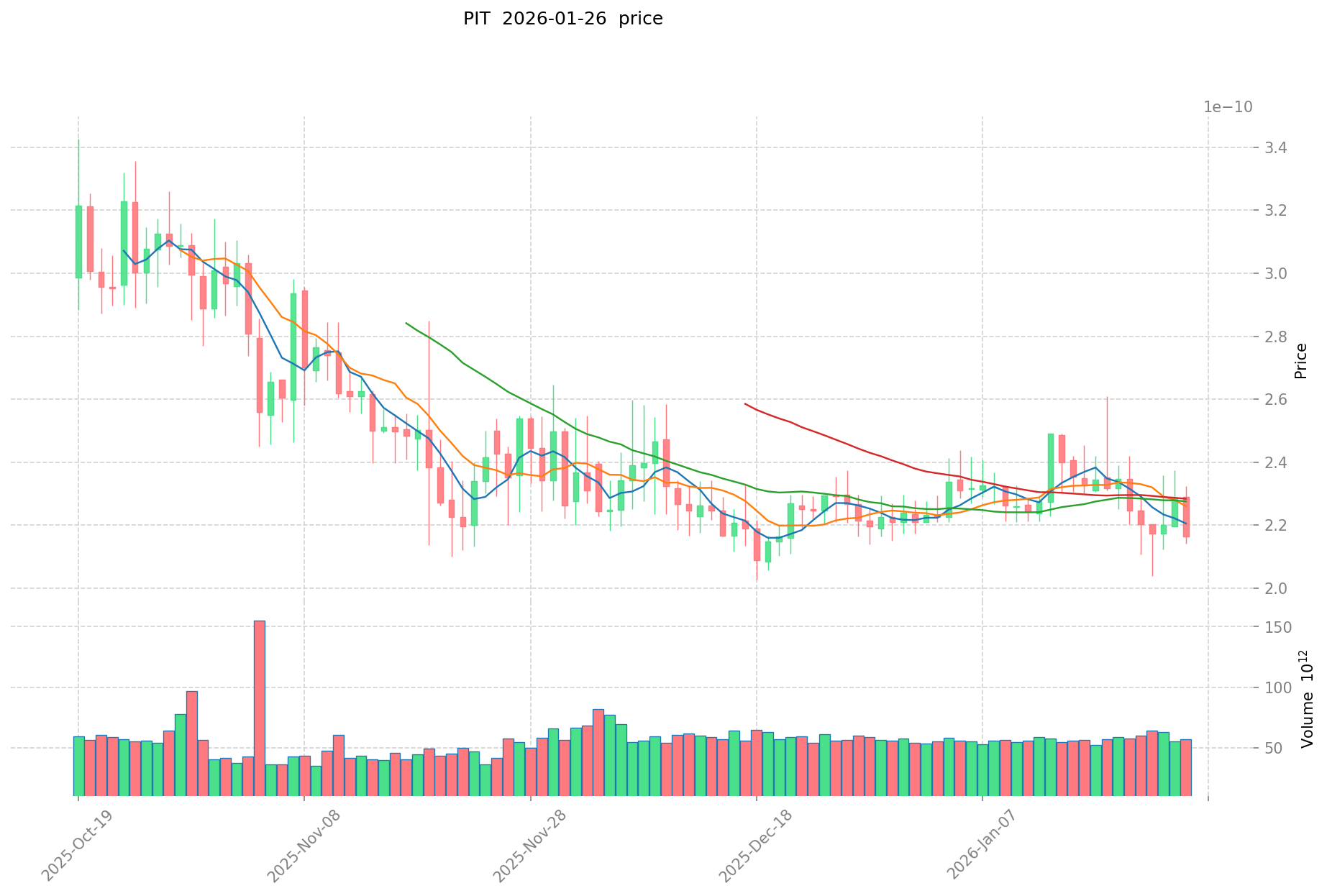
Pitbull operates on the BSC chain and was released on March 17, 2021. The project has been continuously built and improved by volunteers within the community since its establishment. With over 525,000 holders and a market share of 0.00026%, PIT represents a decentralized community governance model. The project's smart contract has no owner, as ownership was transferred to the community at the time of creation, making it a fully community-driven initiative. Recent price performance shows a 24-hour change of 0.13%, a 7-day change of -7.68%, and a 1-year change of -26.59%, reflecting the volatility characteristics of cryptocurrency markets.
I. Pitbull (PIT) Price History Review and Investment Value Status
- 2021: Launch on Binance Smart Chain (March 17) → Early community-driven growth phase initiated
- 2021: Price reached $0.000000150393 (August 18) → Significant volatility observed during initial market cycle
- 2021-2025: Market correction and consolidation → Price fluctuated from peak levels to $0.0000000002165 range
Current PIT Investment Market Status (January 2026)
- PIT current price: $0.0000000002165
- 24-hour trading volume: $12,388.38
- Market capitalization: $8,399,505.01
- Circulating supply: 38,796,789,872,756,800 PIT
- Total supply: 38,796,789,872,756,800 PIT
- Maximum supply: 100,000,000,000,000,000 PIT
- Token holders: 525,809 addresses
- Price changes: +0.13% (24H), -7.68% (7D), -2.35% (30D), -26.59% (1Y)
- Market ranking: #1290
- Contract address: 0xA57ac35CE91Ee92CaEfAA8dc04140C8e232c2E50 (BSC)
Click to view real-time PIT market price
II. Core Factors Influencing Whether PIT is a Good Investment (Is Pitbull(PIT) a Good Investment)
Supply Mechanism and Scarcity (PIT Investment Scarcity)
- Maximum supply: 100,000,000,000,000,000 PIT, with a current circulating supply of approximately 38.8% (38,796,789,872,756,800 PIT) → influences price dynamics and investment considerations
- Historical context: PIT recorded a notable price level of $0.000000150393 in August 2021, reflecting periods of market activity
- Investment perspective: The token's supply structure and circulation ratio may contribute to discussions around long-term scarcity considerations
Institutional Investment and Mainstream Adoption (Institutional Investment in PIT)
- Community-driven model: PIT operates as a 100% community-driven project with no central ownership, as ownership was transferred to the community upon creation
- Holder base: Approximately 525,809 holders participate in the PIT ecosystem
- Exchange presence: Listed on 4 exchanges, indicating a level of market accessibility
Macroeconomic Environment's Impact on PIT Investment
- Market positioning: With a market capitalization of approximately $8.4 million and a market dominance of 0.00026%, PIT represents a small-cap cryptocurrency asset
- Volatility characteristics: Recent price changes show fluctuations across different timeframes (1H: -0.27%, 24H: +0.13%, 7D: -7.68%, 30D: -2.35%, 1Y: -26.59%), reflecting sensitivity to broader market conditions
- Risk profile: As a community-driven token with significant price volatility, macroeconomic factors may influence investor sentiment and participation levels
Technology and Ecosystem Development (Technology & Ecosystem for PIT Investment)
- Core feature: PIT incorporates a holding reward mechanism, where token holders may receive benefits through participation
- Blockchain infrastructure: Deployed on the Binance Smart Chain (BSC) with contract address 0xA57ac35CE91Ee92CaEfAA8dc04140C8e232c2E50
- Ecosystem activities: Community volunteers, including designers, developers, marketers, and data analysts, contribute to ongoing project development
- Application expansion: The project has explored staking features and NFT-related initiatives as part of its ecosystem development efforts
III. PIT Future Investment Forecast and Price Outlook (Is Pitbull (PIT) worth investing in 2026-2031)
Short-term Investment Forecast (2026, short-term PIT investment outlook)
- Conservative forecast: $0.000000000119405 - $0.0000000002171
- Neutral forecast: $0.0000000002171 - $0.000000000230
- Optimistic forecast: $0.000000000230 - $0.000000000245323
Mid-term Investment Outlook (2027-2028, mid-term Pitbull (PIT) investment forecast)
- Market phase expectation: PIT may experience gradual growth during 2027-2028, with average prices potentially ranging from $0.000000000231211 to $0.000000000261269.
- Return on investment forecast:
- 2027: $0.000000000215026 - $0.000000000291326
- 2028: $0.000000000248205 - $0.000000000316135
- Key catalysts: Community-driven development initiatives, market sentiment shifts, and broader adoption within the BSC ecosystem.
Long-term Investment Outlook (Is PIT a good long-term investment?)
- Base scenario: $0.000000000262719 - $0.000000000355103 (assumes steady community engagement and moderate market conditions through 2029-2030)
- Optimistic scenario: $0.000000000421505 - $0.000000000522002 (assumes enhanced community growth, favorable market conditions, and increased trading activity)
- Risk scenario: Below $0.000000000191755 (under unfavorable market conditions or reduced community participation)
Check PIT long-term investment and price prediction: Price Prediction
2026-01-27 - 2031 Long-term Outlook
- Base scenario: $0.000000000191755 - $0.000000000355103 (corresponding to steady progress and gradual mainstream application growth)
- Optimistic scenario: $0.000000000421505 - $0.000000000522002 (corresponding to large-scale adoption and favorable market environment)
- Transformative scenario: Above $0.000000000522002 (if ecosystem achieves breakthrough developments and mainstream adoption)
- 2031-12-31 forecast high: $0.000000000464866 (based on optimistic development assumptions)
Disclaimer: The above forecasts are based on historical data and market analysis models, and do not constitute investment advice. Cryptocurrency markets are highly volatile, and actual prices may differ significantly from predictions. Investors should conduct thorough research and consider their risk tolerance before making investment decisions.
| Year |
Predicted High Price |
Predicted Average Price |
Predicted Low Price |
Price Change |
| 2026 |
0.000000000245323 |
0.0000000002171 |
0.000000000119405 |
0 |
| 2027 |
0.000000000291326 |
0.000000000231211 |
0.000000000215026 |
6 |
| 2028 |
0.000000000316135 |
0.000000000261269 |
0.000000000248205 |
20 |
| 2029 |
0.000000000421505 |
0.000000000288702 |
0.000000000262719 |
33 |
| 2030 |
0.000000000522002 |
0.000000000355103 |
0.000000000191755 |
64 |
| 2031 |
0.000000000464866 |
0.000000000438553 |
0.000000000425396 |
102 |
IV. Pitbull Investment Strategy and Risk Management (How to invest in Pitbull)
Investment Methodology (Pitbull investment strategy)
Long-term Holding (HODL Pitbull)
For conservative investors seeking steady approaches, long-term holding represents a strategy that aligns with Pitbull's community-driven nature. Given that PIT implements a reflection mechanism where holders earn passive rewards, extended holding periods may allow investors to benefit from token redistribution over time. This approach minimizes transaction costs and reduces exposure to short-term price fluctuations.
Active Trading
Active trading strategies rely on technical analysis and swing trading techniques. Given Pitbull's price volatility, traders may identify entry and exit points through chart patterns, volume analysis, and momentum indicators. However, this approach requires continuous market monitoring and understanding of cryptocurrency market dynamics.
Risk Management (Risk management for Pitbull investment)
Asset Allocation Ratios
- Conservative Investors: Allocate 1-3% of crypto portfolio to Pitbull, maintaining larger positions in established cryptocurrencies
- Aggressive Investors: May consider 5-10% allocation, accepting higher risk for potential returns
- Professional Investors: Implement dynamic allocation based on market conditions and portfolio rebalancing strategies
Risk Hedging Solutions
Diversified asset portfolios can mitigate concentration risk. Investors may consider combining Pitbull with other cryptocurrency categories, including established coins and stablecoins. Portfolio diversification across different blockchain ecosystems can reduce exposure to BSC-specific risks.
Secure Storage
Cold Wallet Storage: For long-term holdings, hardware wallets provide enhanced security by keeping private keys offline. Options include devices specifically compatible with BSC tokens.
Hot Wallet Considerations: For active trading, reputable software wallets supporting BSC network offer convenience while maintaining reasonable security standards. Enable multi-factor authentication and regularly update wallet software.
V. Pitbull Investment Risks and Challenges (Risks of investing in Pitbull)
Market Risk
High Volatility: Pitbull's price data shows significant fluctuations, with 7-day changes reaching -7.68% and 1-year changes of -26.59%. The current price of $0.0000000002165 demonstrates substantial volatility potential. Small-cap cryptocurrencies typically experience amplified price movements compared to established assets.
Liquidity Considerations: With a 24-hour trading volume of approximately $12,388 and market capitalization around $8.4 million, Pitbull operates in a relatively limited liquidity environment. This may result in larger price impacts from individual transactions.
Regulatory Risk
Cryptocurrency regulations vary significantly across jurisdictions. Community-driven tokens without centralized ownership may face uncertain regulatory classification in different countries. Potential regulatory developments could impact token accessibility, trading venues, and compliance requirements.
Technical Risk
Smart Contract Vulnerabilities: While Pitbull's contract ownership was transferred to the community at creation, smart contract code remains subject to potential security vulnerabilities. Investors should recognize that contract immutability prevents certain upgrades or fixes.
Network Dependencies: As a BSC-based token, Pitbull relies on Binance Smart Chain infrastructure. Network congestion, technical issues, or changes to the underlying blockchain could affect token functionality.
Community Governance: The 100% community-driven model, while promoting decentralization, may present coordination challenges for protocol improvements or emergency responses to technical issues.
VI. Conclusion: Is Pitbull a Good Investment?
Investment Value Summary
Pitbull presents characteristics of a community-driven cryptocurrency project with reflection tokenomics. The project's value proposition centers on its decentralized governance structure and holder reward mechanism. However, its market performance shows considerable price fluctuations, with the current price substantially below its historical peak from August 2021. The token's market capitalization ranking of 1290 and relatively low trading volume indicate its position as a small-cap cryptocurrency asset.
Investor Recommendations
✅ Beginners: Consider dollar-cost averaging strategies with very small allocations. Prioritize learning secure wallet storage practices, particularly hardware wallets compatible with BSC network. Understand that community-driven tokens carry distinct risks compared to established cryptocurrencies.
✅ Experienced Investors: May explore swing trading opportunities based on technical analysis, while maintaining strict position sizing relative to overall portfolio. Consider Pitbull as a speculative allocation within a diversified cryptocurrency portfolio.
✅ Institutional Investors: Evaluate Pitbull within the context of community-governed token models and DeFi ecosystem trends. Implement comprehensive due diligence regarding smart contract security, liquidity conditions, and community sustainability.
⚠️ Disclaimer: Cryptocurrency investments involve substantial risk. Market volatility can result in significant value fluctuations. This content serves informational purposes only and does not constitute investment advice. Investors should conduct independent research and consider their risk tolerance before making investment decisions.
VII. FAQ
Q1: What is Pitbull (PIT) and how does its holding reward mechanism work?
Pitbull is a community-driven cryptocurrency launched on March 17, 2021, operating on the Binance Smart Chain (BSC). The token features a reflection mechanism where holders automatically receive passive rewards through token redistribution. When transactions occur, a portion is redistributed to existing holders proportionally, incentivizing long-term holding behavior. The project operates with 100% community governance, as ownership was transferred to the community at creation, making it a fully decentralized initiative with no central authority. With over 525,000 holders and a contract address of 0xA57ac35CE91Ee92CaEfAA8dc04140C8e232c2E50, PIT represents a community-governed token model in the cryptocurrency ecosystem.
Q2: What are the primary risks associated with investing in Pitbull?
The main risks include extreme price volatility, limited liquidity, and market capitalization concerns. Pitbull's current price of $0.0000000002165 shows significant fluctuations with a 1-year decline of -26.59% and 7-day change of -7.68%. With a 24-hour trading volume of approximately $12,388 and market capitalization around $8.4 million, the token operates in a relatively constrained liquidity environment, which can lead to substantial price impacts from individual transactions. Additional risks include regulatory uncertainty surrounding community-driven tokens, smart contract vulnerabilities inherent to immutable code, and dependency on Binance Smart Chain infrastructure. The token's ranking at position 1290 with 0.00026% market dominance further emphasizes its classification as a high-risk, small-cap cryptocurrency asset.
Q3: How does Pitbull's current market position compare to its historical performance?
Pitbull experienced its peak price of $0.000000150393 in August 2021, approximately five months after launch. Since then, the token has undergone significant market correction, with the current price of $0.0000000002165 representing a substantial decline from historical highs. The circulating supply stands at approximately 38.8 trillion tokens (38,796,789,872,756,800 PIT) out of a maximum supply of 100 quadrillion tokens. Despite the price decline, the holder base has expanded to over 525,000 addresses, indicating continued community participation. The 24-hour trading volume of $12,388.38 and market capitalization of approximately $8.4 million position PIT as a micro-cap asset within the cryptocurrency market, reflecting both the challenges and speculative nature characteristic of community-driven tokens in evolving market conditions.
Q4: What are the price predictions for Pitbull from 2026 to 2031?
Short-term forecasts for 2026 suggest a conservative range of $0.000000000119405 to $0.0000000002171, with optimistic scenarios reaching $0.000000000245323. Mid-term projections for 2027-2028 indicate potential gradual growth, with average prices ranging from $0.000000000231211 to $0.000000000261269. Long-term outlooks through 2031 vary significantly based on adoption scenarios: base scenarios project $0.000000000191755 to $0.000000000355103, while optimistic scenarios anticipate $0.000000000421505 to $0.000000000522002, assuming enhanced community growth and favorable market conditions. The 2031 predicted high reaches $0.000000000464866 under optimistic development assumptions. However, these forecasts are based on historical data and analytical models and do not constitute investment advice, as actual prices may differ substantially due to cryptocurrency market volatility.
Q5: What investment strategies are suitable for different types of Pitbull investors?
For conservative investors, long-term holding (HODL) strategies align with Pitbull's reflection mechanism, allowing accumulation of passive rewards through token redistribution while minimizing transaction costs. Recommended allocation is 1-3% of a cryptocurrency portfolio. Aggressive investors may consider 5-10% allocation with active trading approaches utilizing technical analysis, swing trading techniques, and momentum indicators to capitalize on price volatility. Professional investors should implement dynamic allocation with comprehensive due diligence regarding smart contract security and community sustainability. All investment approaches require secure storage solutions: cold wallets (hardware wallets compatible with BSC) for long-term holdings, and reputable hot wallets with multi-factor authentication for active trading. Dollar-cost averaging strategies are particularly appropriate for beginners exploring community-driven tokens while managing exposure to volatility.
Q6: How does Pitbull's community-driven governance model affect its investment profile?
Pitbull's 100% community-driven governance structure, where ownership was transferred to the community at creation, presents both opportunities and challenges for investors. The decentralized model eliminates central authority concerns but may result in coordination challenges for protocol improvements or emergency responses. Community volunteers including designers, developers, marketers, and data analysts contribute to ongoing project development, demonstrating grassroots engagement. However, the absence of centralized decision-making mechanisms can affect response times to technical issues or market opportunities. The smart contract's immutability prevents certain upgrades or fixes, requiring investors to recognize that community consensus processes may differ from traditional corporate governance structures. This governance model attracts investors prioritizing decentralization principles while requiring acceptance of unique operational dynamics inherent to community-governed cryptocurrency projects.
Q7: What security considerations should investors evaluate before purchasing Pitbull?
Investors should implement multiple security layers when engaging with Pitbull. First, verify the official contract address (0xA57ac35CE91Ee92CaEfAA8dc04140C8e232c2E50) on BSC before transactions to avoid scam tokens with similar names. Second, utilize hardware wallets for long-term storage, as these devices keep private keys offline and provide enhanced security against online threats. For active trading, employ reputable software wallets supporting BSC network with enabled multi-factor authentication and regular software updates. Third, recognize that smart contract vulnerabilities represent inherent risks in decentralized protocols, and while Pitbull's contract has operated since March 2021, immutable code cannot be modified to address potential security issues. Finally, practice proper operational security by avoiding public WiFi for transactions, maintaining separate wallets for different purposes, and conducting thorough research on exchange platforms before trading PIT tokens.
Q8: What factors could influence Pitbull's future adoption and market performance?
Several factors may impact Pitbull's trajectory through 2026-2031. Community engagement sustainability remains critical, as the project's development relies on volunteer contributions from designers, developers, and marketers. Broader cryptocurrency market conditions significantly affect small-cap tokens like PIT, with bull markets potentially amplifying gains and bear markets intensifying declines. Technological developments within the Binance Smart Chain ecosystem, including network upgrades or fee structure changes, directly impact PIT functionality and accessibility. Regulatory developments concerning community-driven tokens across different jurisdictions may affect trading availability and compliance requirements. The project's ability to expand utility through staking features, NFT initiatives, and ecosystem partnerships could drive adoption. Finally, macroeconomic factors including monetary policy shifts, institutional cryptocurrency adoption trends, and competing blockchain platforms influence investor sentiment toward speculative assets like Pitbull, contributing to the projected price ranges varying significantly across different market scenarios.
* The information is not intended to be and does not constitute financial advice or any other recommendation of any sort offered or endorsed by Gate.