This comprehensive analysis examines PixelVerse (PIXEL), a Web3 gaming token on the Ronin Network, to determine its investment viability. The article evaluates PIXEL's market position with a $6.07M market cap and $0.007875 current price, analyzing historical performance showing a 92.94% decline since launch. It explores core investment factors including supply mechanics, ecosystem development, and macroeconomic impacts. The guide presents price projections ranging from conservative ($0.00424) to optimistic ($0.2036) scenarios through 2031. Investment strategies cover long-term holding and active trading approaches, with risk management guidance for different investor types. Readers gain insights into market risks, regulatory uncertainties, and technical vulnerabilities, enabling informed decision-making on PIXEL as a gaming sector investment opportunity on Gate and other platforms.
Introduction: PixelVerse (PIXEL) Investment Status and Market Outlook
PIXEL is a notable asset in the cryptocurrency sector, having been launched in 2024 as part of the web3 gaming ecosystem. As of January 28, 2026, PixelVerse maintains a market capitalization of approximately $6.07 million, with a circulating supply of around 771 million tokens and a current trading price near $0.007875. Positioned as a social casual web3 game powered by the Ronin Network, PIXEL has developed around farming, exploration, and creation-based gameplay mechanics. With its market share at 0.0012% and availability across 33 exchanges, PIXEL has become a focal point when investors examine "Is PixelVerse (PIXEL) a good investment?" This article provides a comprehensive analysis of PIXEL's investment characteristics, historical price movements, future price projections, and associated investment risks to serve as reference material for market participants.
I. PixelVerse (PIXEL) Price History Review and Current Investment Value
- 2024: Token launched in February at $0.44 → Price reached $2.2908 later in the month
- 2025: Market experienced significant correction → Price declined from previous levels to $0.00637
- 2026: Trading in range between $0.00772 and $0.008027 over recent 24-hour period
Current PIXEL Investment Market Status (January 2026)
- PIXEL current price: $0.007875
- 24-hour trading volume: $121,055.26
- Circulating supply: 771,041,667 PIXEL
- Market capitalization: $6,071,953.13
- Trading on 33 exchanges with 6,332 holders
Click to view real-time PIXEL market price
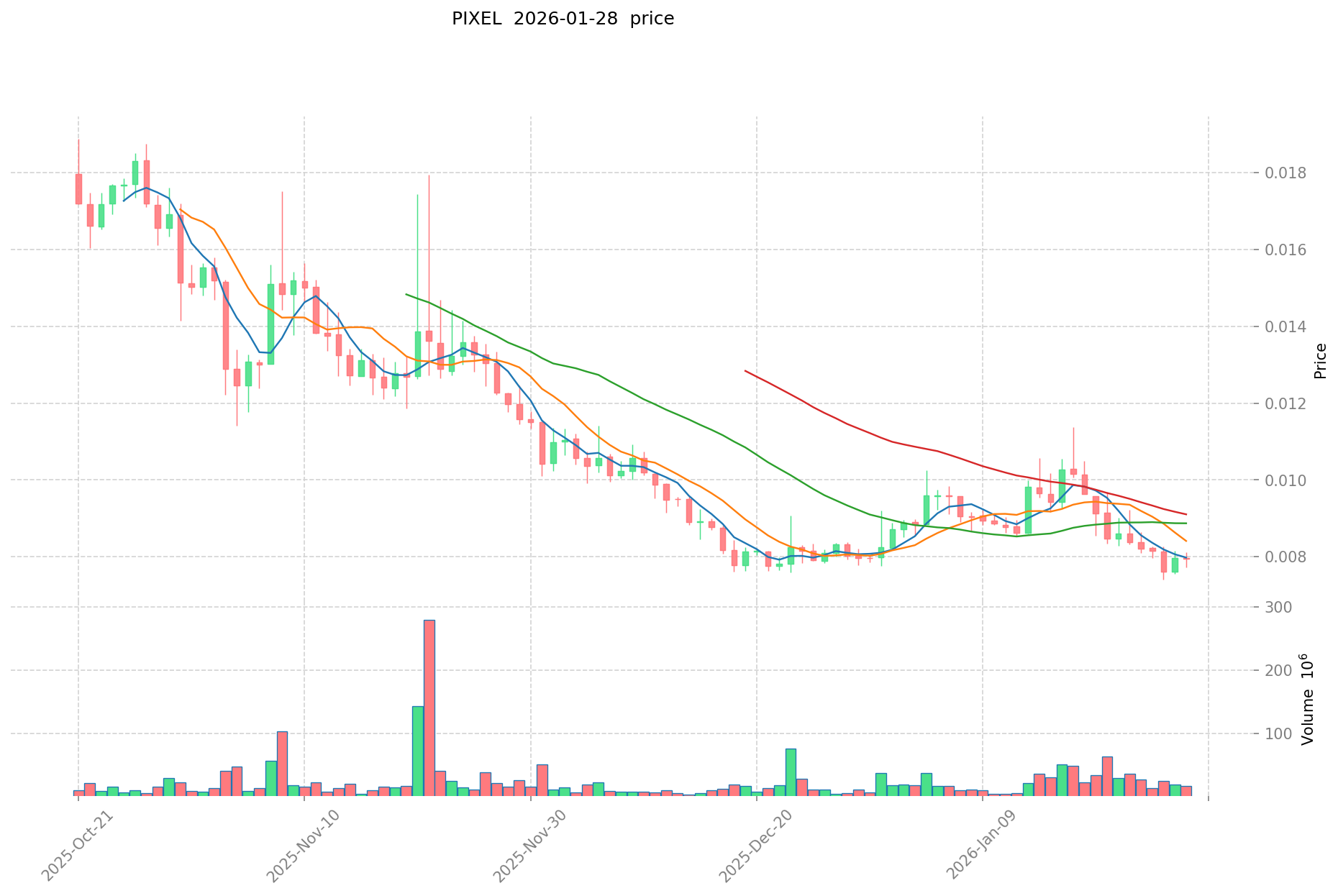
II. Core Factors Influencing Whether PIXEL is a Good Investment
Supply Mechanism and Scarcity (PIXEL Investment Scarcity)
- Total Supply Structure → PixelVerse (PIXEL) has established a maximum supply cap of 5,000,000,000 tokens, with approximately 771,041,667 tokens currently in circulation, representing a circulating ratio of about 15.42%. This controlled supply structure may contribute to potential scarcity dynamics.
- Token Burning Mechanism → According to reference materials, the network implements a burning mechanism for the majority of daily treasury proceeds generated through in-game purchases. This deflationary approach aims to maintain token scarcity and support price stability over time.
- Investment Significance → The combination of capped maximum supply and active burning mechanism could create a foundation for long-term value consideration, though actual market performance depends on multiple factors including demand dynamics and ecosystem development.
Macroeconomic Environment's Impact on PIXEL Investment
- Blockchain Gaming Sector Dynamics → Reference materials indicate that PIXEL, along with other blockchain gaming tokens, has experienced price fluctuations reflecting broader sector trends. The token's performance may be influenced by the overall sentiment and investment flows within the blockchain gaming and Web3 entertainment space.
- Market Correlation → As a gaming-focused digital asset, PIXEL's investment profile may respond to changes in risk appetite among digital asset investors, particularly those interested in the intersection of gaming and blockchain technology.
Technology and Ecosystem Development (Technology & Ecosystem for PIXEL Investment)
- Multi-Chain Infrastructure → PIXEL operates across multiple blockchain networks, with contract addresses deployed on both Ethereum (ETH) and Ronin (RON) chains. This multi-chain presence may provide broader accessibility and integration opportunities within different blockchain ecosystems.
- Gaming Ecosystem Foundation → Pixels is described as a social casual Web3 game powered by the Ronin Network, featuring an open-world experience centered around farming, exploration, and creation. The project's gaming ecosystem development and user engagement levels could influence its long-term investment value proposition.
- In-Game Economy Integration → The token serves as part of the in-game economic system, with purchases contributing to the treasury and burning mechanism. The sustainability and growth of this gaming economy may be relevant factors for evaluating investment potential.
III. PIXEL Future Investment Prediction and Price Outlook (Is PixelVerse(PIXEL) worth investing in 2026-2031)
Short-term Investment Prediction (2026, short-term PIXEL investment outlook)
Based on statistical modeling and market analysis, PIXEL may demonstrate varied performance trajectories in 2026:
- Conservative Prediction: $0.00424 - $0.00786
- Neutral Prediction: $0.00786 - $0.01155
- Optimistic Prediction: $0.1666 - $0.2036
The wide range reflects differing analytical approaches, with technical models suggesting trading between $0.1666 and $0.2036, while conservative estimates indicate potential consolidation near current levels.
Mid-term Investment Outlook (2027-2029, mid-term PixelVerse(PIXEL) investment forecast)
- Market Stage Expectation: Potential gradual value appreciation as the gaming ecosystem continues development and user adoption progresses within the Ronin Network framework
- Investment Return Prediction:
- 2027: $0.0051 - $0.0130 (representing approximately 23% potential growth from 2026 baseline)
- 2028: $0.0086 - $0.0125 (indicating approximately 44% potential growth from 2026 baseline)
- 2029: $0.0103 - $0.0163 (suggesting approximately 51% potential growth from 2026 baseline)
- Key Catalysts: Web3 gaming sector development, Ronin Network infrastructure enhancements, player engagement metrics, and broader blockchain gaming adoption trends
Long-term Investment Outlook (Is PIXEL a good long-term investment?)
Long-term projections through 2031 present multiple scenarios based on varying market conditions and ecosystem development trajectories:
- Baseline Scenario: $0.013 - $0.0169 (assuming steady ecosystem growth and sustained user engagement)
- Optimistic Scenario: $0.0174 - $0.0255 (contingent upon accelerated adoption and favorable market conditions)
- Risk Scenario: Below $0.005 (under conditions of reduced player activity or challenging market environments)
View PIXEL long-term investment and price prediction: Price Prediction
2026-2031 Long-term Outlook
- Base Scenario: $0.00424 - $0.0169 USD (corresponding to steady progress and gradual mainstream application growth)
- Optimistic Scenario: $0.0174 - $0.0255 USD (corresponding to large-scale adoption and favorable market environment)
- Transformative Scenario: Above $0.0255 USD (in case of breakthrough ecosystem developments and mainstream penetration)
- 2031-12-31 Predicted High: $0.0255 USD (based on optimistic development assumptions)
Disclaimer: These predictions are based on historical patterns, statistical models, and current market trends. Cryptocurrency markets remain highly volatile and subject to numerous external factors including regulatory developments, technological changes, and broader market dynamics. Past performance does not guarantee future results. Projections should not be construed as investment advice, and investors should conduct their own research and consider their risk tolerance before making investment decisions.
| Year |
Predicted High Price |
Predicted Average Price |
Predicted Low Price |
Price Change |
| 2026 |
0.01155126 |
0.007858 |
0.00424332 |
0 |
| 2027 |
0.0130042042 |
0.00970463 |
0.0051434539 |
23 |
| 2028 |
0.01248985881 |
0.0113544171 |
0.008629356996 |
44 |
| 2029 |
0.01633332899835 |
0.011922137955 |
0.0102530386413 |
51 |
| 2030 |
0.020626490875945 |
0.014127733476675 |
0.012997514798541 |
79 |
| 2031 |
0.025544354899176 |
0.01737711217631 |
0.01685579881102 |
120 |
IV. PixelVerse (PIXEL) Investment Strategy and Risk Management (How to invest in gaming tokens)
Investment Methodology (PIXEL investment strategy)
Long-term Holding (HODL PIXEL): Suitable for conservative investors
Long-term holding strategies involve acquiring PIXEL tokens and maintaining positions over extended periods, regardless of short-term price fluctuations. This approach may be appropriate for investors who believe in the fundamental value proposition of the Pixels ecosystem and its potential growth within the Web3 gaming sector. Conservative investors focusing on this strategy typically allocate a smaller percentage of their portfolio to volatile assets like PIXEL, considering the token's historical volatility demonstrated by its decline from a publication price of $0.44 to current levels around $0.007875.
Active Trading: Relying on technical analysis and swing trading
Active trading strategies involve utilizing technical analysis tools to identify entry and exit points based on price movements, volume patterns, and market indicators. Given PIXEL's 24-hour trading volume of approximately $121,055 and price movements within a range of $0.00772 to $0.008027 over 24 hours, traders may identify opportunities for short-term gains. This approach requires continuous market monitoring and understanding of technical patterns, making it more suitable for experienced traders with higher risk tolerance.
Risk Management (Risk management for PIXEL investment)
Asset Allocation Ratio: Conservative / Aggressive / Professional investors
- Conservative investors: May consider allocating 1-3% of their cryptocurrency portfolio to gaming tokens like PIXEL, maintaining majority positions in established assets
- Aggressive investors: Could allocate 5-10% of their portfolio to PIXEL, accepting higher volatility for potential returns
- Professional investors: May utilize dynamic allocation strategies ranging from 3-15% based on market conditions and technical indicators
Risk Hedging Solutions: Multi-asset portfolio + hedging instruments
Investors can implement diversification strategies by combining PIXEL holdings with other digital assets across different sectors to reduce concentration risk. The token's circulating supply of 771,041,667 tokens represents approximately 15.42% of the maximum supply of 5,000,000,000 tokens, indicating potential future supply increases that should be considered in hedging strategies.
Secure Storage: Hot and cold wallets + hardware wallet recommendations
PIXEL tokens, available on ETH (contract address: 0x3429d03c6F7521AeC737a0BBF2E5ddcef2C3Ae31) and RON (contract address: 0x7eae20d11ef8c779433eb24503def900b9d28ad7) networks, require appropriate storage solutions:
- Cold storage: Hardware wallets for long-term holdings
- Hot wallets: Convenient for active trading but with higher security considerations
- Multi-signature wallets: Enhanced security for larger holdings
V. PixelVerse (PIXEL) Investment Risks and Challenges (Risks of investing in gaming tokens)
Market Risk: High volatility and price manipulation concerns
PIXEL has experienced substantial volatility since its launch in February 2024. The token's price has declined approximately 92.94% over the past year, from higher levels to the current price of $0.007875. With a relatively limited 24-hour trading volume of $121,055 across 33 exchanges, the token may be susceptible to price volatility and liquidity constraints during periods of market stress. The market capitalization of approximately $6.07 million represents a modest position within the cryptocurrency market, accounting for 0.0012% of total market dominance.
Regulatory Risk: Policy uncertainty across different jurisdictions
Web3 gaming tokens like PIXEL operate in an evolving regulatory landscape where different jurisdictions maintain varying approaches to digital asset classification and gaming-related tokens. Regulatory developments in key markets could impact the token's utility, trading availability, or the broader Pixels gaming ecosystem. The Ronin Network's association with gaming applications adds another layer of regulatory consideration, as authorities continue to develop frameworks for blockchain gaming assets.
Technical Risk: Network security vulnerabilities and upgrade failures
As a token operating on both Ethereum (ERC20) and Ronin (RON) networks, PIXEL faces technical risks associated with multi-chain infrastructure, including potential smart contract vulnerabilities, bridge security concerns, and network congestion issues. The dependence on the Ronin Network's infrastructure means that any technical issues, security breaches, or performance degradation on the underlying blockchain could affect PIXEL's functionality and value. With 6,332 token holders recorded, the relatively concentrated holder base may present additional considerations for token distribution and network resilience.
VI. Conclusion: Is gaming token a Good Investment?
Investment Value Summary: PIXEL presents potential opportunities within the Web3 gaming sector, though it carries substantial volatility and has experienced significant price declines since its launch.
The token's integration with the Pixels gaming ecosystem and its presence on the Ronin Network positions it within the emerging Web3 gaming space. However, the substantial price decline of 92.94% over one year, combined with relatively modest trading volumes and market capitalization, reflects the challenges and volatility inherent in gaming token investments. The circulating supply representing only 15.42% of maximum supply suggests potential future token releases that could impact price dynamics.
Investor Recommendations:
✅ Beginners: Consider dollar-cost averaging strategies with small position sizes + secure wallet storage solutions, limiting exposure to gaming tokens within a diversified portfolio
✅ Experienced investors: May explore swing trading opportunities based on technical analysis + portfolio allocation strategies that account for gaming sector exposure and volatility patterns
✅ Institutional investors: Could evaluate strategic positions as part of Web3 gaming sector exposure, with appropriate risk assessment frameworks and position sizing relative to overall digital asset allocations
⚠️ Disclaimer: Cryptocurrency investments involve substantial risk. This content is for informational purposes only and does not constitute investment advice. Investors should conduct thorough research and consider their individual risk tolerance before making investment decisions.
VII. FAQ
Q1: What is the current circulating supply ratio of PIXEL tokens?
Approximately 15.42% of the maximum supply is currently in circulation. PixelVerse (PIXEL) has a maximum supply cap of 5,000,000,000 tokens, with around 771,041,667 tokens currently circulating in the market as of January 2026. This relatively low circulation ratio indicates that a substantial portion of tokens remains to be released, which could potentially impact future price dynamics and should be considered when evaluating investment strategies.
Q2: How has PIXEL performed since its launch in 2024?
PIXEL has experienced a decline of approximately 92.94% from its peak levels. The token launched in February 2024 at $0.44 and reached a high of $2.2908 later that month. However, by January 2026, the price has declined to around $0.007875. This substantial volatility reflects the high-risk nature of gaming tokens and demonstrates the importance of understanding market dynamics before investing in this asset class.
Q3: What are the primary use cases of PIXEL within its ecosystem?
PIXEL serves as the economic token for the Pixels gaming ecosystem on the Ronin Network. The token is integrated into the in-game economy, where it facilitates transactions for in-game purchases and activities within the social casual Web3 game focused on farming, exploration, and creation. Additionally, the network implements a burning mechanism for the majority of daily treasury proceeds from in-game purchases, which aims to maintain token scarcity and support long-term price stability.
Q4: What is the projected price range for PIXEL in 2027-2028?
Conservative projections suggest a range of $0.0051 to $0.0163 during this period. For 2027, predictions indicate a potential range of $0.0051 to $0.0130, representing approximately 23% potential growth from 2026 baseline levels. For 2028, the forecast extends to $0.0086 to $0.0125, indicating approximately 44% potential growth from the 2026 baseline. These projections are contingent upon sustained ecosystem development, user adoption growth, and favorable market conditions within the Web3 gaming sector.
Q5: What are the main risks associated with investing in PIXEL?
Three primary risk categories impact PIXEL investments: market risk, regulatory risk, and technical risk. Market risk involves high volatility, as evidenced by the 92.94% decline over one year, combined with relatively modest trading volumes of approximately $121,055 across 24 hours, which may lead to liquidity constraints. Regulatory risk stems from evolving frameworks for Web3 gaming tokens across different jurisdictions. Technical risk includes potential smart contract vulnerabilities, bridge security concerns related to its multi-chain infrastructure (Ethereum and Ronin networks), and dependency on the Ronin Network's performance.
Q6: Which blockchain networks support PIXEL, and what are the contract addresses?
PIXEL operates on two blockchain networks with distinct contract addresses. On the Ethereum network, the token operates as an ERC20 token with the contract address: 0x3429d03c6F7521AeC737a0BBF2E5ddcef2C3Ae31. On the Ronin network, it uses the contract address: 0x7eae20d11ef8c779433eb24503def900b9d28ad7. This multi-chain infrastructure provides broader accessibility and integration opportunities within different blockchain ecosystems, though it also introduces additional technical considerations for security and interoperability.
Q7: How many exchanges currently list PIXEL for trading?
PIXEL is currently available for trading on 33 exchanges. With a 24-hour trading volume of approximately $121,055.26 and 6,332 token holders as of January 2026, the token maintains presence across multiple trading platforms. However, the relatively modest trading volume compared to major cryptocurrencies suggests that investors should consider liquidity factors when planning entry and exit strategies, particularly for larger position sizes.
Q8: What allocation percentage is recommended for different investor types?
Allocation recommendations vary based on investor experience and risk tolerance. Conservative investors may consider allocating 1-3% of their cryptocurrency portfolio to gaming tokens like PIXEL, maintaining majority positions in established assets. Aggressive investors could allocate 5-10% of their portfolio, accepting higher volatility for potential returns. Professional investors may utilize dynamic allocation strategies ranging from 3-15% based on market conditions, technical indicators, and overall Web3 gaming sector exposure within their diversified digital asset portfolios.
* The information is not intended to be and does not constitute financial advice or any other recommendation of any sort offered or endorsed by Gate.