Play Solana (PLAYSOLANA) is a Web3 gaming platform built on Solana that integrates hardware, games, and branded IP with GameFi and DeFi mechanisms. As of January 2026, PLAYSOLANA holds a market capitalization of $2.78 million with 1.135 billion tokens in circulation (22.7% of 5 billion total supply) and trades at $0.002451 with 7,969 holders. This comprehensive analysis examines PLAYSOLANA's tokenomics, historical price performance showing -91.85% one-year decline, and multi-scenario forecasts through 2031 ranging from $0.00229 to $0.00611 depending on ecosystem adoption. The article evaluates investment suitability across investor profiles, analyzes key catalysts including platform development and GameFi sector growth, and details significant risks including market volatility, regulatory uncertainties, and technical dependencies on Solana infrastructure. Real-time price data available on Gate platform with strategic recommendations for portfolio allocation and secure wallet storage practices included for inf
Introduction: Play Solana (PLAYSOLANA) Investment Position and Market Outlook
Play Solana (PLAYSOLANA) represents a notable presence in the crypto asset sector as a Web3 gaming platform built on Solana. As of January 2026, PLAYSOLANA holds a market ranking of 1875 with a market capitalization of approximately $2.78 million and a circulating supply of 1.135 billion tokens. The current price stands at around $0.002451, with a 24-hour trading volume of $35,032.59. Operating as a SuperHub that integrates hardware, games, and branded IP with GameFi and DeFi mechanisms, PLAYSOLANA has attracted 7,969 holders since its deployment. The platform aims to enable users to play, build, and participate in its ecosystem. With a total supply of 5 billion tokens and 22.7% currently in circulation, the project presents specific characteristics within the GameFi segment. This article examines PLAYSOLANA's investment aspects, historical price movements, future projections, and associated risks to provide analytical reference for market participants considering exposure to this digital asset.
I. Play Solana (PLAYSOLANA) Price History Review and Current Investment Value
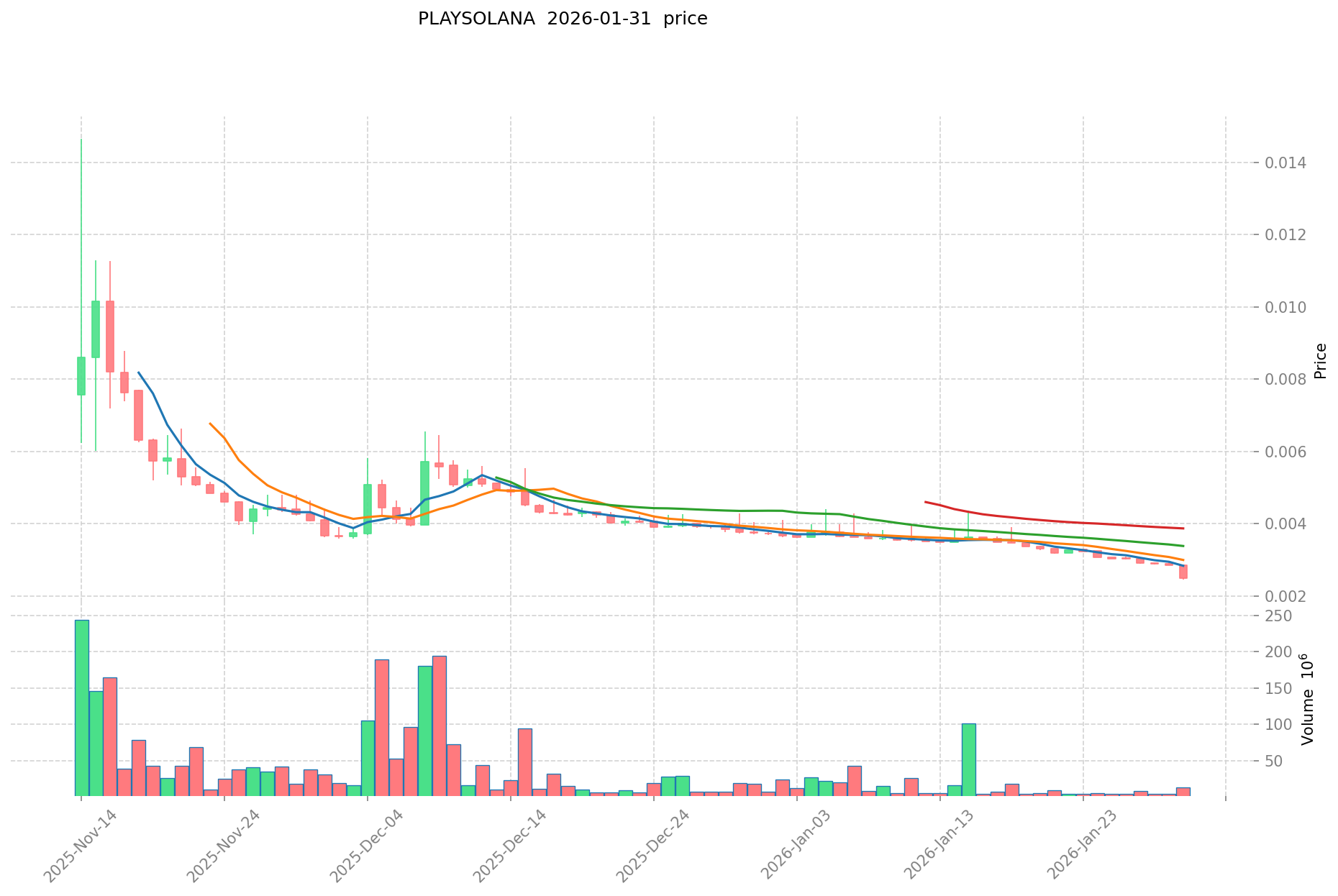
- November 2025: PLAYSOLANA reached a price level of $0.01466 on November 14, 2025 → representing a notable early-stage valuation milestone for the token
- January 2026: Market correction phase → PLAYSOLANA price declined from higher levels to $0.002437, reflecting broader market adjustment patterns
- Recent Period: Trading activity continues → current price stabilizing around $0.002451 with 24-hour trading volume of $35,032.59
Current PLAYSOLANA Investment Market Status (January 2026)
- PLAYSOLANA current price: $0.002451
- 24-hour trading volume: $35,032.59
- Market capitalization: $2,781,885
- Circulating supply: 1,135,000,000 PLAYSOLANA (22.7% of total supply)
- Total supply: 5,000,000,000 PLAYSOLANA
- Token holders: 7,969 addresses
- Market cap to fully diluted valuation ratio: 22.7%
Click to view real-time PLAYSOLANA market price
II. Core Factors Affecting Whether PLAYSOLANA is a Good Investment (Is Play Solana(PLAYSOLANA) a Good Investment)
Supply Mechanism and Scarcity (PLAYSOLANA investment scarcity)
- Total Supply Cap: Play Solana has a maximum supply of 5,000,000,000 tokens, with 1,135,000,000 tokens currently in circulation, representing a circulation ratio of 22.7%. This controlled supply structure provides a foundation for potential scarcity-driven value appreciation.
- Market Capitalization Dynamics: The current market cap stands at $2,781,885, while the fully diluted valuation reaches $12,255,000. The market cap to FDV ratio of 22.7% indicates substantial room for circulation expansion, which may influence price dynamics as more tokens enter the market.
- Investment Significance: The defined maximum supply creates a scarcity framework that could support long-term value retention, though the relatively low current circulation percentage suggests potential dilution pressure as additional tokens are released into circulation.
Institutional Investment and Mainstream Adoption (Institutional investment in PLAYSOLANA)
- Holder Base: With 7,969 token holders, Play Solana demonstrates a growing community base, though the scale remains relatively modest compared to established projects in the Web3 gaming sector.
- Exchange Presence: The token is currently listed on 1 exchange platform, indicating limited accessibility for institutional participants. Broader exchange listings could potentially enhance liquidity and institutional access.
- GameFi and DeFi Integration: Play Solana positions itself as a SuperHub merging hardware, games, and branded IP with GameFi and DeFi mechanisms, which may attract investment interest as Web3 gaming adoption expands. However, concrete data on institutional holdings or major enterprise partnerships is not currently available.
Macroeconomic Environment's Impact on PLAYSOLANA Investment
- Cryptocurrency Market Conditions: The broader crypto market environment significantly influences smaller-cap tokens like PLAYSOLANA. Price movements in major assets such as Solana (the underlying blockchain) can create spillover effects on ecosystem projects.
- Web3 Gaming Sector Trends: As a gaming-focused platform, Play Solana's investment potential correlates with the growth trajectory of the GameFi sector. Increased mainstream adoption of blockchain gaming could provide tailwinds for ecosystem tokens.
- Risk-On vs. Risk-Off Sentiment: During periods of market uncertainty, smaller-cap tokens may experience heightened volatility. The token's 24-hour price decline of 14.12% and 30-day decline of 34.31% reflect sensitivity to market sentiment shifts.
Technology and Ecosystem Development (Technology & Ecosystem for PLAYSOLANA investment)
- Solana Blockchain Foundation: Built on Solana using the SPL token standard, Play Solana benefits from the underlying network's high throughput and low transaction costs. The platform's technical infrastructure supports gaming applications requiring fast settlement times.
- SuperHub Concept: The platform integrates hardware, gaming content, and branded intellectual property with GameFi and DeFi functionalities. This multi-layered approach aims to create diverse value streams for participants who can "play, build, live, and earn."
- Ecosystem Applications: The fusion of gaming mechanics with decentralized finance elements provides multiple engagement pathways. As the platform develops its gaming library and DeFi offerings, these ecosystem expansions could enhance the token's utility and investment appeal.
- Development Transparency: The project maintains a litepaper accessible through its official website, providing technical documentation for investors evaluating the platform's roadmap and implementation strategy.
III. PLAYSOLANA Future Investment Forecast and Price Outlook (Is Play Solana(PLAYSOLANA) worth investing in 2026-2031)
Short-term Investment Forecast (2026, short-term PLAYSOLANA investment outlook)
- Conservative Forecast: $0.00229 - $0.00243
- Neutral Forecast: $0.00243 - $0.00280
- Optimistic Forecast: $0.00280 - $0.00314
Mid-term Investment Outlook (2027-2029, mid-term Play Solana(PLAYSOLANA) investment forecast)
-
Market Phase Expectation: During this period, PLAYSOLANA may experience gradual development as the Web3 gaming platform continues to integrate hardware, games, and branded IP with GameFi and DeFi mechanisms. The project's ecosystem expansion and user adoption could influence price movements.
-
Investment Return Forecast:
- 2027: $0.00187 - $0.00390
- 2028: $0.00271 - $0.00385
- 2029: $0.00313 - $0.00507
-
Key Catalysts: Platform development progress, gaming ecosystem growth, strategic partnerships, and broader adoption within the Solana ecosystem may serve as important factors.
Long-term Investment Outlook (Is PLAYSOLANA a good long-term investment?)
- Base Scenario: $0.00316 - $0.00522 (assuming steady platform development and moderate user growth)
- Optimistic Scenario: $0.00522 - $0.00611 (assuming accelerated ecosystem expansion and favorable market conditions)
- Risk Scenario: Below $0.00271 (under adverse market conditions or significant competitive pressure)
Click to view PLAYSOLANA long-term investment and price forecast: Price Prediction
2026-2031 Long-term Outlook
- Base Scenario: $0.00229 - $0.00433 (corresponding to steady progress and gradual mainstream application enhancement)
- Optimistic Scenario: $0.00433 - $0.00611 (corresponding to large-scale adoption and favorable market environment)
- Transformative Scenario: Above $0.00611 (such as breakthrough progress in ecosystem development and mainstream popularization)
- 2031-12-31 Forecast High: $0.00580 (based on optimistic development assumptions)
Disclaimer: The above forecasts are based on current available data and market analysis models. Cryptocurrency markets are highly volatile and unpredictable. These projections should not be considered as investment advice. Investors should conduct their own research and consider their risk tolerance before making any investment decisions. Past performance does not guarantee future results.
| Year |
Predicted High Price |
Predicted Average Price |
Predicted Low Price |
Price Change |
| 2026 |
0.00314115 |
0.002435 |
0.0022889 |
0 |
| 2027 |
0.003903305 |
0.002788075 |
0.00186801025 |
13 |
| 2028 |
0.0038475435 |
0.00334569 |
0.0027100089 |
36 |
| 2029 |
0.0050712296175 |
0.00359661675 |
0.0031290565725 |
46 |
| 2030 |
0.006110831689087 |
0.00433392318375 |
0.003163763924137 |
76 |
| 2031 |
0.005796838954424 |
0.005222377436418 |
0.00412567817477 |
113 |
IV. Play Solana Investment Strategy and Risk Management (How to invest in Web3 Gaming Tokens)
Investment Methodology (Play Solana investment strategy)
Long-term Holding (HODL Play Solana)
For conservative investors seeking exposure to the Web3 gaming sector, a long-term holding strategy may be considered. Play Solana's positioning as a SuperHub integrating hardware, games, and branded IP with GameFi and DeFi elements represents an evolving ecosystem approach. The token's total supply is capped at 5,000,000,000 PLAYSOLANA, with approximately 22.7% currently in circulation (1,135,000,000 tokens). Investors following this approach typically focus on the platform's ecosystem development, user adoption metrics, and partnerships within the Solana gaming ecosystem rather than short-term price movements.
Active Trading
Active traders may utilize technical analysis and swing trading strategies given the token's price volatility. Recent data shows significant price fluctuations, with 24-hour changes of -14.12% and 7-day movements of -24.14%. The 24-hour trading range between $0.002447 and $0.002873 indicates intraday volatility opportunities. However, relatively modest trading volume ($35,032.59 over 24 hours) suggests liquidity considerations for larger position sizes.
Risk Management (Risk management for Play Solana investment)
Asset Allocation Ratios
- Conservative Investors: Consider limiting exposure to Web3 gaming tokens to 1-3% of total portfolio, prioritizing established assets
- Aggressive Investors: May allocate 5-10% to emerging gaming protocols, with Play Solana as part of a diversified gaming token basket
- Professional Investors: Could incorporate strategic positions of 3-7% within thematic gaming/metaverse allocations, with active monitoring of ecosystem metrics
Risk Hedging Approaches
Multi-asset portfolio construction remains essential when holding gaming tokens. Consider diversification across:
- Established layer-1 protocols (including Solana ecosystem exposure)
- Blue-chip gaming tokens with proven user bases
- Stablecoin reserves for opportunistic rebalancing
Secure Storage
Play Solana is deployed on the Solana blockchain as an SPL token (contract address: PLAYs3GSSadH2q2JLS7djp7yzeT75NK78XgrE5YLrfq). Storage options include:
- Cold Wallets: Hardware wallets supporting Solana SPL tokens (such as Ledger devices with Solana app) for long-term holdings
- Hot Wallets: Solana-compatible wallets (Phantom, Solflare) for active trading, maintaining only necessary liquidity
- Security Practice: Implement multi-signature solutions where feasible and never store significant holdings on centralized exchanges
V. Play Solana Investment Risks and Challenges (Risks of investing in Web3 Gaming Tokens)
Market Risks
Play Solana exhibits substantial price volatility characteristic of smaller-cap gaming tokens. The token has experienced a -91.85% decline over a one-year period, with the current price of $0.002451 representing a significant distance from its peak of $0.01466 recorded on November 14, 2025. The 30-day decline of -34.31% further illustrates ongoing downward pressure. With a market capitalization of approximately $2.78 million and fully diluted valuation of $12.26 million, the token's limited liquidity may result in amplified price swings during periods of concentrated buying or selling activity. The market capitalization represents only 0.00041% of the total cryptocurrency market, indicating susceptibility to broader market sentiment shifts.
Regulatory Risks
Web3 gaming platforms that integrate GameFi and DeFi elements face evolving regulatory landscapes across jurisdictions. Potential considerations include:
- Classification uncertainties regarding gaming tokens that provide both utility and potential financial returns
- Varying national approaches to blockchain gaming regulation
- Potential licensing requirements for gaming operations that incorporate token economics
- Tax treatment complexities for play-to-earn mechanisms across different territories
Investors should monitor regulatory developments in key markets and assess their individual jurisdictional requirements.
Technical Risks
As a platform built on Solana infrastructure, Play Solana inherits both opportunities and technical considerations:
- Network Dependencies: Platform functionality relies on Solana network stability and performance
- Smart Contract Risk: SPL token contract vulnerabilities could potentially impact token functionality
- Integration Complexity: The platform's stated integration of hardware, games, and branded IP introduces multiple technical dependency points
- Adoption Uncertainty: The success of the SuperHub concept depends on continued developer engagement and user acquisition within a competitive gaming landscape
The platform holds 7,969 token holders according to available data, representing an early-stage adoption level that carries execution risk.
VI. Conclusion: Is Web3 Gaming Token a Good Investment?
Investment Value Summary
Play Solana represents an early-stage Web3 gaming platform attempt to create an integrated ecosystem on Solana. While the concept of merging hardware, games, and IP with GameFi and DeFi elements demonstrates innovation, the token's performance trajectory shows significant headwinds. The substantial decline over multiple timeframes (-14.12% in 24 hours, -24.14% over 7 days, -91.85% over one year) reflects either broader market corrections, project-specific challenges, or both. The limited market capitalization and trading volume suggest this remains a speculative asset with considerable price volatility.
Investor Recommendations
✅ Beginners: If considering exposure, utilize dollar-cost averaging with minimal allocation (under 2% of portfolio) and prioritize secure wallet storage. Conduct thorough research on the platform's ecosystem development progress and competitive positioning before any investment decision.
✅ Experienced Investors: May consider tactical positions as part of a diversified gaming token basket, employing strict position sizing and stop-loss disciplines. Monitor on-chain metrics including holder growth, transaction activity, and ecosystem partnership announcements for trend signals.
✅ Institutional Investors: Given the early-stage nature and limited liquidity, assess whether Play Solana fits thematic exposure mandates for emerging gaming protocols. Consider waiting for clearer traction indicators such as expanded holder base, increased trading volume, and demonstrable platform usage metrics before strategic allocation.
⚠️ Important Notice: Cryptocurrency investments, particularly in emerging gaming tokens, carry substantial risk including potential total loss of capital. This analysis is provided for informational purposes only and does not constitute investment advice. Conduct independent research and consult qualified financial advisors before making investment decisions. Past performance does not indicate future results.
VII. FAQ
Q1: What is Play Solana (PLAYSOLANA) and what makes it different from other gaming tokens?
Play Solana is a Web3 gaming platform built on Solana that positions itself as a SuperHub integrating hardware, games, and branded IP with GameFi and DeFi mechanisms. Unlike many single-purpose gaming tokens, PLAYSOLANA aims to create a comprehensive ecosystem where users can play, build, live, and earn. The platform operates as an SPL token on Solana (contract address: PLAYs3GSSadH2q2JLS7djp7yzeT75NK78XgrE5YLrfq) with a total supply of 5 billion tokens, of which 22.7% (1.135 billion) are currently in circulation. The project's multi-layered approach combines gaming content with decentralized finance functionalities, creating diverse engagement pathways for participants within the Solana ecosystem.
Q2: How has PLAYSOLANA's price performed historically and what is the current market situation?
PLAYSOLANA has experienced significant price volatility since launch. The token reached a notable price level of $0.01466 on November 14, 2025, representing an early-stage valuation milestone. As of January 2026, the price has declined to approximately $0.002451, reflecting a -91.85% decrease over the one-year period. Recent performance shows a -14.12% decline over 24 hours, -24.14% over 7 days, and -34.31% over 30 days. The current market capitalization stands at $2.78 million with a 24-hour trading volume of $35,032.59. The token holds market ranking 1875 and has 7,969 holders, indicating early-stage adoption within a competitive gaming landscape.
Q3: What is the long-term investment outlook for PLAYSOLANA through 2031?
Forecast models project varied scenarios for PLAYSOLANA's potential price trajectory. For 2026, conservative estimates range from $0.00229 to $0.00243, while optimistic scenarios suggest $0.00280 to $0.00314. By 2029, projections indicate a potential range of $0.00313 to $0.00507 under normal development conditions. Long-term forecasts for 2031 suggest a predicted high of $0.00580, with base scenarios ranging from $0.00229 to $0.00433 and optimistic scenarios from $0.00433 to $0.00611. These projections assume steady platform development, growing user adoption, successful ecosystem expansion, and favorable market conditions. However, investors should recognize that cryptocurrency markets are highly unpredictable, and these forecasts do not guarantee future results.
Q4: What are the main risks associated with investing in PLAYSOLANA?
PLAYSOLANA carries several significant risk factors. Market risks include substantial price volatility, limited liquidity with a modest market cap of $2.78 million, and the token's performance representing only 0.00041% of the total cryptocurrency market. Technical risks involve dependencies on Solana network stability, potential smart contract vulnerabilities, integration complexity across hardware and gaming components, and execution uncertainty given the early-stage adoption level of 7,969 holders. Regulatory risks encompass classification uncertainties for tokens providing both utility and financial returns, varying national approaches to blockchain gaming regulation, and potential licensing requirements. The significant price decline of -91.85% over one year demonstrates the high-risk nature of this asset.
Q5: How should different investor types approach PLAYSOLANA as an investment?
Investment approaches should vary based on experience level and risk tolerance. Beginners should limit exposure to under 2% of portfolio using dollar-cost averaging strategies and prioritize secure wallet storage such as hardware wallets supporting Solana SPL tokens. Experienced investors may consider tactical positions as part of a diversified gaming token basket, employing strict position sizing (3-7% allocation) and stop-loss disciplines while monitoring on-chain metrics including holder growth and transaction activity. Institutional investors should assess whether PLAYSOLANA fits thematic exposure mandates for emerging gaming protocols, potentially waiting for clearer traction indicators such as expanded holder base, increased trading volume, and demonstrable platform usage metrics before strategic allocation.
Q6: What factors could potentially drive PLAYSOLANA's value in the future?
Several catalysts could influence PLAYSOLANA's valuation trajectory. Platform-specific factors include ecosystem development progress, successful integration of hardware and gaming content, strategic partnerships within the Solana ecosystem, and user adoption metrics. The controlled supply structure with a maximum of 5 billion tokens provides a scarcity framework that could support value appreciation, though the current 22.7% circulation ratio suggests potential dilution pressure as additional tokens enter the market. Broader market factors include the growth trajectory of the GameFi sector, mainstream adoption of blockchain gaming, Solana ecosystem expansion, and general cryptocurrency market conditions. Exchange listings beyond the current single platform could enhance liquidity and institutional access, potentially supporting price discovery.
Q7: What storage and security practices should PLAYSOLANA investors follow?
Secure storage practices are essential for PLAYSOLANA holders. For long-term holdings, cold wallet solutions such as hardware wallets supporting Solana SPL tokens (including Ledger devices with Solana app installed) provide optimal security. Active traders may utilize hot wallets like Phantom or Solflare that are specifically designed for Solana-compatible tokens, maintaining only necessary liquidity for trading purposes. Investors should never store significant holdings on centralized exchanges to minimize counterparty risk. Where feasible, implementing multi-signature solutions adds additional security layers. The token's contract address (PLAYs3GSSadH2q2JLS7djp7yzeT75NK78XgrE5YLrfq) should be verified before any transaction to prevent interaction with fraudulent contracts. Regular security audits of wallet software and backup procedures are recommended practices for asset protection.
Q8: How does PLAYSOLANA's tokenomics structure affect investment considerations?
PLAYSOLANA's tokenomics present specific investment considerations. The total supply cap of 5 billion tokens creates a defined scarcity framework, with 1.135 billion tokens (22.7%) currently in circulation. This results in a market cap to fully diluted valuation ratio of 22.7%, indicating substantial room for circulation expansion that could influence price dynamics as additional tokens are released. The current market capitalization of $2.78 million compared to the fully diluted valuation of $12.26 million suggests potential dilution pressure that investors should monitor. The project's distribution timeline and token release schedule are important factors for assessing supply-side pressure. The relatively modest holder base of 7,969 addresses indicates concentrated ownership patterns that may affect liquidity and price stability during periods of market stress.
* The information is not intended to be and does not constitute financial advice or any other recommendation of any sort offered or endorsed by Gate.