Plume (PLUME) is a RWAfi Layer 1 blockchain platform designed for crypto-native users, currently trading at $0.01453 with a market cap of $29.06 million as of January 2026. This comprehensive analysis examines whether PLUME represents a viable investment opportunity by evaluating key factors including its capped 10 billion token supply (20% circulating), institutional adoption potential, macroeconomic influences, and technological ecosystem development. The token has experienced significant volatility since launch, declining 27% annually despite reaching a peak of $0.249 in March 2025, reflecting both early-stage market dynamics and limited liquidity of $559,447 in 24-hour trading volume. Mid-term price forecasts (2027-2029) range from $0.012-$0.031 across scenarios, while long-term outlooks suggest potential movement toward $0.038-$0.040 by 2030-2031 under optimistic adoption conditions. Investment strategies vary by risk profile, with conservative investors suggested 1-3% allocation and aggressive investors
Introduction: Plume (PLUME) Investment Position and Market Outlook
Plume (PLUME) represents a notable asset in the cryptocurrency sector, positioning itself as the first RWAfi Layer 1 network focused on crypto-native users. As of January 21, 2026, PLUME maintains a market capitalization of approximately $29.06 million with a circulating supply of 2 billion tokens, trading at around $0.01453. The project aims to bridge real-world assets with crypto markets through infrastructure that enables RWA derivatives, lending protocols, and yield farming mechanisms. With a ranking of 727 in the cryptocurrency market and a market dominance of 0.0046%, PLUME has attracted attention from 21,830 holders across 36 exchanges. The token has experienced price fluctuations since its launch, with recorded movements including a 17.86% decline over seven days and a 27% decrease over the past year. This article provides a comprehensive analysis of PLUME's investment characteristics, historical performance trends, future price considerations, and associated investment risks to assist investors in their evaluation process.
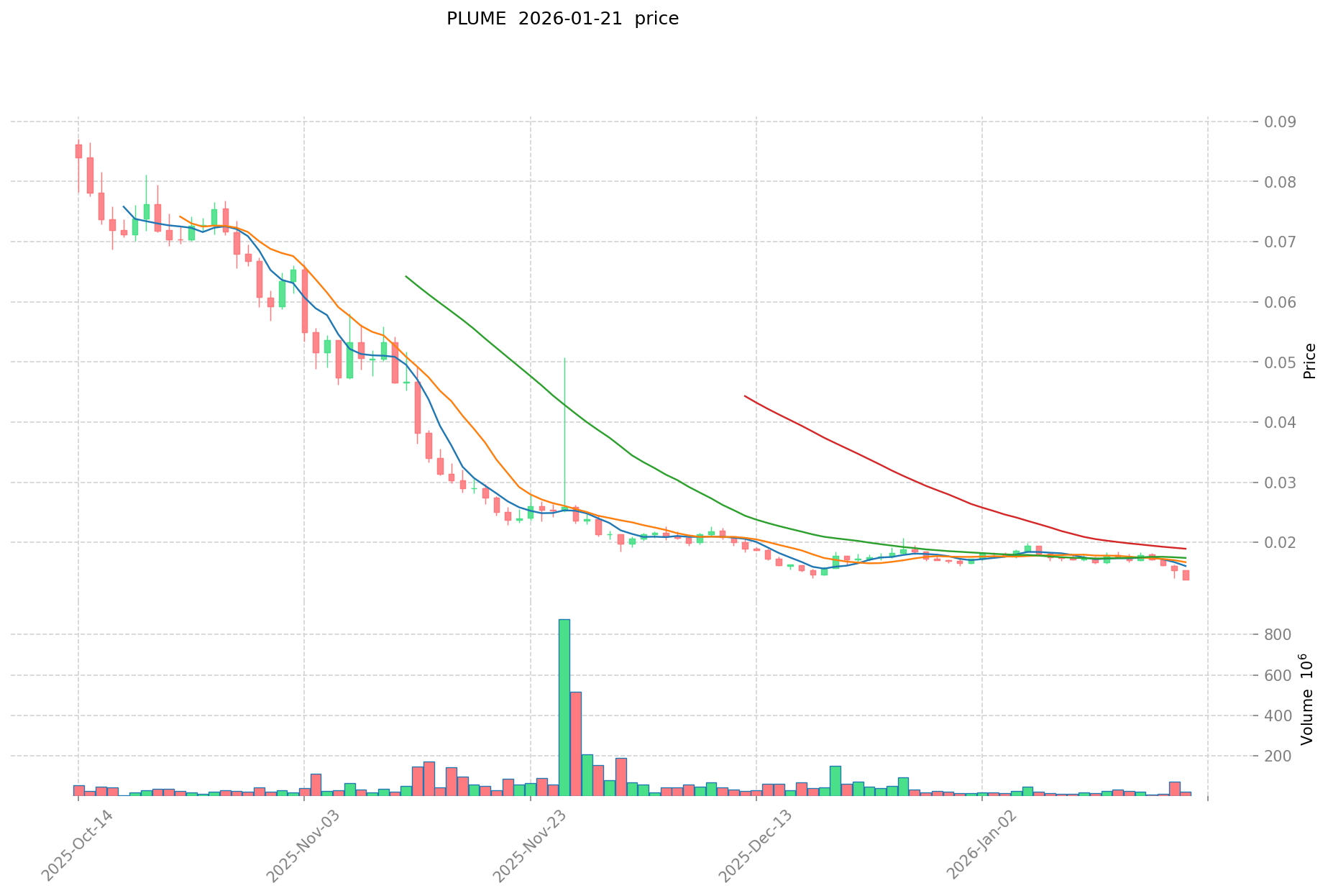
I. PLUME Token Price History Review and Current Investment Value
- 2025: Token launch at $0.1 → Price experienced significant volatility in early trading
- March 2025: Peak price reached $0.24903 → PLUME price showed upward momentum in Q1
- October 2025: Price declined to $0.01007 → Market experienced notable correction
- January 2026: Price stabilized around $0.01453 → Token showed signs of price consolidation
Current PLUME Investment Market Status (January 2026)
- PLUME current price: $0.01453
- 24-hour trading volume: $559,447.85
- Market capitalization: $29.06 million
- Circulating supply: 2 billion PLUME tokens (20% of total supply)
- Total supply: 10 billion PLUME tokens
- Price changes: -1.29% (1H), -0.13% (24H), -17.86% (7D), -15.37% (30D)
- Token holders: 21,830 addresses
Click to view real-time PLUME market price
II. Core Factors Affecting Whether PLUME is a Good Investment (Is Plume(PLUME) a Good Investment)
Supply Mechanism and Scarcity (PLUME investment scarcity)
-
Capped Supply Model → Impacts Price and Investment Value
According to available data, PLUME has a maximum supply of 10,000,000,000 tokens, with a current circulating supply of 2,000,000,000 tokens (representing 20% of the total). The circulating market cap stands at approximately $29.06 million, while the fully diluted market cap reaches around $145.3 million. This fixed supply ceiling introduces a degree of scarcity, as the token's issuance is predetermined and cannot be infinitely expanded.
-
Historical Price Movements and Supply Dynamics
Since its listing on January 20, 2025, at an initial price of $0.1, PLUME has experienced notable volatility. The token reached a recorded high of approximately $0.249 on March 19, 2025, and subsequently declined to a low near $0.01007 on October 10, 2025. As of January 21, 2026, the price is approximately $0.01453, reflecting a decline of about 27% over the past year and 15.37% over the past 30 days. These fluctuations suggest that while supply constraints exist, demand dynamics and broader market sentiment have played a significant role in price formation.
-
Investment Implications of Scarcity
A capped supply framework can contribute to long-term value preservation, particularly if adoption and demand increase over time. However, with only 20% of tokens currently in circulation, future token unlocks or distribution events could introduce additional supply pressure, potentially affecting price stability. Investors should consider both the scarcity profile and the token release schedule when evaluating PLUME's investment potential.
Institutional Investment and Mainstream Adoption (Institutional investment in PLUME)
-
Current Adoption Indicators
Available data indicates that PLUME is listed on 36 exchanges and has approximately 21,830 token holders. The 24-hour trading volume is around $559,447, and the token's market share stands at approximately 0.0046%. While these metrics suggest growing interest, there is no publicly available information on institutional holdings or notable corporate adoption at this time.
-
Impact of Mainstream Use Cases
Plume Network positions itself as the first RWAfi Layer 1 blockchain focused on crypto-native users, aiming to bridge real-world assets (RWA) with decentralized finance (DeFi) applications. The platform's emphasis on RWA derivatives, lending, borrowing, and yield farming may attract participants seeking exposure to tokenized real-world assets. However, concrete evidence of enterprise partnerships or institutional adoption has not been disclosed in the available materials.
-
Regulatory and Policy Considerations
The evolving regulatory landscape for digital assets and RWAs may influence PLUME's investment outlook. Favorable policy developments could enhance legitimacy and attract institutional capital, while restrictive measures might pose challenges. Investors should monitor regulatory trends in key jurisdictions to assess potential impacts on PLUME's adoption trajectory.
Macroeconomic Environment's Impact on PLUME Investment
-
Monetary Policy and Interest Rate Dynamics
Broader macroeconomic conditions, including central bank policies and interest rate adjustments, can influence risk appetite for digital assets. In environments characterized by accommodative monetary policy and low interest rates, investors may seek higher-yielding alternatives such as crypto assets. Conversely, tightening financial conditions could reduce speculative demand and affect PLUME's price performance.
-
Inflation and Store-of-Value Narratives
While certain digital assets are sometimes discussed in the context of inflation hedging, PLUME's investment case appears more closely tied to its utility within the RWAfi ecosystem rather than as a store of value. The token's role in facilitating transactions, governance, and DeFi activities may be more relevant to its valuation than macroeconomic inflation trends.
-
Geopolitical Uncertainty and Risk-On Sentiment
Periods of heightened geopolitical instability can drive demand for alternative assets. However, PLUME's relatively small market capitalization and emerging status mean it may be more sensitive to overall risk sentiment in crypto markets rather than serving as a traditional safe-haven asset. Investors should consider how global economic conditions and risk appetite shifts might influence PLUME's demand dynamics.
Technology and Ecosystem Development (Technology & Ecosystem for PLUME investment)
-
Layer 1 Infrastructure and Network Performance
Plume Network operates as a Layer 1 blockchain designed to support real-world asset tokenization and DeFi applications. The platform's focus on integrating crypto-native RWA use cases—such as derivatives, lending, and yield farming—represents an attempt to differentiate itself from traditional RWA approaches. Continued development of network infrastructure, transaction throughput, and security features could enhance the platform's attractiveness to developers and users, thereby supporting long-term investment value.
-
Ecosystem Expansion and Application Deployment
The growth of decentralized applications (dApps) and protocols built on Plume Network may contribute to increased token utility and demand. As the ecosystem matures, the integration of DeFi primitives, NFT functionalities, and tokenized asset markets could provide additional use cases for PLUME. However, specific details regarding ecosystem partnerships, developer activity, and application deployment milestones have not been provided in the available materials.
-
DeFi, NFT, and Payment Use Cases
The expansion of DeFi services, NFT marketplaces, and payment solutions on Plume Network may drive network activity and token adoption. As these applications gain traction, the utility of PLUME as a medium of exchange, collateral, or governance token could strengthen, potentially supporting its investment thesis. Investors should assess the pace of ecosystem development and user adoption when evaluating PLUME's long-term prospects.
III. PLUME Future Investment Forecast and Price Outlook (Is Plume(PLUME) worth investing in 2026-2031)
Short-term Investment Forecast (2026, short-term PLUME investment outlook)
- Conservative forecast: $0.013824 - $0.0144
- Neutral forecast: $0.0144 - $0.01764
- Optimistic forecast: $0.01764 - $0.02088
Mid-term Investment Outlook (2027-2029, mid-term Plume(PLUME) investment forecast)
-
Market phase expectation: The period from 2027 to 2029 may witness gradual development in the RWAfi ecosystem, with potential expansion of use cases beyond traditional TradFi tokenization. As Plume continues to build infrastructure connecting real-world assets with crypto markets, adoption rates and network activity could influence price movements.
-
Investment return forecast:
- 2027: $0.0121716 - $0.0227556
- 2028: $0.01817802 - $0.027469008
- 2029: $0.01525337856 - $0.0309834252
-
Key catalysts: Development of RWA derivatives and speculation products, expansion of borrow/lend capabilities, growth in yield farming opportunities, partnerships within the RWAfi sector, and overall adoption of the L1 network by crypto-native users.
Long-term Investment Outlook (Is Plume a good long-term investment?)
- Base scenario: $0.013978291446 - $0.032753055447 (assuming steady infrastructure development and moderate ecosystem growth)
- Optimistic scenario: $0.032753055447 - $0.038097696294 (assuming accelerated adoption of RWAfi use cases and favorable market conditions)
- Risk scenario: Below $0.013978291446 (under conditions of significant market downturns or competitive pressure from other RWA-focused platforms)
Click to view PLUME long-term investment and price forecast: Price Prediction
2026-01-21 - 2031 Long-term Outlook
- Base scenario: $0.013978291446 - $0.032753055447 (corresponding to steady progress and gradual mainstream application improvement)
- Optimistic scenario: $0.032753055447 - $0.038097696294 (corresponding to large-scale adoption and favorable market environment)
- Transformative scenario: Above $0.038097696294 (if the ecosystem achieves breakthrough progress and mainstream popularization)
- 2031-12-31 predicted high: $0.03701095265511 (based on optimistic development assumptions)
Disclaimer: The above predictions are for reference only and do not constitute investment advice. Cryptocurrency markets are highly volatile, and actual prices may differ significantly from forecasts. Investors should conduct their own research and assess risks carefully before making any investment decisions.
| Year |
Predicted High Price |
Predicted Average Price |
Predicted Low Price |
Price Change |
| 2026 |
0.02088 |
0.0144 |
0.013824 |
0 |
| 2027 |
0.0227556 |
0.01764 |
0.0121716 |
21 |
| 2028 |
0.027469008 |
0.0201978 |
0.01817802 |
39 |
| 2029 |
0.0309834252 |
0.023833404 |
0.01525337856 |
64 |
| 2030 |
0.038097696294 |
0.0274084146 |
0.013978291446 |
88 |
| 2031 |
0.03701095265511 |
0.032753055447 |
0.01735911938691 |
125 |
IV. Plume Investment Strategy and Risk Management (How to invest in RWAfi Layer 1)
Investment Methodology (Plume investment strategy)
-
Long-term Holding (HODL Plume): Suitable for conservative investors who believe in the project's long-term vision of connecting real-world assets with crypto markets. This approach minimizes exposure to short-term price fluctuations while potentially benefiting from the development of RWAfi infrastructure and ecosystem growth.
-
Active Trading: Relies on technical analysis and swing trading strategies. Given Plume's price movements over different timeframes (with reported changes of -1.29% in 1H, -0.13% in 24H, -17.86% in 7D, and -15.37% in 30D), traders may identify opportunities through chart patterns, support/resistance levels, and volume analysis. This approach requires constant market monitoring and experience in reading technical indicators.
Risk Management (Risk management for Plume investment)
V. Plume Investment Risks and Challenges (Risks of investing in RWAfi Layer 1)
-
Market Risk: Plume exhibits significant price volatility, as evidenced by price fluctuations between a low of $0.0138 and high of $0.01525 within 24 hours. The token has experienced a -27% change over one year, indicating substantial price movement. With a circulating supply of 2 billion tokens out of a maximum supply of 10 billion (20% circulation ratio), future token releases could impact price dynamics.
-
Regulatory Risk: As a project focused on real-world asset integration, Plume operates in a space subject to evolving regulatory frameworks across different jurisdictions. Changes in securities laws, asset tokenization regulations, or cross-border financial policies could affect the project's operations and token utility. The intersection of traditional finance and crypto presents unique compliance challenges that may vary significantly by region.
-
Technical Risk: As a Layer 1 blockchain network, Plume faces inherent technical challenges including network security vulnerabilities, smart contract risks, and potential issues during protocol upgrades. The success of the RWAfi infrastructure depends on seamless integration between real-world assets and crypto markets, which introduces technical complexity. Being an ERC-20 token deployed on Ethereum, the project also inherits risks associated with the underlying blockchain network.
VI. Conclusion: Is RWAfi Layer 1 a Good Investment?
-
Investment Value Summary: Plume represents an emerging sector within the blockchain ecosystem, focusing on real-world asset finance through crypto-native infrastructure. The project aims to expand beyond traditional RWA concepts by enabling derivatives, lending, and yield farming for real-world assets. However, the token has shown notable price volatility with declines across multiple timeframes, and its relatively early stage (20% token circulation) suggests ongoing development and potential dilution considerations.
-
Investor Recommendations:
✅ Beginners: Consider dollar-cost averaging (DCA) to mitigate entry timing risk, and prioritize secure wallet storage using hardware solutions for ERC-20 tokens. Start with small allocations to understand market dynamics.
✅ Experienced Investors: Evaluate swing trading opportunities based on technical analysis while maintaining a core position. Implement portfolio diversification across different blockchain sectors and market cap categories.
✅ Institutional Investors: Assess strategic long-term allocation potential within the RWAfi sector, considering the project's infrastructure development roadmap and total addressable market for real-world asset tokenization.
⚠️ Disclaimer: Cryptocurrency investments carry substantial risk due to market volatility, regulatory uncertainty, and technical complexities. This content is provided for informational purposes only and does not constitute financial, investment, or trading advice. Conduct thorough research and consider consulting with qualified financial advisors before making investment decisions.
VII. FAQ
Q1: What is PLUME's current market position and how does it differ from traditional RWA projects?
PLUME currently ranks #727 in the cryptocurrency market with a market capitalization of approximately $29.06 million and 21,830 holders as of January 2026. Unlike traditional RWA (Real-World Asset) approaches that primarily focus on TradFi tokenization, Plume positions itself as the first RWAfi Layer 1 network specifically designed for crypto-native users. The platform emphasizes crypto-first infrastructure that enables RWA derivatives, speculation products, lending protocols, and yield farming mechanisms rather than simple asset tokenization. With only 20% of its 10 billion total supply currently in circulation (2 billion tokens), the project remains in early-stage development with significant token unlock events potentially ahead.
Q2: How has PLUME's price performed since launch and what explains its volatility?
PLUME launched on January 20, 2025, at $0.1 and reached a peak of $0.24903 in March 2025 before declining to a low of $0.01007 in October 2025. As of January 2026, the token trades around $0.01453, representing a 27% decline over the past year and 17.86% drop over seven days. This volatility reflects several factors: the token's early-stage nature with low liquidity ($559,447 24-hour trading volume), limited market adoption (0.0046% market dominance), ongoing ecosystem development, and broader crypto market sentiment. The significant price swings also suggest that demand dynamics and speculative trading have played major roles in price formation during this initial period.
Q3: What are the key investment risks associated with holding PLUME tokens?
PLUME carries multiple investment risks. Market risk is evident through substantial price volatility and a -27% annual decline, with only 20% token circulation suggesting potential future dilution from token unlocks. Regulatory risk stems from the project's focus on real-world asset integration, which subjects it to evolving securities laws, asset tokenization regulations, and cross-border financial policies that vary significantly by jurisdiction. Technical risk includes Layer 1 blockchain vulnerabilities, smart contract exploits, protocol upgrade complications, and the complexity of integrating real-world assets with crypto markets. Additionally, as an ERC-20 token on Ethereum, PLUME inherits risks from the underlying blockchain network.
Q4: What allocation strategy should different investor types consider for PLUME?
Conservative investors should limit PLUME exposure to 1-3% of their crypto portfolio, treating it as a high-risk, early-stage allocation within the emerging RWAfi sector. Aggressive investors with higher risk tolerance may allocate 5-10%, but should maintain diversification across multiple blockchain ecosystems and asset classes. Professional investors might implement dynamic allocation strategies based on project milestone achievements, ecosystem development metrics, and broader market conditions. All investor types should use dollar-cost averaging (DCA) to mitigate entry timing risk and prioritize secure storage solutions, including hardware wallets for long-term holdings and limited hot wallet amounts for active trading needs.
Q5: What factors could drive PLUME's price in the mid to long term (2027-2031)?
Mid-term price drivers (2027-2029) include the development of RWA derivatives and speculation products, expansion of lending and borrowing capabilities, growth in yield farming opportunities, strategic partnerships within the RWAfi sector, and overall adoption of the L1 network by crypto-native users. Long-term outlook (through 2031) depends on the pace of ecosystem maturation, mainstream adoption of RWAfi use cases, favorable regulatory developments, competition from other RWA-focused platforms, and broader crypto market conditions. Price forecasts range from a base scenario of $0.013978-$0.032753 (assuming steady development) to an optimistic scenario reaching $0.038097 by 2030, though actual outcomes may vary significantly due to market volatility and execution risks.
Q6: How liquid is PLUME and what are the practical implications for investors?
PLUME demonstrates relatively limited liquidity with a 24-hour trading volume of approximately $559,447 across 36 exchanges. This low liquidity environment presents several practical implications: larger orders may experience significant slippage, meaning the executed price could differ substantially from the quoted price; bid-ask spreads tend to be wider, increasing transaction costs; and sudden buying or selling pressure can cause sharp price movements. For active traders, this necessitates careful order sizing and potentially using limit orders rather than market orders. For long-term holders, low liquidity may complicate exit strategies during market stress periods, emphasizing the importance of position sizing and maintaining the token as a minor portfolio component rather than a core holding.
Q7: What role does token circulation rate play in PLUME's investment thesis?
PLUME's current circulation rate of 20% (2 billion out of 10 billion total supply) represents a critical consideration for investors. This low circulation ratio means 80% of tokens remain locked or unissued, creating potential future supply pressure as tokens unlock or are distributed through ecosystem incentives, team allocations, or strategic partnerships. While a capped maximum supply provides some scarcity framework, the unlocking schedule could introduce significant dilution events that affect price stability and holder value. The fully diluted market cap of approximately $145.3 million versus the current circulating market cap of $29.06 million illustrates this gap. Investors should research the token vesting schedule, unlock timelines, and distribution mechanisms to assess potential supply-side impacts on their investment horizon.
Q8: How does PLUME's RWAfi infrastructure differentiate it in the competitive Layer 1 landscape?
Plume's differentiation strategy centers on creating crypto-native infrastructure for real-world asset finance rather than simply tokenizing traditional assets. The platform aims to enable RWA derivatives trading, speculation products, lending/borrowing against real-world collateral, and yield farming opportunities that combine crypto mechanics with real asset exposure. This approach targets crypto-savvy users seeking to bridge their digital asset activities with real-world economic exposure, rather than traditional finance institutions looking to tokenize existing assets. However, concrete evidence of ecosystem partnerships, developer activity metrics, and application deployment milestones has not been extensively disclosed, making the practical realization of this differentiation strategy a key factor for investors to monitor through project updates and on-chain activity metrics.
* The information is not intended to be and does not constitute financial advice or any other recommendation of any sort offered or endorsed by Gate.