This comprehensive analysis evaluates Pocket Network (POKT) as an investment opportunity within the decentralized Web3 infrastructure sector. Trading at $0.01147 with a $23.07 million market cap, POKT provides blockchain API relay services across 21 networks including Ethereum and Solana. The article examines historical price performance, identifying a 55.90% one-year decline from previous levels, alongside current market metrics and technical fundamentals. Key investment factors include infinite supply mechanics, multi-chain utility adoption, and ecosystem growth potential. Price forecasts through 2031 range from conservative scenarios at $0.005865-$0.0115 to optimistic projections exceeding $0.029. The analysis addresses substantial risks including market volatility, regulatory uncertainty, and competitive pressures, while providing differentiated investment strategies for beginner, experienced, and institutional investors. Risk management frameworks, secure storage solutions, and comprehensive monitoring m
Introduction: Pocket Network (POKT) Investment Position and Market Outlook
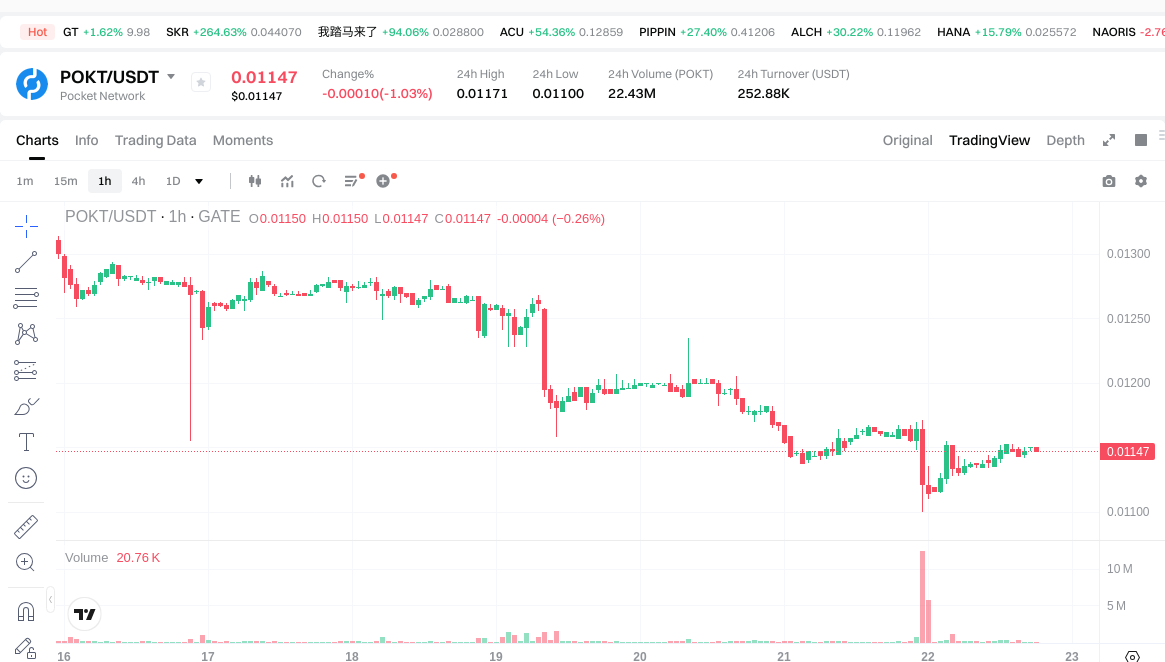
POKT is a notable asset in the cryptocurrency sector, having launched in 2022 and established itself within the decentralized Web3 infrastructure space. As of 22 January 2026, Pocket Network holds a market capitalization of approximately $23.07 million, with a circulating supply of around 2.01 billion tokens, and the current price stands at approximately $0.01147. Positioned as a decentralized blockchain API protocol for Web3 applications, POKT has gradually attracted attention from investors exploring "Is Pocket Network (POKT) a good investment?" This article provides a comprehensive analysis of POKT's investment value, historical price movements, future price projections, and associated investment risks to serve as a reference for investors.
I. Historical Price Review and Current Investment Value of POKT
- 2022: Token reached a notable price level of $3.11 in January → subsequent market adjustments affected investor returns
- 2025: Price experienced significant volatility → declined to $0.00883573 in April
- Recent period: Market dynamics led to price fluctuations → current trading around $0.01147
Current POKT Investment Market Status (January 2026)
- POKT current price: $0.01147
- 24-hour trading volume: $252,836.59
- Market capitalization: $23,073,971.07
- Circulating supply: 2,011,680,128.05 POKT
- Total supply: 2,351,355,446.25 POKT
- Circulating supply ratio: 85.55%
- Price changes: -0.09% (1H), -1.2% (24H), -14.46% (7D), -7.57% (30D), -55.90% (1Y)
Click to view real-time POKT market price
II. Core Factors Affecting Whether POKT is a Good Investment (Is Pocket Network(POKT) a Good Investment)
Supply Mechanism and Scarcity (POKT investment scarcity)
- Supply mechanism → affects price and investment value
- Pocket Network has a maximum supply marked as infinite (∞), with a current circulating supply of approximately 2.01 billion POKT and a total supply of approximately 2.35 billion POKT. The circulating supply accounts for approximately 85.55% of the total supply.
- Historical context: POKT's price fluctuations have shown sensitivity to supply dynamics in the market. The protocol rewards participating nodes with POKT tokens proportionally for validating relay data.
- Investment implication: The infinite supply model suggests that scarcity may not be a primary driver of long-term value, and investors should consider other factors such as network growth and demand dynamics.
Institutional Investment and Mainstream Adoption (Institutional investment in POKT)
- Pocket Network provides decentralized RPC relay services for dApps operating on blockchains, supporting 21 blockchains including Harmony, Ethereum, Fuse, Avalanche, and Solana.
- The protocol serves as infrastructure middleware, providing custom RPC endpoints for applications such as MetaMask wallet and real-time on-chain data for DEX contract interactions.
- Market presence: POKT is currently listed on 8 exchanges, with a market capitalization of approximately $23.07 million and trading volume of approximately $252,836 in the last 24 hours.
- Adoption indicator: The network's ability to relay data across thousands of nodes demonstrates operational capacity, though specific institutional holding data and enterprise adoption metrics are not detailed in available materials.
Macroeconomic Environment Impact on POKT Investment
- As a Web3 infrastructure protocol, POKT's investment value may be influenced by broader cryptocurrency market sentiment and macroeconomic conditions.
- Price trends: POKT has experienced declines of 0.09% (1H), 1.2% (24H), 14.46% (7D), 7.57% (30D), and 55.90% (1Y), reflecting general market volatility.
- Current price context: Trading at approximately $0.01147, POKT has moved significantly below previous levels, with its current price approximately 99.63% below levels seen in January 2022.
- Investment consideration: Macroeconomic factors such as interest rate policies, inflation trends, and risk appetite in the crypto market may continue to influence POKT's price performance.
Technology and Ecosystem Development (Technology & Ecosystem for POKT investment)
- Decentralized infrastructure protocol: Pocket Network functions as a decentralized blockchain API for Web3 applications, transmitting data across blockchains through a network composed of thousands of nodes.
- Validation and reward mechanism: The protocol validates all relay data and proportionally rewards participating nodes with POKT tokens, creating an incentive structure for network participants.
- Multi-chain support: Current support for 21 blockchains positions POKT within the broader Web3 infrastructure ecosystem, with potential expansion opportunities.
- Ecosystem applications: The protocol's role in providing RPC services for DeFi platforms, wallets, and other blockchain applications represents practical utility that may support long-term investment value.
- Investment perspective: Technology development and ecosystem expansion are key factors that could influence POKT's investment attractiveness, though actual adoption rates and competitive positioning require ongoing monitoring.
III. POKT Future Investment Forecast and Price Outlook (Is Pocket Network(POKT) worth investing in 2026-2031)
Short-term Investment Forecast (2026, short-term POKT investment outlook)
- Conservative Forecast: $0.005865 - $0.0115
- Neutral Forecast: $0.0115
- Optimistic Forecast: $0.0115 - $0.016215
Mid-term Investment Outlook (2027-2029, mid-term Pocket Network(POKT) investment forecast)
-
Market Stage Expectation: The mid-term outlook suggests gradual recovery and development phases, with price ranges potentially expanding as the decentralized RPC infrastructure market matures and adoption increases across supported blockchain networks.
-
Investment Return Forecast:
- 2027: $0.010947425 - $0.01856905
- 2028: $0.0152404785 - $0.01896953175
- 2029: $0.01143441219375 - $0.02374839455625
-
Key Catalysts: Expansion of supported blockchain networks, growth in Web3 application usage requiring decentralized RPC services, and increased demand for blockchain API infrastructure.
Long-term Investment Outlook (Is POKT a good long-term investment?)
- Base Scenario: $0.019636404017343 - $0.026457470676 (assuming steady growth in decentralized infrastructure adoption and stable market conditions through 2030)
- Optimistic Scenario: $0.020736042642315 - $0.029454606026015 (assuming accelerated Web3 adoption and expanded network utility through 2031)
- Risk Scenario: Below $0.01 (under conditions of market downturn or reduced demand for decentralized RPC services)
Check POKT long-term investment and price prediction: Price Prediction
2026-01-22 - 2031 Long-term Outlook
- Base Scenario: $0.016 - $0.021 (corresponding to steady progress and gradual mainstream application growth)
- Optimistic Scenario: $0.023 - $0.029 (corresponding to large-scale adoption and favorable market conditions)
- Transformative Scenario: Above $0.030 (contingent upon breakthrough ecosystem developments and mainstream proliferation)
- 2031-12-31 Predicted High: $0.029454606026015 (based on optimistic development assumptions)
Disclaimer: This analysis is for informational purposes only and does not constitute investment advice. Cryptocurrency markets are highly volatile and unpredictable. Past performance does not guarantee future results. Investors should conduct their own research and consider their risk tolerance before making investment decisions.
| Year |
Predicted High Price |
Predicted Average Price |
Predicted Low Price |
Price Change |
| 2026 |
0.016215 |
0.0115 |
0.005865 |
0 |
| 2027 |
0.01856905 |
0.0138575 |
0.010947425 |
20 |
| 2028 |
0.01896953175 |
0.016213275 |
0.0152404785 |
41 |
| 2029 |
0.02374839455625 |
0.017591403375 |
0.01143441219375 |
53 |
| 2030 |
0.026457470676 |
0.020669898965625 |
0.019636404017343 |
80 |
| 2031 |
0.029454606026015 |
0.023563684820812 |
0.020736042642315 |
105 |
IV. POKT Investment Strategy and Risk Management (How to invest in Pocket Network)
Investment Strategy (POKT investment strategy)
Long-term Holding (HODL POKT)
Long-term holding represents a suitable approach for conservative investors seeking to participate in the decentralized infrastructure sector. This strategy involves acquiring POKT tokens and maintaining positions through market cycles, potentially benefiting from the protocol's expansion as more blockchains and dApps utilize its RPC relay services.
Investors considering this approach should evaluate:
- The protocol's network growth trajectory, as Pocket Network currently supports 21 blockchains including Ethereum, Solana, and Avalanche
- Token distribution dynamics, with approximately 85.55% of the total supply in circulation
- The project's role in providing essential middleware infrastructure for Web3 applications
Active Trading Strategy
Active trading involves utilizing technical analysis and market timing techniques to capitalize on price movements. Given POKT's historical price volatility, with fluctuations ranging from its all-time high of $3.11 (January 2022) to its all-time low of $0.00883573 (April 2025), this approach requires substantial market monitoring and risk management discipline.
Traders may consider:
- Identifying support and resistance levels based on historical price data
- Monitoring trading volume patterns, with current 24-hour volume at approximately $252,837
- Implementing stop-loss mechanisms to limit potential downside exposure
Risk Management (Risk management for POKT investment)
Asset Allocation Framework
Conservative Investor Profile:
- Allocate 1-3% of cryptocurrency portfolio to POKT
- Focus on established assets with POKT as a minor infrastructure exposure
- Maintain longer holding periods to reduce transaction costs
Moderate Investor Profile:
- Allocate 5-8% of cryptocurrency portfolio to infrastructure tokens like POKT
- Balance between established cryptocurrencies and emerging protocol tokens
- Implement periodic rebalancing based on market conditions
Aggressive Investor Profile:
- Allocate 10-15% of cryptocurrency portfolio to infrastructure and emerging protocols
- Actively monitor protocol developments and network metrics
- Utilize both spot holdings and potential trading opportunities
Risk Hedging Approaches
Implementing a diversified approach across multiple asset classes can help mitigate concentration risk:
- Multi-Asset Portfolio Construction: Combine POKT holdings with established cryptocurrencies, stablecoins, and potentially traditional assets
- Infrastructure Sector Diversification: Consider exposure to multiple blockchain infrastructure protocols rather than single-protocol concentration
- Rebalancing Mechanisms: Establish predetermined thresholds for portfolio rebalancing to maintain target allocations
Secure Storage Solutions
Hot Wallet Options:
- Web-based wallets for active trading and smaller amounts
- Mobile applications for convenient access
- Always enable two-factor authentication and strong password protocols
Cold Storage Methods:
- Hardware wallets provide offline storage for larger POKT holdings
- Paper wallets as an alternative offline storage method
- Multi-signature wallet configurations for institutional holdings
Hardware Wallet Considerations:
- Research compatibility with POKT token standards
- Verify firmware authenticity and regular security updates
- Maintain secure backup procedures for recovery phrases
V. POKT Investment Risks and Challenges (Risks of investing in Pocket Network)
Market Risk Factors
Price Volatility Characteristics
POKT has demonstrated significant price fluctuations throughout its trading history. The token's price has experienced substantial movements, with a one-year decline of approximately 55.90% and a 30-day decrease of 7.57%. These fluctuations reflect broader market conditions, sector-specific dynamics, and protocol-related developments.
Key volatility considerations include:
- Limited trading volume compared to major cryptocurrencies, with 24-hour volume around $252,837
- Market capitalization of approximately $23.07 million, positioning POKT in the mid-to-small cap category
- Price correlation with broader infrastructure token sector trends
Market Manipulation Concerns
Smaller market capitalization tokens may face increased susceptibility to concentrated trading activities. Investors should be aware of:
- Potential impact of large transactions on price discovery
- Importance of monitoring order book depth across exchanges
- The token's presence on 8 exchanges, which may affect liquidity distribution
Regulatory Risk Considerations
Jurisdictional Policy Uncertainty
The regulatory landscape for decentralized infrastructure protocols continues to evolve across different jurisdictions:
- Regulatory Classification: Infrastructure tokens may face varying treatment depending on their functional characteristics and jurisdictional interpretation
- Compliance Requirements: Evolving regulations may impact protocol operations, token distribution mechanisms, and exchange listings
- Cross-border Considerations: Different regulatory approaches across regions may affect accessibility and trading conditions
Operational Compliance Factors
Protocol participants, including node operators and token holders, should monitor:
- Potential reporting requirements in their respective jurisdictions
- Changes in tax treatment for staking rewards or node operation income
- Evolving regulatory guidance for decentralized network participation
Technical Risk Assessment
Network Security Considerations
As a decentralized infrastructure protocol serving multiple blockchains, Pocket Network faces various technical challenges:
- Protocol Security: The relay validation mechanism must maintain integrity across supported chains
- Node Network Health: The distributed node network's security depends on proper operator incentivization and participation
- Smart Contract Risk: Protocol economics rely on properly functioning reward distribution mechanisms
Protocol Upgrade Challenges
Technical evolution presents both opportunities and risks:
- Implementation Complexity: Upgrades to support additional blockchains or improve relay efficiency require careful testing
- Network Coordination: Protocol changes require coordination across the distributed node operator community
- Backward Compatibility: Maintaining service continuity during upgrades represents an ongoing technical challenge
Infrastructure Dependencies
The protocol's role as middleware creates specific risk factors:
- Dependence on the continued operation and security of supported blockchain networks
- Potential impact of significant changes to underlying blockchain protocols
- Competition from alternative RPC service providers and infrastructure solutions
VI. Conclusion: Is Pocket Network a Good Investment?
Investment Value Assessment
Pocket Network represents exposure to the decentralized infrastructure sector, specifically addressing RPC relay services for blockchain applications. The protocol's support for 21 blockchains and its role in serving dApps like MetaMask indicates established utility within the Web3 ecosystem.
However, the investment proposition must be evaluated within the context of:
- Significant price volatility, with a one-year decline of 55.90%
- Moderate market capitalization of approximately $23.07 million
- Competition within the blockchain infrastructure sector
- Ongoing development of the protocol and its node network
Long-term potential exists for protocols that successfully scale their infrastructure services, though short-term price movements may remain volatile given market dynamics and sector-specific factors.
Investor Recommendations
✅ Beginner Investors
Suggested Approach:
- Consider dollar-cost averaging strategies to mitigate timing risk
- Allocate only a small percentage of overall portfolio to infrastructure tokens
- Prioritize secure storage solutions, starting with reputable wallet providers
- Focus on understanding the protocol's fundamental value proposition before investing
Key Considerations:
- Begin with thorough research on Pocket Network's operational mechanics
- Understand the relationship between node operations and token economics
- Monitor the protocol's integration with additional blockchain networks
✅ Experienced Investors
Suggested Approach:
- Implement technical analysis for potential entry and exit points
- Consider position sizing based on infrastructure sector allocation targets
- Monitor protocol metrics alongside price movements
- Evaluate portfolio diversification across multiple infrastructure protocols
Key Considerations:
- Track network growth indicators such as relay count and supported chains
- Assess competitive positioning relative to centralized and decentralized alternatives
- Consider correlation with broader infrastructure token performance
✅ Institutional Investors
Suggested Approach:
- Evaluate POKT as part of strategic infrastructure sector allocation
- Implement comprehensive due diligence on protocol governance and economics
- Consider risk-adjusted position sizing within defined investment mandates
- Establish monitoring frameworks for protocol development milestones
Key Considerations:
- Assess regulatory implications within relevant jurisdictions
- Evaluate custody solutions appropriate for institutional requirements
- Consider engagement with protocol governance mechanisms if applicable
- Monitor competitive dynamics within the blockchain infrastructure sector
⚠️ Important Disclaimer
Cryptocurrency investments carry substantial risk, including the potential for complete loss of invested capital. Price volatility, regulatory uncertainty, technological challenges, and market dynamics contribute to this risk profile. This analysis is provided for informational purposes only and does not constitute financial advice, investment recommendations, or an endorsement of any particular investment strategy. Individuals should conduct independent research, consider their financial situation and risk tolerance, and consult with qualified financial advisors before making investment decisions. Past performance does not indicate future results, and all cryptocurrency investments should be made with capital that investors can afford to lose entirely.
VII. FAQ
Q1: What is Pocket Network (POKT) and how does it generate investment value?
Pocket Network is a decentralized blockchain API protocol that provides RPC (Remote Procedure Call) relay services for Web3 applications across 21 blockchains including Ethereum, Solana, and Avalanche. The protocol generates investment value through its role as essential middleware infrastructure, connecting dApps to blockchain networks via a distributed network of thousands of nodes. Node operators earn POKT tokens by validating and relaying data, creating a demand-driven ecosystem. The protocol's utility in serving applications like MetaMask wallet and DEX platforms demonstrates practical value, though investors should note that investment returns depend on network growth, adoption rates, and overall market conditions rather than token scarcity alone, given POKT's infinite maximum supply model.
Q2: How has POKT's price performed historically and what drives its volatility?
POKT reached a peak price of $3.11 in January 2022 but has experienced significant volatility since then, declining to an all-time low of $0.00883573 in April 2025. As of January 2026, the token trades at approximately $0.01147, representing a 55.90% decline over the past year. This volatility stems from several factors: limited trading volume ($252,837 daily), relatively small market capitalization ($23.07 million), correlation with broader cryptocurrency market trends, and sensitivity to Web3 adoption rates. The token's price movements also reflect changes in demand for decentralized RPC infrastructure services, competitive dynamics within the blockchain infrastructure sector, and the protocol's success in expanding to additional blockchain networks.
Q3: What are the main risks associated with investing in POKT?
Investing in POKT carries several significant risks that require careful consideration. Market risks include substantial price volatility, potential manipulation due to relatively low market capitalization, and limited liquidity across 8 exchanges. Technical risks involve protocol security challenges, upgrade implementation complexity, and dependencies on the continued operation of supported blockchain networks. Regulatory uncertainty remains a concern as decentralized infrastructure tokens face evolving classification and compliance requirements across different jurisdictions. Additionally, POKT faces competitive pressure from both centralized and decentralized RPC service providers, and its infinite supply model means that scarcity is not a primary value driver. Investors should only allocate capital they can afford to lose entirely and maintain appropriate portfolio diversification.
Q4: What is the price forecast for POKT through 2031?
Price forecasts suggest a gradual recovery trajectory with significant uncertainty. For 2026, conservative estimates range from $0.005865 to $0.0115, with neutral scenarios around $0.0115 and optimistic projections reaching $0.016215. Mid-term forecasts (2027-2029) show potential price ranges of $0.010947 to $0.02375, assuming steady growth in Web3 adoption and decentralized infrastructure demand. Long-term projections for 2030-2031 range from $0.0196 to $0.0295 in optimistic scenarios, contingent upon accelerated mainstream adoption. However, these forecasts carry substantial uncertainty and should not be interpreted as guaranteed outcomes. Actual performance will depend on protocol development, competitive positioning, regulatory environment, and broader cryptocurrency market conditions. Investors should conduct independent research and consider multiple scenarios when evaluating potential returns.
Q5: What investment strategy is most appropriate for different investor profiles?
Investment strategies should align with individual risk tolerance and experience levels. Beginner investors should consider dollar-cost averaging with small allocations (1-3% of cryptocurrency portfolio), focusing on secure storage and fundamental understanding before investing. Conservative investors may implement long-term holding strategies, monitoring protocol growth metrics like supported blockchain expansion and relay volume increases. Experienced investors might allocate 5-8% of their cryptocurrency portfolio, combining spot holdings with active trading based on technical analysis, utilizing stop-loss mechanisms, and monitoring 24-hour volume patterns. Aggressive investors could allocate 10-15% with active management, though they must accept higher volatility risk. All investor types should implement secure storage solutions, diversify across multiple infrastructure protocols rather than concentrating in POKT alone, and establish predetermined rebalancing thresholds to maintain target allocations.
Q6: How does POKT's technology and ecosystem development affect its investment potential?
POKT's technological foundation as a decentralized blockchain API protocol directly influences its investment potential through several mechanisms. The protocol's current support for 21 blockchains positions it within the expanding Web3 infrastructure ecosystem, with each new blockchain integration potentially increasing utility and demand. The validation and reward mechanism creates economic incentives for node operators, contributing to network security and reliability. Ecosystem applications including DeFi platforms, wallets, and blockchain applications demonstrate practical utility beyond speculative value. However, investment attractiveness depends on actual adoption rates, competitive positioning against alternative RPC providers, and successful execution of protocol upgrades. The approximately 85.55% circulating supply ratio indicates relatively mature token distribution, though the infinite maximum supply model means long-term value appreciation depends primarily on demand growth rather than scarcity mechanics.
Q7: Is POKT suitable for long-term investment compared to short-term trading?
Both approaches carry distinct considerations for POKT investors. Long-term holding may suit investors seeking exposure to decentralized infrastructure growth, betting on increased Web3 adoption and expanded protocol utility across multiple blockchains. This strategy requires patience through market cycles and tolerance for significant volatility, as evidenced by the 55.90% one-year decline. Short-term trading offers opportunities to capitalize on price movements, given historical volatility between $0.00883573 and previous highs, but demands intensive market monitoring, technical analysis skills, and disciplined risk management. The relatively low 24-hour trading volume ($252,837) may create liquidity challenges for larger positions. Investors should consider that long-term value depends on protocol development success, competitive dynamics, and mainstream adoption rates, while short-term returns face market sentiment volatility and limited liquidity. Neither approach guarantees profitability, and position sizing should reflect individual risk tolerance regardless of chosen strategy.
Q8: What specific metrics should investors monitor to evaluate POKT's investment performance?
Investors should track multiple metrics beyond price to assess POKT's investment potential comprehensively. Network metrics include relay count growth, number of active nodes, supported blockchain expansion beyond current 21 chains, and daily transaction volume across the protocol. Market metrics encompass trading volume trends, market capitalization changes, exchange listing developments, and circulating supply ratio evolution from the current 85.55%. Protocol-specific indicators include node operator participation rates, reward distribution efficiency, integration announcements with major dApps, and competitive positioning relative to alternative RPC providers. Additionally, monitoring broader market conditions affecting infrastructure tokens, regulatory developments impacting decentralized protocols, and technological upgrade implementations provides context for price movements. Correlation analysis with major cryptocurrencies and sector-specific infrastructure tokens helps identify market-driven versus protocol-specific price factors. Regular evaluation of these metrics enables more informed investment decisions than price movements alone.
* The information is not intended to be and does not constitute financial advice or any other recommendation of any sort offered or endorsed by Gate.