This comprehensive analysis evaluates whether Polkadex (PDEX) represents a viable investment opportunity within the decentralized exchange sector. The article examines PDEX's current market metrics—trading at $0.02658 with a $198,286.80 market capitalization—alongside its historical performance from 2021 launch through February 2026. Key findings highlight the platform's innovative Substrate-based architecture and Fluid Exchange Protocol, balanced against significant challenges including 79.79% annual price decline and limited liquidity across only 2 exchanges. Price forecasts through 2031 range from $0.0236 to $0.0684 depending on adoption scenarios. The analysis provides tailored investment strategies for beginners, experienced traders, and institutional investors, incorporating dollar-cost averaging, swing trading, and portfolio allocation frameworks. Critical risk assessments address market volatility, regulatory uncertainty, and technical vulnerabilities. Ultimately, PDEX suits only high-risk-tolerance i
Introduction: Polkadex (PDEX) Investment Position and Market Prospects
PDEX is a noteworthy asset in the cryptocurrency field. Since its launch in 2021, it has been developing within the decentralized exchange sector. As of February 2026, Polkadex maintains a market capitalization of approximately $198,286, with a circulating supply of around 7,460,000 tokens, and the current price is approximately $0.02658. As an open-source decentralized trading platform built on the Substrate blockchain framework, Polkadex utilizes an order book system to provide traders with a centralized exchange-like user experience, with its Fluid Exchange Protocol (FSP) being a distinctive feature. With 4,258 holders and a market share of 0.0000078%, PDEX has gradually attracted attention from market participants. This article will comprehensively analyze Polkadex's investment characteristics, historical price movements, future price outlook, and associated investment risks to provide reference information for investors.
I. Polkadex (PDEX) Price History Review and Current Investment Value
- 2021: Recorded early-stage price levels following platform launch → Early participants observed initial market establishment phase
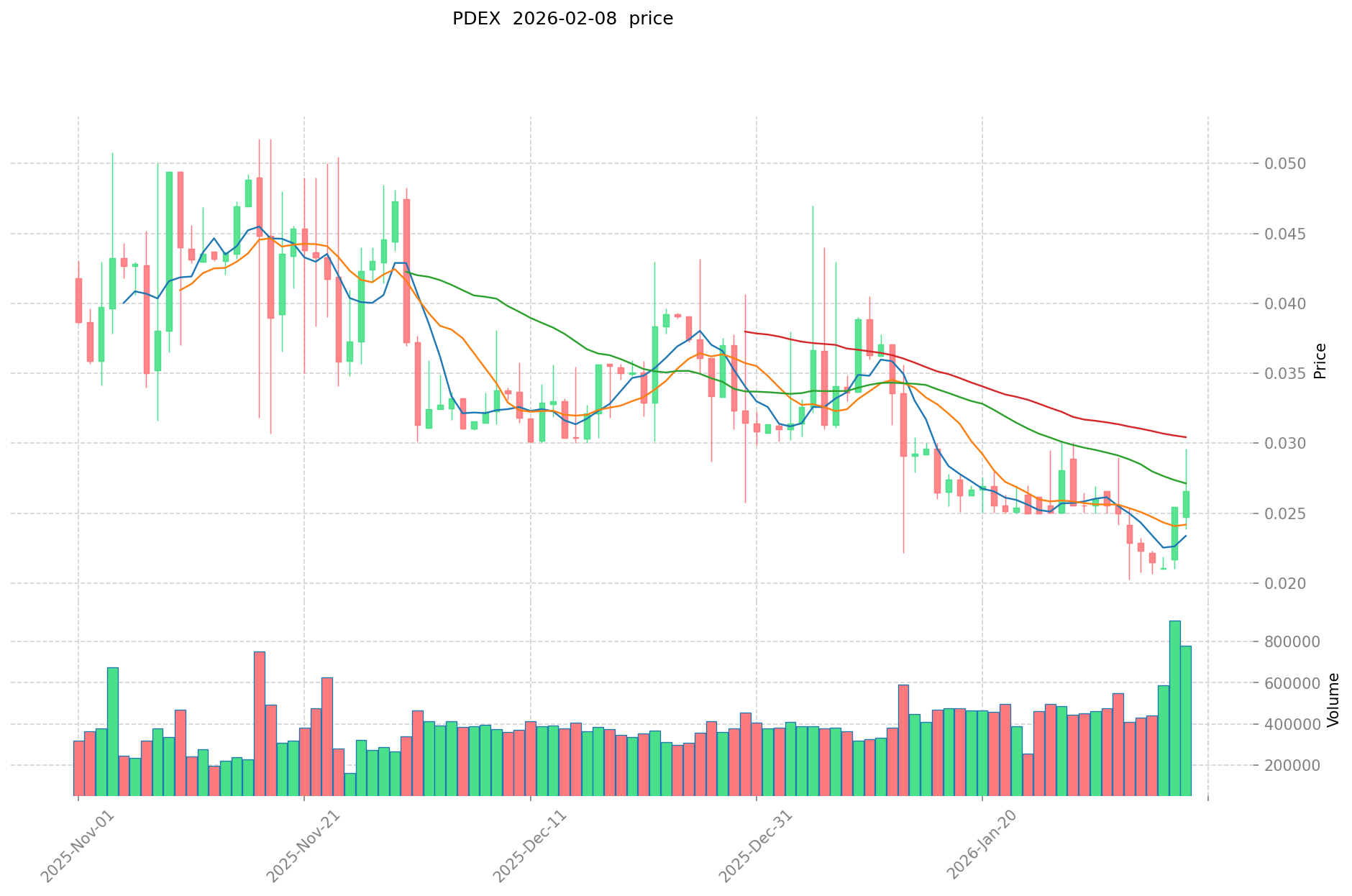
- 2025: Trading range fluctuated between approximately $0.04063 and $0.0429 → PDEX price demonstrated volatility characteristics typical of emerging decentralized exchange tokens
- Price movement: From peak levels observed in previous periods to current trading range around $0.02658 → Reflecting broader market cycles affecting decentralized exchange platforms
Current PDEX Investment Market Status (February 2026)
- PDEX Current Price: $0.02658
- 24-hour Trading Volume: $10,251.37
- Market Capitalization: $198,286.80
- Circulating Supply: 7,460,000 PDEX (37.3% of maximum supply)
- Total Supply: 7,460,000 PDEX
- Maximum Supply: 20,000,000 PDEX
Click to view real-time PDEX market price
II. Core Factors Affecting Whether PDEX is a Good Investment (Is Polkadex(PDEX) a Good Investment)
Supply Mechanism and Scarcity (PDEX Investment Scarcity)
- Maximum supply of 20,000,000 PDEX with current circulating supply of 7,460,000 (37.3% circulation ratio) → impacts price dynamics and investment considerations
- Historical price patterns: PDEX traded at $39.38 during 2021, while recent price levels around $0.02658 reflect significant market adjustment
- Investment perspective: The fixed maximum supply mechanism establishes a supply ceiling, though current low circulation ratio indicates substantial future supply potential
Institutional Investment and Mainstream Adoption (Institutional Investment in PDEX)
- Holder base: 4,258 addresses currently hold PDEX
- Exchange availability: Listed on 2 exchanges with Gate.com among active trading platforms
- Market positioning: Polkadex's orderbook-based decentralized exchange model and Fluid Swap Protocol (FSP) aim to bridge centralized exchange user experience with decentralized infrastructure
Macroeconomic Environment's Impact on PDEX Investment
- Broader crypto market conditions influence PDEX performance, as evidenced by correlation between market sentiment and price movements
- Risk appetite in digital asset markets → affects altcoin investment attractiveness
- Regulatory developments for decentralized exchanges → may impact project adoption trajectory
Technology and Ecosystem Development (Technology & Ecosystem for PDEX Investment)
- Substrate framework foundation: Built on Polkadot's Substrate blockchain framework → provides technical infrastructure for cross-chain interoperability
- Orderbook model differentiation: Combines orderbook trading mechanism with decentralized architecture → targets traders seeking centralized exchange features with self-custody benefits
- Fluid Swap Protocol (FSP): Core technical innovation designed to enhance liquidity provision and trading experience
III. PDEX Future Investment Forecast and Price Outlook (Is Polkadex(PDEX) worth investing in 2026-2031)
Short-term Investment Forecast (2026, short-term PDEX investment outlook)
- Conservative forecast: $0.0226 - $0.0266
- Neutral forecast: $0.0266 - $0.0286
- Optimistic forecast: $0.0286 - $0.0306
Mid-term Investment Outlook (2027-2028, mid-term Polkadex(PDEX) investment forecast)
- Market phase expectations: The token may experience gradual recovery with moderate volatility, reflecting potential ecosystem development and broader market conditions.
- Investment return forecast:
- 2027: $0.0254 - $0.0386
- 2028: $0.0222 - $0.0467
- Key catalysts: Platform adoption trends, overall crypto market sentiment, and technological developments within the Polkadex ecosystem.
Long-term Investment Outlook (Is PDEX a good long-term investment?)
- Base scenario: $0.0236 - $0.0542 (assuming steady platform development and moderate market growth)
- Optimistic scenario: $0.0461 - $0.0684 (assuming enhanced ecosystem adoption and favorable market conditions)
- Risk scenario: $0.0184 - $0.0254 (under adverse market conditions or reduced platform traction)
Click to view PDEX long-term investment and price prediction: Price Prediction
2026-2031 Long-term Outlook
- Base scenario: $0.0236 - $0.0542 (corresponding to steady progress and gradual mainstream application enhancement)
- Optimistic scenario: $0.0461 - $0.0684 (corresponding to large-scale adoption and favorable market environment)
- Transformative scenario: Above $0.0684 (in case of breakthrough ecosystem developments and mainstream adoption)
- 2031-12-31 predicted high: $0.0670 (based on optimistic development assumptions)
Disclaimer: The above forecasts are based on historical data and market analysis models. Cryptocurrency markets are highly volatile and subject to numerous unpredictable factors. Past performance does not guarantee future results. This content does not constitute investment advice, and investors should conduct independent research and consult professional advisors before making investment decisions.
| Year |
Predicted High Price |
Predicted Average Price |
Predicted Low Price |
Price Change |
| 2026 |
0.030567 |
0.02658 |
0.022593 |
0 |
| 2027 |
0.038574225 |
0.0285735 |
0.025430415 |
7 |
| 2028 |
0.046667668875 |
0.0335738625 |
0.02215874925 |
26 |
| 2029 |
0.054163033678125 |
0.0401207656875 |
0.023671251755625 |
50 |
| 2030 |
0.068355754540078 |
0.047141899682812 |
0.041013452724046 |
77 |
| 2031 |
0.066988639449276 |
0.057748827111445 |
0.046199061689156 |
117 |
IV. Polkadex Investment Strategy and Risk Management (How to invest in Polkadex)
Investment Methodology (Polkadex investment strategy)
Long-term Holding (HODL PDEX)
Long-term holding represents a conservative approach suitable for investors who believe in the fundamental value proposition of decentralized exchanges built on Substrate framework. This strategy involves:
- Accumulation during market corrections: Investors may consider gradual position building during periods of price decline
- Multi-year time horizon: Holding through market cycles to potentially benefit from ecosystem development
- Regular portfolio review: Periodic assessment of project progress and technological advancement
This approach suits investors who:
- Have lower risk tolerance for short-term volatility
- Believe in the long-term adoption of decentralized trading platforms
- Prefer passive investment strategies with minimal active management
Active Trading
Active trading strategies rely on technical analysis and market timing:
- Swing trading: Capitalizing on short to medium-term price movements based on chart patterns and indicators
- Range trading: Identifying support and resistance levels for entry and exit points
- Momentum trading: Following established trends with appropriate stop-loss mechanisms
This approach requires:
- Strong understanding of technical analysis tools
- Ability to monitor markets regularly
- Disciplined risk management protocols
Risk Management (Risk management for PDEX investment)
Asset Allocation Ratios
Conservative Investors (1-3% portfolio allocation)
- Limited exposure to volatile assets
- Primary focus on established cryptocurrencies with PDEX as minor allocation
- Suitable for risk-averse individuals prioritizing capital preservation
Moderate Investors (3-7% portfolio allocation)
- Balanced approach between growth potential and risk control
- Diversified across multiple blockchain projects
- Regular rebalancing based on performance metrics
Aggressive Investors (7-15% portfolio allocation)
- Higher tolerance for volatility in exchange for potential returns
- Active portfolio management and frequent rebalancing
- Deep understanding of DeFi and DEX ecosystem dynamics
Risk Hedging Solutions
Multi-asset Portfolio Construction
- Combining PDEX with established assets (BTC, ETH) to reduce correlation risk
- Including stablecoins for liquidity and downside protection
- Sector diversification across DeFi, infrastructure, and application layers
Hedging Instruments
- Stop-loss orders to limit downside exposure
- Position sizing based on volatility metrics
- Gradual entry and exit strategies to minimize timing risk
Secure Storage Solutions
Cold Wallet Storage
- Hardware wallets (Ledger, Trezor) for long-term holdings
- Paper wallets for offline storage of private keys
- Air-gapped computers for maximum security
Hot Wallet Management
- Exchange wallets for active trading positions only
- Software wallets with multi-signature capabilities
- Regular security audits and password updates
Recommended Hardware Wallets
- Ledger Nano X: Multi-currency support with Bluetooth connectivity
- Trezor Model T: Touchscreen interface with Substrate compatibility
- SafePal S1: Air-gapped cold storage with QR code transactions
V. Polkadex Investment Risks and Challenges (Risks of investing in Polkadex)
Market Risk
High Volatility Characteristics
PDEX has demonstrated significant price fluctuations:
- 24-hour price movement of 4.03%
- 30-day decline of 31.75%
- 1-year decrease of 79.79%
These metrics indicate substantial volatility that investors must be prepared to withstand. Price movements can be influenced by:
- Overall cryptocurrency market sentiment
- Trading volume concentration (daily volume of $10,251.37)
- Limited exchange availability (listed on 2 exchanges)
Market Manipulation Concerns
With a relatively small market capitalization of $198,286.80 and limited liquidity:
- Potential for price manipulation by large holders
- Susceptibility to coordinated trading activities
- Impact of whale movements on price stability
The circulating supply of 7,460,000 PDEX (37.3% of max supply) suggests concentrated ownership patterns that may amplify volatility.
Regulatory Risk
International Policy Uncertainty
Decentralized exchanges face evolving regulatory frameworks:
Jurisdictional Variations
- Different countries maintain diverse approaches to DEX regulation
- KYC/AML requirements may impact decentralized trading platforms
- Securities classification uncertainty for utility tokens
Potential Regulatory Impacts
- Trading restrictions in specific jurisdictions
- Compliance requirements affecting platform operations
- Licensing obligations for decentralized protocols
Ongoing Developments
- Global coordination efforts on crypto regulation
- National security considerations regarding blockchain technology
- Tax treatment variations across different regions
Technical Risk
Network Security Vulnerabilities
As a Substrate-based platform, Polkadex faces several technical considerations:
Smart Contract Risks
- Potential bugs in protocol code
- Vulnerability to exploit attacks
- Dependency on underlying Substrate framework security
Blockchain Infrastructure Risks
- Network congestion affecting transaction processing
- Validator set centralization concerns
- Cross-chain bridge security for interoperability
Upgrade Failure Scenarios
Protocol Development Risks
- Failed runtime upgrades disrupting network operations
- Backward compatibility issues with existing features
- Community governance disagreements on upgrade proposals
Technical Debt Accumulation
- Legacy code maintenance challenges
- Integration complexity with evolving Substrate framework
- Testing limitations for complex decentralized systems
Migration Challenges
- User transition to new protocol versions
- Liquidity fragmentation during upgrade periods
- Documentation and developer tool synchronization
VI. Conclusion: Is Polkadex a Good Investment?
Investment Value Summary
Polkadex presents a mixed investment profile characterized by innovative technology and significant volatility. The platform's Substrate-based architecture and fluid exchange protocol (FSP) offer technical differentiation in the DEX space. However, investors should carefully weigh several factors:
Potential Considerations:
- Technological foundation built on proven Substrate framework
- Focused approach on improving DEX user experience through order book functionality
- Early-stage development with 37.3% of maximum supply in circulation
Challenging Factors:
- Substantial price decline of 79.79% over one year
- Limited market capitalization of $198,286.80
- Restricted exchange availability (2 platforms)
- High volatility evidenced by 31.75% decline in 30 days
Investor Recommendations
✅ Beginners
Dollar-Cost Averaging (DCA) Strategy
- Invest fixed amounts at regular intervals to mitigate timing risk
- Start with minimal allocation (0.5-1% of portfolio)
- Focus on understanding platform fundamentals before increasing exposure
Secure Storage Practices
- Utilize hardware wallets for all holdings
- Maintain backup seed phrases in multiple secure locations
- Avoid keeping assets on exchanges except for active trading
Educational Foundation
- Study DEX mechanics and Substrate ecosystem
- Monitor project development through official channels
- Understand basic technical analysis before trading
✅ Experienced Investors
Swing Trading Approach
- Identify support and resistance levels for entry/exit points
- Implement strict stop-loss protocols (5-10% below entry)
- Monitor on-chain metrics and trading volume patterns
Portfolio Configuration
- Maintain 3-5% allocation within cryptocurrency portfolio
- Combine with established assets for risk balancing
- Regular rebalancing based on performance thresholds
Risk Management Framework
- Position sizing based on volatility metrics
- Hedging strategies using correlated assets
- Profit-taking protocols at predetermined levels
✅ Institutional Investors
Strategic Long-term Allocation
- Conduct thorough due diligence on technology and team
- Assess market positioning within DEX competitive landscape
- Evaluate tokenomics and supply distribution dynamics
Governance Participation
- Engage with protocol governance mechanisms
- Contribute to development roadmap discussions
- Monitor regulatory developments affecting DEX platforms
Portfolio Integration
- Include within broader DeFi infrastructure allocation
- Maintain professional custody solutions
- Implement compliance frameworks for regulatory adherence
⚠️ Important Disclaimer
Cryptocurrency investments carry substantial risk due to price volatility, regulatory uncertainty, and technological complexities. Historical price performance, including PDEX's decline from $39.38 to $0.02658, demonstrates potential for significant capital loss. This analysis is provided for informational purposes only and does not constitute investment advice, financial guidance, or recommendations to buy, sell, or hold any asset. Investors should:
- Conduct independent research and due diligence
- Consult qualified financial advisors
- Only invest amounts they can afford to lose
- Understand the technical and regulatory risks involved
- Stay informed about project developments and market conditions
Past performance does not indicate future results. The cryptocurrency market remains highly speculative and suitable only for investors who thoroughly understand the associated risks.
VII. FAQ
Q1: What is Polkadex (PDEX) and what makes it different from other decentralized exchanges?
Polkadex is an open-source decentralized trading platform built on the Substrate blockchain framework that combines order book functionality with decentralized architecture. Unlike typical automated market maker (AMM) based DEXs, Polkadex utilizes an order book system to provide traders with a centralized exchange-like user experience while maintaining self-custody benefits. Its distinctive Fluid Exchange Protocol (FSP) is designed to enhance liquidity provision and trading experience, bridging the gap between centralized exchange features and decentralized infrastructure through its Substrate foundation, which also enables cross-chain interoperability.
Q2: What is PDEX's current market position and how has its price performed historically?
As of February 2026, PDEX maintains a market capitalization of approximately $198,286.80 with a current price around $0.02658. The token has experienced significant volatility since its launch in 2021, when it traded at $39.38. Recent performance shows substantial declines: a 79.79% decrease over one year, a 31.75% decline over 30 days, and a 4.03% movement in 24 hours. With 7,460,000 tokens in circulation (37.3% of the 20,000,000 maximum supply), 4,258 holders, and listing on 2 exchanges, PDEX represents a small-cap asset with limited liquidity and high volatility characteristics typical of emerging decentralized exchange tokens.
Q3: What are the price predictions for PDEX from 2026 to 2031?
Short-term forecasts for 2026 range from $0.0226 to $0.0306 depending on market conditions. Mid-term outlook suggests potential recovery with 2027 predictions between $0.0254-$0.0386 and 2028 estimates at $0.0222-$0.0467. Long-term projections through 2031 vary significantly by scenario: base case estimates $0.0236-$0.0542, optimistic scenario projects $0.0461-$0.0684, while risk scenarios suggest $0.0184-$0.0254. The predicted high for December 2031 stands at $0.0670 under optimistic development assumptions. These forecasts reflect potential ecosystem development, platform adoption trends, and broader market conditions, though cryptocurrency markets remain highly unpredictable and past performance does not guarantee future results.
Q4: What investment strategies are recommended for different types of PDEX investors?
For beginners, a dollar-cost averaging (DCA) strategy with 0.5-1% portfolio allocation is recommended, focusing on secure hardware wallet storage and fundamental education. Experienced investors may consider swing trading approaches with 3-5% allocation, implementing strict stop-loss protocols (5-10% below entry) and regular rebalancing based on performance thresholds. Institutional investors should conduct thorough due diligence, engage with protocol governance, and maintain professional custody solutions while integrating PDEX within broader DeFi infrastructure allocations. Conservative investors should limit exposure to 1-3%, moderate investors to 3-7%, and aggressive investors may allocate 7-15%, always combined with established cryptocurrencies and proper risk hedging instruments.
Q5: What are the main risks associated with investing in Polkadex?
PDEX investment carries substantial risks across multiple dimensions. Market risks include high volatility (79.79% annual decline), limited liquidity with daily volume of only $10,251.37, and potential price manipulation due to the small $198,286.80 market capitalization. Regulatory risks involve evolving frameworks for decentralized exchanges, KYC/AML requirements, and jurisdictional variations in crypto regulation. Technical risks encompass smart contract vulnerabilities, network security concerns on the Substrate framework, protocol upgrade failure scenarios, and cross-chain bridge security issues. The concentrated ownership pattern (37.3% circulating supply) amplifies volatility, while limited exchange availability (2 platforms) restricts liquidity and market access for investors.
Q6: How should investors securely store their PDEX tokens?
For long-term holdings, cold wallet storage using hardware wallets such as Ledger Nano X, Trezor Model T, or SafePal S1 is recommended, providing maximum security through offline private key storage. Hardware wallets offer multi-currency support and Substrate compatibility while protecting against online threats. Investors should maintain backup seed phrases in multiple secure locations and never store these digitally. For active trading positions, hot wallets with multi-signature capabilities may be used, but only minimal amounts should remain on exchanges. Additional security measures include regular password updates, security audits, and consideration of air-gapped computers for high-value holdings. Paper wallets represent another offline storage option for technically proficient users.
Q7: What factors could drive PDEX price appreciation in the future?
Several catalysts could potentially influence PDEX's future price trajectory. Technological developments include successful implementation of the Fluid Swap Protocol (FSP), ecosystem expansion on the Substrate framework, and enhanced cross-chain interoperability features. Platform adoption factors encompass increased trading volume, growing user base beyond the current 4,258 holders, and additional exchange listings beyond the current 2 platforms. Market conditions such as broader cryptocurrency bull markets, increased interest in decentralized exchanges, and favorable regulatory clarity for DEX platforms could provide supportive environments. The fixed maximum supply of 20,000,000 PDEX establishes scarcity dynamics, though the current 37.3% circulation ratio indicates substantial future supply potential that investors should consider.
Q8: Is Polkadex suitable as a long-term investment for 2026-2031?
Polkadex presents a high-risk, speculative investment profile suitable only for investors with strong risk tolerance and thorough understanding of DeFi and DEX ecosystems. The platform's innovative Substrate-based architecture and order book functionality offer technical differentiation, but significant challenges include the 79.79% annual price decline, limited market capitalization of $198,286.80, and restricted liquidity. Long-term suitability depends on individual risk tolerance, portfolio diversification, and belief in the project's fundamental value proposition. Conservative investors should avoid or maintain minimal exposure (1-3%), while aggressive investors comfortable with potential total loss may consider higher allocations (7-15%) as part of a diversified cryptocurrency portfolio. Investors should only allocate capital they can afford to lose and conduct independent research before making investment decisions.
* The information is not intended to be and does not constitute financial advice or any other recommendation of any sort offered or endorsed by Gate.