This comprehensive guide examines whether Polkadot (DOT) represents a viable investment opportunity in 2024. Currently trading near $2.16 with a market capitalization of $3.58 billion, DOT has evolved as a multi-chain blockchain platform addressing cross-chain interoperability challenges. The article analyzes DOT's historical price performance, ranging from $1.76 at launch to a 2021 peak of $54.98, alongside current market dynamics including neutral sentiment indicators and $830.88 million daily trading volume. Key investment factors include the September 2025 supply cap at 2.1 billion tokens, institutional adoption patterns, macroeconomic influences, and Polkadot 2.0 technological upgrades. The guide presents multiple price scenarios through 2030, ranging from $1.65 to $5.35, while detailing proven investment strategies for various investor profiles. Critical risk assessments cover market volatility, regulatory uncertainties, and technical vulnerabilities. Comprehensive recommendations address beginner, expe
Introduction: Polkadot (DOT)'s Investment Position and Market Prospects
DOT is a significant asset in the cryptocurrency field. Since its launch in 2019, it has achieved notable development in blockchain interoperability and cross-chain communication. As of 2026, Polkadot holds a market capitalization of approximately $3.58 billion, with a circulating supply of around 1.65 billion tokens, and the current price remains near $2.16. With its positioning as a multi-chain network connecting various blockchains, DOT has gradually become a focal point for investors discussing "Is Polkadot (DOT) a good investment?" This article will comprehensively analyze Polkadot's investment value, historical trends, future price forecasts, and investment risks to provide reference for investors.
I. Polkadot (DOT) Price History Review and Current Investment Value Status
- 2020: Polkadot launched with an initial price around $1.76 → Early investors experienced significant opportunities during the network's mainnet rollout phase
- 2021: Market cycle peak occurred in November → DOT reached a significant price level of $54.98 during the broader crypto market expansion
- 2025: Current market cycle → Price declined from previous peaks to approximately $2.16, reflecting broader market adjustment patterns
Current DOT Investment Market Status (January 2026)
- DOT current price: $2.161
- Market sentiment (Fear & Greed Index): Data indicates neutral sentiment as measured by market emotion indicator value of 1
- 24-hour trading volume: $830,883,008.64
- Circulating supply: 1,654,835,616.193019 DOT with a market capitalization of $3,576,099,766.59
Click to view real-time DOT market price
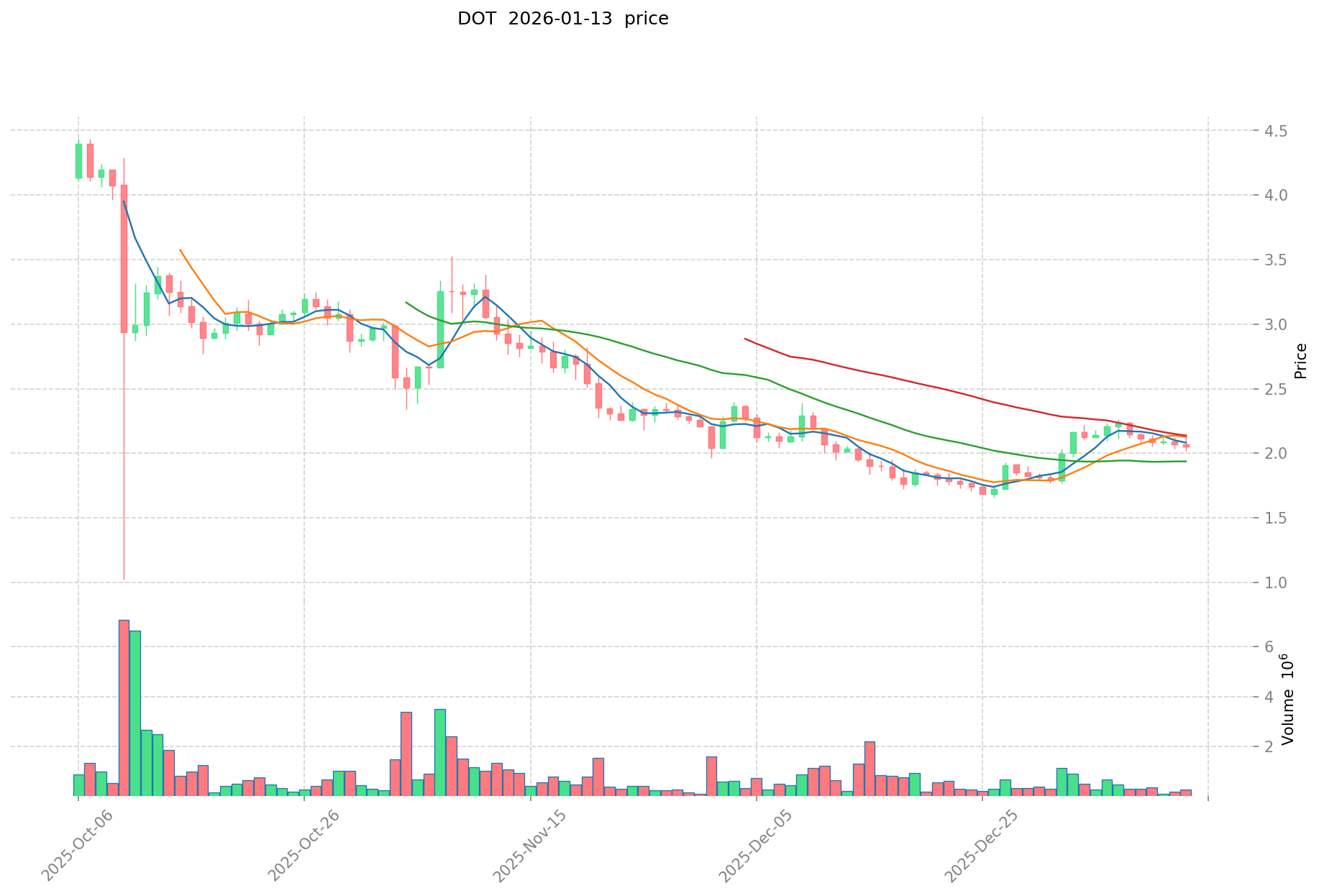
II. Core Factors Affecting Whether DOT is a Good Investment (Is Polkadot(DOT) a Good Investment)
Supply Mechanism and Scarcity (DOT investment scarcity)
- Supply Cap Implementation → Influences Price and Investment Value
- Historical Pattern: In September 2025, Polkadot's community approved Referendum 1710 with approximately 81% support to impose a hard cap on the total DOT supply at 2.1 billion tokens, replacing the previous unlimited issuance model. This shift from unlimited to capped supply represents a structural change that may affect the token's scarcity profile.
- Investment Significance: Scarcity characteristics resulting from supply mechanisms serve as one of several considerations in long-term investment evaluation.
Institutional Investment and Mainstream Adoption (Institutional investment in DOT)
- Market Position: As of January 13, 2026, DOT ranks 36th by market capitalization with approximately 1,322,473 holders.
- Adoption Context: The broader cryptocurrency market showed varied investor preferences, with interest rate cuts in 2024 and 2025 driving some investors toward established tokens, while Polkadot and similar projects experienced different adoption dynamics.
- Ecosystem Development: The network continues to operate with active development efforts, though market reception has varied over time.
Macroeconomic Environment's Impact on DOT Investment
- Monetary Policy Context: Interest rate adjustments in 2024 and 2025 influenced capital flows within the cryptocurrency sector, with varying effects on different asset categories.
- Market Dynamics: Rising interest rates in 2022 and 2023 contributed to shifts in investor preferences across speculative investments, while subsequent rate cuts presented different market conditions.
- Broader Market Influence: DOT's price movements have shown correlation with broader cryptocurrency market trends, regulatory developments, and investor sentiment patterns.
Technology and Ecosystem Development (Technology & Ecosystem for DOT investment)
- Polkadot 2.0 Upgrades: The network has pursued technical enhancements aimed at establishing foundations for JAM (join-accumulate machine), a planned transition to replace its relay chain with what is described as a decentralized computing infrastructure.
- Architecture Design: Polkadot's technical framework was structured to support cross-chain interoperability, positioning itself as infrastructure for blockchain connectivity.
- Ecosystem Applications: The network's governance model enables DOT token holders to participate in decision-making processes, while the platform supports various decentralized applications, though the translation of technical capabilities into measurable economic activity remains an ongoing development consideration.
III. DOT Future Investment Forecast and Price Outlook (Is Polkadot(DOT) Worth Investing in 2026-2030)
Short-term Investment Forecast (2026, Short-term DOT Investment Outlook)
Based on market analysis, DOT's short-term price outlook for 2026 presents varied scenarios. Conservative estimates suggest DOT may trade within a range of $1.77 to $2.18, reflecting cautious market sentiment. Neutral forecasts indicate potential trading between $2.18 and $2.71, aligning with moderate growth expectations. Optimistic projections point toward a range of $2.71 to $3.25, assuming favorable market conditions and increased adoption.
Technical indicators present mixed signals, with some metrics suggesting neutral positioning while others indicate potential resistance levels. The price movement appears influenced by broader market dynamics and ecosystem development progress.
Mid-term Investment Outlook (2027-2028, Mid-term Polkadot(DOT) Investment Forecast)
The mid-term outlook for DOT suggests gradual evolution across 2027-2028. Market analysis indicates potential fluctuations reflecting ecosystem maturity and adoption patterns.
- Investment Return Forecast:
- 2027: Price range between $2.36 and $3.12, with an average around $2.72
- 2028: Potential range spanning $2.10 to $3.56, with mid-point estimates near $2.92
Key factors that may influence mid-term performance include ecosystem expansion, cross-chain functionality enhancements, developer activity levels, and overall cryptocurrency market sentiment. The period may represent a consolidation phase with selective growth opportunities.
Long-term Investment Outlook (Is DOT a Good Long-term Investment?)
Long-term projections for DOT through 2030 suggest multiple potential scenarios based on varying market conditions and adoption trajectories.
- Baseline Scenario: $2.39 - $3.47 (assuming steady development and moderate market conditions)
- Optimistic Scenario: $3.47 - $3.82 (contingent on accelerated adoption and favorable market environment)
- Risk Scenario: $1.65 - $2.39 (under challenging market conditions or delayed ecosystem development)
Click to view DOT long-term investment and price forecast: Price Prediction
2026-01-13 to 2030 Long-term Outlook
- Base Scenario: $2.39 - $3.47 (corresponding to steady progress and mainstream application advancement)
- Optimistic Scenario: $3.47 - $3.82 (corresponding to large-scale adoption and favorable market environment)
- Transformative Scenario: Above $5.35 (contingent on breakthrough ecosystem developments and mainstream adoption)
- 2030-12-31 Projected High: $3.82 (based on optimistic development assumptions)
Disclaimer: These projections are analytical estimates based on available market data and historical patterns. Cryptocurrency markets exhibit high volatility and uncertainty. Past performance does not guarantee future results. These forecasts should not be construed as investment advice. Investors should conduct thorough independent research and consider their risk tolerance before making investment decisions.
| Year |
Predicted High Price |
Predicted Average Price |
Predicted Low Price |
Price Change |
| 2026 |
3.25118 |
2.182 |
1.76742 |
2 |
| 2027 |
3.1240785 |
2.71659 |
2.3634333 |
27 |
| 2028 |
3.562807785 |
2.92033425 |
2.10264066 |
36 |
| 2029 |
3.69539095995 |
3.2415710175 |
1.653201218925 |
51 |
| 2030 |
3.8153290875975 |
3.468480988725 |
2.39325188222025 |
62 |
| 2031 |
5.353600406097037 |
3.64190503816125 |
3.35055263510835 |
70 |
IV. Polkadot Investment Strategy and Risk Management (How to invest in Polkadot)
Investment Strategy (Polkadot investment strategy)
Long-term Holding (HODL DOT)
Long-term holding represents a fundamental investment approach suitable for conservative investors who prefer stability over active trading. This strategy involves purchasing Polkadot tokens and maintaining positions through market cycles, capitalizing on the project's long-term technological development and ecosystem expansion. Given Polkadot's infrastructure-focused nature and its role in connecting multiple blockchain networks, patient investors may benefit from the gradual maturation of the broader multi-chain ecosystem.
This approach requires minimal time commitment for portfolio monitoring and reduces exposure to short-term price fluctuations. Investors adopting this strategy typically focus on fundamental factors such as network upgrades, parachain deployments, and ecosystem growth rather than daily price movements.
Active Trading
Active trading strategies rely on technical analysis and swing trading techniques to capitalize on Polkadot's price movements. Traders employing this methodology typically analyze chart patterns, trading volumes, support and resistance levels, and various technical indicators to identify entry and exit points.
Given DOT's 24-hour price change of 5.57% and historical volatility, active traders may find opportunities in both upward and downward price swings. This approach demands significant time investment, market knowledge, and emotional discipline to execute trades effectively while managing risk exposure.
Risk Management (Risk management for DOT investment)
Asset Allocation Ratios
Conservative Investors: May consider allocating 1-5% of their cryptocurrency portfolio to DOT, maintaining majority positions in more established assets while gaining limited exposure to Polkadot's ecosystem potential.
Aggressive Investors: Could allocate 10-20% of their cryptocurrency holdings to DOT, accepting higher volatility in exchange for potential returns from ecosystem development and network growth.
Professional Investors: Might maintain 5-15% allocation as part of a diversified blockchain infrastructure portfolio, adjusting positions based on market conditions, technical developments, and macro trends.
Risk Hedging Solutions
Implementing a multi-asset portfolio approach helps mitigate concentration risk. Investors may consider combining DOT holdings with other blockchain infrastructure projects, stablecoins, and traditional risk-off assets. Utilizing hedging instruments such as options or futures contracts (where available) can provide downside protection during periods of elevated market volatility.
Portfolio rebalancing at predetermined intervals ensures that DOT exposure remains within target allocation ranges, preventing overconcentration during price rallies and maintaining adequate exposure during corrections.
Secure Storage Solutions
Secure storage of DOT tokens requires careful consideration of custody options:
Hot Wallets: Suitable for active traders requiring frequent access, though they carry higher security risks due to internet connectivity. Users should enable all available security features including two-factor authentication and withdrawal whitelisting.
Cold Wallets: Recommended for long-term holders, cold storage solutions keep private keys offline, significantly reducing exposure to online threats. Paper wallets and offline-generated key pairs provide maximum security for dormant holdings.
Hardware Wallets: Represent the optimal balance between security and accessibility. Devices from reputable manufacturers offer robust protection against malware and phishing attacks while allowing periodic access for staking or transfers. Hardware wallets are particularly recommended for holdings representing significant value.
V. Polkadot Investment Risks and Challenges (Risks of investing in Polkadot)
Market Risks
High Volatility: DOT exhibits substantial price fluctuations characteristic of cryptocurrency markets. The token's 1-year performance showing a -67.31% change demonstrates the significant downside potential during bearish market conditions. The 24-hour trading range between $2.02 and $2.159 illustrates short-term price instability that can impact portfolio values.
Investors should anticipate continued volatility driven by factors including overall cryptocurrency market sentiment, Bitcoin correlation, macroeconomic conditions, and project-specific developments. Such volatility creates both trading opportunities and risks of substantial capital loss during adverse market movements.
Price Manipulation Concerns: With a 24-hour trading volume of approximately $830.88 million and listings on 67 exchanges, DOT maintains reasonable liquidity. However, like all cryptocurrency markets, risks of coordinated trading activity, wash trading, and artificial volume inflation exist, potentially distorting true price discovery mechanisms.
Regulatory Risks
Cryptocurrency regulatory frameworks vary significantly across jurisdictions, creating uncertainty for Polkadot investors. Different countries maintain divergent approaches ranging from supportive innovation policies to restrictive or prohibitive regulations. Changes in regulatory stances can materially impact DOT's accessibility, trading volumes, and valuation.
Potential regulatory developments include classification changes (security versus commodity), tax treatment modifications, restrictions on staking activities, and limitations on exchange listings. Investors must monitor regulatory developments in their jurisdictions and consider the impact of international regulatory trends on global cryptocurrency markets.
The evolving nature of blockchain regulation introduces ongoing uncertainty that may affect Polkadot's operational flexibility, expansion capabilities, and market acceptance.
Technical Risks
Network Security Vulnerabilities: While Polkadot employs sophisticated security mechanisms, all blockchain networks face potential vulnerabilities. Smart contract bugs, consensus mechanism weaknesses, or unforeseen attack vectors could compromise network security, potentially resulting in token value erosion or temporary network disruptions.
The complexity of Polkadot's architecture, including its relay chain and parachain structure, introduces additional surface area for potential security issues compared to simpler blockchain designs.
Upgrade Implementation Risks: Blockchain networks regularly implement protocol upgrades to enhance functionality, improve performance, or address security concerns. Failed upgrades, contentious hard forks, or implementation delays can create network instability, community fragmentation, and temporary price volatility.
Technical risks also encompass potential competition from alternative interoperability solutions, technological obsolescence, or failure to achieve anticipated network effects necessary for long-term success.
VI. Conclusion: Is Polkadot a Good Investment?
Investment Value Summary
Polkadot presents a compelling proposition within the blockchain infrastructure sector, offering a technical foundation for multi-chain interoperability. The project's focus on connecting independent blockchains through its relay chain architecture addresses genuine challenges within the fragmented blockchain ecosystem.
Long-term investment potential centers on Polkadot's ability to execute its technical roadmap, attract quality parachain projects, and establish itself as essential infrastructure for decentralized applications requiring cross-chain functionality. The network's governance model and staking mechanism provide utility beyond speculation, potentially supporting token value through network participation.
However, short-term price volatility remains pronounced, as evidenced by significant price fluctuations across various timeframes. The token's -67.31% performance over the past year reflects broader cryptocurrency market challenges and project-specific factors requiring careful consideration.
Current market capitalization of approximately $3.58 billion positions DOT as a mid-cap cryptocurrency asset, suggesting established market presence while maintaining growth potential relative to larger competitors.
Investor Recommendations
✅ Beginners
- Consider dollar-cost averaging (DCA) strategies to mitigate timing risk and reduce emotional decision-making impact
- Prioritize secure storage using hardware wallets from reputable manufacturers
- Limit DOT allocation to a small percentage of overall portfolio (1-5%) until gaining market experience
- Focus on understanding Polkadot's technology and ecosystem before increasing position sizes
- Avoid leverage and derivative products until developing comprehensive market knowledge
✅ Experienced Investors
- Implement swing trading strategies based on technical analysis and market cycle recognition
- Maintain diversified cryptocurrency holdings including DOT alongside other infrastructure projects
- Consider staking options to generate yield on holdings while supporting network security
- Monitor network developments, parachain auctions, and ecosystem growth metrics
- Adjust position sizing based on overall market conditions and DOT-specific catalysts
✅ Institutional Investors
- Evaluate DOT as part of strategic long-term blockchain infrastructure allocation
- Conduct thorough due diligence on regulatory compliance across operational jurisdictions
- Implement professional custody solutions with appropriate insurance coverage
- Consider governance participation through staking and voting mechanisms
- Monitor correlation with traditional asset classes and broader cryptocurrency markets for portfolio optimization
⚠️ Disclaimer: Cryptocurrency investments carry substantial risk of capital loss. DOT exhibits high volatility, regulatory uncertainty, and technical risks that may result in significant value fluctuations. This analysis provides informational content only and does not constitute investment advice, financial guidance, or recommendations to buy, sell, or hold any cryptocurrency. Investors should conduct independent research, consider personal risk tolerance, and consult qualified financial advisors before making investment decisions. Past performance does not indicate future results.
VII. FAQ
Q1: Is Polkadot (DOT) a good investment in 2026?
Polkadot presents both opportunities and risks as an investment in 2026. The project offers established blockchain interoperability infrastructure with a market capitalization of approximately $3.58 billion and active development efforts. However, the token has experienced significant volatility, declining -67.31% over the past year to approximately $2.16. Investment suitability depends on individual risk tolerance, portfolio strategy, and investment timeline. Conservative investors might consider small allocations (1-5%) as part of diversified cryptocurrency holdings, while those with higher risk appetite may allocate larger portions (10-20%). The recent implementation of a 2.1 billion token supply cap and ongoing technical developments provide potential long-term catalysts, though short-term price movements remain unpredictable.
Q2: What are the price predictions for Polkadot (DOT) through 2030?
Price projections for DOT through 2030 suggest multiple scenarios based on varying market conditions. Short-term forecasts for 2026 indicate potential ranges from $1.77 (conservative) to $3.25 (optimistic). Mid-term projections for 2027-2028 estimate prices between $2.36-$3.12 (2027) and $2.10-$3.56 (2028). Long-term outlook through 2030 presents baseline scenarios of $2.39-$3.47, with optimistic projections reaching $3.82 and transformative scenarios potentially exceeding $5.35. These forecasts consider factors including ecosystem development, technological upgrades, adoption patterns, and broader cryptocurrency market trends. However, cryptocurrency markets exhibit high volatility and uncertainty, making precise predictions challenging. These projections should serve as analytical reference points rather than guaranteed outcomes.
Q3: What are the main risks of investing in Polkadot?
Polkadot investments carry several material risks requiring careful consideration. Market risks include high volatility, as demonstrated by significant price fluctuations and potential for substantial capital loss during adverse conditions. The token's 24-hour trading range and historical performance show considerable price instability. Regulatory risks stem from evolving cryptocurrency frameworks across jurisdictions, which may impact token accessibility, trading operations, and valuation. Technical risks encompass potential network security vulnerabilities, smart contract bugs, and upgrade implementation challenges inherent in complex blockchain architectures. Additionally, competition from alternative interoperability solutions and technological obsolescence present ongoing concerns. Price manipulation possibilities exist despite reasonable liquidity, and correlation with broader cryptocurrency market sentiment can amplify downside movements during bearish periods.
Q4: How should beginners approach Polkadot investment?
Beginners should adopt conservative strategies when investing in Polkadot. Dollar-cost averaging (DCA) provides an effective approach to mitigate timing risk by spreading purchases over regular intervals rather than attempting to identify optimal entry points. Initial allocations should remain modest (1-5% of cryptocurrency portfolio) until gaining market experience and understanding Polkadot's technology. Secure storage using hardware wallets from reputable manufacturers is essential to protect holdings from theft or loss. Beginners should prioritize education about Polkadot's architecture, ecosystem developments, and broader cryptocurrency market dynamics before increasing position sizes. Avoiding leverage and derivative products until developing comprehensive market knowledge helps prevent amplified losses. Monitoring network developments, parachain activities, and community governance provides valuable context for informed decision-making.
Q5: What investment strategies work best for Polkadot?
Two primary strategies suit different investor profiles for Polkadot holdings. Long-term holding (HODL) appeals to conservative investors focused on fundamental value and technological development rather than short-term price movements. This approach involves purchasing tokens and maintaining positions through market cycles, capitalizing on ecosystem maturation and network expansion over years. It requires minimal time commitment and reduces exposure to short-term volatility. Active trading strategies suit experienced investors comfortable with technical analysis and swing trading techniques. This approach involves analyzing chart patterns, trading volumes, and technical indicators to identify entry and exit points during DOT's price fluctuations. Given the token's historical volatility, active traders may find opportunities in both upward and downward movements, though this demands significant time investment, market knowledge, and emotional discipline.
Q6: What is the significance of Polkadot's supply cap implementation?
In September 2025, Polkadot's community approved Referendum 1710 with approximately 81% support to impose a hard cap on total DOT supply at 2.1 billion tokens. This represents a fundamental shift from the previous unlimited issuance model to a capped supply structure. The implementation affects token scarcity characteristics, potentially influencing long-term value dynamics through reduced supply inflation. This structural change aligns DOT with assets featuring fixed or capped supplies, though market reception and practical impact on price appreciation remain subject to broader adoption patterns and ecosystem development. The supply cap serves as one of several factors in long-term investment evaluation, alongside technological progress, network adoption, and competitive positioning within the blockchain infrastructure sector.
Q7: How does Polkadot's technology support its investment value?
Polkadot's technical architecture focuses on blockchain interoperability through its relay chain and parachain structure, enabling communication between independent blockchains. This positions the network as infrastructure for connecting fragmented blockchain ecosystems. The ongoing Polkadot 2.0 upgrades pursue enhancements including the JAM (join-accumulate machine) transition, aimed at establishing decentralized computing infrastructure. The platform's governance model enables DOT token holders to participate in decision-making processes through on-chain voting mechanisms. Technical capabilities support various decentralized applications requiring cross-chain functionality, though translation of these features into measurable economic activity represents an ongoing development consideration. Investment value ultimately depends on successful execution of the technical roadmap, attraction of quality parachain projects, and establishment of network effects necessary for sustained ecosystem growth.
Q8: What allocation percentages are appropriate for different investor types?
Allocation recommendations vary significantly based on investor experience and risk tolerance. Conservative investors may consider allocating 1-5% of their cryptocurrency portfolio to DOT, maintaining majority positions in more established assets while gaining limited exposure to Polkadot's ecosystem potential. Aggressive investors with higher risk tolerance could allocate 10-20% of cryptocurrency holdings to DOT, accepting greater volatility in exchange for potential returns from network development. Professional investors might maintain 5-15% allocation as part of diversified blockchain infrastructure portfolios, adjusting positions based on market conditions, technical developments, and macroeconomic trends. These ranges serve as general guidelines; actual allocations should reflect individual financial circumstances, investment goals, risk capacity, and overall portfolio composition. Regular rebalancing helps maintain target allocations and prevents overconcentration during price rallies or excessive underexposure during corrections.
* The information is not intended to be and does not constitute financial advice or any other recommendation of any sort offered or endorsed by Gate.