This comprehensive guide examines whether Polyhedra Network (ZKJ) represents a viable investment opportunity within the zero-knowledge proof infrastructure sector. The article analyzes ZKJ's current market position, including its $15.49 million market capitalization and $0.0358 price as of January 2026, alongside its technological foundation powered by zkBridge—a cross-chain protocol processing over 20 million transactions across 25+ Layer-1 and Layer-2 networks. The analysis covers ZKJ's price history from its March 2024 launch, presents price forecasts ranging from conservative to optimistic scenarios through 2031, and outlines investment methodologies for different investor profiles. A detailed risk assessment addresses market volatility (98.15% decline since launch), regulatory uncertainty, and technical vulnerabilities inherent to cross-chain bridge protocols. The guide provides actionable investment strategies, portfolio allocation recommendations spanning 1-15% depending on risk tolerance, and security
Introduction: Polyhedra Network (ZKJ) Investment Position and Market Outlook
ZKJ is a cryptocurrency asset in the blockchain interoperability sector, launched in March 2024. As of January 24, 2026, Polyhedra Network has established itself within the Web3 infrastructure space through its zero-knowledge proof technology. The token maintains a market capitalization of approximately $15.49 million, with a circulating supply of 432.61 million tokens out of a total supply of 1 billion. The current price stands at $0.0358, representing a circulating supply ratio of 43.26%. As the native token of a project facilitating over 20 million cross-chain transactions across more than 25 Layer-1 and Layer-2 blockchains, ZKJ has attracted attention from observers evaluating "Is Polyhedra Network (ZKJ) a good investment?" This article examines the investment characteristics, historical performance, price dynamics, and associated considerations of ZKJ to provide information for market participants.
I. ZKJ Price History Review and Investment Value Status
- 2024: Token launch in March → Initial trading established investment baseline with opening price around $1.00
- 2024: Market correction phase → ZKJ price experienced notable fluctuations throughout the year
- 2025: Extended market adjustment → Price range moved from higher levels to approximately $0.02323
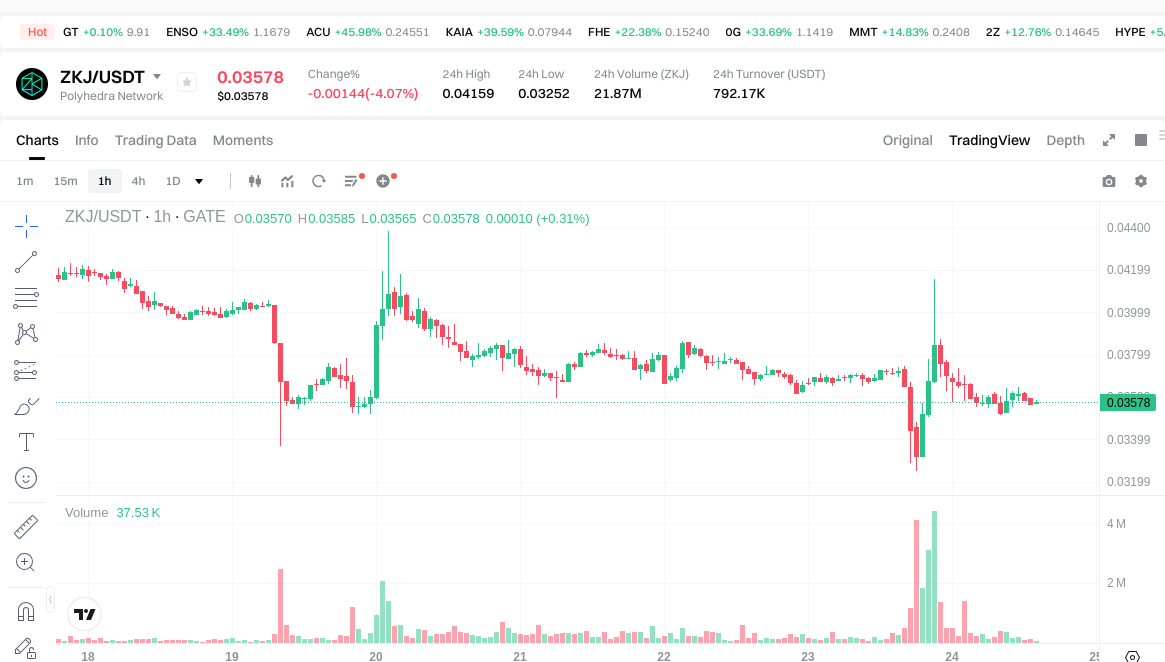
Current ZKJ Investment Market Status (January 2026)
- ZKJ current price: $0.0358
- Market sentiment (Fear & Greed Index): Data shows cautious market sentiment
- 24-hour trading volume: $792,983.36
- Market capitalization: $15,487,477.74
- Circulating supply: 432,611,110 ZKJ (43.26% of total supply)
- Number of holders: 44,238
Click to view real-time ZKJ market price
II. Core Factors Affecting Whether ZKJ is a Good Investment (Is Polyhedra Network(ZKJ) a Good Investment)
Supply Mechanism and Scarcity (ZKJ investment scarcity)
- Maximum supply capped at 1,000,000,000 tokens with current circulating supply of 432,611,110 tokens (43.26% of total) → influences price dynamics and investment valuation
- Market capitalization to fully diluted valuation ratio stands at 43.26%, indicating substantial token supply yet to enter circulation
- Investment significance: controlled token release schedule and fixed maximum supply represent fundamental scarcity characteristics supporting long-term investment consideration
Institutional Investment and Mainstream Adoption (Institutional investment in ZKJ)
- Current holder base comprises 44,238 addresses, reflecting community participation levels
- zkBridge has facilitated over 20 million cross-chain transactions across more than 25 Layer-1 and Layer-2 blockchain networks, demonstrating ecosystem integration
- Trading availability across 18 exchanges indicates market accessibility for institutional and retail participants
Technology and Ecosystem Development (Technology & Ecosystem for ZKJ investment)
- zkBridge technology: delivers zero-knowledge proof infrastructure for blockchain interoperability → enhances utility value proposition through trustless cross-chain functionality
- Network expansion: active integration across 25+ Layer-1 and Layer-2 networks → broadens ecosystem reach and potential use cases
- Web3 infrastructure positioning: focuses on providing foundational ZK-proof capabilities for decentralized applications, potentially supporting long-term value through protocol-level adoption
III. ZKJ Future Investment Forecast and Price Outlook (Is Polyhedra Network(ZKJ) worth investing in 2026-2031)
Short-term Investment Forecast (2026, short-term ZKJ investment outlook)
- Conservative Forecast: $0.0258 - $0.0358
- Neutral Forecast: $0.0358 - $0.0418
- Optimistic Forecast: $0.0418 - $0.0480
Mid-term Investment Outlook (2027-2029, mid-term Polyhedra Network(ZKJ) investment forecast)
-
Market Phase Expectation: The mid-term period may witness continued development of cross-chain infrastructure and broader adoption of zero-knowledge proof technology across Layer-1 and Layer-2 networks, potentially supporting gradual price appreciation.
-
Investment Return Forecast:
- 2027: $0.0243 - $0.0511
- 2028: $0.0339 - $0.0614
- 2029: $0.0410 - $0.0701
-
Key Catalysts: Expansion of zkBridge adoption across additional blockchain networks, advancement in zero-knowledge proof efficiency, and potential integration with emerging Web3 applications.
Long-term Investment Outlook (Is Polyhedra Network a good long-term investment?)
- Base Scenario: $0.0583 - $0.0887 (Assuming steady development of cross-chain infrastructure and sustained adoption of zkBridge technology)
- Optimistic Scenario: $0.0753 - $0.0942 (Assuming accelerated adoption of zero-knowledge proofs in blockchain interoperability and favorable market conditions for Web3 infrastructure)
- Risk Scenario: Below $0.0243 (Under conditions of reduced demand for cross-chain solutions or significant technological disruption)
View ZKJ long-term investment and price forecast: Price Prediction
2026-01-24 to 2031 Long-term Outlook
- Base Scenario: $0.0583 - $0.0887 (Corresponding to steady progress and gradual mainstream application enhancement)
- Optimistic Scenario: $0.0753 - $0.0942 (Corresponding to large-scale adoption and favorable market environment)
- Transformative Scenario: Above $0.0942 (In case of breakthrough ecosystem developments and mainstream adoption)
- 2031-12-31 Predicted High: $0.0942 (Based on optimistic development assumptions)
Disclaimer: The forecasts presented are based on historical data and market analysis. Cryptocurrency investments involve substantial risk, and past performance does not guarantee future results. Investors should conduct independent research and consider their risk tolerance before making investment decisions.
| Year |
Predicted High Price |
Predicted Average Price |
Predicted Low Price |
Price Change |
| 2026 |
0.0479586 |
0.03579 |
0.0257688 |
0 |
| 2027 |
0.051086646 |
0.0418743 |
0.024287094 |
16 |
| 2028 |
0.06135422436 |
0.046480473 |
0.03393074529 |
29 |
| 2029 |
0.070092553284 |
0.05391734868 |
0.0409771849968 |
50 |
| 2030 |
0.08866707990426 |
0.062004950982 |
0.05828465392308 |
73 |
| 2031 |
0.094170019303912 |
0.07533601544313 |
0.063282252972229 |
110 |
IV. ZKJ Investment Strategy and Risk Management (How to invest in Polyhedra Network)
Investment Methodology (ZKJ investment strategy)
Long-term Holding (HODL ZKJ)
For conservative investors, a long-term holding strategy may be appropriate when considering ZKJ tokens. This approach typically involves acquiring tokens and maintaining positions through market cycles, focusing on the fundamental development of Polyhedra Network's zkBridge technology and its adoption across blockchain ecosystems.
Given the project's focus on zero-knowledge proof infrastructure and cross-chain interoperability, long-term investors might consider the ongoing development of zkBridge and its integration across Layer-1 and Layer-2 networks as key factors in their investment thesis.
Active Trading
Active traders may approach ZKJ through technical analysis and swing trading strategies. The token has demonstrated notable volatility, with 24-hour price fluctuations between $0.03252 and $0.04159, and wider movements across different timeframes (7-day change: -14.46%, 30-day change: -9.29%). This volatility may present opportunities for traders who employ technical indicators and chart patterns to identify entry and exit points.
Risk Management (Risk management for ZKJ investment)
Asset Allocation Ratios
Conservative Investors: May consider allocating 1-3% of their cryptocurrency portfolio to ZKJ, treating it as a higher-risk component within a diversified crypto holding strategy.
Aggressive Investors: Might allocate 5-10% of their cryptocurrency portfolio, accepting higher volatility in pursuit of potential returns from the zero-knowledge proof sector.
Professional Investors: Could implement dynamic allocation strategies ranging from 3-15%, with position sizing adjusted based on technical indicators, market conditions, and fundamental developments in the Polyhedra Network ecosystem.
Risk Hedging Approaches
A diversified portfolio approach may help manage exposure to ZKJ-specific risks. This could include:
- Combining ZKJ holdings with established cryptocurrencies to balance volatility
- Diversifying across different blockchain infrastructure categories
- Utilizing stablecoin allocations as a buffer against market downturns
- Considering correlated and uncorrelated assets to manage overall portfolio risk
Secure Storage
Hot Wallets: For active traders requiring frequent access, reputable exchange wallets or mobile wallets compatible with ERC-20 tokens (ZKJ is available on both ETH and BSC chains) may be suitable, though these carry higher security risks.
Cold Wallets: For long-term holders, hardware wallets such as Ledger or Trezor devices offer enhanced security by keeping private keys offline. These devices support ERC-20 tokens and provide protection against online threats.
Best Practices:
- Store the majority of holdings in cold storage
- Maintain only necessary trading amounts in hot wallets
- Use multi-signature wallets for large holdings
- Regularly backup wallet recovery phrases and store them securely offline
- Verify contract addresses (0xC71B5F631354BE6853eFe9C3Ab6b9590F8302e81) before transactions
V. ZKJ Investment Risks and Challenges (Risks of investing in Polyhedra Network)
Market Risk
High Volatility: ZKJ has exhibited substantial price volatility, with significant fluctuations across multiple timeframes. The token showed a 1-year decline of -98.15%, indicating exposure to broader market cycles and sector-specific dynamics. The 24-hour trading range between $0.03252 and $0.04159 demonstrates ongoing short-term volatility that investors should anticipate.
Price Dynamics: With a current price of $0.0358 and a relatively modest 24-hour trading volume of approximately $793,000, the token may be susceptible to price movements influenced by trading activity. The market capitalization of approximately $15.49 million represents a smaller-cap position within the cryptocurrency market.
Regulatory Risk
Policy Uncertainty: Cryptocurrency regulations vary significantly across jurisdictions and continue to evolve. Zero-knowledge proof technologies and cross-chain bridge protocols may face scrutiny from financial regulators concerning:
- Securities classification and compliance requirements
- Cross-border transaction monitoring and reporting obligations
- Data privacy regulations intersecting with blockchain technology
- Evolving frameworks for decentralized infrastructure projects
Investors should monitor regulatory developments in their jurisdiction and key markets where Polyhedra Network operates.
Technical Risk
Network Security: As a cross-chain infrastructure project, Polyhedra Network's zkBridge technology handles transactions across multiple blockchain networks. This creates potential vulnerability points including:
- Smart contract vulnerabilities in bridge protocols
- Cryptographic implementation risks in zero-knowledge proof systems
- Integration challenges across diverse Layer-1 and Layer-2 networks
- Potential exploits targeting cross-chain transaction mechanisms
Upgrade and Development Risk: The ongoing development and improvement of ZK proof technology and cross-chain infrastructure involve technical complexity. Implementation challenges, delays in planned upgrades, or technical setbacks could impact the project's competitiveness and token value.
VI. Conclusion: Is Polyhedra Network a Good Investment?
Investment Value Summary
Polyhedra Network (ZKJ) represents exposure to the zero-knowledge proof infrastructure sector, with its zkBridge technology facilitating cross-chain interoperability. The project has demonstrated operational traction through its integration across Layer-1 and Layer-2 networks.
However, investors should note significant price volatility, as evidenced by substantial declines over various timeframes, and the relatively early-stage nature of both the project and the broader ZK proof infrastructure sector. The token's current circulation ratio of 43.26% (432.6 million out of 1 billion max supply) indicates potential future supply increases that may influence price dynamics.
Investor Recommendations
✅ Beginners: Consider a dollar-cost averaging approach if entering a position, limiting initial exposure to a small percentage of overall portfolio. Prioritize secure storage using hardware wallets and thoroughly research zero-knowledge proof technology before investing.
✅ Experienced Investors: May employ technical analysis for swing trading opportunities given the token's volatility patterns. Consider position sizing within a diversified cryptocurrency portfolio, balancing ZKJ exposure with other blockchain infrastructure assets.
✅ Institutional Investors: Could evaluate ZKJ as part of a strategic allocation to zero-knowledge proof infrastructure, conducting comprehensive due diligence on the technical architecture, team credentials, and competitive positioning within the cross-chain bridge landscape.
⚠️ Disclaimer: Cryptocurrency investments carry substantial risk including potential loss of principal. This analysis is provided for informational purposes only and does not constitute investment advice. Investors should conduct independent research and consult with qualified financial advisors before making investment decisions.
VII. FAQ
Q1: What is Polyhedra Network (ZKJ) and what makes it different from other blockchain infrastructure projects?
Polyhedra Network (ZKJ) is a Web3 infrastructure project utilizing zero-knowledge proof technology to enable secure cross-chain interoperability. The project's zkBridge technology facilitates trustless transactions across more than 25 Layer-1 and Layer-2 blockchain networks, having processed over 20 million cross-chain transactions. Unlike traditional bridge solutions, zkBridge employs zero-knowledge proofs to verify cross-chain transactions without revealing underlying transaction data, potentially offering enhanced security and privacy compared to conventional bridge architectures.
Q2: How has ZKJ performed historically, and what caused the significant price decline?
ZKJ launched in March 2024 with an opening price around $1.00 and experienced a substantial decline of -98.15% over the subsequent year, with the current price at $0.0358 as of January 24, 2026. This performance reflects broader market corrections in the cryptocurrency sector, particularly affecting smaller-cap infrastructure tokens. The token has demonstrated high volatility across multiple timeframes, including a -14.46% change over 7 days and -9.29% over 30 days, indicating ongoing price fluctuations that characterize early-stage blockchain infrastructure projects.
Q3: What are the key risks associated with investing in ZKJ?
ZKJ investment carries multiple risk categories: Market Risk includes substantial price volatility and relatively low trading volume ($793,000 in 24 hours), which may result in significant price movements. Technical Risk encompasses potential vulnerabilities in smart contract implementations, cryptographic systems, and cross-chain bridge mechanisms. Regulatory Risk involves evolving policies concerning zero-knowledge technologies and cross-chain protocols across different jurisdictions. Additionally, the token's circulating supply represents only 43.26% of total supply, indicating potential future dilution effects from additional token releases.
Q4: How should investors approach position sizing and portfolio allocation for ZKJ?
Portfolio allocation should align with individual risk tolerance: Conservative investors might consider 1-3% allocation within their cryptocurrency portfolio, treating ZKJ as a higher-risk component. Aggressive investors could allocate 5-10%, accepting greater volatility for potential upside exposure to the zero-knowledge proof sector. Professional investors might implement dynamic allocation strategies ranging from 3-15%, adjusting positions based on technical indicators and fundamental developments. All investors should prioritize secure storage using hardware wallets for long-term holdings and maintain only necessary trading amounts in hot wallets.
Q5: What factors could drive ZKJ price appreciation in the medium to long term?
Key catalysts for potential price appreciation include: Expansion of zkBridge adoption across additional blockchain networks, which could increase utility and transaction volume. Advancements in zero-knowledge proof efficiency may enhance competitive positioning within the cross-chain infrastructure sector. Integration with emerging Web3 applications could broaden the use case ecosystem. Price forecasts suggest potential ranges of $0.0243-$0.0511 for 2027 and $0.0583-$0.0942 for 2031 under base to optimistic scenarios, assuming sustained development progress and favorable market conditions for blockchain interoperability solutions.
Q6: Is ZKJ suitable for active trading or long-term holding strategies?
ZKJ may accommodate both approaches depending on investor objectives. Active traders might capitalize on the token's volatility, with 24-hour price ranges between $0.03252 and $0.04159 providing potential swing trading opportunities through technical analysis. Long-term holders could focus on the fundamental development of zkBridge technology and its ecosystem adoption across Layer-1 and Layer-2 networks. The project's position in the zero-knowledge proof infrastructure sector may appeal to holders anticipating gradual mainstream adoption of cross-chain interoperability solutions, though this strategy requires tolerance for substantial short-term volatility.
Q7: What security measures should ZKJ investors implement?
Security practices should include: Using hardware wallets (Ledger or Trezor) for the majority of holdings to keep private keys offline. Verifying the correct contract address (0xC71B5F631354BE6853eFe9C3Ab6b9590F8302e81) before any transactions to prevent phishing attacks. Implementing multi-signature wallets for large holdings to add an additional security layer. Regularly backing up wallet recovery phrases and storing them securely offline in multiple physical locations. Maintaining only necessary trading amounts in exchange wallets or hot wallets, while keeping long-term holdings in cold storage to minimize exposure to online threats.
Q8: How does ZKJ compare to other investments in the blockchain interoperability sector?
ZKJ differentiates itself through its focus on zero-knowledge proof technology for cross-chain transactions, operating within a competitive landscape of bridge solutions. With a market capitalization of approximately $15.49 million and integration across 25+ networks, the project represents a smaller-cap position compared to established cross-chain protocols. The token's 44,238 holder base and availability on 18 exchanges indicate moderate market accessibility. Investors evaluating ZKJ should compare technical approaches, adoption metrics, security track records, and ecosystem partnerships against alternative cross-chain infrastructure projects to assess relative positioning and competitive advantages within the sector.
* The information is not intended to be and does not constitute financial advice or any other recommendation of any sort offered or endorsed by Gate.








