Polymesh (POLYX) operates as an institutional-grade blockchain infrastructure specifically designed for regulated assets and security tokenization. As of January 2026, POLYX trades at approximately $0.0672 with an $83.14 million market cap, representing a specialized investment opportunity in the compliance-focused blockchain sector. This analysis examines POLYX's investment viability by evaluating historical price trends, institutional adoption potential, and market dynamics. The article provides price forecasts ranging from conservative to optimistic scenarios through 2031, strategic allocation recommendations (1-15% depending on investor profile), and comprehensive risk assessments including market volatility, regulatory uncertainty, and limited liquidity. Key considerations include POLYX's unlimited supply mechanism and recent 30-day recovery of 42.51% against a 75.57% annual decline. Suitable for investors seeking exposure to regulated asset tokenization via Gate and other platforms, though requiring car
Introduction: Polymesh (POLYX) Investment Position and Market Outlook
POLYX is a significant asset in the cryptocurrency space. As of January 2026, Polymesh holds a market capitalization of approximately $83.14 million, with a circulating supply of around 1.24 billion tokens, and the current price is maintained at approximately $0.0672. Positioned as an institutional-grade, public-permissioned blockchain built specifically for regulated assets, Polymesh has been addressing challenges around governance, identity, compliance, confidentiality, and settlement. With its market ranking at 407 and a market dominance of 0.0024%, POLYX has gradually become a focal point when investors discuss "Is Polymesh (POLYX) a good investment?" This article comprehensively analyzes the investment value, historical trends, future price predictions, and investment risks of Polymesh, providing reference for investors.
I. POLYX Price History Review and Current Investment Value
Polymesh (POLYX) launched in October 2021, establishing itself as a specialized blockchain infrastructure for regulated assets. The token's price journey reflects the broader evolution of the Real-World Asset (RWA) tokenization narrative within the crypto ecosystem.
-
2021-2022: Following its launch at $0.748771, POLYX experienced significant volatility as the project worked to establish partnerships and develop its institutional-grade infrastructure for security token standards.
-
2023-2024: The token traded within a range as the RWA sector began gaining institutional attention, with major players like BlackRock entering the tokenization space, though POLYX remained focused on its compliance-first approach.
-
2024-2025: Price movements reflected broader market dynamics, with POLYX declining approximately 75.57% over the annual period, moving from higher levels toward $0.04574115 in December 2025.
-
Recent Recovery (Early 2026): The token showed signs of stabilization and modest recovery, gaining 4.39% over a seven-day period and 42.51% over 30 days as of January 2026.
Current Investment Market Status (January 2026)
As of January 18, 2026, Polymesh demonstrates the following market characteristics:
- Current Price: $0.06718
- Market Capitalization: $83.14 million (ranked #407)
- 24-Hour Trading Volume: $26,516.66
- Circulating Supply: 1.24 billion POLYX tokens
- Market Share: 0.0024% of total crypto market
- Exchange Listings: Available on 18 trading platforms
- Holder Base: 6,077 addresses
The token's recent 30-day performance shows a 42.51% increase, indicating renewed market interest potentially connected to broader institutional adoption trends in RWA tokenization. However, shorter-term metrics reveal consolidation, with a 0.66% decline over 24 hours and 0.27% decrease in the past hour.
Click to view real-time POLYX market price
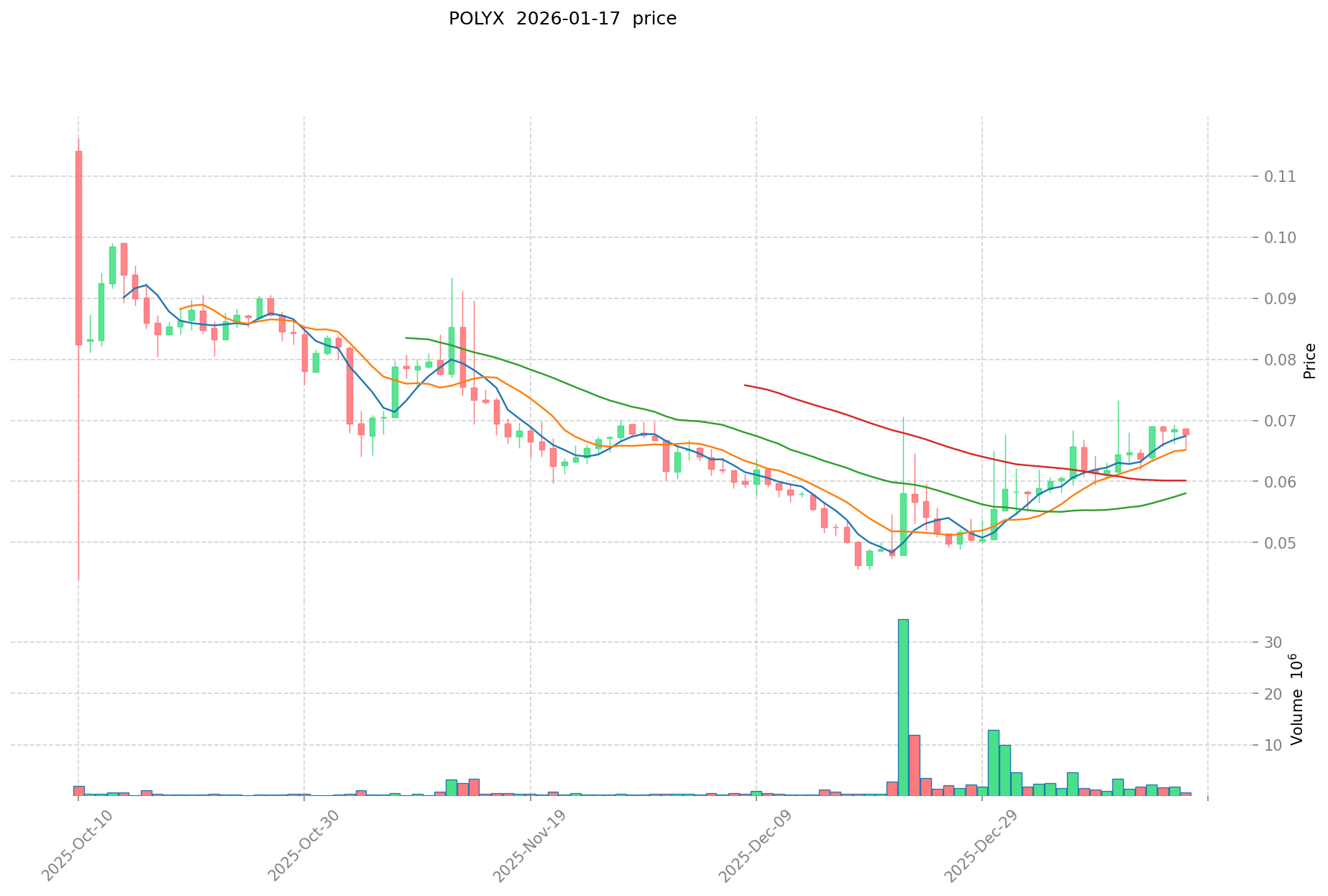
II. Core Factors Influencing Whether POLYX is a Good Investment (Is Polymesh(POLYX) a Good Investment)
Supply Mechanism and Scarcity (POLYX investment scarcity)
- Unlimited maximum supply mechanism → influences price dynamics and investment considerations
- Current circulating supply stands at approximately 1.24 billion POLYX tokens as of January 2026
- Investment consideration: the unlimited supply structure may affect long-term scarcity characteristics compared to assets with fixed caps
Institutional Investment and Mainstream Adoption (Institutional investment in POLYX)
- Polymesh positions itself as an institutional-grade, public-permissioned blockchain specifically designed for regulated assets
- The platform targets financial institutions by addressing governance, identity, compliance, confidentiality, and settlement challenges
- Regulatory compliance focus may attract institutions seeking blockchain solutions that align with existing financial frameworks
Macroeconomic Environment's Impact on POLYX Investment
- The broader cryptocurrency market conditions influence POLYX price movements, as evidenced by the token experiencing a 75.57% decline over the one-year period ending January 2026
- Market sentiment and risk appetite in digital asset markets affect specialized blockchain tokens like POLYX
- Regulatory developments in traditional finance may create opportunities or challenges for compliance-focused blockchain platforms
Technology and Ecosystem Development (Technology & Ecosystem for POLYX investment)
- Polymesh's specialized architecture addresses specific challenges in regulated asset tokenization, including governance frameworks and compliance mechanisms
- The platform's focus on confidentiality and settlement processes targets institutional use cases in financial markets
- Integration capabilities with existing financial infrastructure may influence adoption rates and long-term utility value
III. POLYX Future Investment Forecast and Price Outlook (Is Polymesh(POLYX) worth investing in 2026-2031)
Short-term Investment Forecast (2026, short-term POLYX investment outlook)
- Conservative forecast: $0.0361 - $0.0669
- Neutral forecast: $0.0669 - $0.0800
- Optimistic forecast: $0.0800 - $0.0936
Mid-term Investment Outlook (2027-2029, mid-term Polymesh(POLYX) investment forecast)
- Market stage expectation: POLYX may experience gradual growth during this period, with price volatility reflecting broader market sentiment and adoption trends in the regulated asset blockchain sector.
- Investment return forecast:
- 2027: $0.0746 - $0.0891
- 2028: $0.0728 - $0.1211
- 2029: $0.0885 - $0.1090
- Key catalysts: Expansion of institutional adoption, evolution of regulatory frameworks for digital assets, and continued development of the Polymesh ecosystem.
Long-term Investment Outlook (Is Polymesh a good long-term investment?)
- Base scenario: $0.0953 - $0.1112 (assuming steady ecosystem development and moderate institutional adoption)
- Optimistic scenario: $0.1042 - $0.1618 (assuming accelerated adoption among regulated financial institutions and favorable regulatory developments)
- Risk scenario: Below $0.0728 (under conditions of prolonged market downturn or significant setbacks in the regulated blockchain asset sector)
Click to view POLYX long-term investment and price prediction: Price Prediction
2026-2031 Long-term Outlook
- Base scenario: $0.0953 - $0.1112 (corresponding to steady progress and gradual increase in mainstream application)
- Optimistic scenario: $0.1042 - $0.1618 (corresponding to large-scale adoption and favorable market conditions)
- Transformative scenario: Above $0.1618 (if the ecosystem achieves breakthrough developments and mainstream adoption)
- 2031-12-31 forecast high: $0.1618 (based on optimistic development assumptions)
Disclaimer: The above forecasts are based on historical data analysis and market trend assessments. Cryptocurrency markets involve considerable volatility and risk. These projections should not be construed as investment advice, and actual performance may differ materially from predictions.
| Year |
Predicted High Price |
Predicted Average Price |
Predicted Low Price |
Price Change |
| 2026 |
0.093618 |
0.06687 |
0.0361098 |
0 |
| 2027 |
0.08907084 |
0.080244 |
0.07462692 |
19 |
| 2028 |
0.1210601106 |
0.08465742 |
0.0728053812 |
26 |
| 2029 |
0.109030291218 |
0.1028587653 |
0.088458538158 |
53 |
| 2030 |
0.11124175467195 |
0.105944528259 |
0.0953500754331 |
57 |
| 2031 |
0.161803780783557 |
0.108593141465475 |
0.104249415806856 |
61 |
IV. Polymesh Investment Strategy and Risk Management (How to invest in Polymesh)
Investment Methodology (Polymesh investment strategy)
Long-term Holding (HODL Polymesh)
For investors seeking a conservative approach to Polymesh (POLYX), a long-term holding strategy may be considered. This method involves acquiring tokens and maintaining positions over extended periods, potentially benefiting from the project's development in the regulated asset blockchain space. Given Polymesh's focus on institutional-grade infrastructure for securities tokenization, this approach may align with investors who believe in the gradual adoption of blockchain technology in traditional finance.
Active Trading
Active traders may approach Polymesh through technical analysis and swing trading strategies. With a 24-hour trading volume of approximately $26,517 and price fluctuations observed across different timeframes, traders can potentially identify entry and exit points. Recent data shows varied performance across periods: a 4.39% increase over 7 days and a 42.51% rise over 30 days, while experiencing a 0.66% decline in the past 24 hours. Such volatility patterns may present opportunities for those skilled in technical analysis and short-term market timing.
Risk Management (Risk management for Polymesh investment)
Asset Allocation Ratios
- Conservative Investors: May consider allocating 1-3% of their cryptocurrency portfolio to POLYX, given its specialized focus on regulated assets and institutional applications
- Moderate Investors: Could explore a 3-7% allocation, balancing exposure to the security token sector with other digital assets
- Specialized Investors: Those with particular interest in security tokens and regulated blockchain infrastructure might allocate 7-15%, depending on their research and risk tolerance
Risk Hedging Approaches
Diversification remains fundamental when considering Polymesh investments. A multi-asset portfolio approach may include:
- Combination with established cryptocurrencies to balance specialized sector exposure
- Consideration of different blockchain infrastructure projects
- Potential correlation analysis with traditional financial markets, given Polymesh's focus on regulated assets
Secure Storage Solutions
For POLYX holders, implementing proper security measures is important:
- Cold Wallets: For long-term holdings, cold storage solutions provide enhanced security by keeping private keys offline
- Hot Wallets: Suitable for active traders requiring frequent access, though with increased security considerations
- Hardware Wallets: Recommended for significant holdings, offering a balance between security and accessibility
Note: Investors should verify wallet compatibility with Polymesh's native blockchain infrastructure before transferring assets.
V. Polymesh Investment Risks and Challenges (Risks of investing in Polymesh)
Market Risks
High Volatility
Polymesh has demonstrated significant price volatility. The token has experienced a substantial decline of 75.57% over the past year, from higher price levels to its current trading range. The historical high of $0.748771 (recorded on April 1, 2024) contrasts with the historical low of $0.04574115 (December 19, 2025), illustrating the considerable price swings that investors may encounter.
Market Liquidity Considerations
With a market capitalization of approximately $83.14 million and ranking at position 407 among cryptocurrencies, Polymesh operates in a relatively smaller market segment compared to leading digital assets. The 24-hour trading volume of around $26,517 suggests limited liquidity, which may impact the ability to execute large transactions without affecting market prices.
Regulatory Risks
Given Polymesh's positioning as a blockchain specifically designed for regulated assets, the project's trajectory may be particularly sensitive to regulatory developments. Different jurisdictions maintain varying approaches to security tokens and blockchain-based securities, creating an uncertain regulatory landscape. Changes in securities laws, tokenization regulations, or blockchain governance requirements across different countries could impact the platform's adoption and utility.
Technical Risks
Network Security Considerations
As with any blockchain infrastructure, Polymesh faces ongoing security challenges. The platform's focus on institutional-grade operations means that any security vulnerabilities could have implications for the regulated assets it aims to support. Investors should remain aware that blockchain networks require continuous security monitoring and updates.
Technology Evolution Risks
The blockchain industry continues to evolve rapidly, and platforms must adapt to remain competitive. Technology upgrade processes carry inherent risks, including potential implementation challenges or compatibility issues. Additionally, the success of Polymesh depends on its ability to maintain technical advantages in the specialized field of regulated asset tokenization.
VI. Conclusion: Is Polymesh a Good Investment?
Investment Value Summary
Polymesh represents a specialized approach to blockchain technology, focusing specifically on regulated assets and institutional applications. The project addresses particular challenges in governance, identity, compliance, confidentiality, and settlement within the securities tokenization space. While this focused positioning may offer long-term potential as traditional financial institutions explore blockchain adoption, the token has experienced considerable volatility, with a 75.57% decline over the past year alongside recent shorter-term gains of 42.51% over 30 days.
Investor Recommendations
✅ For Newcomers
- Consider a dollar-cost averaging approach to mitigate timing risks
- Prioritize secure wallet storage solutions from the outset
- Allocate only funds that align with personal risk tolerance
- Conduct thorough research on Polymesh's technical infrastructure and use cases
✅ For Experienced Investors
- May explore swing trading opportunities based on technical analysis
- Consider Polymesh as part of a diversified cryptocurrency portfolio
- Monitor developments in security token regulations across key jurisdictions
- Evaluate position sizing relative to overall portfolio risk parameters
✅ For Institutional Participants
- Assess strategic alignment with regulated asset tokenization trends
- Consider long-term positioning if institutional blockchain adoption accelerates
- Evaluate Polymesh's governance model and network security architecture
- Implement appropriate risk management frameworks for exposure management
⚠️ Important Notice
Cryptocurrency investments carry substantial risks, including the potential for significant loss of capital. Market volatility, regulatory uncertainty, and technological challenges represent ongoing considerations for any digital asset investment. The information presented in this analysis is for educational and informational purposes only and does not constitute financial, investment, or trading advice. Individuals should conduct their own research, consider their financial circumstances, and consult with qualified financial advisors before making investment decisions.
VII. FAQ
Q1: What is Polymesh and how does it differ from other blockchain platforms?
Polymesh is an institutional-grade, public-permissioned blockchain specifically built for regulated assets and security tokens. Unlike general-purpose blockchains, Polymesh focuses exclusively on addressing the unique challenges of tokenizing and managing regulated assets, including governance, identity verification, compliance automation, confidentiality, and settlement. The platform's specialized architecture is designed to meet the requirements of traditional financial institutions and regulatory frameworks, distinguishing it from broader blockchain networks that serve multiple use cases.
Q2: Is POLYX suitable for long-term investment?
The suitability of POLYX for long-term investment depends on individual risk tolerance and investment objectives. Conservative forecasts suggest potential prices ranging from $0.0953 to $0.1618 by 2031, assuming continued development in the regulated asset tokenization sector. However, investors should consider that POLYX has experienced significant volatility, with a 75.57% decline over the past year. Long-term holders may benefit from dollar-cost averaging and should allocate only a portion of their portfolio (typically 1-7% depending on risk profile) to this specialized asset class.
Q3: What are the main risks associated with investing in Polymesh?
The primary risks include high market volatility, limited liquidity with a market cap of approximately $83.14 million and 24-hour trading volume around $26,517, regulatory uncertainty affecting security token platforms, and technology evolution risks. Additionally, Polymesh's specialized focus on regulated assets means its success depends heavily on institutional adoption rates and favorable regulatory developments. The token's ranking at position 407 and market dominance of only 0.0024% indicate it operates in a niche segment with corresponding concentration risks.
Q4: How does Polymesh's unlimited supply affect its investment value?
Unlike cryptocurrencies with fixed maximum supplies, Polymesh has an unlimited supply mechanism, which may impact long-term scarcity dynamics. As of January 2026, approximately 1.24 billion POLYX tokens are in circulation. This unlimited supply structure means price appreciation depends more heavily on demand growth and utility expansion rather than inherent supply constraints. Investors should consider that without a hard cap, value retention relies on the platform's ability to generate sustained demand through increased adoption and network effects.
Q5: What trading platforms support POLYX and what are the storage options?
POLYX is currently available on 18 different trading platforms, providing reasonable accessibility for investors. For storage, holders have several options: cold wallets for maximum security with long-term holdings, hot wallets for active traders requiring frequent access, and hardware wallets recommended for significant holdings balancing security and accessibility. Before transferring assets, investors should verify wallet compatibility with Polymesh's native blockchain infrastructure to ensure proper support and functionality.
Q6: What factors could drive POLYX price appreciation in 2026-2027?
Key potential catalysts include increased institutional adoption of security token infrastructure, favorable regulatory developments in major jurisdictions regarding digital asset tokenization, successful expansion of the Polymesh ecosystem and partnerships with financial institutions, and broader market recovery in the cryptocurrency sector. Short-term forecasts for 2026 range from $0.0361 to $0.0936 depending on conservative to optimistic scenarios, while 2027 projections suggest $0.0746 to $0.0891. However, actual performance may vary significantly based on market conditions and execution of the platform's development roadmap.
* The information is not intended to be and does not constitute financial advice or any other recommendation of any sort offered or endorsed by Gate.