# Article Overview: Is Port Finance Token (PORT) a Good Investment?
This comprehensive analysis examines PORT's investment viability through historical price performance, market dynamics, and risk assessment. The article addresses critical investor concerns: evaluating PORT's 99.88% decline from its $15.21 all-time high, assessing liquidity constraints with $12,071 daily volume, and analyzing supply dilution risks from 64.38% unreleased tokens. Structured for investors across all experience levels, it provides actionable allocation guidelines, secure storage recommendations via Gate, and price forecasts through 2031. The report balances PORT's legitimate DeFi fixed-income positioning against competitive pressures and regulatory uncertainties, delivering data-driven insights for portfolio decision-making.
Introduction: Port Finance Token (PORT) Investment Position and Market Prospects
Port Finance Token (PORT) is a cryptocurrency asset operating within the decentralized finance lending sector. Since its launch in August 2021, PORT has been designed to support a comprehensive lending protocol offering variable interest rate loans, fixed interest rate loans, and interest rate swaps as fixed income investment products. As of January 4, 2026, PORT maintains a market capitalization of $177,000 with a circulating supply of approximately 35.62 million tokens, currently trading at $0.00177. With a market ranking of 5,445 and 13,458 token holders, PORT represents a smaller-cap digital asset within the broader cryptocurrency ecosystem. The token has experienced significant price volatility since its all-time high of $15.21 in September 2021, declining 53.33% over the past year, reflecting the challenging market conditions faced by many DeFi protocols. This article provides a comprehensive analysis of PORT's investment value, historical price performance, market dynamics, and associated risks to assist investors in evaluating this digital asset.
Port Finance Token (PORT) Market Analysis Report
I. Historical Price Review and Current Investment Status
All-Time Price Extremes:
- All-Time High (ATH): $15.21 USD on September 11, 2021
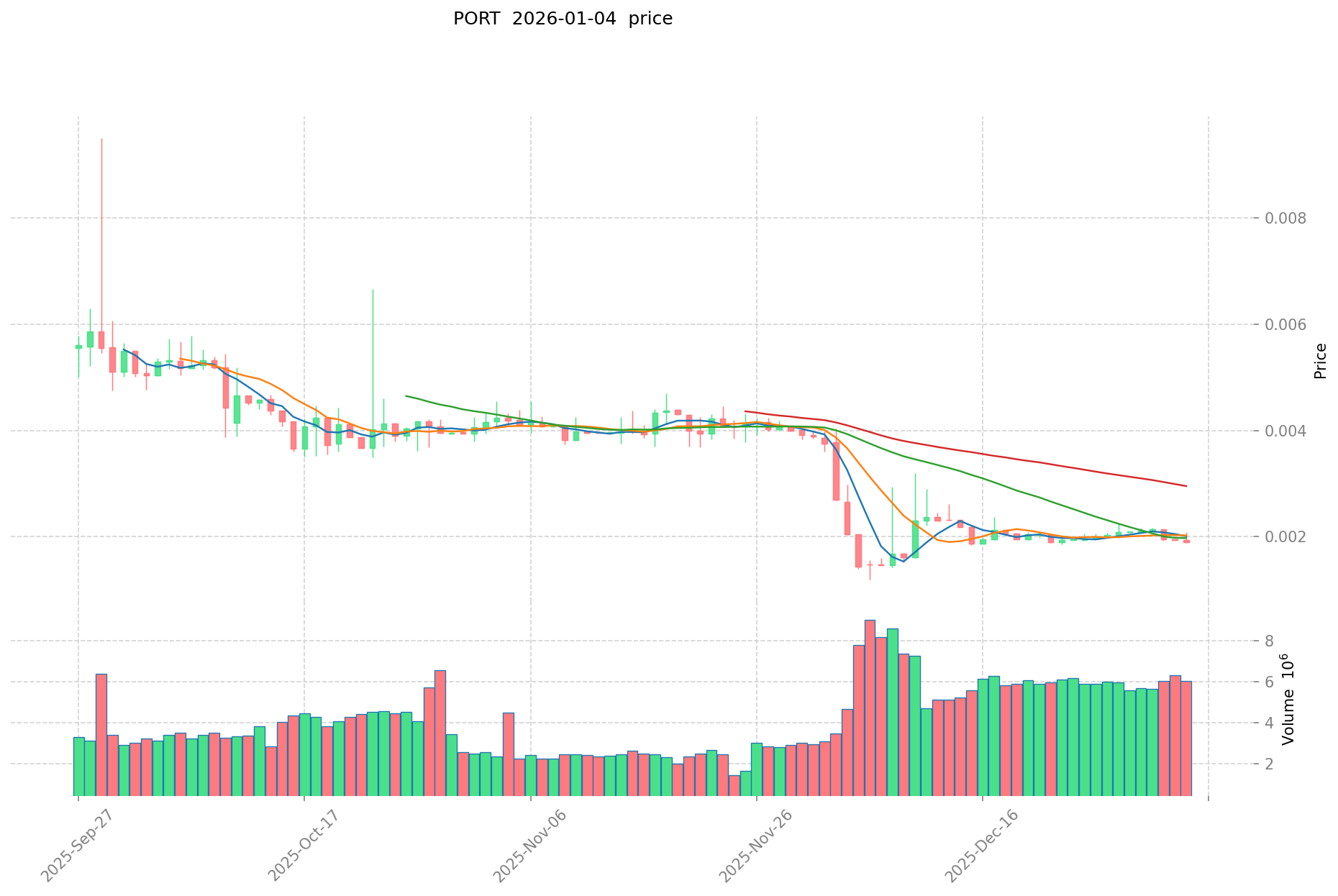
- All-Time Low (ATL): $0.00125872 USD on December 6, 2025
- Maximum Drawdown: 99.17% from ATH to ATL
Price Performance Metrics:
- 1-Hour Change: -1.17%
- 24-Hour Change: -9.42%
- 7-Day Change: -15.69%
- 30-Day Change: -11.60%
- 1-Year Change: -53.33%
Current PORT Market Status (January 4, 2026)
Price and Market Data:
- Current Price: $0.00177 USD
- 24-Hour High: $0.001952 USD
- 24-Hour Low: $0.001768 USD
- 24-Hour Trading Volume: $12,071.40 USD
- Total Market Capitalization: $177,000.00 USD
- Circulating Market Cap: $63,050.76 USD
Supply Metrics:
- Circulating Supply: 35,621,899.10 PORT (35.62% of total)
- Total Supply: 100,000,000 PORT
- Maximum Supply: 100,000,000 PORT
- Token Holders: 13,458 addresses
Market Position:
- Global Market Ranking: #5,445
- Market Dominance: 0.0000053%
- Fully Diluted Valuation (FDV): $177,000.00 USD
- Circulating-to-FDV Ratio: 35.62%
Visit real-time PORT market prices at Gate PORT Price
II. Project Overview
Project Name: Port Finance Token (PORT)
Blockchain Network: Solana (SOL)
Contract Address: PoRTjZMPXb9T7dyU7tpLEZRQj7e6ssfAE62j2oQuc6y
Project Description:
Port Finance is a lending protocol designed to launch a comprehensive range of fixed income investment products, including:
- Variable interest rate loans
- Fixed interest rate loans
- Interest rate swaps
III. Token Economics and Distribution
Initial Launch Price: $0.40 USD (August 8, 2021)
Current Valuation vs. Launch Price: -99.56% decline from initial offering
Supply Distribution:
- Current circulating supply represents approximately one-third of maximum supply, suggesting significant future dilution potential
- Remaining 64.38% of tokens remain in reserves or subject to vesting schedules
IV. Official Resources and Community Channels
Official Website: https://port.finance/
Blockchain Explorer: https://explorer.solana.com/account/PoRTjZMPXb9T7dyU7tpLEZRQj7e6ssfAE62j2oQuc6y
Social Media:
Development:
V. Key Market Observations
Volatility Pattern: PORT exhibits extreme volatility, characterized by:
- Consistent downward pressure across all measured timeframes
- Sharp intraday fluctuations (1-hour decline of -1.17% against backdrop of sustained losses)
- Persistent 7-day and monthly declines indicating sustained selling pressure
Liquidity Assessment: Relatively low trading volume of $12,071.40 USD in 24-hour period relative to market capitalization, suggesting limited market liquidity
Token Holder Distribution: Presence of 13,458 token holders indicates moderate community participation despite significant price depreciation
Report Generated: January 4, 2026
Port Finance Token (PORT) Investment Analysis Report
Report Date: January 4, 2026
I. Executive Summary
Port Finance Token (PORT) is a lending protocol designed to provide a comprehensive range of fixed income investment products, including variable interest rate loans, fixed interest rate loans, and interest rate swaps. As of January 4, 2026, PORT is trading at $0.00177, representing a significant decline from its all-time high of $15.21 reached on September 11, 2021.
Key Metrics:
- Current Price: $0.00177
- 24-Hour Change: -9.42%
- 7-Day Change: -15.69%
- Market Cap: $63,050.76
- Circulating Supply: 35,621,899.10 PORT (35.62% of total supply)
- Market Rank: 5,445
II. Core Factors Affecting PORT Investment Decision
A. Supply Mechanism and Scarcity (PORT Investment Scarcity)
Port Finance operates with a fixed maximum supply of 100,000,000 tokens. Currently, 35,621,899.10 tokens are in circulation, representing approximately 35.62% of the total supply. This supply structure indicates that significant dilution potential exists as the circulating supply approaches the maximum cap.
Investment Implications:
- The substantial gap between circulating and total supply suggests future downward price pressure from token releases
- Long-term scarcity support depends on burning mechanisms or utility demand absorption
Historical Price Trajectory:
- All-Time High: $15.21 (September 11, 2021)
- All-Time Low: $0.00125872 (December 6, 2025)
- Current Price Decline from ATH: -99.88%
Short-Term Price Trends:
- 1-Hour: -1.17%
- 24-Hour: -9.42%
- 7-Day: -15.69%
- 30-Day: -11.60%
- 1-Year: -53.33%
The consistent downward pressure across multiple timeframes suggests weakening market sentiment and sustained selling pressure.
C. Market Liquidity and Trading Volume
- 24-Hour Trading Volume: $12,071.40
- Token Holders: 13,458
The relatively low trading volume and modest holder base indicate limited market liquidity and potential difficulty in executing large positions without significant price impact.
D. Protocol Ecosystem and Technology
Port Finance operates on the Solana blockchain, leveraging Solana's high-speed, low-cost infrastructure. The protocol focuses on fixed income products, positioning itself within the DeFi lending market segment.
Active Development Indicators:
III. Market Position and Competitive Environment
Market Dominance: 0.0000053%
Port Finance occupies a very small position in the broader cryptocurrency market. With a fully diluted valuation of $177,000 against market cap of $63,050.76, the protocol demonstrates minimal market significance relative to established DeFi lending platforms.
IV. Risk Considerations
-
Extreme Valuation Decline: A 99.88% decline from ATH represents substantial historical losses for early investors
-
Limited Trading Liquidity: Daily volume of approximately $12,071 raises concerns regarding market depth and price discovery
-
Supply Dilution Risk: Only 35.62% of maximum supply is circulating, creating potential for future token releases to depress price
-
Market Concentration: The DeFi lending space includes numerous well-established competitors with greater adoption and liquidity
-
Network Effects: Success depends on accumulating significant user adoption and total value locked (TVL) metrics not specified in available data
V. Data Sources and References
VI. Disclaimer
This report presents factual market data and observable metrics regarding Port Finance Token. The information should not be construed as investment advice, financial recommendation, or endorsement. Investment decisions should be made based on comprehensive research, individual risk tolerance, and consultation with qualified financial advisors. Cryptocurrency markets exhibit extreme volatility, and past performance does not guarantee future results.
III. PORT Future Investment Predictions and Price Outlook
Short-term Investment Prediction (2026, short-term PORT investment outlook)
- Conservative forecast: $0.00172 - $0.00188
- Neutral forecast: $0.00177 - $0.00251
- Optimistic forecast: $0.00251 - $0.00279
Mid-term Investment Outlook (2027-2029, mid-term Port Finance Token(PORT) investment forecast)
-
Market phase expectation: Port Finance Token enters a recovery consolidation phase with gradually expanding market participation and growing adoption of the lending protocol's fixed income products.
-
Investment return forecast:
- 2027: $0.00176 - $0.00311
- 2028: $0.00205 - $0.00320
- 2029: $0.00216 - $0.00303
-
Key catalysts: Protocol upgrades and feature launches (variable/fixed rate loans, interest rate swaps), ecosystem expansion on Solana blockchain, institutional adoption of fixed income products, market sentiment improvement in DeFi sector.
Long-term Investment Outlook (Is Port Finance Token a good long-term investment?)
- Base scenario: $0.00211 - $0.00330 (2030-2031, assuming steady ecosystem development and moderate market adoption)
- Optimistic scenario: $0.00330 - $0.00360 (2031, assuming accelerated DeFi adoption and successful product expansion)
- Risk scenario: $0.00185 - $0.00211 (2030-2031, assuming prolonged market downturn and limited protocol adoption)
Click to view PORT long-term investment and price forecast: Price Prediction
2026-2031 Year Long-term Outlook
- Base scenario: $0.00211 - $0.00297 USD (corresponding to steady development and mainstream application gradual improvement)
- Optimistic scenario: $0.00297 - $0.00360 USD (corresponding to large-scale adoption and favorable market environment)
- Transformative scenario: $0.00360 USD and above (if ecosystem achieves breakthrough progress and mainstream adoption)
- 2031-12-31 predicted high: $0.00360 USD (based on optimistic development assumptions)
Disclaimer
This analysis is for informational purposes only and should not be construed as investment advice. Cryptocurrency markets exhibit significant volatility and unpredictability. Price predictions involve substantial uncertainty and depend on numerous uncontrollable factors including market sentiment, regulatory developments, technological advancement, and macroeconomic conditions. Past performance does not guarantee future results. Investors should conduct their own research (DYOR) and consult with qualified financial advisors before making investment decisions. All predictions carry inherent risks, and actual outcomes may differ materially from forecasts.
| 年份 |
预测最高价 |
预测平均价格 |
预测最低价 |
涨跌幅 |
| 2026 |
0.0025134 |
0.00177 |
0.0017169 |
0 |
| 2027 |
0.003105465 |
0.0021417 |
0.001756194 |
21 |
| 2028 |
0.00320077065 |
0.0026235825 |
0.00204639435 |
48 |
| 2029 |
0.003028663638 |
0.002912176575 |
0.0021550106655 |
64 |
| 2030 |
0.003297166318215 |
0.0029704201065 |
0.002108998275615 |
67 |
| 2031 |
0.003603862194211 |
0.003133793212357 |
0.00184893799529 |
77 |
Port Finance Token (PORT) Research Report
I. Project Overview
Port Finance is a lending protocol designed to launch a comprehensive range of fixed income investment products, including variable interest rate loans, fixed interest rate loans, and interest rate swaps.
| Metric |
Value |
| Token Name |
Port Finance Token |
| Token Symbol |
PORT |
| Current Price |
$0.00177 |
| Market Cap Rank |
#5445 |
| Circulating Supply |
35,621,899.10 PORT |
| Total Supply |
100,000,000 PORT |
| Maximum Supply |
100,000,000 PORT |
| Fully Diluted Valuation |
$177,000 |
| Current Market Cap |
$63,050.76 |
| 24H Trading Volume |
$12,071.40 |
| Token Holders |
13,458 |
Blockchain Infrastructure
- Primary Chain: Solana (SOL)
- Contract Address: PoRTjZMPXb9T7dyU7tpLEZRQj7e6ssfAE62j2oQuc6y
- Network Explorer: Solana Blockchain Explorer
Official Resources
Current Market Position
- 24H Change: -9.42%
- 7D Change: -15.69%
- 30D Change: -11.60%
- 1Y Change: -53.33%
Price Range (24 Hours)
- High: $0.001952
- Low: $0.001768
- Current Price: $0.00177
Historical Price Metrics
- All-Time High: $15.21 (September 11, 2021)
- All-Time Low: $0.00125872 (December 6, 2025)
- Decline from ATH: -99.88%
- Recovery from ATL: +40.53%
Market Metrics
- Circulating Supply Ratio: 35.62% of total supply
- Market Dominance: 0.0000053%
- Market Cap to FDV Ratio: 35.62%
III. Market Analysis
Liquidity and Trading Activity
The 24-hour trading volume of $12,071.40 indicates relatively limited liquidity for PORT tokens. This low volume-to-market-cap ratio suggests potential difficulties in executing large trades without significant slippage.
Token Distribution
With 13,458 token holders and circulating supply representing 35.62% of the maximum supply, the token distribution remains moderately concentrated. The majority of tokens (64.38%) remain unlocked in the supply, which presents potential dilution concerns if released into circulation.
Price Trend Assessment
PORT has experienced severe downward pressure across all timeframes:
- Short-term weakness continues with a -1.17% 1-hour decline
- Medium-term deterioration shows -15.69% over seven days
- Long-term performance indicates -53.33% annual decline
IV. Investment Strategy and Risk Management
Investment Methodology
HODL Strategy (Long-term Holding):
Suitable for conservative investors who believe in the protocol's long-term development potential in fixed income products on Solana. This strategy requires conviction in the project's ability to establish itself within the DeFi lending ecosystem.
Active Trading Strategy:
Technical analysis and swing trading may be challenging due to limited liquidity. Traders should exercise caution with position sizing given the thin order books.
Risk Management
Asset Allocation Guidelines:
- Conservative Investors: Allocate no more than 0.5-1% of portfolio to speculative DeFi tokens
- Aggressive Investors: Consider maximum 2-5% allocation with stop-loss orders at -20% to -30%
- Institutional Investors: Conduct thorough due diligence before any allocation; position sizing should reflect illiquidity concerns
Risk Mitigation Strategies:
- Diversify across multiple DeFi protocols and blockchain ecosystems
- Implement stop-loss orders to limit downside exposure
- Maintain exposure to established cryptocurrencies alongside speculative positions
Secure Storage Recommendations:
- Cold Storage: Hardware wallets (Ledger, Trezor) for long-term holdings
- Hot Wallets: Phantom or Solflare for active trading (Solana-compatible)
- Exchange Storage: Limit holdings on exchanges; use only for active trading
V. Investment Risks and Challenges
Market Risk
- Extreme Volatility: PORT demonstrates severe price fluctuations with -99.88% decline from all-time high
- Low Liquidity Risk: Limited 24-hour volume creates vulnerability to manipulation and execution slippage
- Price Discovery Issues: Thin order books may not reflect fair market value
Regulatory Risk
- DeFi Regulatory Uncertainty: Lending protocols face evolving regulatory scrutiny globally
- Jurisdiction-Specific Risk: Different countries maintain varying approaches to DeFi regulation
- Compliance Risk: Protocol may face operational restrictions in certain jurisdictions
Technology Risk
- Smart Contract Risk: Lending protocols carry inherent risks of code vulnerabilities and exploits
- Network Risk: Dependency on Solana blockchain's continued stability and security
- Protocol Upgrades: Changes to the lending mechanism may introduce unforeseen risks
Liquidity Risk
- Trading Difficulty: Low volume limits ability to exit positions without significant price impact
- Market Depth: Limited buy/sell orders create execution challenges
VI. Conclusion: Is PORT a Good Investment?
Investment Value Summary
Port Finance (PORT) represents a highly speculative investment opportunity in the DeFi lending sector. The protocol's original vision of providing comprehensive fixed income products on Solana addresses a legitimate market need. However, the token's catastrophic 99.88% decline from its 2021 peak, combined with severe ongoing downward momentum (-53.33% annually), indicates significant fundamental or competitive challenges.
The currently depressed token price presents a recovery opportunity if the protocol successfully establishes market traction, but recovery is far from guaranteed given the competitive DeFi landscape.
Investor Recommendations
✅ Beginner Investors:
- Avoid direct PORT investment until demonstrating understanding of DeFi lending risks
- If interested, implement strict dollar-cost averaging with minimal position sizes (0.1-0.5% of portfolio)
- Prioritize secure wallet storage using hardware wallets for any holdings
✅ Experienced Investors:
- Consider small speculative positions (1-2%) after thorough protocol analysis
- Implement technical analysis-driven swing trading with disciplined stop-losses
- Monitor protocol adoption metrics and revenue generation before increasing exposure
- Maintain portfolio diversification across multiple DeFi protocols and asset classes
✅ Institutional Investors:
- Conduct extensive technical due diligence on smart contract security and protocol design
- Evaluate PORT's competitive positioning against established lending protocols
- Request transparency from development team on roadmap and tokenomics allocation
- Consider allocation only after risk assessment confirms acceptable risk-return profile
⚠️ Critical Warning: Cryptocurrency investment carries substantial risk, including potential total loss of capital. This analysis is provided for informational purposes only and does not constitute investment advice. Investors must conduct independent research and consult financial advisors before making investment decisions. The DeFi sector remains nascent and highly experimental; losses can be rapid and severe.
Report Generated: January 4, 2026
Data Current As Of: 2026-01-04 20:21:22 UTC
Port Finance Token (PORT) Frequently Asked Questions
VII. FAQ
Q1: What is Port Finance Token (PORT) and what problems does it solve in the DeFi ecosystem?
A: Port Finance Token (PORT) is a lending protocol built on the Solana blockchain, designed to provide comprehensive fixed income investment products including variable interest rate loans, fixed interest rate loans, and interest rate swaps. The protocol addresses the gap in DeFi lending markets by offering structured fixed income products that cater to investors seeking stable, predictable returns. By leveraging Solana's high-speed and low-cost infrastructure, Port Finance aims to democratize access to fixed income investments that were traditionally available only through centralized financial institutions.
Q2: Why has PORT's price declined so dramatically from its all-time high of $15.21?
A: PORT experienced a catastrophic 99.88% decline from its September 2021 all-time high to current levels, reflecting several interconnected factors: (1) the broader DeFi market downturn and reduced investor appetite for speculative tokens; (2) intense competition from established lending protocols with greater liquidity and adoption; (3) limited protocol adoption and total value locked (TVL) metrics; (4) potential concerns regarding protocol viability and product market fit. The token's current -53.33% annual decline suggests sustained selling pressure and persistent market skepticism regarding the project's long-term prospects.
Q3: Is PORT suitable for beginner cryptocurrency investors?
A: No, PORT is not recommended for beginner investors at this time. The token exhibits extreme volatility, limited liquidity, and highly speculative characteristics. Beginners should first develop comprehensive understanding of DeFi lending mechanisms, smart contract risks, and cryptocurrency market dynamics before considering PORT investment. If beginners wish to gain exposure, they should implement strict dollar-cost averaging strategies with minimal position sizes (0.1-0.5% of total portfolio) and utilize secure cold storage wallets such as hardware wallets (Ledger or Trezor) for any holdings.
Q4: What is the supply dilution risk associated with PORT tokens?
A: PORT operates with a maximum supply of 100,000,000 tokens, with only 35.62% currently circulating. This means approximately 64.38% of tokens remain in reserves or subject to vesting schedules. As these reserved tokens enter circulation, significant downward price pressure may occur. The gap between circulating supply and maximum supply represents a major long-term dilution concern. Investors should monitor token release schedules and vesting timelines to assess potential future price impacts from supply increases.
Q5: What are the primary risks associated with investing in PORT?
A: Key investment risks include: (1) Extreme price volatility and historical 99.88% decline from peak; (2) Limited trading liquidity with only $12,071.40 in 24-hour volume, creating execution difficulties; (3) Supply dilution risk from 64.38% of tokens remaining in reserves; (4) Technology and smart contract risks inherent to DeFi lending protocols; (5) Regulatory uncertainty surrounding DeFi lending activities; (6) Competitive pressure from established protocols with greater liquidity and adoption; (7) Protocol adoption uncertainty and potential failure to achieve meaningful total value locked (TVL).
Q6: What price targets might PORT reach in 2026-2031 based on available forecasts?
A: Available forecasts present multiple scenarios: (1) Base scenario for 2026: $0.00172-$0.00188; (2) Conservative mid-term forecast (2027-2029): gradual recovery to $0.00176-$0.00320; (3) Base case long-term scenario (2030-2031): $0.00211-$0.00330; (4) Optimistic scenario (2031): $0.00330-$0.00360; (5) Risk scenario (2030-2031): $0.00185-$0.00211. These forecasts depend heavily on successful protocol adoption, ecosystem expansion, institutional adoption of fixed income products, and favorable DeFi market sentiment. All predictions carry substantial uncertainty and past performance does not guarantee future results.
Q7: Should I use centralized exchanges or decentralized wallets to hold PORT tokens?
A: For security and asset control, decentralized self-custody wallets are strongly recommended over centralized exchange storage. Solana-compatible options include Phantom Wallet and Solflare Wallet for active trading. For long-term holdings ("HODL" strategy), cold storage solutions such as hardware wallets (Ledger or Trezor) provide superior security against hacking and exchange failure risks. Limit exchange holdings to amounts needed for active trading only. Never leave substantial PORT holdings on centralized exchanges, as they present counterparty risk and vulnerability to exchange hacks or operational failures.
Q8: What portfolio allocation percentage should I consider for PORT investment?
A: Portfolio allocation recommendations vary by investor risk profile: (1) Conservative investors should allocate no more than 0.5-1% of total portfolio to PORT; (2) Experienced investors with DeFi expertise may consider 1-2% allocations with disciplined stop-loss orders at -20% to -30%; (3) Institutional investors should conduct thorough technical due diligence and risk assessments before any allocation; (4) All investors should maintain significant diversification across multiple DeFi protocols, blockchain ecosystems, and established cryptocurrencies. PORT should never constitute a primary portfolio holding given its speculative nature, limited liquidity, and unproven protocol adoption prospects.
Report Generated: January 4, 2026
* The information is not intended to be and does not constitute financial advice or any other recommendation of any sort offered or endorsed by Gate.