This comprehensive analysis examines Privasea AI (PRAI), a DePIN project focused on confidential AI infrastructure utilizing Fully Homomorphic Encryption (FHE) technology. Currently trading at $0.003434 with a market cap of $707,525.91, PRAI addresses growing enterprise demand for privacy-preserving AI solutions across healthcare, finance, and digital identity sectors. The article evaluates PRAI's investment potential through historical price performance, technological advantages, tokenomics, and associated risks including market volatility and regulatory uncertainty. Featured are detailed price forecasts through 2031, investment strategies for different investor profiles, and risk management approaches available on Gate exchange. While PRAI presents exposure to emerging decentralized AI infrastructure, investors must carefully consider substantial volatility and early-stage development status before committing capital.
Introduction: Privasea AI (PRAI) Investment Position and Market Outlook
PRAI is an emerging cryptographic asset in the digital currency sector, operating as a token for the Privasea ecosystem. As of February 04, 2026, PRAI maintains a market capitalization of approximately $707,525.907 USD, with a circulating supply of 206,035,500 tokens and a current trading price around $0.003434 USD. Positioned as a DePIN (Decentralized Physical Infrastructure Network) project focused on confidential AI infrastructure utilizing Fully Homomorphic Encryption (FHE), PRAI has garnered attention from market participants. The token supports a platform designed for secure computation on encrypted data across Web2 and Web3 applications, particularly in machine learning contexts. With 29,062 holders and availability on 13 exchanges, PRAI represents a developing segment within the intersection of decentralized infrastructure and artificial intelligence sectors. This article examines PRAI's investment characteristics, historical price performance, future price considerations, and associated risk factors to provide reference information for market observers.
I. Privasea AI (PRAI) Price History Review and Current Investment Value Status
- 2025: Token launch in January → Initial price performance showed volatility from launch to mid-year
- 2025: Price reached 0.425 in May → Market experienced significant upward momentum during initial trading period
- 2026: Market adjustment phase → Price declined from earlier levels to 0.003434 as of February 2026
Current PRAI Investment Market Status (February 2026)
- PRAI current price: $0.003434
- 24-hour trading volume: $22,962.12
- 24-hour price range: $0.003317 - $0.003773
- Circulating supply: 206,035,500 PRAI (20.6% of total supply)
- Market capitalization: $707,525.91
- Fully diluted valuation: $3,434,000
- Token holders: 29,062
- Listed on 13 exchanges
- Market dominance: 0.00012%
Click to view real-time PRAI market price
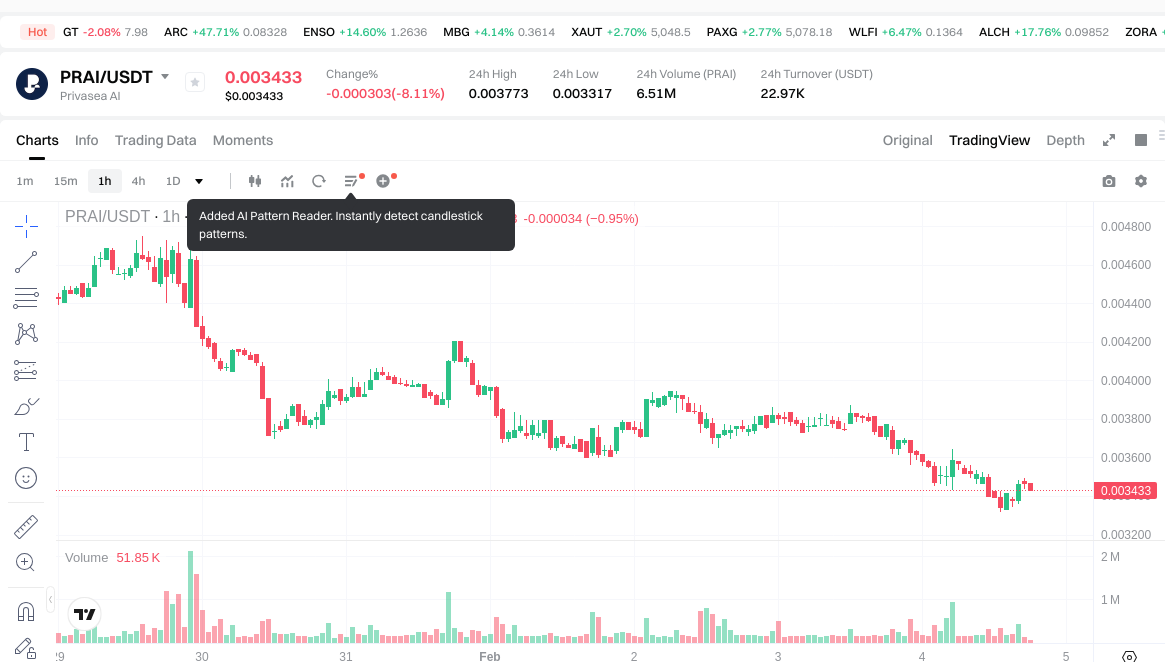
II. Core Factors Affecting Whether PRAI is a Good Investment (Is Privasea AI(PRAI) a Good Investment)
Supply Mechanism and Scarcity (PRAI investment scarcity)
- Total supply capped at 1,000,000,000 PRAI tokens with a current circulating supply of 206,035,500 tokens (20.6% circulation ratio) → impacts price dynamics and investment value assessment
- Market cap to fully diluted valuation ratio stands at 20.6%, indicating significant supply yet to enter circulation → potential dilution concerns for investors
- Investment significance: The controlled release of supply and maximum cap mechanism may provide long-term scarcity characteristics, though the majority of tokens remain unlocked
Institutional Investment and Mainstream Adoption (Institutional investment in PRAI)
- Current holder base of 29,062 addresses reflects early-stage adoption metrics
- Listed on 13 exchanges with trading volume of $22,962.12 in the past 24 hours → indicates developing liquidity conditions
- DePIN sector positioning focuses on decentralized confidential AI infrastructure using Fully Homomorphic Encryption (FHE) technology, targeting sectors including healthcare, finance, and digital identity
Macroeconomic Environment's Impact on PRAI Investment
- As an AI and privacy-focused DePIN project, PRAI operates within the emerging confidential computing sector, which may see demand influenced by data protection regulations and enterprise privacy requirements
- Price performance shows significant volatility with a 97.86% decline over one year, reflecting broader market conditions and project-specific factors
- Near-term liquidity challenges and token unlock schedules may create headwinds, while AI privacy trends could serve as potential catalysts
Technology and Ecosystem Development (Technology & Ecosystem for PRAI investment)
- FHE technology implementation: Enables secure computation on encrypted data without plaintext exposure → supports compliance with data protection standards
- Platform supports both Web2 and Web3 applications with emphasis on machine learning use cases → expands potential adoption pathways
- Confidential AI infrastructure positioning aligns with growing enterprise demand for privacy-preserving AI solutions, though ecosystem maturity remains in early stages
III. PRAI Future Investment Forecast and Price Outlook (Is Privasea AI(PRAI) worth investing in 2026-2031)
Short-term Investment Forecast (2026, short-term PRAI investment outlook)
- Conservative Forecast: $0.00189 - $0.00343
- Neutral Forecast: $0.00343 - $0.00357
- Optimistic Forecast: $0.00343 - $0.00357
Mid-term Investment Outlook (2027-2029, mid-term Privasea AI(PRAI) investment forecast)
-
Market Phase Expectation: The mid-term period may witness gradual development as the project seeks broader adoption of its Fully Homomorphic Encryption technology in AI applications. Market sentiment and overall crypto conditions could influence price trajectories during this phase.
-
Investment Return Forecast:
- 2027: $0.00210 - $0.00410
- 2028: $0.00277 - $0.00399
- 2029: $0.00222 - $0.00553
-
Key Catalysts: Factors such as technological advancements in privacy-preserving AI, strategic partnerships, regulatory developments in data protection sectors, and overall market conditions may serve as potential catalysts.
Long-term Investment Outlook (Is PRAI a good long-term investment?)
- Base Scenario: $0.00306 - $0.00674 (assuming steady progress in technology adoption and stable market conditions)
- Optimistic Scenario: $0.00532 - $0.00773 (assuming expanded adoption and favorable market environment)
- Risk Scenario: Below $0.00306 (under adverse market conditions or slower-than-expected adoption)
Click to view PRAI long-term investment and price forecast: Price Prediction
2026-02-04 to 2031 Long-term Outlook
- Base Scenario: $0.00306 - $0.00471 USD (corresponding to steady progress and gradual mainstream application enhancement)
- Optimistic Scenario: $0.00573 - $0.00773 USD (corresponding to large-scale adoption and favorable market environment)
- Transformative Scenario: Above $0.00773 USD (if the ecosystem achieves breakthrough developments and mainstream popularization)
- 2031-12-31 Forecast High: $0.00773 USD (based on optimistic development assumptions)
Disclaimer: This analysis is for informational purposes only and does not constitute investment advice. Cryptocurrency markets are highly volatile, and predictions involve inherent uncertainties. Investors should conduct their own research and consider their risk tolerance before making any investment decisions.
| Year |
Predicted High Price |
Predicted Average Price |
Predicted Low Price |
Price Change |
| 2026 |
0.00357032 |
0.003433 |
0.00188815 |
0 |
| 2027 |
0.0040969422 |
0.00350166 |
0.002100996 |
1 |
| 2028 |
0.003989266155 |
0.0037993011 |
0.002773489803 |
10 |
| 2029 |
0.00552988275105 |
0.0038942836275 |
0.002219741667675 |
13 |
| 2030 |
0.006738278960663 |
0.004712083189275 |
0.003062854073028 |
37 |
| 2031 |
0.007728994451208 |
0.005725181074969 |
0.005324418399721 |
66 |
IV. PRAI Investment Strategy and Risk Management (How to invest in Privasea AI)
Investment Methodology (PRAI investment strategy)
-
Long-term Holding (HODL PRAI): Suitable for conservative investors who believe in the long-term potential of decentralized confidential AI infrastructure. This approach involves accumulating PRAI tokens during market corrections and holding through volatility cycles, betting on the adoption of Fully Homomorphic Encryption (FHE) technology in AI applications.
-
Active Trading: Relies on technical analysis and swing trading strategies. Given PRAI's notable price fluctuations, experienced traders may capitalize on short-term price movements by monitoring trading volumes, support and resistance levels, and market sentiment indicators.
Risk Management (Risk management for PRAI investment)
-
Asset Allocation Ratios:
- Conservative investors: Allocate 1-3% of crypto portfolio to PRAI
- Aggressive investors: Allocate 5-10% of crypto portfolio to PRAI
- Professional investors: May consider higher allocations based on thorough due diligence and risk tolerance
-
Risk Hedging Strategies: Diversify across multiple asset classes including established cryptocurrencies, stablecoins, and traditional assets. Consider dollar-cost averaging to mitigate entry point risk and reduce exposure to extreme volatility.
-
Secure Storage:
- Hot wallets: Suitable for active trading amounts only
- Cold wallets: Recommended for long-term holdings
- Hardware wallets: Ledger and Trezor devices provide enhanced security for substantial PRAI holdings
V. PRAI Investment Risks and Challenges (Risks of investing in Privasea AI)
-
Market Risk: PRAI exhibits substantial price volatility, with recorded declines of 7.66% in 24 hours and 24.84% over 7 days. The token has experienced a significant drawdown from its high, indicating sensitivity to broader market conditions and investor sentiment shifts.
-
Regulatory Risk: As a DePIN project operating in the AI and data privacy space, PRAI faces evolving regulatory landscapes across different jurisdictions. Changing policies regarding data protection, AI governance, and cryptocurrency classification may impact the project's operations and token value.
-
Technical Risk: The project's reliance on Fully Homomorphic Encryption technology presents implementation challenges. Potential network security vulnerabilities, smart contract bugs, or difficulties in technology adoption could affect the platform's functionality and investor confidence.
-
Liquidity Risk: With a relatively limited circulating supply of 206,035,500 tokens (20.6% of total supply) and moderate trading volume, investors may face challenges executing large transactions without significant price impact.
-
Competition Risk: The decentralized AI infrastructure space is increasingly competitive, with multiple projects vying for market share in privacy-preserving computation and confidential AI solutions.
VI. Conclusion: Is Privasea AI a Good Investment?
-
Investment Value Summary: PRAI represents an exposure to the emerging intersection of decentralized infrastructure, artificial intelligence, and data privacy. The project's focus on Fully Homomorphic Encryption for confidential AI applications addresses growing concerns about data security in sectors like healthcare, finance, and digital identity. However, the token has experienced considerable price volatility and remains in early stages of development.
-
Investor Recommendations:
✅ Beginners: Consider dollar-cost averaging with small allocations, prioritize secure wallet storage, and thoroughly research the project's technology and roadmap before investing.
✅ Experienced Investors: May employ swing trading strategies while maintaining core positions, diversify across multiple DePIN and AI-related projects, and monitor technical developments and partnership announcements.
✅ Institutional Investors: Conduct comprehensive due diligence on the project's technology, team, and competitive positioning. Consider strategic long-term allocation as part of a broader thesis on decentralized AI infrastructure.
⚠️ Disclaimer: Cryptocurrency investments carry substantial risk due to market volatility, regulatory uncertainty, and technological challenges. This content is provided for informational purposes only and does not constitute investment advice. Investors should conduct independent research and consult with financial professionals before making investment decisions.
VII. FAQ
Q1: What is the current market position of PRAI and its key metrics?
As of February 04, 2026, PRAI trades at $0.003434 with a market capitalization of approximately $707,525.91 USD. The token has a circulating supply of 206,035,500 PRAI (20.6% of the 1 billion total supply), with 29,062 holders and availability on 13 exchanges. The 24-hour trading volume stands at $22,962.12, indicating developing liquidity conditions. PRAI operates as the native token of the Privasea ecosystem, a DePIN project focused on confidential AI infrastructure utilizing Fully Homomorphic Encryption (FHE) technology.
Q2: What are the projected price ranges for PRAI through 2031?
Short-term forecasts for 2026 suggest a range between $0.00189 and $0.00357 under various scenarios. Mid-term projections show potential price levels of $0.00210-$0.00410 for 2027, $0.00277-$0.00399 for 2028, and $0.00222-$0.00553 for 2029. Long-term outlook for 2031 presents a base scenario range of $0.00306-$0.00674, with an optimistic scenario extending to $0.00532-$0.00773, and a predicted high of $0.00773 by December 2031 under favorable development assumptions.
Q3: What technological advantages does PRAI offer in the decentralized AI space?
PRAI's core technological advantage lies in its implementation of Fully Homomorphic Encryption (FHE), which enables secure computation on encrypted data without plaintext exposure. This technology addresses critical privacy concerns in AI applications across sectors including healthcare, finance, and digital identity. The platform supports both Web2 and Web3 applications with emphasis on machine learning use cases, positioning itself to meet growing enterprise demand for privacy-preserving AI solutions while maintaining compliance with data protection standards.
Q4: What are the primary risk factors when investing in PRAI?
PRAI presents several notable risk factors: market risk evidenced by substantial volatility with a 97.86% decline over one year; regulatory uncertainty affecting DePIN projects operating in AI and data privacy spaces; technical risks associated with FHE implementation and potential smart contract vulnerabilities; liquidity challenges due to limited circulating supply and moderate trading volume; and competition risk from multiple projects in the decentralized AI infrastructure sector. Investors should carefully consider these factors alongside their risk tolerance.
Q5: What investment strategies are suitable for different investor profiles with PRAI?
Conservative investors should consider allocating 1-3% of their crypto portfolio to PRAI using dollar-cost averaging and long-term holding strategies. Aggressive investors may allocate 5-10% while employing active trading tactics based on technical analysis of PRAI's price fluctuations. Professional investors can consider higher allocations after thorough due diligence. All investors should implement proper risk management including diversification across asset classes, secure storage solutions (hardware wallets for substantial holdings), and maintaining realistic expectations about the project's early-stage development status.
Q6: How does PRAI's tokenomics affect its investment potential?
PRAI's tokenomics feature a maximum supply of 1 billion tokens with only 20.6% currently in circulation, creating a market cap to fully diluted valuation ratio of 20.6%. This structure indicates significant future supply releases that could impact price dynamics through potential dilution. The controlled release mechanism may provide long-term scarcity characteristics, but investors should be aware that the majority of tokens remain unlocked. The current holder base of 29,062 addresses reflects early-stage adoption, and the gradual supply release schedule will be a critical factor in determining future price trajectories.
Q7: What catalysts could drive PRAI's future price appreciation?
Key potential catalysts for PRAI include: technological advancements in privacy-preserving AI and successful FHE implementation across applications; strategic partnerships with enterprises in healthcare, finance, or digital identity sectors; favorable regulatory developments regarding data protection and AI governance; expansion of the holder base and increased exchange listings improving liquidity; broader adoption of decentralized AI infrastructure solutions; and positive overall cryptocurrency market conditions. However, the realization of these catalysts remains uncertain and dependent on execution and market conditions.
* The information is not intended to be and does not constitute financial advice or any other recommendation of any sort offered or endorsed by Gate.