Prometeus (PROM) operates as a unified access point for NFT gaming and metaverse infrastructure, offering marketplaces, rental services, educational tools, and GameFi DEX functionality. As of January 2026, PROM trades at $3.45 with a market cap of $62.94 million and 18.25 million tokens in circulation. This comprehensive analysis examines whether PROM represents a sound investment by evaluating historical price performance, core ecosystem factors, market projections through 2031, and associated risks. Key considerations include PROM's constrained supply mechanism (94.81% circulating), listing on 20 exchanges, and exposure to volatile NFT gaming sectors. The analysis provides tailored investment strategies for beginners through institutional investors, emphasizing portfolio allocation ratios (1-3% conservative, 5-10% aggressive), risk management protocols, and secure storage practices. While PROM presents growth opportunities within emerging Web3 sectors, significant volatility and regulatory uncertainties req
Introduction: Prometeus (PROM) Investment Position and Market Outlook
Prometeus (PROM) represents a notable asset in the cryptocurrency sector, serving as a unified access point for the NFT gaming and metaverse industry. The project encompasses NFT marketplaces and aggregators, unsecured NFT rental and staking services, educational portals, analytical tools, NFT launchpads, and DEX functionality for GameFi assets. As of January 18, 2026, PROM maintains a market capitalization of approximately $62.94 million, with a circulating supply of 18.25 million tokens out of a maximum supply of 19.25 million. The current price stands at approximately $3.45, reflecting recent market fluctuations. Positioned within the NFT and GameFi ecosystem, PROM has attracted attention from market participants examining "Is Prometeus (PROM) a good investment?" This analysis provides a comprehensive examination of PROM's investment characteristics, historical price movements, future price projections, and associated risks to inform potential investment considerations.
I. PROM Price History Review and Current Investment Value Status
- 2019: Initial launch period → Price started from $1.00 at publish, establishing entry point for early investors
- 2021: Market expansion phase → PROM experienced price volatility, with observations of price movements between lower ranges and mid-double-digit levels during the year
- 2025: Recent market environment → Price declined from approximately $9.20 to current $3.449, reflecting broader market adjustments
Current PROM Investment Market Status (January 2026)
- PROM current price: $3.449
- Market sentiment (Fear & Greed Index): Data shows market emotion indicator at positive level (1)
- 24-hour trading volume: $311,178.33
- Circulating supply: 18,250,000 PROM (representing 94.81% of total supply)
Click to view real-time PROM market price
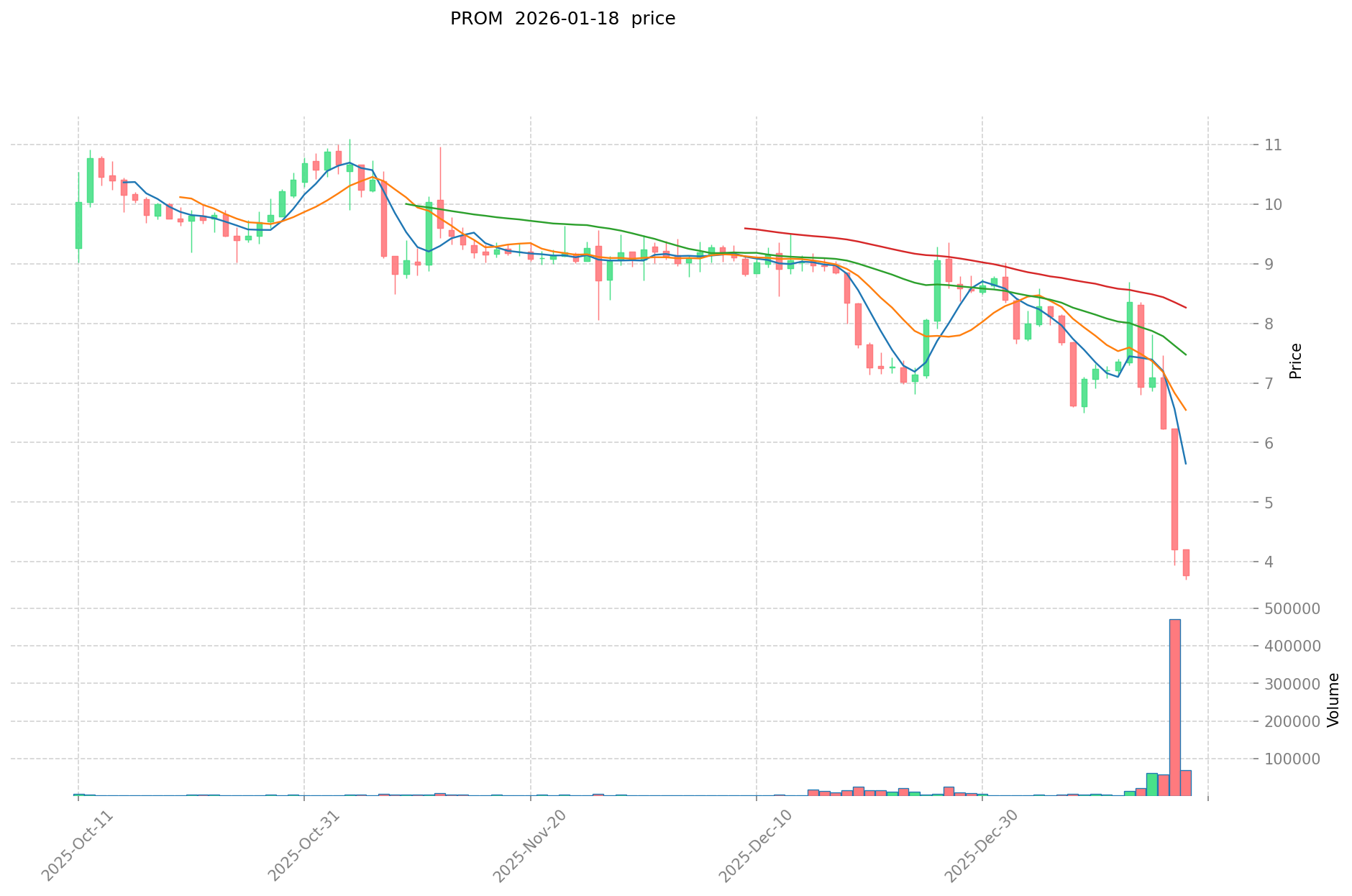
II. Core Factors Influencing Whether PROM is a Good Investment (Is Prometeus(PROM) a Good Investment)
Supply Mechanism and Scarcity (PROM investment scarcity)
- Supply mechanism → influences price and investment value
- PROM has a maximum supply of 19,250,000 tokens, with a circulating supply of 18,250,000 tokens (approximately 94.81% of total supply). This relatively limited supply structure may contribute to price volatility, particularly in market conditions where demand fluctuates.
- Historical context: PROM reached a notable price level of $105.94 in April 2021, though current trading levels are substantially lower at $3.449 as of January 2026.
- Investment significance: The constrained supply model, with nearly all tokens already in circulation, may play a role in supporting long-term investment considerations, though market dynamics and broader adoption remain critical factors.
Institutional Investment and Mainstream Adoption (Institutional investment in PROM)
- The token is listed on 20 exchanges, indicating a degree of market accessibility and trading infrastructure.
- Holder count stands at 2,623 addresses, reflecting a relatively modest but present user base.
Macroeconomic Environment's Impact on PROM Investment
- Broader market sentiment toward Web3 gaming, NFT-related tokens, and metaverse projects influences PROM's investment appeal.
- Market conditions in the cryptocurrency sector, including liquidity trends and risk appetite, affect demand for niche gaming and NFT infrastructure tokens like PROM.
- General economic uncertainty and shifts in digital asset adoption patterns may alter investment attractiveness across the sector.
Technology and Ecosystem Development (Technology & Ecosystem for PROM investment)
- Ecosystem positioning: PROM serves as an access point for the NFT gaming and metaverse industry, encompassing NFT marketplaces and aggregators, unsecured NFT rental and staking, educational portals and analytics tools, NFT launchpads, and a DEX for GameFi assets.
- Historical patterns suggest that announcements of platform updates, testing results for features such as NFT rentals or marketplace functionalities, and partnership developments have previously been associated with price movements.
- Broader sentiment toward Web3 gaming and NFT-related tokens continues to be a significant factor influencing PROM's market position and potential investment value.
III. PROM Future Investment Predictions and Price Outlook (Is Prometeus(PROM) worth investing in 2026-2031)
Short-term Investment Prediction (2026, short-term PROM investment outlook)
- Conservative Forecast: $2.52 - $3.45
- Neutral Forecast: $3.45 - $4.41
- Optimistic Forecast: $4.41 - $5.07
Mid-term Investment Outlook (2027-2029, mid-term Prometeus(PROM) investment forecast)
-
Market Phase Expectations: According to available data, PROM may experience moderate growth during the mid-term period, with price fluctuations influenced by broader market sentiment, technical developments, and adoption trends within the NFT gaming and metaverse sectors.
-
Investment Return Predictions:
- 2027: $3.46 - $5.07
- 2028: $2.34 - $5.67
- 2029: $2.69 - $6.81
-
Key Catalysts: Factors that may influence PROM's mid-term performance include overall cryptocurrency market trends, developments in NFT marketplaces and GameFi ecosystems, regulatory dynamics, and user adoption rates within decentralized applications.
Long-term Investment Outlook (Is PROM a good long-term investment?)
- Base Scenario: $3.90 - $6.71 (assuming steady growth in ecosystem adoption and stable market conditions through 2031)
- Optimistic Scenario: $5.47 - $6.84 (assuming accelerated adoption of NFT gaming platforms and favorable regulatory developments)
- Risk Scenario: $2.34 - $3.90 (under adverse market conditions or significant competitive pressure)
For more on PROM long-term investment and price predictions: Price Prediction
2026-2031 Long-term Outlook
- Base Scenario: $3.90 - $6.39 (corresponding to steady progress and gradual mainstream application growth)
- Optimistic Scenario: $5.47 - $6.84 (corresponding to large-scale adoption and favorable market environment)
- Transformative Scenario: Above $6.84 (if the ecosystem achieves breakthrough developments and mainstream adoption)
- Predicted High by 2031-12-31: $6.71 (based on optimistic development assumptions)
Disclaimer: These predictions are for informational purposes only and should not be construed as investment advice. Cryptocurrency markets are highly volatile, and actual prices may differ significantly from forecasts. Investors should conduct their own research and consider their risk tolerance before making investment decisions.
| Year |
Predicted High Price |
Predicted Average Price |
Predicted Low Price |
Price Change |
| 2026 |
4.41216 |
3.447 |
2.51631 |
0 |
| 2027 |
5.0691582 |
3.92958 |
3.4580304 |
13 |
| 2028 |
5.669205066 |
4.4993691 |
2.339671932 |
30 |
| 2029 |
6.81294469122 |
5.084287083 |
2.69467215399 |
47 |
| 2030 |
6.8409082701765 |
5.94861588711 |
5.4727266161412 |
72 |
| 2031 |
6.714500182575412 |
6.39476207864325 |
3.900804867972382 |
85 |
IV. PROM Investment Strategy and Risk Management (How to invest in PROM)
Investment Strategy (PROM investment strategy)
Long-term Holding (HODL PROM)
For conservative investors seeking stable exposure to the NFT gaming and metaverse sector, long-term holding may be considered as part of a diversified portfolio strategy. This approach focuses on the project's fundamental development rather than short-term price movements.
Active Trading
Traders may utilize technical analysis and swing trading strategies based on PROM's price movements. With 24-hour trading volume of approximately $311,178 and notable price volatility (24-hour change of -9.29%), active traders should employ rigorous technical indicators and risk controls.
Risk Management (Risk management for PROM investment)
Asset Allocation Ratios
- Conservative investors: Consider allocating no more than 1-3% of total portfolio to PROM
- Aggressive investors: May allocate 5-10% while maintaining diversification across multiple assets
- Professional investors: Can adjust allocation based on comprehensive market analysis and risk tolerance
Risk Hedging Solutions
- Diversify across multiple crypto assets and traditional investment vehicles
- Consider hedging instruments available in crypto markets
- Implement stop-loss orders to limit potential downside
Secure Storage
- Cold wallets: Hardware wallets (such as Ledger or Trezor) for long-term storage
- Hot wallets: Exchange wallets for active trading with minimal balance
- Best practice: Store majority of holdings in cold storage, maintain only trading amounts on exchanges
V. PROM Investment Risks and Challenges (Risks of investing in PROM)
Market Risks
- High volatility: PROM has experienced significant price fluctuations, with 7-day change of -51.84% and 30-day change of -56.86%
- Price volatility: 24-hour price range between $3.359 and $3.875 demonstrates considerable intraday movement
- Liquidity considerations: With daily trading volume of approximately $311,178, market depth should be evaluated before large transactions
Regulatory Risks
- Policy uncertainty: Different jurisdictions maintain varying regulatory frameworks for crypto assets
- Compliance evolution: Regulatory landscape for NFT gaming and metaverse projects continues to develop globally
- Jurisdiction-specific restrictions: Investment accessibility may vary across different regions
Technical Risks
- Network security: Smart contract vulnerabilities could potentially impact asset security
- Platform dependencies: Project functionality relies on underlying blockchain infrastructure
- Technology evolution: Rapid changes in blockchain technology may require protocol adaptations
VI. Conclusion: Is PROM a Good Investment?
Investment Value Summary
PROM operates as a unified access point for NFT gaming and metaverse sectors, with features including NFT marketplace, aggregator, lending, staking, educational portal, analytics tools, launchpad, and DEX for GameFi assets. The project has a circulating supply of 18.25 million tokens (94.81% of total supply) and maintains listings on 20 exchanges. Price performance shows significant volatility with a 1-year change of -52.90%.
Investor Recommendations
✅ Beginners:
- Consider dollar-cost averaging (DCA) strategy to mitigate timing risk
- Prioritize secure wallet storage and understand basic security practices
- Start with small allocations while learning about the project and broader market
✅ Experienced investors:
- Evaluate swing trading opportunities based on technical analysis
- Implement portfolio diversification across multiple crypto assets
- Monitor project developments and market trends regularly
✅ Institutional investors:
- Conduct comprehensive due diligence on project fundamentals
- Consider strategic long-term allocation as part of broader crypto portfolio
- Implement professional risk management and compliance frameworks
⚠️ Disclaimer: Cryptocurrency investments involve high risk and significant price volatility. This content is for informational purposes only and does not constitute investment advice. Investors should conduct their own research and consult with qualified financial advisors before making investment decisions.
VII. FAQ
Q1: Is Prometeus (PROM) a good investment for beginners in 2026?
PROM may be suitable for beginners as a small portfolio allocation (1-3%) within a diversified cryptocurrency portfolio, though it carries substantial risks. As of January 2026, PROM trades at $3.45 with a market cap of $62.94 million and has experienced significant volatility, including a 7-day decline of -51.84% and a 1-year change of -52.90%. For beginners, a dollar-cost averaging (DCA) strategy is recommended to mitigate timing risks. The project serves as an access point for NFT gaming and metaverse infrastructure, offering exposure to emerging sectors. However, beginners should prioritize secure storage solutions, start with minimal allocations, and thoroughly understand the high-risk nature of cryptocurrency investments before committing capital to PROM.
Q2: What is the predicted price range for PROM by 2031?
According to current forecasts, PROM is predicted to reach a price range between $3.90 and $6.71 by December 2031 under base scenario assumptions. The optimistic scenario projects a range of $5.47 to $6.84, while a transformative scenario suggests prices above $6.84 if breakthrough adoption occurs. The predicted high for 2031 is $6.71, representing approximately 94% growth from current levels of $3.45. These projections assume various factors including steady ecosystem development, gradual mainstream adoption of NFT gaming platforms, and favorable market conditions. However, these predictions carry significant uncertainty due to cryptocurrency market volatility, and actual prices may differ substantially from forecasts based on competitive developments, regulatory changes, and broader market dynamics.
Q3: What are the main risks associated with investing in PROM?
PROM investment carries three primary risk categories. Market risks include extreme price volatility, with recent 7-day declines of -51.84% and 30-day declines of -56.86%, plus relatively limited liquidity with daily trading volume around $311,178. Regulatory risks encompass evolving policy frameworks for NFT gaming and metaverse projects across different jurisdictions, with potential compliance requirements that may impact project operations. Technical risks involve smart contract vulnerabilities, dependencies on underlying blockchain infrastructure, and the need for protocol adaptations as blockchain technology evolves. Additionally, PROM's concentrated exposure to the NFT gaming and metaverse sectors means its performance is highly correlated with sentiment toward these emerging industries, which remain subject to adoption uncertainty and competitive pressures.
Q4: How does PROM's supply mechanism affect its investment value?
PROM has a maximum supply of 19.25 million tokens, with 18.25 million tokens already in circulation (94.81% of total supply), creating a relatively constrained supply structure. This high circulation percentage means limited future token inflation, which may support long-term price stability compared to projects with significant unreleased supply. The token's scarcity model can theoretically contribute to price appreciation during periods of increased demand. However, with nearly all tokens already circulating, future price movements will depend primarily on demand-side factors such as ecosystem adoption, user growth, and broader market sentiment toward NFT gaming and metaverse projects rather than supply dynamics. Historical context shows PROM reached $105.94 in April 2021 but currently trades at $3.45, demonstrating that supply constraints alone do not guarantee price performance.
Q5: What investment strategy is recommended for PROM holdings?
The recommended strategy varies by investor profile and risk tolerance. Conservative investors should consider a long-term holding (HODL) approach with 1-3% portfolio allocation, focusing on fundamental project development rather than short-term price movements. Aggressive investors may allocate 5-10% while implementing active trading strategies based on technical analysis and swing trading opportunities, utilizing PROM's notable volatility (24-hour changes of -9.29%). All investors should prioritize risk management through diversification across multiple crypto assets, implementation of stop-loss orders, and secure storage practices with cold wallets for long-term holdings and hot wallets only for active trading amounts. Dollar-cost averaging (DCA) is particularly recommended for beginners to mitigate timing risks in this highly volatile asset.
Q6: Which exchanges support PROM trading and what are the liquidity considerations?
PROM is currently listed on 20 cryptocurrency exchanges, providing reasonable market accessibility for investors. However, liquidity considerations are important, as the 24-hour trading volume stands at approximately $311,178.33, which is relatively modest compared to major cryptocurrencies. This limited daily volume means large transactions may experience slippage or impact market prices significantly. The 24-hour price range between $3.359 and $3.875 demonstrates considerable intraday movement, suggesting active but potentially shallow order books. Investors planning substantial positions should evaluate market depth across multiple exchanges before executing large orders. For smaller retail investors, current liquidity levels may be sufficient, but institutional investors or those considering significant allocations should factor in potential execution challenges and consider spreading orders across multiple venues or time periods.
Q7: How does PROM compare to other NFT gaming and metaverse tokens?
PROM positions itself as a unified access point for the NFT gaming and metaverse industry, offering comprehensive infrastructure including NFT marketplaces and aggregators, unsecured NFT rental and staking services, educational portals, analytical tools, NFT launchpads, and DEX functionality for GameFi assets. With a market cap of $62.94 million and 2,623 token holders, PROM represents a mid-tier project within the sector. Its comprehensive service offering differentiates it from single-function competitors, though this also creates execution complexity. The token's performance correlates strongly with broader sentiment toward Web3 gaming and NFT-related assets. Compared to sector leaders, PROM maintains lower trading volumes and market capitalization but offers potentially higher growth opportunities if ecosystem adoption accelerates. Investors should evaluate PROM within the context of their broader NFT gaming and metaverse exposure rather than as a standalone position.
Q8: What security measures should PROM investors implement?
PROM investors should implement a multi-layered security approach prioritizing asset protection. For long-term holdings, cold storage solutions such as hardware wallets (Ledger or Trezor) are essential, keeping the majority of tokens offline and protected from online threats. Hot wallets on exchanges should maintain only minimal balances needed for active trading to limit exposure in case of exchange security breaches. Best practices include using unique, strong passwords, enabling two-factor authentication (2FA) on all exchange accounts, and maintaining secure backup procedures for wallet recovery phrases stored in physically secure locations. Investors should verify smart contract addresses before transactions, be cautious of phishing attempts, and avoid sharing wallet details or private keys. Given PROM's technical risks including potential smart contract vulnerabilities, staying informed about project security audits and any reported issues is crucial for protecting investment capital.
* The information is not intended to be and does not constitute financial advice or any other recommendation of any sort offered or endorsed by Gate.