Propbase (PROPS) is a tokenized real estate investment token launched in November 2023, offering fractional ownership in Southeast Asian properties with a minimum $100 entry point. As of January 2026, PROPS trades at $0.007087 with a market cap of $3.29 million across 8 exchanges including Gate, though it has declined 96.22% from its April 2024 peak of $0.1873. This comprehensive analysis evaluates PROPS investment viability by examining its utility as the Propbase settlement token, supply mechanics with 464.26 million tokens circulating from a 1.2 billion maximum, and market dynamics showing 85.32% annual decline. The article provides short-term, mid-term, and long-term price forecasts through 2031 while detailing investment strategies for beginners through institutional investors. Critical risk factors include regulatory uncertainty in tokenized real estate, limited liquidity with only $45,519 daily volume, and concentrated holder base of 6,334 addresses. Investors are advised on asset allocation ratios, ri
Introduction: Propbase (PROPS) Investment Position and Market Outlook
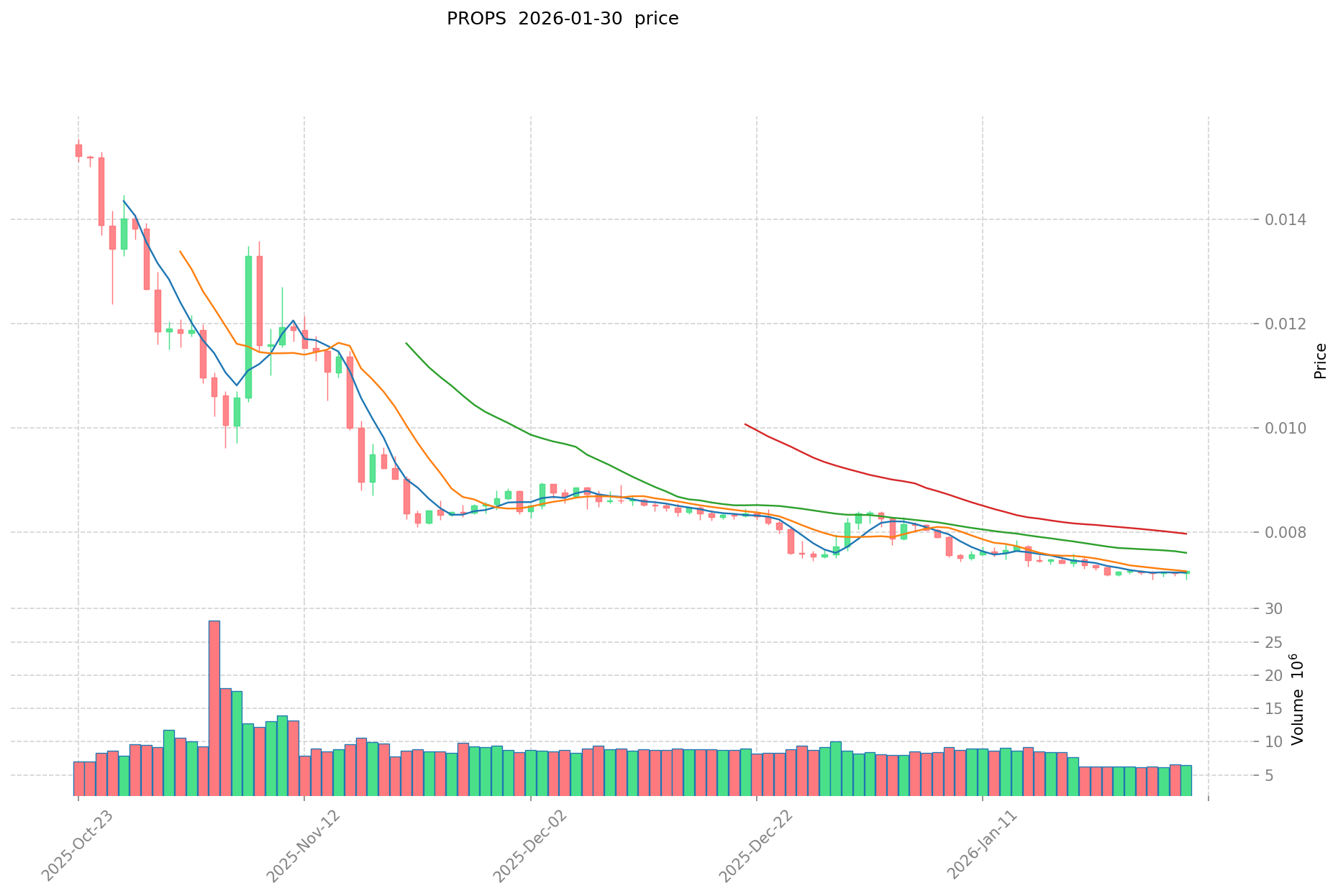
PROPS is a crypto asset in the digital currency field, launched in November 2023, and has been making strides in the tokenized real estate investment sector. As of January 30, 2026, PROPS maintains a market capitalization of approximately $3.29 million with a circulating supply of around 464.26 million tokens, and the current price stands at about $0.007087. With its positioning as a utility token for Southeast Asian fractional real estate investment, PROPS has gradually become a focal point for investors discussing "Is Propbase (PROPS) a good investment?" This article will comprehensively analyze PROPS's investment value, historical trends, future price predictions, and investment risks to provide reference for investors.
I. Propbase (PROPS) Price History Review and Current Investment Value
- 2024: PROPS reached a notable price level in April 2024 → The token demonstrated significant volatility during this period
- 2025-2026: Continuous market adjustments occurred → PROPS price experienced substantial fluctuations with notable corrections
- Recent Period: Market dynamics shifted from elevated levels to more moderate ranges → Price adjusted from previous peaks to current trading zones
Current PROPS Investment Market Status (January 2026)
- PROPS current price: $0.007087
- Market sentiment (Fear & Greed Index): Data suggests cautious market positioning
- 24-hour trading volume: $45,518.92
- Circulating supply: 464,264,125.63 PROPS
- Market capitalization: $3,290,239.86
- Fully diluted valuation: $8,504,400.00
- Market cap to FDV ratio: 38.69%
Click to view real-time PROPS market price
II. Core Factors Influencing Whether PROPS is a Good Investment
Supply Mechanism and Scarcity (PROPS Investment Scarcity)
- Total Supply and Circulation → Impact on Price and Investment Value
- Propbase has a maximum supply of 1,200,000,000 PROPS tokens, with a current circulating supply of approximately 464,264,125 tokens, representing a circulation ratio of around 38.69%. The controlled supply mechanism may influence token scarcity and potentially affect its market valuation over time.
- Historical Context: PROPS reached a notable price level of $0.1873 on April 30, 2024, while trading near $0.007068 on January 30, 2026. The token has experienced significant price fluctuations since its launch at $0.0032 in November 2023, reflecting market volatility and changing investor sentiment.
- Investment Consideration: Scarcity characteristics, influenced by supply dynamics and circulating token percentage, may play a role in long-term valuation considerations for investors evaluating PROPS.
- Platform Function: PROPS serves as the native utility token for the Propbase platform, functioning as the settlement method for smart contract interactions, property transaction fees, and access to new real estate listings in Southeast Asia.
- Investment Proposition: The token's utility is tied to fractional real estate investment opportunities, allowing participants to invest in real estate assets with a minimum entry point of $100, while earning potential rental yields.
- Ecosystem Application: The integration of tokenized real estate investment within the platform creates a use case for PROPS, where token demand may correlate with platform adoption and transaction volume in the Southeast Asian real estate market.
Market Sentiment and Price Volatility (PROPS Market Investment Dynamics)
- Short-term Performance: According to available data, bullish market sentiment in January 2026 contributed to a price increase of 8.74%, reflecting investor confidence during that period.
- Recent Price Trends: As of January 30, 2026, PROPS has experienced mixed short-term performance, with a 1-hour change of -0.08%, 24-hour change of -2%, 7-day change of -1.9%, 30-day change of -14.49%, and 1-year change of -85.32%.
- Market Indicators: Current market capitalization stands at approximately $3,290,239, with 24-hour trading volume of $45,518. The fully diluted market cap is approximately $8,504,400, indicating potential supply expansion considerations.
- Price Range: Recent 24-hour trading showed a high of $0.007257 and a low of $0.007068, demonstrating intraday volatility patterns that investors should consider when evaluating entry and exit strategies.
Blockchain Infrastructure and Technical Foundation (PROPS Technical Investment)
- Blockchain Platform: PROPS operates on the Aptos blockchain infrastructure, which may influence transaction efficiency, security characteristics, and interoperability within the broader crypto ecosystem.
- Token Holder Base: The token has approximately 6,334 holders as of the latest data, indicating a developing community base and distribution pattern.
- Exchange Accessibility: PROPS is available on 8 exchanges, including Gate.com, providing liquidity options for investors seeking to enter or exit positions in the token.
III. PROPS Future Investment Forecast and Price Outlook (Is Propbase(PROPS) worth investing in 2026-2031)
Short-term Investment Forecast (2026, short-term PROPS investment outlook)
- Conservative Estimate: $0.0064 - $0.0071
- Neutral Estimate: $0.0071 - $0.0085
- Optimistic Estimate: $0.0085 - $0.0095
Mid-term Investment Outlook (2027-2029, mid-term Propbase(PROPS) investment forecast)
-
Market Phase Expectation: The token may experience gradual growth as the tokenized real estate investment platform expands its user base in Southeast Asia. Price movements could be influenced by adoption rates of fractional property ownership and rental yield distribution mechanisms.
-
Investment Return Forecast:
- 2027: $0.0078 - $0.0089
- 2028: $0.0049 - $0.0117
- 2029: $0.0065 - $0.0105
-
Key Catalysts: Platform adoption in Southeast Asian real estate markets, regulatory developments in tokenized asset trading, expansion of property listings, and broader acceptance of blockchain-based real estate investment solutions.
Long-term Investment Outlook (Is Propbase a good long-term investment?)
- Base Scenario: $0.0057 - $0.0109 (assuming steady platform development and moderate market adoption)
- Optimistic Scenario: $0.0078 - $0.0139 (assuming accelerated adoption of tokenized real estate and favorable regulatory environment)
- Risk Scenario: $0.0049 - $0.0065 (under adverse market conditions or regulatory challenges)
Click to view PROPS long-term investment and price forecast: Price Prediction
2026-01-30 - 2031 Long-term Outlook
- Base Scenario: $0.0057 - $0.0103 USD (corresponding to steady progress and gradual mainstream application growth)
- Optimistic Scenario: $0.0078 - $0.0139 USD (corresponding to large-scale adoption and favorable market environment)
- Transformative Scenario: Above $0.0139 USD (if ecosystem achieves breakthrough developments and mainstream penetration)
- 2031-12-31 Predicted High: $0.0139 USD (based on optimistic development assumptions)
Disclaimer: This analysis is for informational purposes only and does not constitute investment advice. Cryptocurrency markets are highly volatile, and past performance does not guarantee future results. Investors should conduct their own research and consider their risk tolerance before making investment decisions.
| Year |
Predicted High Price |
Predicted Average Price |
Predicted Low Price |
Price Change |
| 2026 |
0.00949926 |
0.007089 |
0.0063801 |
0 |
| 2027 |
0.0088747191 |
0.00829413 |
0.0077964822 |
17 |
| 2028 |
0.011674817388 |
0.00858442455 |
0.0048931219935 |
21 |
| 2029 |
0.01053480580776 |
0.010129620969 |
0.00648295742016 |
42 |
| 2030 |
0.010952146191682 |
0.01033221338838 |
0.005682717363609 |
45 |
| 2031 |
0.013941255524941 |
0.010642179790031 |
0.007768791246722 |
50 |
IV. Propbase (PROPS) Investment Strategy and Risk Management (How to invest in tokenized real estate crypto)
Investment Methodology (Propbase investment strategy)
Long-term Holding (HODL PROPS): This approach may suit conservative investors who believe in the long-term potential of tokenized real estate markets in Southeast Asia. By holding PROPS tokens over an extended period, investors could potentially benefit from the platform's growth as adoption of fractional property ownership increases. However, given the token's historical performance showing an 85.32% decline over the past year, long-term holders should carefully evaluate the project's fundamental developments and market traction.
Active Trading: Traders employing technical analysis and swing trading strategies should note PROPS exhibits price volatility, with recent fluctuations ranging from $0.007068 to $0.007257 within 24 hours. The token's relatively low trading volume of approximately $45,519 over 24 hours suggests limited liquidity, which could impact execution of larger trades. Active traders should monitor support and resistance levels while being mindful of potential slippage in this lower-liquidity environment.
Risk Management (Risk management for PROPS investment)
Asset Allocation Ratios:
- Conservative investors: Consider limiting PROPS exposure to 1-2% of total crypto portfolio given the token's early stage and price decline history
- Moderate investors: May allocate 3-5% while maintaining diversification across different crypto asset classes
- Aggressive investors: Could consider up to 5-10% allocation with understanding of heightened risk profile
Risk Hedging Strategies: Implementing a diversified portfolio approach combining PROPS with established cryptocurrencies and traditional assets could help mitigate concentration risk. Investors might consider pairing exposure to real estate-focused tokens with broader market crypto assets to balance sector-specific risks.
Secure Storage:
- Hot wallets: Suitable for active traders needing frequent access, though PROPS is deployed on the Aptos blockchain, requiring compatible wallet solutions
- Cold storage: Recommended for long-term holders to minimize security risks
- Hardware wallets: Investors should verify hardware wallet compatibility with Aptos-based tokens before transferring PROPS
V. Propbase (PROPS) Investment Risks and Challenges (Risks of investing in tokenized real estate crypto)
Market Risks: PROPS demonstrates significant price volatility, having declined approximately 96.22% from its all-time high of $0.1873 in April 2024 to current levels around $0.007087. The token's market capitalization of approximately $3.29 million and trading across only 8 exchanges indicates a relatively small market presence. Price fluctuations could be influenced by limited liquidity conditions, with the 24-hour trading volume representing a modest percentage of total market cap.
Regulatory Risks: As a platform facilitating tokenized real estate investments in Southeast Asia, Propbase operates in a regulatory landscape that varies significantly across jurisdictions. Real estate tokenization faces evolving regulatory frameworks regarding securities classification, property ownership rights, and cross-border investment rules. Changes in regulations governing digital assets or real estate crowdfunding in key Southeast Asian markets could impact the platform's operational model and token utility.
Technical Risks: The project's infrastructure relies on the Aptos blockchain for smart contract functionality. Potential vulnerabilities include smart contract bugs that could affect property transaction processing, platform security breaches targeting user assets, or technical issues during protocol upgrades. With approximately 6,334 token holders, the relatively concentrated holder base could present additional risks related to token distribution and market stability.
VI. Conclusion: Is tokenized real estate crypto a Good Investment?
Investment Value Summary: Propbase (PROPS) represents an innovative approach to real estate investment through blockchain technology, offering fractional ownership opportunities in Southeast Asian property markets. However, the token has experienced substantial price decline since launch, with current metrics showing significant distance from historical highs. The project's long-term potential depends on successful execution of its real estate tokenization model and broader market adoption.
Investor Recommendations:
✅ Beginners: Consider starting with small allocations through dollar-cost averaging approach, ensure proper wallet setup compatible with Aptos blockchain, and thoroughly research the underlying real estate platform mechanics before investing.
✅ Experienced Investors: May explore swing trading opportunities while maintaining strict position sizing limits, diversify across multiple real estate-focused crypto projects, and monitor platform development milestones and property listing growth.
✅ Institutional Investors: Should conduct comprehensive due diligence on regulatory compliance across target markets, evaluate the platform's real estate asset quality and rental yield mechanisms, and assess long-term strategic fit within alternative investment portfolios.
⚠️ Disclaimer: Cryptocurrency investments carry substantial risk, including potential loss of principal. This content serves informational purposes only and does not constitute investment advice. Investors should conduct independent research and consult financial professionals before making investment decisions.
VII. FAQ
Q1: Is Propbase (PROPS) a good investment for beginners in 2026?
PROPS carries high risk and may not be suitable for most beginners due to its significant volatility and limited market maturity. The token has declined approximately 96.22% from its all-time high of $0.1873 in April 2024 to around $0.007087 as of January 2026, demonstrating substantial downside risk. For beginners considering exposure, starting with minimal allocation (1-2% of crypto portfolio) through dollar-cost averaging could help mitigate timing risk. Beginners should ensure they understand the tokenized real estate model, verify wallet compatibility with Aptos blockchain, and recognize that PROPS represents an early-stage project with limited trading volume of approximately $45,519 over 24 hours, which may impact liquidity during exit scenarios.
Q2: What makes PROPS different from other real estate tokenization projects?
PROPS differentiates itself through its focus on fractional real estate investment in Southeast Asian markets with a low minimum entry point of $100. The token serves as the native utility asset on the Propbase platform, functioning as the settlement method for smart contract interactions, property transaction fees, and access to new real estate listings. Operating on the Aptos blockchain infrastructure, PROPS aims to provide rental yield distribution mechanisms to token holders participating in property investments. However, with only approximately 6,334 holders and availability on 8 exchanges, the project maintains a relatively small market presence compared to established real estate tokenization platforms, which investors should consider when evaluating competitive positioning.
Q3: What are the main risks associated with investing in PROPS?
The primary risks include significant price volatility evidenced by an 85.32% decline over the past year, limited liquidity with modest trading volume relative to market capitalization, and regulatory uncertainty surrounding tokenized real estate across Southeast Asian jurisdictions. Technical risks encompass potential smart contract vulnerabilities on the Aptos blockchain, platform security concerns, and concentrated token distribution among approximately 6,334 holders. Additionally, the project's success depends on adoption of its fractional property ownership model in competitive real estate markets, which remains unproven at scale. The token's market capitalization of approximately $3.29 million indicates early-stage status, exposing investors to heightened execution risk regarding platform development and property listing expansion.
Q4: How should investors manage risk when holding PROPS tokens?
Conservative investors should limit PROPS exposure to 1-2% of total crypto portfolio given the token's early stage and historical price decline, while moderate investors may consider 3-5% allocation with proper diversification across different crypto asset classes. Risk management strategies include implementing dollar-cost averaging for position building, pairing PROPS with established cryptocurrencies to balance sector-specific risks, and maintaining strict position sizing limits. For security, long-term holders should utilize cold storage solutions or hardware wallets compatible with Aptos-based tokens, while active traders may use hot wallets with appropriate security measures. Investors should establish predetermined exit points based on both downside protection thresholds and profit-taking targets to manage emotional decision-making during volatile price movements.
Q5: What factors could influence PROPS price performance through 2031?
Key catalysts include platform adoption rates in Southeast Asian real estate markets, expansion of tokenized property listings, and successful distribution of rental yields to token holders. Regulatory developments regarding digital asset classification and real estate tokenization across target jurisdictions could significantly impact operational viability and investor confidence. Technical factors such as improvements to the Aptos blockchain infrastructure, enhanced smart contract functionality, and increased exchange listings may improve accessibility and liquidity. Market sentiment toward tokenized real estate investment solutions and broader crypto market conditions will influence price dynamics. According to forecast models, PROPS could potentially range from $0.0049 to $0.0139 by 2031 depending on execution success, though such predictions carry substantial uncertainty given the project's early stage and limited performance history.
Q6: What is the token supply structure and how does it affect investment decisions?
PROPS has a maximum supply of 1,200,000,000 tokens with approximately 464,264,125 tokens currently in circulation, representing a circulation ratio of 38.69%. The fully diluted market cap stands at approximately $8,504,400 compared to current market capitalization of $3,290,239, indicating potential supply expansion as additional tokens enter circulation. This supply structure suggests future token releases could create downward price pressure if not matched by corresponding demand growth from platform adoption. Investors should monitor the token unlock schedule and circulation ratio changes, as increased supply without proportional utility expansion could dilute investment value. The controlled supply mechanism may influence scarcity characteristics over time, though the impact depends on successful platform development and token burn mechanisms if implemented.
Q7: How does PROPS compare to traditional real estate investment options?
PROPS offers lower entry barriers with minimum investments of $100 compared to traditional real estate requiring substantial capital, providing accessibility for retail investors seeking property market exposure. The tokenized structure enables fractional ownership, instant liquidity through crypto exchanges (subject to market conditions), and potential rental yield distribution without property management responsibilities. However, traditional real estate investments typically provide more regulatory protection, established valuation methodologies, and historical performance data spanning decades. PROPS faces regulatory uncertainty, technical risks inherent to blockchain infrastructure, and limited operational history since launch in November 2023. The volatility profile differs substantially, with PROPS experiencing 96.22% decline from peak while traditional real estate generally demonstrates more stable price appreciation patterns, making the two investment vehicles incomparable in risk-return characteristics.
Q8: What role does the Aptos blockchain play in PROPS investment thesis?
The Aptos blockchain infrastructure provides the technical foundation for PROPS smart contract functionality, property transaction processing, and token transfer mechanisms. Aptos characteristics such as transaction throughput, security architecture, and development ecosystem may influence platform performance and scalability potential. Investors should consider that reliance on Aptos creates both opportunities and dependencies—improvements to the blockchain could enhance PROPS utility, while technical issues or security vulnerabilities in Aptos infrastructure could negatively impact the platform. The choice of Aptos over alternative blockchains like Ethereum or Polygon suggests specific technical considerations regarding cost, speed, and developer tools, though this also limits interoperability with other blockchain ecosystems. Investors should verify wallet compatibility with Aptos-based tokens and understand that the platform's success partly depends on Aptos blockchain adoption and continued development support.
* The information is not intended to be and does not constitute financial advice or any other recommendation of any sort offered or endorsed by Gate.