This comprehensive analysis evaluates Propchain (PROPC) as an investment opportunity by examining its tokenomics, market fundamentals, and risk factors. PROPC is a blockchain-powered ecosystem addressing real estate finance inefficiencies through tokenization and DeFi integration, currently trading at $0.161 with a $6.91 million market cap and 11,298 holders. The article evaluates PROPC's price history from its May 2023 launch at $0.351, including the December 2024 peak of $1.77, and provides detailed price range forecasts across short-term (2026), mid-term (2027-2029), and long-term (2030-2031) horizons. Core investment factors analyzed include the Propchain Foundation's systematic token buyback program reducing supply, institutional adoption potential, real estate market correlation, and Ethereum-based DeFi infrastructure. Risk assessment covers market volatility, regulatory uncertainties in asset tokenization, and technical execution challenges. Investment strategies and security recommendations are provid
Introduction: Propchain (PROPC) Investment Position and Market Prospects
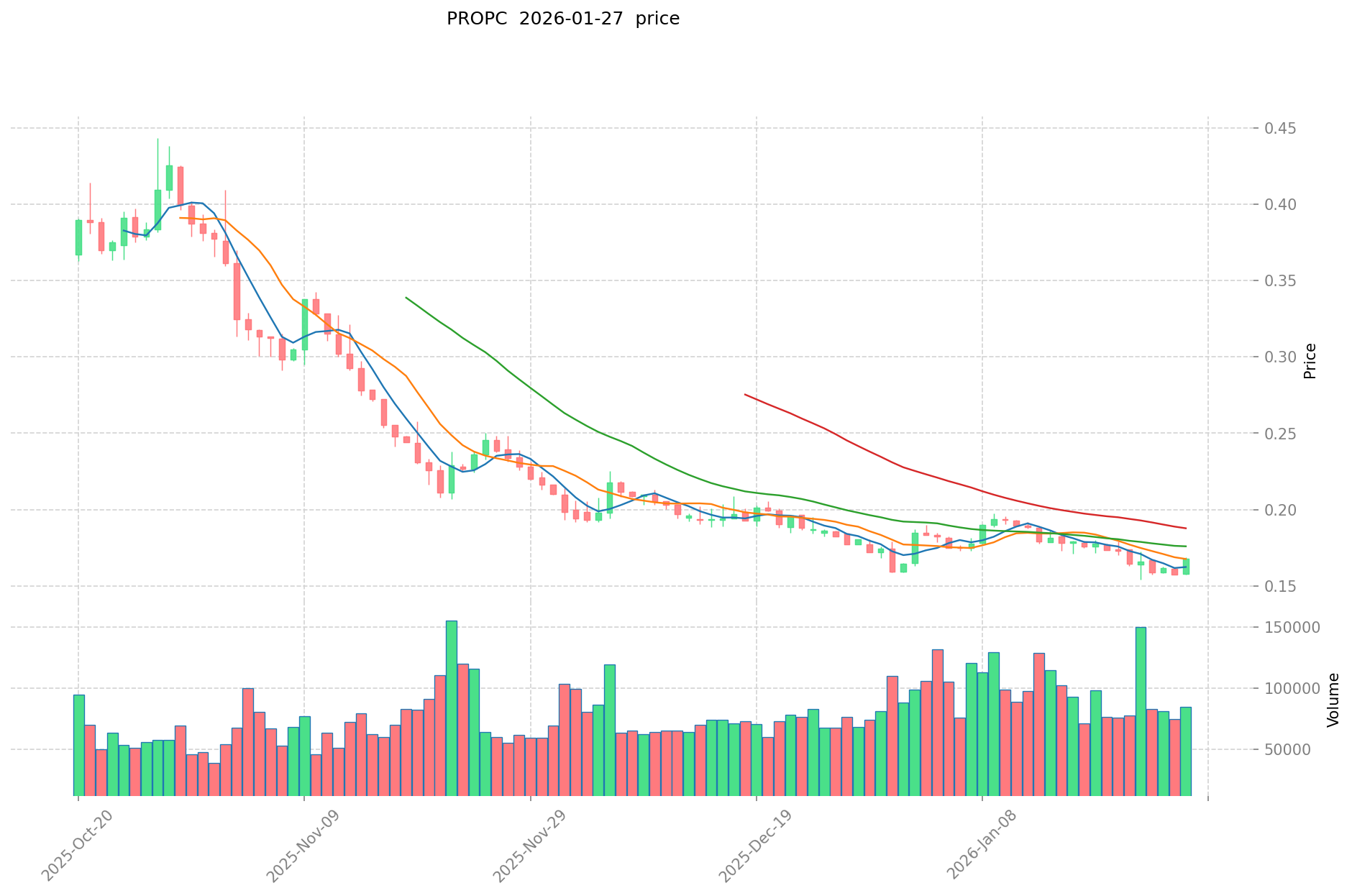
Propchain (PROPC) represents a blockchain-powered ecosystem addressing inefficiencies in real estate finance through tokenization, smart contract infrastructure, and decentralized finance (DeFi) integration. As of January 28, 2026, PROPC maintains a market capitalization of approximately $6.91 million with a circulating supply of 42.91 million tokens. The current trading price stands at $0.161, with 11,298 holders participating in the ecosystem. Launched in May 2023 with an initial price of $0.351, the token has experienced significant market fluctuations, trading between $0.1541 and $1.77 over its lifecycle. With a market share of 0.00032% and a circulating supply ratio of 42.91% relative to its maximum supply of 100 million tokens, PROPC operates within a specialized segment connecting traditional finance with digital asset markets. This analysis examines PROPC's investment characteristics, historical performance patterns, potential price trajectories, and associated risk factors for consideration by market participants evaluating the question "Is Propchain (PROPC) a suitable investment opportunity?"
I. Propchain (PROPC) Price History Review and Investment Value Status
- 2024: Token launched in May 2024 at $0.351 → Price experienced significant volatility throughout the year
- December 2024: Market momentum peaked → PROPC reached $1.77 level
- 2025-2026: Market correction period → Price declined from December peak to $0.1541 range
Current PROPC Investment Market Status (January 2026)
- PROPC current price: $0.161
- Market sentiment (Fear & Greed Index): Data indicates cautious sentiment
- 24-hour trading volume: $13,221.90
- Market capitalization: $6.91 million
Click to view real-time PROPC market price
II. Core Factors Affecting Whether PROPC is a Good Investment
Supply Mechanism and Scarcity (PROPC Investment Scarcity)
- Token Supply Structure: Propchain (PROPC) has a maximum supply of 100,000,000 tokens, with a current circulating supply of approximately 42,910,885 tokens (42.91% of max supply). The total supply stands at 63,763,336 tokens, indicating controlled token distribution that may influence scarcity dynamics.
- Strategic Buyback Program: The Propchain Foundation has implemented systematic token repurchases from exchanges. Since July 2025, the foundation has repurchased approximately 1.93 million PROPC tokens (valued at $1.03 million), consolidating these tokens into transparent onchain wallets. Additional repurchase rounds included 184,725 PROPC tokens, with all repurchased CEX tokens transferred to foundation-controlled addresses.
- Scarcity Impact on Value: The combination of capped maximum supply and ongoing buyback initiatives reduces circulating supply over time, potentially creating upward pressure on token value through enhanced scarcity mechanisms.
Institutional Investment and Mainstream Adoption (Institutional Investment in PROPC)
- Foundation-Led Investment Strategy: The Propchain Foundation's systematic token repurchase program demonstrates institutional commitment to reducing market supply and supporting token economics through strategic capital deployment.
- Real Estate Finance Integration: Propchain's positioning as a blockchain-powered ecosystem for real estate finance aims to bridge traditional finance with digital asset markets, targeting qualified institutional investors and DeFi participants as primary user segments.
- Market Accessibility: PROPC is currently listed on 2 exchanges with Gate.com confirmed as a trading venue, providing institutional and retail investors with access points for token acquisition and trading.
Macroeconomic Environment Impact on PROPC Investment
- Real Estate Market Correlation: As a real estate finance-focused blockchain platform, Propchain's investment value may be influenced by broader real estate market conditions, property valuations, and financing trends that affect the underlying asset class the platform seeks to tokenize.
- Digital Asset Market Dynamics: PROPC operates within the broader cryptocurrency market ecosystem, where macroeconomic factors such as regulatory developments, market sentiment cycles, and capital flows into blockchain-based real-world asset (RWA) tokenization projects may affect investment performance.
- Price Volatility Context: Recent price performance shows PROPC trading at $0.161 (as of January 28, 2026), representing a decline from its price at launch ($0.351) and considerable distance from previous higher price levels, reflecting sensitivity to market conditions and investor risk appetite.
Technology and Ecosystem Development (Technology & Ecosystem for PROPC Investment)
- Tokenization Infrastructure: Propchain provides solutions for asset tokenization within real estate finance, utilizing smart contract infrastructure to create digital representations of property assets and facilitate transactions.
- DeFi Integration: The platform incorporates decentralized finance (DeFi) elements to enhance capital market efficiency, offering mechanisms for institutional investors and DeFi participants to engage with tokenized real estate assets.
- Technical Standard: PROPC operates using the ERC-20 token standard on the Ethereum blockchain, providing compatibility with existing DeFi protocols, wallets, and infrastructure within the Ethereum ecosystem.
- Ecosystem Growth Metrics: The token has attracted 11,298 holders, indicating a developing user base for the platform's real estate tokenization and DeFi services.
III. PROPC Future Investment Prediction and Price Outlook (Is Propchain(PROPC) worth investing in 2026-2031)
Short-term Investment Prediction (2026, short-term PROPC investment outlook)
- Conservative forecast: $0.088 - $0.124
- Neutral forecast: $0.160 - $0.172
- Optimistic forecast: $0.184 - $0.232
Mid-term Investment Outlook (2027-2029, mid-term Propchain(PROPC) investment forecast)
-
Market stage expectation: During this period, PROPC may experience gradual growth as the platform continues to develop its blockchain-based real estate finance ecosystem. The integration of tokenization and DeFi solutions could attract institutional interest.
-
Investment return forecast:
- 2027: $0.124 - $0.234
- 2028: $0.146 - $0.252
- 2029: $0.180 - $0.253
-
Key catalysts: Platform adoption by institutional investors, expansion of tokenized real estate assets, DeFi integration developments, and overall market conditions in the blockchain real estate sector.
Long-term Investment Outlook (Is PROPC a good long-term investment?)
- Base scenario: $0.151 - $0.271 (assuming steady platform development and moderate market adoption)
- Optimistic scenario: $0.302 - $0.393 (assuming accelerated institutional adoption and favorable regulatory environment)
- Risk scenario: Below $0.088 (under adverse market conditions or platform development setbacks)
For long-term PROPC investment and price predictions: Price Prediction
2026-2031 Long-term Outlook
- Base scenario: $0.088 - $0.271 (corresponding to steady progress and gradual mainstream application improvement)
- Optimistic scenario: $0.302 - $0.393 (corresponding to large-scale adoption and favorable market environment)
- Transformative scenario: Above $0.393 (if the ecosystem achieves breakthrough developments and mainstream popularization)
- 2031-12-31 predicted high: $0.393 (based on optimistic development assumptions)
Disclaimer: Price predictions are subject to market volatility and various risk factors. Historical performance does not guarantee future results. Investors should conduct thorough research and consider their risk tolerance before making investment decisions.
| Year |
Predicted High Price |
Predicted Average Price |
Predicted Low Price |
Price Change |
| 2026 |
0.18423 |
0.1602 |
0.08811 |
0 |
| 2027 |
0.2342124 |
0.172215 |
0.1239948 |
6 |
| 2028 |
0.251984988 |
0.2032137 |
0.146313864 |
26 |
| 2029 |
0.25263527184 |
0.227599344 |
0.17980348176 |
41 |
| 2030 |
0.3025478079792 |
0.24011730792 |
0.1512739039896 |
49 |
| 2031 |
0.39343220902692 |
0.2713325579496 |
0.160086209190264 |
68 |
IV. Propchain Investment Strategy and Risk Management (How to invest in Propchain)
Investment Methodology (Propchain investment strategy)
Long-term Holding (HODL Propchain): This approach suits conservative investors who believe in the project's long-term vision of transforming real estate finance through blockchain technology. Given Propchain's focus on bridging traditional finance with digital assets and creating opportunities for institutional investors, patient capital allocation may align with the platform's gradual ecosystem development and market adoption trajectory.
Active Trading: For experienced traders, Propchain's price movements present opportunities for tactical positioning. The token has demonstrated notable volatility, with 24-hour fluctuations and broader price swings across different timeframes. Active traders may leverage technical analysis, chart patterns, and volume indicators to identify entry and exit points, though this strategy requires continuous market monitoring and disciplined execution.
Risk Management (Risk management for Propchain investment)
Asset Allocation Ratios: Investment positioning should align with individual risk tolerance and portfolio objectives:
- Conservative investors: Consider limiting Propchain allocation to a minor percentage of cryptocurrency holdings within a diversified portfolio
- Moderate investors: May allocate a measured portion to Propchain while maintaining exposure to established digital assets and traditional investments
- Experienced investors: Could incorporate larger allocations based on thorough due diligence and conviction in the project's fundamentals
Risk Hedging Solutions: Prudent investors may consider portfolio diversification across multiple asset classes and cryptocurrencies to mitigate concentration risk. Implementing position sizing discipline and establishing predetermined exit thresholds can help manage downside exposure during adverse market conditions.
Secure Storage: Propchain tokens (PROPC) are ERC-20 tokens deployed on the Ethereum network. Security-conscious holders should consider:
- Cold storage solutions: Hardware wallets such as Ledger or Trezor provide offline security for long-term holdings
- Hot wallet management: For active trading or DeFi participation, reputable software wallets with strong security features
- Custody considerations: Institutional participants may evaluate qualified custodial services with appropriate insurance and regulatory compliance
V. Propchain Investment Risks and Challenges (Risks of investing in Propchain)
Market Risks: Propchain exhibits characteristics common to smaller-cap cryptocurrencies, including pronounced price volatility. The token has experienced substantial price movements across various timeframes, reflecting both broader market conditions and project-specific dynamics. The relatively limited trading volume and exchange availability may contribute to liquidity constraints during periods of market stress, potentially amplifying price swings in either direction.
Regulatory Risks: As a blockchain project operating at the intersection of real estate finance and digital assets, Propchain may face evolving regulatory considerations across multiple jurisdictions. The tokenization of real-world assets and DeFi integration involve complex legal frameworks that continue to develop globally. Regulatory clarity or restrictions in key markets could materially impact the project's operational scope, user adoption, and token utility.
Technical Risks: Blockchain infrastructure projects face inherent technological challenges, including smart contract vulnerabilities, network security considerations, and integration complexities. As Propchain builds infrastructure connecting traditional real estate finance with blockchain technology, execution risks related to platform development, security audits, and seamless functionality warrant attention. Additionally, the project's reliance on Ethereum infrastructure means it may be affected by network congestion, gas fee fluctuations, or broader Ethereum ecosystem developments.
VI. Conclusion: Is Propchain a Good Investment?
Investment Value Summary: Propchain presents a specialized proposition within the blockchain and real estate finance intersection. The project addresses recognized inefficiencies in real estate capital markets through tokenization and DeFi integration, targeting both institutional investors and digital asset participants. While the platform's vision aligns with broader trends toward asset digitization, the token has experienced notable price volatility and remains in relatively early stages of market development.
Investor Recommendations:
✅ Newcomers: Consider gradual accumulation strategies rather than concentrated positions, paired with secure storage practices using reputable wallet solutions. Prioritize understanding the project fundamentals and broader cryptocurrency market dynamics before committing capital.
✅ Experienced Investors: May explore tactical trading approaches based on technical analysis while maintaining portfolio diversification across multiple assets. Consider the token's liquidity profile and exchange availability when planning position sizing and exit strategies.
✅ Institutional Investors: Evaluate Propchain's positioning within real estate technology and tokenization themes as part of broader digital asset allocation frameworks. Conduct comprehensive due diligence on team credentials, technological infrastructure, regulatory compliance, and market differentiation.
⚠️ Disclaimer: Cryptocurrency investments carry substantial risk, including potential loss of capital. This content provides informational analysis only and does not constitute investment advice, financial guidance, or recommendations to buy or sell any asset. Investors should conduct independent research and consult qualified financial advisors before making investment decisions.
VII. FAQ
Q1: What is Propchain (PROPC) and what problem does it solve?
Propchain (PROPC) is a blockchain-powered ecosystem that addresses inefficiencies in real estate finance through tokenization, smart contract infrastructure, and DeFi integration. The platform bridges traditional real estate finance with digital asset markets, enabling institutional investors and DeFi participants to access tokenized real estate assets. Operating as an ERC-20 token on the Ethereum blockchain, PROPC provides infrastructure for asset tokenization and facilitates transactions through smart contracts, aiming to enhance capital market efficiency in the real estate sector.
Q2: How has PROPC performed since its launch and what is its current market position?
PROPC launched in May 2023 at $0.351 and experienced significant volatility, reaching a peak of $1.77 in December 2024 before declining to its current price of $0.161 as of January 28, 2026. The token maintains a market capitalization of approximately $6.91 million with 11,298 holders and a circulating supply of 42.91 million tokens (42.91% of the maximum supply of 100 million). With a market share of 0.00032% and daily trading volume of $13,221.90, PROPC operates in a specialized segment of the cryptocurrency market focused on real estate tokenization.
Q3: What is the Propchain Foundation's token buyback program and how does it affect token scarcity?
The Propchain Foundation has implemented a systematic token repurchase program to reduce circulating supply and support token economics. Since July 2025, the foundation has repurchased approximately 1.93 million PROPC tokens valued at $1.03 million, consolidating these tokens into transparent onchain wallets. Additional rounds included the repurchase of 184,725 PROPC tokens, with all repurchased tokens transferred to foundation-controlled addresses. This strategic buyback initiative, combined with the capped maximum supply of 100 million tokens, creates potential upward pressure on token value through enhanced scarcity mechanisms.
Q4: What are the predicted price ranges for PROPC through 2031?
Short-term predictions for 2026 range from $0.088-$0.124 (conservative), $0.160-$0.172 (neutral), to $0.184-$0.232 (optimistic). Mid-term forecasts suggest gradual growth: 2027 ($0.124-$0.234), 2028 ($0.146-$0.252), and 2029 ($0.180-$0.253). Long-term outlook for 2031 presents three scenarios: base scenario ($0.151-$0.271), optimistic scenario ($0.302-$0.393), and risk scenario (below $0.088). The predicted high for December 31, 2031 stands at $0.393 under optimistic development assumptions, though these predictions remain subject to market volatility and various risk factors.
Q5: What are the main risks associated with investing in PROPC?
PROPC faces three primary risk categories: (1) Market risks including pronounced price volatility, limited trading volume, and liquidity constraints that may amplify price movements; (2) Regulatory risks stemming from evolving legal frameworks governing real estate tokenization and DeFi integration across multiple jurisdictions, which could impact operational scope and token utility; (3) Technical risks involving smart contract vulnerabilities, network security considerations, integration complexities, and dependence on Ethereum infrastructure performance including gas fees and network congestion.
Q6: Which investment strategy is most suitable for different types of PROPC investors?
For newcomers, a gradual accumulation strategy with secure cold storage (hardware wallets like Ledger or Trezor) is recommended, limiting PROPC to a minor percentage of cryptocurrency holdings. Experienced investors may employ active trading approaches leveraging technical analysis while maintaining portfolio diversification, allocating a measured portion based on risk tolerance. Institutional investors should evaluate PROPC within broader digital asset allocation frameworks through comprehensive due diligence on team credentials, technological infrastructure, and regulatory compliance, potentially using qualified custodial services with appropriate insurance coverage.
Q7: What technological infrastructure supports PROPC and how does it integrate with existing systems?
PROPC operates as an ERC-20 token on the Ethereum blockchain, providing compatibility with existing DeFi protocols, wallets, and infrastructure within the Ethereum ecosystem. The platform utilizes smart contract infrastructure to create digital representations of property assets and facilitate transactions. The DeFi integration enhances capital market efficiency by offering mechanisms for institutional investors and DeFi participants to engage with tokenized real estate assets, while the standardized ERC-20 format ensures seamless interaction with established blockchain infrastructure and services.
Q8: How does the macroeconomic environment affect PROPC's investment value?
PROPC's investment value is influenced by two primary macroeconomic factors: (1) Real estate market conditions, including property valuations, financing trends, and overall health of the underlying asset class that the platform seeks to tokenize; (2) Digital asset market dynamics encompassing regulatory developments, market sentiment cycles, and capital flows into blockchain-based real-world asset (RWA) tokenization projects. The token's price performance—declining from its $0.351 launch price to the current $0.161—reflects sensitivity to broader market conditions, investor risk appetite, and the evolving landscape of both traditional finance and cryptocurrency markets.
* The information is not intended to be and does not constitute financial advice or any other recommendation of any sort offered or endorsed by Gate.