This comprehensive analysis evaluates PumpBTC (PUMPBTC) as an investment opportunity, examining whether this AI-driven Bitcoin staking and liquidity platform represents viable cryptocurrency exposure. The article provides detailed assessment of PUMPBTC's current market position at $0.02512 with $7.16 million market capitalization, analyzing historical price performance alongside future projections through 2030. Key investment factors evaluated include token supply mechanics, institutional adoption trends, and ecosystem integration with DeFi protocols through Babylon Protocol collaboration. The analysis presents investment strategies tailored for conservative, moderate, and experienced investors, emphasizing position sizing between 1-15% of cryptocurrency portfolios. Critical risk factors including market volatility, limited liquidity, regulatory uncertainty, and technical complexities are thoroughly examined. Price predictions range from conservative 2026 estimates of $0.0181-$0.0236 to optimistic 2030 scenar
Introduction: PumpBTC (PUMPBTC) Investment Position and Market Prospects
PumpBTC represents an AI-driven staking and liquidity operating system designed for modular chains within the cryptocurrency space. As of January 28, 2026, PUMPBTC holds a market capitalization of approximately $7.16 million, with a circulating supply of 285 million tokens and a current trading price around $0.02512. The project positions itself as a bridge enabling Bitcoin holders to participate in decentralized finance (DeFi) while maintaining asset control through secure, scalable infrastructure. With approximately 133 holders and a market dominance of 0.00080%, PUMPBTC operates primarily on Ethereum-based infrastructure. This analysis examines PUMPBTC's investment characteristics, historical performance, future outlook, and associated risks to provide perspective for those evaluating "Is PumpBTC (PUMPBTC) a good investment?" within the context of emerging Bitcoin liquidity solutions.
I. PUMPBTC Price History Review and Current Investment Value Status
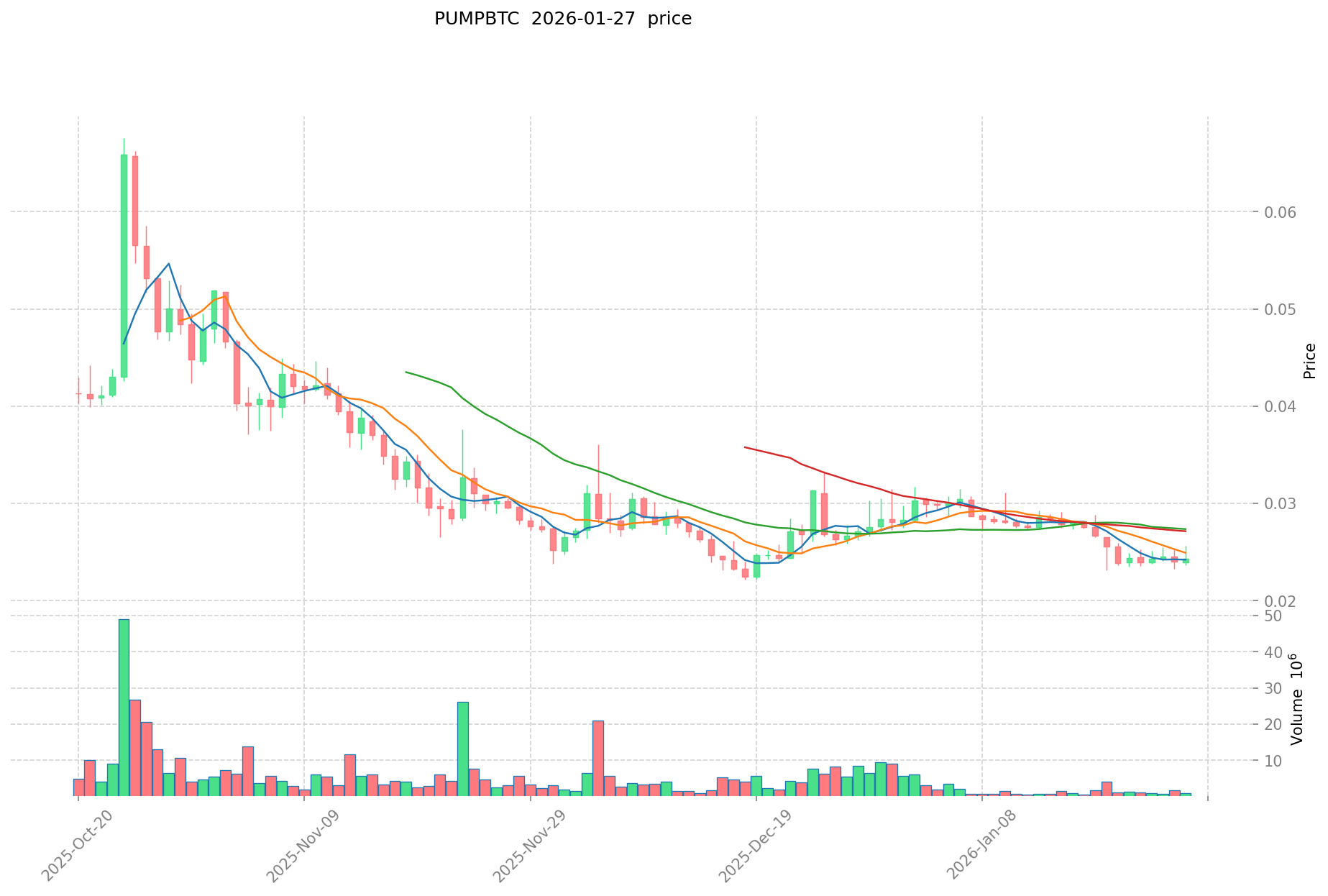
PumpBTC (PUMPBTC) has demonstrated significant volatility since its market debut. According to available data, the token reached a notable price level of $0.76464 on September 22, 2025, before experiencing a substantial decline. By December 18, 2025, the price dropped to $0.02217, reflecting a period of considerable market correction. As of January 28, 2026, PUMPBTC is trading at approximately $0.02512, showing a modest recovery from its recent lows.
The token's performance over various timeframes reveals mixed results. Over the past year, PUMPBTC has experienced a decline of approximately 63.49%, indicating challenges in maintaining sustained value appreciation. However, shorter-term trends show more positive momentum, with the token registering gains of 4.63% over 24 hours and 4.16% over a 7-day period. The 30-day performance shows a decline of 4.89%, suggesting ongoing price volatility.
The platform's Total Value Locked (TVL) reportedly exceeded $200 million in 2024, indicating meaningful adoption within the DeFi ecosystem for Bitcoin holders seeking yield opportunities through modular chain integration.
Current PUMPBTC Investment Market Status (January 2026)
- Current PUMPBTC Price: $0.02512
- 24-hour Trading Volume: $41,544.62
- Market Capitalization: $7,159,200
- Circulating Supply: 285,000,000 PUMPBTC (28.5% of total supply)
- Total Supply: 1,000,000,000 PUMPBTC
- 24-hour Price Range: $0.02398 - $0.02631
- Market Dominance: 0.00080%
- Number of Holders: 133
- Exchange Listings: Available on 1 exchange platform
The token operates on multiple blockchain standards, including BEP-20 and ERC-20, with its primary contract address on the Ethereum network (0xb7c0007ab75350c582d5eab1862b872b5cf53f0c). The fully diluted market capitalization stands at $25,120,000, with the current market cap representing approximately 21.28% of this valuation.
Click to view real-time PUMPBTC market price
II. Core Factors Influencing Whether PUMPBTC is a Good Investment (Is PumpBTC(PUMPBTC) a Good Investment)
Supply Mechanism and Scarcity (PUMPBTC investment scarcity)
- Total Supply Cap: PumpBTC has a maximum supply of 1,000,000,000 tokens, with a current circulating supply of 285,000,000 tokens, representing approximately 28.5% of the total supply.
- Supply Distribution Impact: The relatively low circulation ratio of 21.28% may indicate controlled token release, which could influence market dynamics and price volatility over time.
- Investment Significance: The predetermined maximum supply cap provides a framework for understanding potential scarcity, though the large portion of tokens yet to enter circulation remains a consideration for investment evaluation.
Institutional Investment and Mainstream Adoption (Institutional investment in PUMPBTC)
- Institutional Activity: According to available data, Nasdaq-listed Fitell acquired approximately $1.5 million worth of PUMP tokens in October 2025, indicating some level of institutional interest in the project.
- Market Positioning: PumpBTC positions itself as an AI-driven liquid staking platform for Bitcoin, collaborating with Babylon Protocol to enable BTC holders to earn yields while maintaining liquidity.
- Ecosystem Integration: The platform's integration with DeFi protocols and its focus on Bitcoin liquid staking represents an approach to expanding utility within the broader cryptocurrency ecosystem.
Macroeconomic Environment's Impact on PUMPBTC Investment
- Market Volatility: PumpBTC has demonstrated considerable price volatility, with price movements showing a decline of approximately 63.49% over a one-year period as of January 28, 2026.
- Broader Market Correlation: As a Bitcoin-related staking platform, PumpBTC's investment appeal may be influenced by overall sentiment toward Bitcoin and the broader cryptocurrency market conditions.
- Risk Considerations: The token's price fluctuations, including a recorded range from a higher level of $0.76464 to a lower level of $0.02217, reflect the volatile nature typical of emerging governance tokens.
Technology and Ecosystem Development (Technology & Ecosystem for PUMPBTC investment)
- Core Technology: PumpBTC operates as a liquid staking solution that integrates AI-powered yield optimization, designed to work with modular blockchain architectures.
- Protocol Integration: The platform's collaboration with Babylon Protocol aims to enable Bitcoin holders to participate in staking activities without locking their assets, potentially expanding use cases.
- Token Standards: PUMPBTC is deployed using BEP-20 and ERC-20 standards, with a contract address on the Ethereum network, facilitating compatibility across multiple blockchain environments.
- DeFi Utility: The platform's focus on seamless DeFi integration seeks to provide Bitcoin holders with access to decentralized finance opportunities while maintaining asset control and transparency.
III. PUMPBTC Future Investment Prediction and Price Outlook (Is PumpBTC (PUMPBTC) worth investing in 2026-2030)
Short-term Investment Prediction (2026, short-term PUMPBTC investment outlook)
- Conservative Prediction: $0.0181 - $0.0236
- Neutral Prediction: $0.0252 - $0.0266
- Optimistic Prediction: $0.0279 - $0.0385
Mid-term Investment Outlook (2027-2029, mid-term PumpBTC (PUMPBTC) investment forecast)
-
Market Stage Expectation: The token may experience gradual development as the AI-driven staking and liquidity operating system continues to integrate with DeFi ecosystems. Market adoption and ecosystem expansion could contribute to moderate price movements during this period.
-
Investment Return Prediction:
- 2027: $0.0236 - $0.0385
- 2028: $0.0303 - $0.0442
- 2029: $0.0338 - $0.0495
-
Key Catalysts: Platform adoption growth, DeFi ecosystem integration progress, modular chain development, and overall cryptocurrency market sentiment.
Long-term Investment Outlook (Is PUMPBTC a good long-term investment?)
- Baseline Scenario: $0.0299 - $0.0440 (assuming steady platform development and moderate DeFi sector growth)
- Optimistic Scenario: $0.0495 - $0.0684 (assuming accelerated adoption, successful ecosystem partnerships, and favorable market conditions)
- Risk Scenario: $0.0181 - $0.0302 (under challenging market conditions or slower-than-expected platform adoption)
Click to view PUMPBTC long-term investment and price prediction: Price Prediction
2026-2030 Long-term Outlook
- Base Scenario: $0.0299 - $0.0440 (corresponding to steady progress and gradual mainstream application growth)
- Optimistic Scenario: $0.0495 - $0.0684 (corresponding to large-scale adoption and favorable market environment)
- Transformative Scenario: Above $0.0684 (if the ecosystem achieves breakthrough progress and mainstream popularization)
- 2030-12-31 Predicted High: $0.0510 (based on optimistic development assumptions)
Disclaimer: Price predictions are based on historical data analysis and market forecasting models. Cryptocurrency markets are highly volatile and subject to numerous unpredictable factors. These predictions should not be considered as investment advice. Investors should conduct their own research and consider their risk tolerance before making any investment decisions.
| Year |
Predicted High Price |
Predicted Average Price |
Predicted Low Price |
Price Change |
| 2026 |
0.0279387 |
0.02517 |
0.0181224 |
0 |
| 2027 |
0.0385038075 |
0.02655435 |
0.0236333715 |
5 |
| 2028 |
0.0442395471 |
0.03252907875 |
0.0302520432375 |
29 |
| 2029 |
0.04951576367325 |
0.038384312925 |
0.033778195374 |
52 |
| 2030 |
0.050982044426985 |
0.043950038299125 |
0.029886026043405 |
74 |
| 2031 |
0.068351099562799 |
0.047466041363055 |
0.037023512263182 |
88 |
IV. PUMPBTC Investment Strategy and Risk Management (How to invest in PUMPBTC)
Investment Methodology (PUMPBTC investment strategy)
Long-term Holding (HODL PUMPBTC)
Long-term holding strategies may suit investors seeking exposure to AI-driven DeFi infrastructure built on modular blockchain architectures. This approach involves acquiring PUMPBTC tokens and maintaining positions through market cycles, based on the project's fundamental value proposition of providing Bitcoin holders with staking and liquidity solutions.
Given the token's circulation ratio of 28.5% (285 million out of 1 billion total supply), investors should consider potential dilution effects as additional tokens enter circulation. The platform's focus on seamless DeFi integration and asset control retention represents its core value thesis for long-term consideration.
Active Trading
Active trading strategies involve utilizing technical analysis and market timing approaches. PUMPBTC has demonstrated notable price volatility, with 24-hour fluctuations reaching 4.63% and price ranges between $0.02398 and $0.02631. The token experienced significant price movements historically, with recorded levels ranging from $0.02217 to previous higher levels.
Traders may consider monitoring:
- Intraday volatility patterns
- Volume trends (24-hour trading volume: $41,544.62)
- Technical support and resistance levels
- Market sentiment indicators
Risk Management (Risk management for PUMPBTC investment)
Asset Allocation Ratios
Conservative Investors: May consider limiting PUMPBTC exposure to 1-3% of total cryptocurrency portfolio, given the project's relatively early stage and market capitalization of $7.16 million.
Moderate Investors: Could allocate 3-7% of crypto holdings, balancing growth potential against volatility risks.
Experienced Investors: May consider higher allocations (7-15%) based on comprehensive due diligence and risk tolerance, while maintaining diversification across multiple assets.
Risk Hedging Approaches
- Multi-asset Portfolio Construction: Combining PUMPBTC with established cryptocurrencies and stablecoins to reduce concentration risk
- Position Sizing: Implementing gradual accumulation strategies rather than single large purchases
- Stop-loss Mechanisms: Setting predetermined exit points to limit potential losses
- Correlation Analysis: Monitoring relationships with Bitcoin and DeFi sector performance
Secure Storage Solutions
PUMPBTC operates on multiple blockchain standards (BEP-20 and ERC-20), requiring appropriate wallet infrastructure:
Hot Wallets: For active trading and frequent transactions
- MetaMask (ERC-20 compatible)
- Trust Wallet (BEP-20 and ERC-20 compatible)
- Exchange wallets for immediate trading needs
Cold Storage: For long-term holdings
- Hardware wallets supporting ERC-20 and BEP-20 tokens
- Multi-signature wallets for enhanced security
- Paper wallets for offline storage (advanced users)
Security Best Practices:
- Verify contract addresses (ETH: 0xb7c0007ab75350c582d5eab1862b872b5cf53f0c)
- Enable two-factor authentication
- Regular security audits of storage solutions
- Backup of recovery phrases in secure locations
V. PUMPBTC Investment Risks and Challenges (Risks of investing in PUMPBTC)
Market Risks
High Volatility: PUMPBTC exhibits significant price fluctuations characteristic of smaller market cap cryptocurrencies. The token's market capitalization of $7.16 million and relatively low holder count (133 addresses) may contribute to amplified price movements during trading periods.
Liquidity Considerations: With 24-hour trading volume of $41,544.62 and listing on limited exchanges, investors may face challenges executing large orders without impacting market prices. Lower liquidity environments can result in wider bid-ask spreads and increased slippage.
Price Discovery: The token's circulating supply represents 28.5% of maximum supply, suggesting potential price pressure as additional tokens enter circulation through unlock schedules or distribution mechanisms.
Regulatory Risks
Jurisdictional Uncertainty: Cryptocurrency regulations vary significantly across different countries and continue evolving. Projects operating at the intersection of Bitcoin, DeFi, and AI-driven solutions may face scrutiny under multiple regulatory frameworks.
Compliance Requirements: Staking and liquidity operations may be subject to securities regulations in certain jurisdictions, potentially affecting platform operations and token utility.
Cross-chain Considerations: Operating on multiple blockchain standards (BEP-20 and ERC-20) may expose the project to varying regulatory treatments across different blockchain ecosystems.
Technical Risks
Smart Contract Security: As a platform facilitating staking and liquidity operations, PUMPBTC relies on smart contract infrastructure. Potential vulnerabilities in contract code could expose user funds to security risks.
Integration Complexity: The platform's design as an AI-driven operating system for modular chains involves complex technical architecture. Implementation challenges or integration issues with DeFi protocols could impact functionality.
Network Dependencies: Operating across multiple blockchain networks introduces dependencies on underlying infrastructure performance, security, and upgrade cycles of both Ethereum and BNB Chain.
Upgrade Risks: Protocol improvements or modifications may require coordination across multiple blockchain environments, potentially creating technical challenges or temporary service disruptions.
AI System Reliability: The platform's AI-driven components introduce additional technical considerations regarding algorithm performance, decision-making accuracy, and system optimization.
VI. Conclusion: Is PUMPBTC a Good Investment?
Investment Value Summary
PUMPBTC represents a specialized DeFi infrastructure project focused on Bitcoin holder participation in decentralized finance through AI-driven staking and liquidity solutions. The platform addresses a specific market segment by offering Bitcoin holders methods to generate returns while maintaining asset control.
The token operates in a competitive landscape where numerous projects target Bitcoin DeFi integration. With a market capitalization of $7.16 million and 28.5% circulating supply, PUMPBTC maintains a relatively early-stage profile among cryptocurrency projects.
Price performance reflects the broader challenges facing smaller market cap tokens, with notable fluctuations across different timeframes. The project's technical approach combining AI systems, modular chain architecture, and multi-standard deployment (BEP-20 and ERC-20) represents both innovation potential and implementation complexity.
Investor Recommendations
✅ New Investors
- Education First: Thoroughly research DeFi concepts, staking mechanisms, and Bitcoin-related protocols before considering investment
- Small Position Sizing: Begin with minimal allocations to understand project mechanics and market behavior
- Secure Storage: Prioritize wallet security by using hardware wallets or reputable wallet providers supporting ERC-20 and BEP-20 standards
- Gradual Accumulation: Consider dollar-cost averaging approaches to mitigate timing risks
✅ Experienced Investors
- Due Diligence: Conduct comprehensive analysis of project documentation, smart contract audits, and team backgrounds
- Portfolio Context: Evaluate PUMPBTC allocation within broader cryptocurrency holdings and overall investment strategy
- Active Monitoring: Track development progress, partnership announcements, and protocol metrics
- Risk-adjusted Positioning: Implement position sizing appropriate to volatility levels and liquidity constraints
✅ Institutional Investors
- Thorough Assessment: Commission independent technical audits and legal reviews before considering positions
- Liquidity Analysis: Evaluate market depth and trading infrastructure relative to position sizing requirements
- Regulatory Review: Assess compliance implications across relevant jurisdictions
- Strategic Evaluation: Determine alignment with broader portfolio thesis regarding DeFi infrastructure and Bitcoin ecosystem development
⚠️ Important Disclaimer
Cryptocurrency investments carry substantial risks, including potential loss of principal. Market volatility, regulatory changes, technical vulnerabilities, and project-specific challenges can significantly impact token values. This analysis provides informational context based on available data as of January 28, 2026, and does not constitute financial advice, investment recommendations, or endorsements. Investors should conduct independent research, consult qualified financial advisors, and carefully consider their risk tolerance and investment objectives before making any investment decisions.
VII. FAQ
Q1: What is PumpBTC (PUMPBTC) and how does it work?
PumpBTC is an AI-driven liquid staking and liquidity operating system designed for Bitcoin holders to participate in decentralized finance (DeFi) while maintaining asset control. The platform integrates with modular blockchain architectures and collaborates with Babylon Protocol to enable BTC holders to earn yields through staking activities without locking their assets. Operating on both BEP-20 and ERC-20 standards, PumpBTC combines AI-powered yield optimization with seamless DeFi integration, allowing Bitcoin holders to access decentralized finance opportunities across multiple blockchain environments while retaining liquidity and transparency.
Q2: What is the current price and market position of PUMPBTC?
As of January 28, 2026, PUMPBTC trades at approximately $0.02512 with a market capitalization of $7.16 million. The token has a circulating supply of 285 million tokens (28.5% of the 1 billion total supply) and 24-hour trading volume of $41,544.62. With approximately 133 holders and market dominance of 0.00080%, PUMPBTC represents a relatively early-stage project within the cryptocurrency ecosystem. The token has experienced significant volatility, declining approximately 63.49% over the past year from previous higher levels, though showing recent short-term gains of 4.63% over 24 hours.
Q3: What are the main investment risks associated with PUMPBTC?
PUMPBTC carries several significant investment risks. Market risks include high volatility typical of smaller market cap cryptocurrencies, limited liquidity with trading available on only one exchange, and potential price pressure as additional tokens enter circulation. Regulatory risks encompass jurisdictional uncertainty regarding DeFi and staking operations, evolving compliance requirements, and cross-chain regulatory considerations. Technical risks involve smart contract security vulnerabilities, integration complexity with modular chain architecture, network dependencies across multiple blockchains, and AI system reliability concerns. The combination of these factors creates a high-risk investment profile requiring careful evaluation and appropriate risk management strategies.
Q4: What investment strategies are suitable for PUMPBTC?
Investment strategies for PUMPBTC vary based on investor experience and risk tolerance. Conservative investors may limit exposure to 1-3% of their cryptocurrency portfolio through long-term holding approaches, focusing on the project's fundamental value proposition in Bitcoin DeFi infrastructure. Moderate investors could allocate 3-7% while implementing diversification across multiple assets. Experienced investors may consider active trading strategies leveraging technical analysis, given the token's notable volatility with 24-hour fluctuations reaching 4.63%. All strategies should incorporate risk management practices including position sizing, stop-loss mechanisms, portfolio diversification, and secure storage using hardware wallets or reputable wallet providers supporting ERC-20 and BEP-20 standards.
Q5: What is the price prediction outlook for PUMPBTC through 2030?
Price predictions for PUMPBTC suggest mixed scenarios across different timeframes. Short-term 2026 forecasts range from conservative estimates of $0.0181-$0.0236 to optimistic projections of $0.0279-$0.0385. Mid-term outlook for 2027-2029 shows potential gradual growth with 2027 predictions of $0.0236-$0.0385, 2028 estimates of $0.0303-$0.0442, and 2029 forecasts of $0.0338-$0.0495. Long-term 2030 projections range from baseline scenarios of $0.0299-$0.0440 to optimistic scenarios of $0.0495-$0.0684, with transformative scenarios potentially exceeding $0.0684 under breakthrough adoption conditions. These predictions assume various levels of platform development, DeFi ecosystem integration, and overall market sentiment, though actual outcomes may vary significantly due to market volatility and unpredictable factors.
Q6: How does institutional investment affect PUMPBTC's investment prospects?
Institutional involvement in PUMPBTC remains limited but shows emerging interest. Nasdaq-listed Fitell's acquisition of approximately $1.5 million worth of PUMP tokens in October 2025 represents notable institutional participation, potentially signaling validation of the platform's value proposition. However, with only 133 holders and limited exchange listings, institutional adoption remains in early stages. Increased institutional investment could improve liquidity, enhance credibility, and potentially stabilize price volatility, though the project's relatively small market capitalization of $7.16 million and early-stage development position suggest significant growth and adoption would be required before attracting substantial institutional capital allocation compared to established cryptocurrency assets.
Q7: What security measures should investors implement when holding PUMPBTC?
Investors should implement comprehensive security measures when holding PUMPBTC tokens. For active trading, use hot wallets like MetaMask or Trust Wallet that support both ERC-20 and BEP-20 standards, while ensuring two-factor authentication is enabled. For long-term holdings, cold storage solutions including hardware wallets supporting both token standards provide enhanced security against online threats. Critical security practices include verifying the correct contract address (ETH: 0xb7c0007ab75350c582d5eab1862b872b5cf53f0c), maintaining secure backups of recovery phrases in offline locations, conducting regular security audits of storage solutions, and utilizing multi-signature wallets for larger holdings. Given the token's operation across multiple blockchain environments, investors must ensure their storage solutions support both Ethereum and BNB Chain infrastructure.
Q8: Is PUMPBTC suitable for long-term investment compared to other DeFi tokens?
PUMPBTC's long-term investment suitability depends on multiple factors compared to established DeFi tokens. The platform addresses a specific niche in Bitcoin DeFi integration through AI-driven staking solutions, potentially offering differentiation in a competitive landscape. However, with a market capitalization of $7.16 million versus established DeFi projects, PUMPBTC carries higher risk due to limited liquidity, early-stage development, and significant circulating supply yet to enter the market (71.5% remains unlocked). Long-term viability depends on successful platform adoption, DeFi ecosystem integration progress, regulatory navigation, and overall cryptocurrency market conditions. While optimistic scenarios project potential growth to $0.0495-$0.0684 by 2030, the project's performance history showing a 63.49% decline over the past year suggests cautious evaluation is warranted compared to more established DeFi infrastructure tokens with proven track records and larger market capitalizations.
* The information is not intended to be and does not constitute financial advice or any other recommendation of any sort offered or endorsed by Gate.













